Home > Resources > OEM Knowledge
How to Build a Requirements Traceability Matrix for a Collaborative Gaming Headset
A buyer-focused method for keeping artwork, connectivity, accessories, packaging, product claims and validation evidence aligned in a collaborative tri-mode gaming headset project.

A collaborative tri-mode gaming headset should be managed as one controlled system, not as separate artwork, hardware and packaging tasks. The practical solution is a requirements traceability matrix: one document that links each buyer requirement to its source, responsible owner, product configuration, approval evidence and downstream deliverables. This matters because a change to a connection mode, microphone, transmitter, battery, graphic or claim can affect the user guide, retail box, test plan and production inspection at the same time.
For sourcing and product teams, the most important decisions are therefore not limited to selecting 2.4GHz wireless, Bluetooth and 3.5mm audio. Buyers must define which functions apply in each mode, which artwork is approved for each part, what accessories ship in the box, what claims have supporting evidence and which sample establishes the release baseline. The Black Flag collaborative triple-mode headset page provides a useful real-world reference because its public information brings these technical and visual workstreams together without implying that every possible configuration or market claim is automatically approved.
Why Collaborative Headset Projects Need Requirements Traceability
A requirements traceability matrix prevents product, artwork, packaging and validation teams from working from different versions of the same headset specification.
A conventional private-label project may begin with a stable platform and a limited logo or color change. A collaborative product can involve a broader set of decisions: protected artwork, part-specific finishes, connection behavior, a branded transmitter, cables, printed materials, packaging claims and market-specific information. Each decision may originate in a different file and be approved by a different stakeholder.
The risk is not simply that one file is late. The larger risk is contradiction. A retail box may show an accessory that is not in the approved pack-out. A user guide may describe microphone support in a mode where the approved compatibility matrix does not. A graphic revision may reach the packaging supplier but not the headset decoration process. A battery or firmware change may leave an old runtime statement in sales content.
Traceability gives buyers a way to detect these conflicts before they become tooling, sampling or inventory problems. Each requirement receives an identifier, source, owner, verification method and approval status. The matrix then becomes a coordination layer across industrial design, electrical engineering, firmware, packaging, quality and marketing. It does not replace specialist documents; it shows how those documents relate to the same released product.
| Without traceability | With traceability | Buyer benefit |
|---|---|---|
| Requirements remain in emails and separate files | Every requirement has an ID and source | Fewer omissions during quotation and sampling |
| Artwork and hardware revisions move independently | Revisions reference one configuration baseline | Lower risk of mismatched samples |
| Claims are copied before evidence is ready | Claims link to a defined test or document | More accurate product listings and packaging |
| Pack-out is checked at the end | Accessories are controlled from specification onward | Fewer missing or incorrect box contents |
Black Flag as a Real-World Project Reference
The public Black Flag page demonstrates why collaborative product requirements must connect technical configuration, visual execution and product communication.
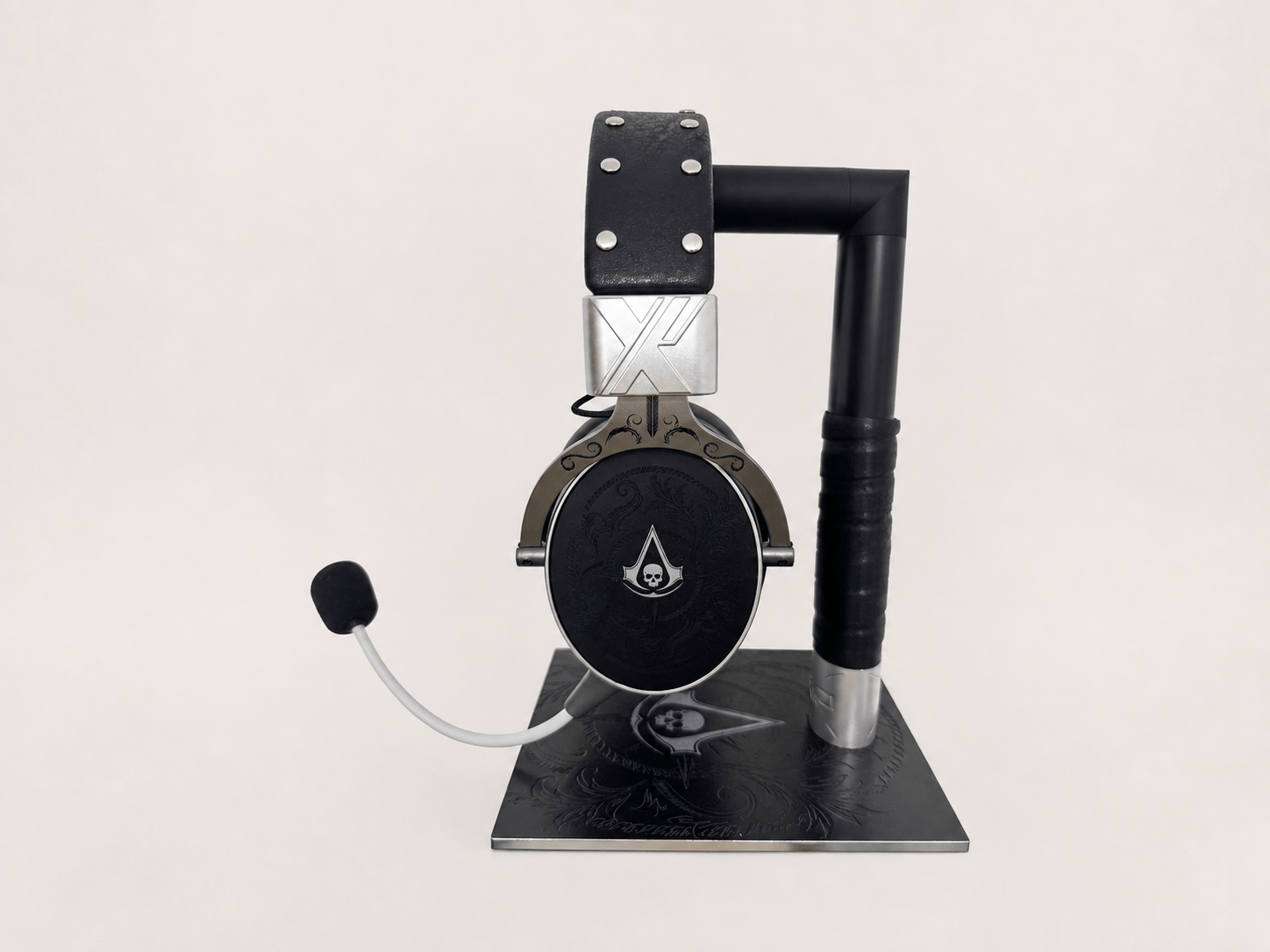
MACH presents Black Flag as a not-for-sale collaborative project demonstration. The published configuration combines 2.4GHz wireless through an included USB transmitter, Bluetooth and 3.5mm wired operation. The same source identifies a JL7018M headset platform, a JL7018M plus PA transmitter architecture, 50mm 16-ohm drivers, an 800mAh protected battery with NTC, USB-C charging and a unidirectional microphone. It also states that the displayed configuration has no lighting.
The public page separately describes project evaluation areas such as ear-cup artwork, headband treatment, structural finishes, transmitter marking, cable configuration and printed packaging materials. This combination is useful for procurement analysis: the product is not defined by its visual theme alone, and it is not defined by a chipset list alone. It is the controlled relationship between the approved appearance, the functional platform, the supplied accessories and the buyer-facing information.
The page also provides an important compliance boundary. It says that certification support is available according to target market and final configuration, while no formal certification files were supplied for publication. A traceability matrix should preserve that distinction. A requirement for certification planning is not evidence that the final commercial product is certified, and a report for one configuration should not be assumed to cover a changed configuration without scope review.
The Buyer Challenge: One Product, Many Interdependent Documents
The buyer must keep the product requirement document, compatibility matrix, artwork files, accessory list, packaging files, test evidence and approved samples synchronized.
The first challenge is ownership. Brand teams may own visual identity and claims, product managers may own user scenarios, engineering teams may own connection behavior, and suppliers may own detailed manufacturing documents. If no one controls the relationship between them, each team can approve its own file while the complete product remains inconsistent.
The second challenge is timing. Connectivity and accessory decisions often continue while artwork and packaging are already being prepared. That creates expensive feedback loops. A transmitter shape affects the inner tray. A detachable microphone affects the accessory cavity and manual. A wired cable specification affects interface claims. A no-light configuration affects product imagery, runtime conditions and the control description.
The third challenge is evidence. Specifications are not interchangeable with validation. A target requirement describes what the buyer wants; a prototype test shows what one sample did; a production control shows how the factory intends to keep output consistent. The traceability matrix should identify all three without presenting a target as a verified result.
- Name one owner for the complete configuration baseline
- List every source file and current revision
- Separate target requirements from verified results
- Map every market claim to supporting evidence
- Link every accessory to packaging and inspection records
- Record open decisions before quotation or sampling
Building the Traceability Matrix From Requirement to Evidence
A useful matrix follows every requirement through source, implementation, verification, approval and downstream communication.
Start with requirement families rather than individual departments. Practical families for a collaborative tri-mode headset include product identity, industrial design and CMF, wireless modes, wired mode, acoustic direction, microphone behavior, power and charging, controls and indicators, host compatibility, transmitter, cables, packaging, labeling, compliance planning and production inspection. This structure exposes dependencies that departmental file lists can hide.
Give each requirement a stable identifier. Record the exact source and revision, not only a verbal summary. Add an implementation field that identifies the relevant component, firmware behavior, artwork layer or packaging item. Then specify verification: visual comparison, dimensional check, functional test, document review or approved-sample comparison. Finally, record the owner, status, approver and evidence link.
The matrix should also include an impact field. When a requirement changes, the team can see which documents and samples require review. For example, changing the microphone from fixed to detachable can affect structure, connector durability, pack-out, tray, manual, service policy and inspection. Changing Bluetooth behavior can affect controls, voice prompts, compatibility wording and test cases. Changing a decorative material can affect color approval, artwork, process limits and packaging photography.
Do not place unverified marketing language directly into the requirement field. Write the engineering requirement first, then maintain a separate claim-and-evidence relationship. A claim such as platform compatibility should identify the connection mode, audio behavior, microphone behavior, volume-control behavior and test configuration. This makes the matrix useful for engineering while reducing the risk of overbroad buyer-facing statements.
| Matrix field | What to record | Example for a tri-mode headset |
|---|---|---|
| Requirement ID | Stable reference code | CONN-2G-01 |
| Source | Document and revision | Approved product brief Rev B |
| Implementation | Part, firmware or file | USB transmitter and headset firmware |
| Verification | How conformity is checked | Pairing and functional test by host type |
| Evidence | Approved result or document | Test record, photo or signed sample |
| Impact | Items reviewed after change | Manual, box claim, test plan and pack-out |
Technical Deep Dive: Mapping Tri-Mode Behavior Without Overclaiming Compatibility
Tri-mode does not mean every function works identically on every host; buyers need a mode-by-host-by-function matrix tied to the exact transmitter, cable and firmware configuration.
The Black Flag public compatibility information illustrates this point. Its 2.4GHz mode uses an included USB transmitter, Bluetooth has its own supported-device behavior, and 3.5mm operation depends on the wired host connection. The published matrix does not treat all three paths as equivalent. For example, Bluetooth audio may be available where Bluetooth microphone support is not, and unsupported hosts are identified rather than generalized away.
A buyer specification should therefore define rows for target hosts and columns for each mode. Under every mode, separate audio output, microphone input, volume control, mute behavior, connection indication, reconnection and power behavior. Record the exact accessory required, such as the approved USB transmitter or analog cable. This avoids the ambiguous claim that a headset simply 'supports' a platform.
The matrix should distinguish native platform behavior from functions implemented through the headset or transmitter. It should also define what happens when users switch modes, connect a cable, charge during use, remove the microphone or leave the device idle. The source page confirms charging while in use and documents mode switching and an automatic shutdown behavior; these are examples of operating requirements that belong in controlled test cases rather than only in marketing copy.
Before sampling, buyers should freeze the intended host list and mode responsibility. During prototype review, test the complete approved configuration, including transmitter, cables and firmware. Before production release, repeat critical mode and host cases using production-representative units. If the transmitter architecture, firmware or cable changes, reopen affected compatibility and claim rows instead of assuming previous evidence remains valid.
This approach also clarifies quotation. Multi-mode products can require more firmware states, accessories, test time, manual content and support preparation than a single-mode product. A requirements matrix allows the supplier to see those obligations before quoting rather than discovering them after the industrial design or packaging has been approved.
| Connection path | Primary role | What the buyer must define |
|---|---|---|
| 2.4GHz with USB transmitter | Dedicated wireless gaming path | Approved transmitter, target hosts, latency evidence, audio and microphone behavior |
| Bluetooth | Wireless use on supported Bluetooth hosts | Supported profiles, host limits, microphone and control behavior |
| 3.5mm wired | Analog fallback or host-specific wired use | Cable wiring, connector type, microphone path and host adapters |
| USB-C charging | Power and charging | Charging state, use-during-charging behavior, cable and safety controls |
How to Control Artwork, Accessories and Packaging Against the Same Baseline
Visual and packaging approval should reference the same released product configuration used for engineering and functional validation.
Collaborative graphics often move through multiple representations: a style guide, flattened artwork, part drawings, decoration samples, product photography and packaging layouts. The traceability matrix should link each visible element to its approved file and manufacturing location. It should also record protected clean zones around controls, ports, labels and moving interfaces so visual execution does not interfere with function.
Accessories require the same discipline. The Black Flag public materials identify the USB transmitter, charging cable, 3.5mm audio cable and detachable microphone as configuration elements. The buyer should link each item to the bill of materials, tray or bag location, user-guide instruction, retail-box content list and pack-out inspection. Branding on a transmitter also needs its own artwork revision and inspection reference.
Packaging should not become the final place where unresolved product decisions are hidden. Claims, icons, screenshots and compatibility language should be reviewed against the approved mode matrix and evidence status. Product renders or photographs must show the released configuration, including lighting state and included accessories. Certification marks should only be used when the applicable evidence and marking rules for the final product are confirmed.

Recommended Development and Approval Workflow
Use staged approval gates so requirements become more detailed without losing their source or change history.
The following workflow is procurement guidance, not a claim that every listed step was completed in the displayed project. Begin with product positioning and rights clearance for any protected collaboration assets. Build a buyer requirement baseline covering users, markets, modes, product appearance, target hosts, accessories, packaging and compliance planning. Then ask the supplier to map the proposed hardware, firmware and manufacturing route to each requirement.
At engineering-sample stage, update the matrix with implementation references and open issues. At appearance-sample stage, link part-level artwork, color and finish approvals. At functional validation stage, attach test records to the exact sample configuration. Before packaging approval, confirm that all product claims and box contents reflect the same baseline. Before pilot production, freeze the approved sample, bill of materials, firmware, artwork, packaging and inspection plan.
After the freeze, use formal change review. A change request should state why the change is needed, which requirements and evidence are affected, whether a new sample is required and who must approve the result. This is especially important for collaborative projects because apparently small visual or accessory revisions may affect licensing approval, packaging inventory or user expectations.
| Gate | Primary output | Release question |
|---|---|---|
| Requirement baseline | Approved requirement matrix | Do all teams agree on what is being developed? |
| Engineering sample | Functional issue and evidence log | Does the proposed platform implement the required behavior? |
| Appearance approval | Part-level artwork and finish baseline | Can the intended visual system be reproduced? |
| Packaging approval | Released pack-out and claims | Does the box describe and contain the approved product? |
| Production release | Golden sample, BOM, firmware and QC plan | Can production verify the same configuration consistently? |
Buyer Checklist Before Sampling
Sampling should begin only after the buyer has defined the product baseline clearly enough for the supplier to build and evaluate the intended configuration.
A sample request that says only 'triple-mode collaborative headset' leaves too much interpretation to the supplier. The buyer should provide the target user, intended selling markets, product status, approved artwork inputs and exact connection scenarios. Open decisions should be listed rather than hidden in provisional files.
The team should also define the purpose of each sample. An engineering sample may verify connection behavior but not final appearance. A CMF sample may verify artwork and texture but not contain production firmware. Labeling every sample by build purpose and revision prevents stakeholders from treating an early sample as the final commercial standard.
- Confirm the collaboration assets and rights-clearance responsibility
- Define 2.4GHz, Bluetooth and 3.5mm use scenarios
- Create a host-by-mode-by-function compatibility matrix
- Freeze the proposed transmitter and cable configuration
- Define driver, microphone, battery and charging requirements
- Identify no-light or lighting configuration clearly
- List every custom part, artwork and finish requirement
- Approve the accessory and packaging content list
- Separate target claims from available evidence
- Define sample type, revision and acceptance criteria
- Identify target-market compliance planning needs
- Assign owners and approvers for each requirement family
What to Review Before Production Release
Production release requires one matched set of product, firmware, artwork, packaging, evidence and inspection references.
The buyer should review the complete released set rather than approving isolated files. Confirm that the product name and model are consistent, the transmitter and cables match the approved accessory list, the manual reflects actual control and mode behavior, and the retail box uses only supported claims. Verify that product images show the correct appearance and configuration.
Quality controls should point back to the same requirements. Cosmetic inspection needs approved samples or defined ranges. Functional inspection needs mode-specific cases. Pack-out inspection needs an unambiguous accessory list. Compliance and labeling checks need final market and configuration information. Any unresolved row should have an owner and disposition before mass production release.
For brands, the value of traceability is not paperwork for its own sake. It reduces late corrections, protects collaboration consistency and creates a clearer basis for supplier communication. It also makes future revisions easier because the team can identify which evidence and downstream files must be reopened when one requirement changes.
Discuss Your Collaborative Gaming Audio Project
Share your product brief, target markets, connection requirements, artwork scope and packaging plan. MACH industry can help evaluate the technical and manufacturing requirements for an OEM/ODM gaming headset project.
Request OEM/ODM EvaluationFrequently Asked Questions
What is a requirements traceability matrix for a gaming headset?
It is a controlled table that links each product requirement to its source, implementation, verification method, approval evidence, owner and affected downstream documents.
Why does a collaborative gaming headset need more traceability than a basic private-label model?
Collaborative projects often combine protected artwork, custom finishes, technical modes, branded accessories, packaging and claims. These workstreams can conflict unless they reference one released configuration.
What should be included in a tri-mode headset compatibility matrix?
List each target host and connection mode, then record audio, microphone, volume, mute, pairing, reconnection, indication, cable or transmitter requirements and known limitations.
Does tri-mode mean every feature works on every platform?
No. 2.4GHz, Bluetooth and 3.5mm paths can have different audio, microphone and control behavior. Compatibility should be stated by mode, host and function.
How should buyers control transmitter and cable requirements?
Give each accessory a specification and revision, link it to the bill of materials, compatibility tests, packaging location, manual instructions and pack-out inspection.
How should artwork revisions be connected to production?
Part-level artwork should identify the approved file, revision, manufacturing process, location, clean zones, sample evidence and inspection reference.
What is the difference between a target requirement and validation evidence?
A target states what the product should achieve. Validation evidence records what a defined sample or configuration demonstrated under specified conditions.
Can certification support be listed as finished-product certification?
No. Certification planning or supplier support is not the same as certification of the final configuration. Applicable reports and marking rules must be confirmed for the target market and released product.
When should a collaborative headset configuration be frozen?
Freeze the matched product, firmware, artwork, accessories, packaging and inspection baseline before pilot or mass-production release, after required approvals and validation are complete.
What should trigger a change-impact review?
Changes to components, firmware, modes, artwork, materials, accessories, packaging, labeling or claims should reopen all linked requirements and evidence identified by the matrix.
Related Resources
Need OEM/ODM gaming audio solutions?
Contact MACH Industry to discuss your gaming headset, gaming earbuds, or private-label audio project.
Contact MACH Industry