Home > Resources > Gaming Headset Guide
How to Write a Control and Indicator Specification for a Tri-Mode Gaming Headset
A buyer guide to defining pairing, mute, RGB, connection LEDs, sleep, recovery and Type-C service-update behavior before approving a tri-mode wireless gaming headset for ODM production.
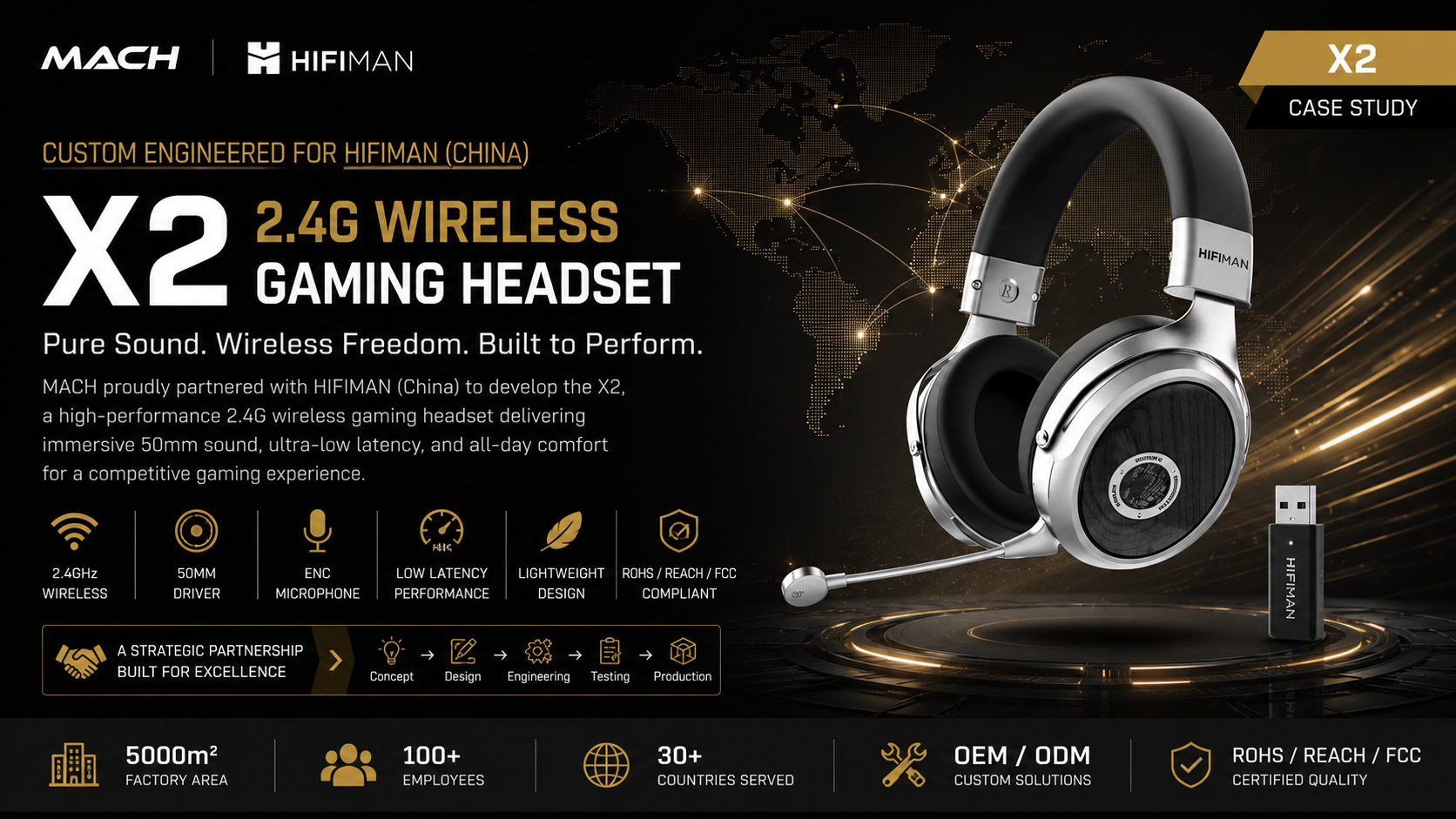
A gaming brand should approve a tri-mode headset with a user-state specification, not only a hardware feature list. The specification must define what every button, LED and prompt does during power-on, pairing, connection, microphone mute, RGB control, inactivity, charging, wired use, recovery and service updates. It must also identify which behavior applies in 2.4GHz, Bluetooth and 3.5mm modes, and where a mode remains unconfirmed.
The X2 China ODM project provides a practical engineering reference. Its confirmed product specification documents USB-transmitter indicators, a combined mute and pairing control, power and RGB control, a 10-minute no-signal sleep condition, 3.5mm AUX input, detachable microphone input and a Type-C port used for charging and headset program updates. This article turns those facts into a buyer decision framework without repeating the existing X2 platform guide.
Why Control Logic Becomes a Market and Support Risk
A headset can pass basic audio tests and still create returns if users cannot understand pairing, mute, connection, RGB, sleep or recovery states.
Wireless gaming headsets expose users to more states than wired products. A single control may perform one action after a short press and another after a long press. The receiver can show connected, disconnected, low-power and microphone states. The headset can enter sleep, switch connection routes or require a recovery action. If those behaviors are not frozen before production, the sample, firmware, manual, packaging and customer-service script can describe different products.
The buyer's job is to turn feature language into observable behavior. Instead of requesting 'easy pairing,' specify how pairing starts, how long the control is held, what the headset and receiver show, what ends the process and what happens after failure. Instead of requesting 'auto sleep,' define the trigger, timer, power state and recovery action. This level of definition improves quotations, sample review and production testing because every team can evaluate the same result.
The state specification should also control claims. A project may be described commercially as tri-mode, but the available engineering document may describe some modes more fully than others. X2 project records include Bluetooth, 2.4GHz and triple-mode requirements, while the extracted product specification gives detailed controls for the USB-transmitter route and AUX input but does not provide a complete Bluetooth state table. The responsible response is to mark Bluetooth behavior for confirmation, not infer prompts, priority or switching logic.
X2 ODM Project Overview
X2 is a wireless gaming headset ODM project with 2.4GHz, Bluetooth and wired planning, plus defined controls, RGB, microphone, sleep and service-update functions.
The approved case card identifies X2 as an OEM plus ODM project for a gaming brand, Amazon seller and distributor context across several export markets. The scope includes RGB, Bluetooth, 2.4GHz, triple-mode and low-latency positioning, together with industrial design, structure, PCB, RF, acoustic, tooling, QC and mass-production support.
The January 3, 2022 product specification identifies a 2.403-2.478GHz transmitter and headset frequency range, USB transmitter, Type-C charging port, 50mm driver, 32-ohm impedance, 20Hz-20kHz speaker range, noise-reduction microphone, detachable 2.5mm microphone input and 3.5mm AUX input. It also documents the control and indicator behavior used in this guide.
The project folder contains CE, FCC and RoHS files, but the readable FCC material and the longer test report list G9000-series models rather than X2. They therefore cannot be presented as X2 test evidence. The X2 article can accurately state that compliance-document coordination was part of the project scope, while requiring model-specific evidence to be verified for the final configuration and destination market.
| Confirmed X2 element | Documented behavior | Buyer control point |
|---|---|---|
| Mute / pairing control | Short press controls mute; three-second hold enters pairing | Confirm timing, feedback and recovery |
| Power / RGB control | Long press controls power; short press controls RGB | Confirm default lighting state after restart |
| USB transmitter LEDs | Blue and red indicate connection and microphone states | Align LED table with manual and QC |
| No-signal sleep | Sleep after ten minutes without signal | Define trigger and required wake action |
| Type-C port | 5V charging and headset program update | Separate user charging from service-update procedure |
Build a User-State Matrix Before Firmware Approval
The matrix should connect each starting state, user action and connection mode to one expected product response, visible feedback and recovery path.
Begin with modes and starting states. List power off, power on but disconnected, 2.4GHz connected, Bluetooth connected, AUX inserted, charging, microphone muted, pairing, low power, sleep and service-update states that are supported by the approved configuration. Do not add a state because it seems typical. If the source does not define Bluetooth priority, simultaneous connections or AUX interaction, mark those cells as engineering questions.
Add user actions next. X2 confirms a short press on the microphone control for mute and a three-second hold for pairing. Its multifunction power control uses a long press for power and a short press for RGB. The matrix should define action timing ranges, whether the action works in every mode, and what happens when the user performs it in an invalid state. Button labels and manual illustrations should refer to the same controls.
Then specify feedback. X2's transmitter uses blue and red LEDs to communicate connection and microphone behavior. The specification records solid blue when connected, alternating red and blue when disconnected, flashing blue for low power, solid red with blue off when the microphone is muted, and solid blue with red off during microphone communication. A buyer should confirm whether one LED condition can represent two competing states and which state has display priority.
Power transitions require their own rows. X2 records sleep after ten minutes without signal, a 1uA sleep-current specification and a requirement to press the power key again before reuse. The approval matrix should define when the timer begins, which activity resets it, whether RGB changes before sleep, what the receiver displays, and whether reconnection is automatic after the user powers the headset back on.
Separate service behavior from consumer behavior. The Type-C port is documented for 5V charging and headset program updates. That does not automatically mean an end user should update firmware or that Type-C carries audio. The release pack should identify the update tool, authorized operator, file name, version, compatible hardware, preconditions, success signal, failure recovery and post-update regression tests. Packaging should describe only the consumer-facing functions approved for sale.
Finish with evidence. Every matrix row should point to a specification revision, firmware build, receiver version, sample identifier, test record or manual section. When firmware changes, affected rows return to validation. This prevents an approved sample from becoming disconnected from the software loaded during pilot or mass production.
| Matrix field | Question to answer | Release evidence |
|---|---|---|
| Starting state | What is connected, powered or inserted? | Mode and hardware definition |
| User action | Which control and press duration are used? | Button map and test step |
| Expected response | What changes in audio, microphone, RF or lighting? | Firmware build and sample result |
| Visible feedback | Which LED or prompt confirms the result? | Indicator table and manual |
| Failure / recovery | What happens if the action cannot complete? | Recovery instruction and regression test |

X2 Control Logic Deep Dive: Mute, Pairing, RGB, Sleep and Type-C Service Updates
The X2 specification shows how a small number of physical controls can carry several functions, making timing, state priority and visible feedback essential approval items.
Mute and pairing share one physical control but represent very different operations. A short press changes the microphone state, while a three-second hold enters pairing. During sample review, test short presses near the timing boundary, repeated presses, long holds when already connected and recovery after an interrupted pairing attempt. Confirm that transmitter LEDs and actual microphone transport agree; an indicator alone is not proof that audio is muted.
The multifunction power control similarly combines power and RGB. The specification records long press for power on or off and short press for RGB on or off. Buyers should confirm the default RGB state after power-on, whether lighting preference is remembered, whether RGB remains available in wired or charging conditions, and whether rapid presses create unintended power behavior. These are questions for approval, not assumptions about the X2 configuration.
The receiver indicator table needs conflict rules. Blue represents connection and communication conditions, red represents mute, alternating red and blue represents no connection, and flashing blue is recorded for low power. The development team should test which signal takes priority when low power, disconnection and mute overlap. The manual should use the exact color and flash vocabulary demonstrated by the production firmware.
Sleep behavior affects battery expectations and support calls. A ten-minute no-signal timer can reduce idle consumption, but users may interpret the required power-key restart as a failed connection. The final instructions should explain the trigger and recovery in plain language. Production testing should verify the timer and wake path on the released headset and receiver build without turning a single sample observation into a universal battery-life claim.
The Type-C service-update function creates release-management responsibility. The supplier should keep firmware identity traceable to the hardware and receiver revision, prevent incorrect files from reaching the line, verify successful programming and repeat controls, LEDs, pairing, audio, microphone, RGB, sleep and charging checks after an update. An update that fixes one state can change another, which is why regression coverage must follow the matrix.

Keep Product, Manual, Packaging and Support Language Aligned
The same released behavior must appear in the firmware, physical labels, quick-start guide, retail copy, FAQ and service procedure.
Marketing language should not outrun the controlled specification. 'Tri-mode' needs an approved definition of each route and its limitations. 'Type-C' should not imply Type-C audio when the confirmed document identifies charging and program update. 'Automatic sleep' should disclose the recovery action where it affects use. The microphone-mute claim should match both the actual audio result and LED feedback.
Packaging and manuals should be reviewed against a production-intent sample, not an early rendering. Verify control icons, press durations, LED colors, receiver illustrations, AUX and microphone port sizes, supplied accessories and troubleshooting steps. Customer support should receive the same pairing and recovery instructions, including what users should do after sleep or a lost receiver link.
Translations require behavior control too. Short press, long press, hold for three seconds, flashing and alternating are operational terms. They should remain consistent across languages and diagrams. A revision table linking firmware, manual and package artwork helps prevent an old instruction from shipping with new behavior.

ODM Development Process for Control and Indicator Approval
Approve behavior through requirement definition, state mapping, engineering builds, regression testing, pilot production and version-controlled mass-production release.
Concept review defines users, target devices, modes, controls, RGB expectations, microphone behavior, power management and service policy. Platform review then identifies which X2 functions already exist, which need confirmation and which require firmware, hardware or documentation changes.
Engineering converts the brief into the state matrix and assigns versions to headset firmware, receiver firmware where applicable, hardware and samples. Prototype tests cover normal actions, timing boundaries, invalid actions, overlapping states and recovery. RF, acoustic, microphone, charging and mechanical checks remain connected because firmware behavior is only one part of the product.
Pilot production verifies that programming files, fixtures, instructions and functional tests reproduce the approved behavior on more than one engineering sample. Operators need an unambiguous method to identify the correct build. Final release connects firmware, BOM, receiver, golden sample, manual, packaging, inspection plan and change-control rules.
MACH industry can coordinate industrial design, structure, PCB, RF, acoustic, tooling, QC and mass-production activities around the approved project scope. Compliance evidence must still be verified for the final model and market, especially because unrelated documents can exist in a historical project folder.

Buyer Checklist Before Releasing Firmware and Production Samples
A release-ready headset has traceable behavior, evidence and user instructions for every approved mode and recovery path.
- List every supported connection mode and explicitly mark unconfirmed interactions.
- Define short-press, long-press and hold timing for every multifunction control.
- Map headset and receiver LEDs to connection, mute, low-power and pairing states.
- Define priority when two indicator conditions occur together.
- Record sleep trigger, timer, current target and user recovery action.
- Separate Type-C charging, service update and any unconfirmed audio behavior.
- Tie headset and receiver firmware versions to hardware, sample and BOM revisions.
- Run regression tests after every firmware change.
- Match manual, packaging, translations and support scripts to released behavior.
- Verify compliance files against the exact model and production configuration.
Conclusion
Control and indicator behavior should be treated as a production specification because it directly affects usability, support, claims and firmware traceability.
The X2 project illustrates why a mature wireless platform still needs project-specific behavior approval. Its documented controls, receiver LEDs, RGB function, sleep rule, AUX input and Type-C service-update role create a useful starting point, but each branded configuration must connect those functions to approved modes, evidence and instructions.
Before requesting an ODM quotation, prepare the target-device list, required connection modes, control map, LED language, sleep and recovery expectations, RGB behavior, microphone requirements, update policy, packaging scope and target markets. MACH industry can use that brief to evaluate the platform, validation scope and production-control plan.
Launch Faster With a Reliable OEM Partner.
Share your required connection modes, control logic, indicator behavior, target devices and market plan with MACH industry. Email: hardy.hu@mach-industry.com | WhatsApp: +86 18038083785
Request OEM/ODM DiscussionFrequently Asked Questions
What is a gaming headset user-state specification?
It is a controlled definition of how the headset responds to power, pairing, connection, mute, RGB, charging, wired input, sleep, recovery and service-update actions in every supported mode.
Why should OEM buyers create a control and indicator matrix?
The matrix gives engineering, QA, packaging and support teams one expected result for every starting state and user action. It reduces inconsistent firmware, instructions and production tests.
What X2 control behavior is confirmed by the product specification?
The specification confirms short-press microphone mute, a three-second pairing hold, long-press power control, short-press RGB control, receiver LED states, AUX input, detachable microphone input and a ten-minute no-signal sleep rule.
Does the X2 Type-C port support audio?
Type-C audio is not confirmed by the available X2 specification. The document identifies the port for 5V charging and headset program updates, so audio should not be claimed without separate evidence.
Should gaming headset firmware updates be offered to consumers?
Not automatically. A documented program-update port may be intended for engineering or production service. The brand must define the authorized operator, tool, compatible file, recovery process and consumer policy.
How should brands test a multifunction gaming headset button?
Test the defined short and long press ranges, timing boundaries, repeated actions, invalid states, overlapping conditions and recovery. Confirm the real audio or connection result as well as LED feedback.
What should happen after a wireless gaming headset enters sleep?
The required behavior is platform-specific. X2 documents sleep after ten minutes without signal and requires the power key to be pressed again before use. The final manual should explain the trigger and recovery.
What should buyers freeze before gaming headset mass production?
Freeze hardware and receiver revisions, firmware identities, the user-state matrix, golden samples, button and LED behavior, manuals, package claims, regression results, inspection criteria and change-control rules.
Related Resources
Need OEM/ODM gaming audio solutions?
Contact MACH Industry to discuss your gaming headset, gaming earbuds, or private-label audio project.
Contact MACH Industry