Home > Resources > Gaming Headset Guide
How to Plan a PC-First Tri-Mode Gaming Headset SKU
A buyer guide to defining the primary 2.4GHz PC connection, secondary Bluetooth and 3.5mm roles, receiver bundle, product claims and OEM scope for one tri-mode headset SKU.
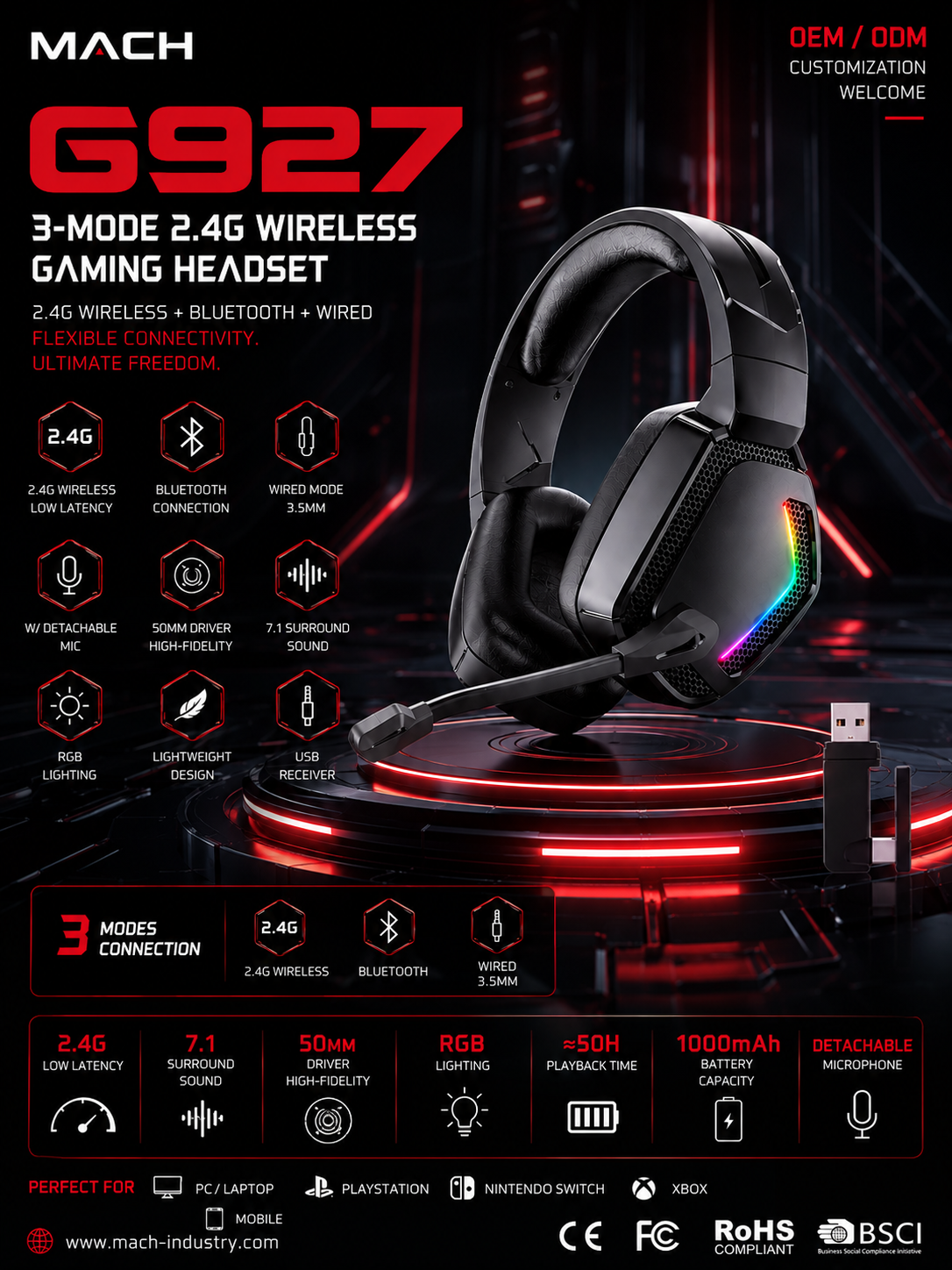
A PC-first tri-mode gaming headset should give 2.4GHz wireless the leading product role, then assign Bluetooth and 3.5mm wired connections clearly defined secondary jobs. The brand should align this hierarchy with the USB receiver, microphone, controls, battery, RGB, accessories, packaging and support content before approving an OEM sample. This creates one understandable retail SKU instead of a long feature list with unclear operating boundaries.
MACH G927 is a useful engineering example. Its confirmed platform combines JL7018M-based 2.4GHz wireless with an included USB receiver, Bluetooth and 3.5mm support. It also lists a 50mm driver, detachable microphone, seven-color RGB direction, optional 7.1 surround sound and a 1000mAh battery. This guide uses those facts to explain PC product-line planning rather than repeat the product page.
The sourcing question is which mode leads the proposition, which situation each secondary mode solves and which claims the final branded sample can support.
Key Takeaways for PC Gaming Headset Buyers
A successful PC-first tri-mode SKU makes one connection the primary promise, gives the other modes specific supporting roles and validates every package claim against the final sample.
- Use 2.4GHz plus the USB receiver as the leading PC gaming path when that is the product position.
- Define Bluetooth as a separate wireless use case rather than assuming it duplicates 2.4GHz behavior.
- Treat 3.5mm as a compatible wired path whose audio, microphone and powered-feature behavior must be confirmed.
- Specify the receiver, detachable microphone, cables, manual and packaging as one controlled accessory bundle.
- Keep optional 7.1 surround sound separate from confirmed standard functions until the final version is approved.
- Carry the approved mode and claim matrix into production inspection and customer-support content.
Why PC-First Positioning Requires a Mode Hierarchy
A mode hierarchy tells buyers and users what the headset is primarily designed to do, while preserving secondary connection options without making unsupported all-platform claims.
Tri-mode hardware can support a broad commercial story, but breadth creates ambiguity if every connection is presented as equal. A PC gaming buyer may expect a supplied receiver, straightforward setup, microphone support and a defined low-delay path. A mobile user may prioritize Bluetooth convenience. A wired user may only need a direct 3.5mm connection. These are different expectations even when they share one headset shell.
Product managers should therefore write one leading sentence for the SKU before selecting package icons. For G927, the public product identity is a 2.4G wireless headset for PC gaming. Bluetooth and 3.5mm expand the possible scenarios, but they should support that PC-first position rather than blur it.
This decision affects which accessory is visible in the box, which setup route leads the manual, which mode receives the most detailed testing and which questions customer support must answer.
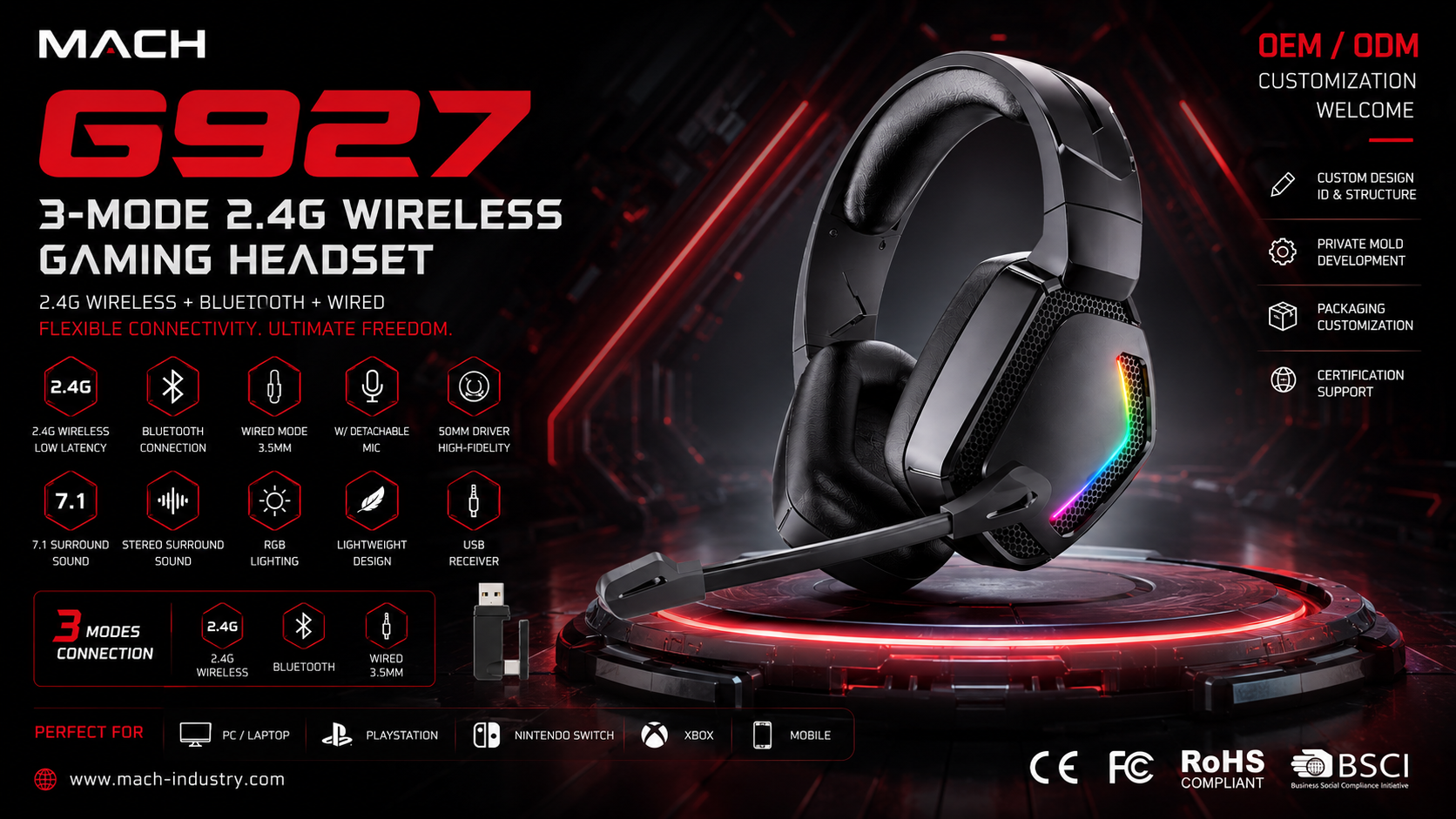
G927 Product Platform Reference
G927 is a tri-mode gaming headset platform positioned around 2.4GHz PC gaming, with Bluetooth and 3.5mm support for additional use scenarios.
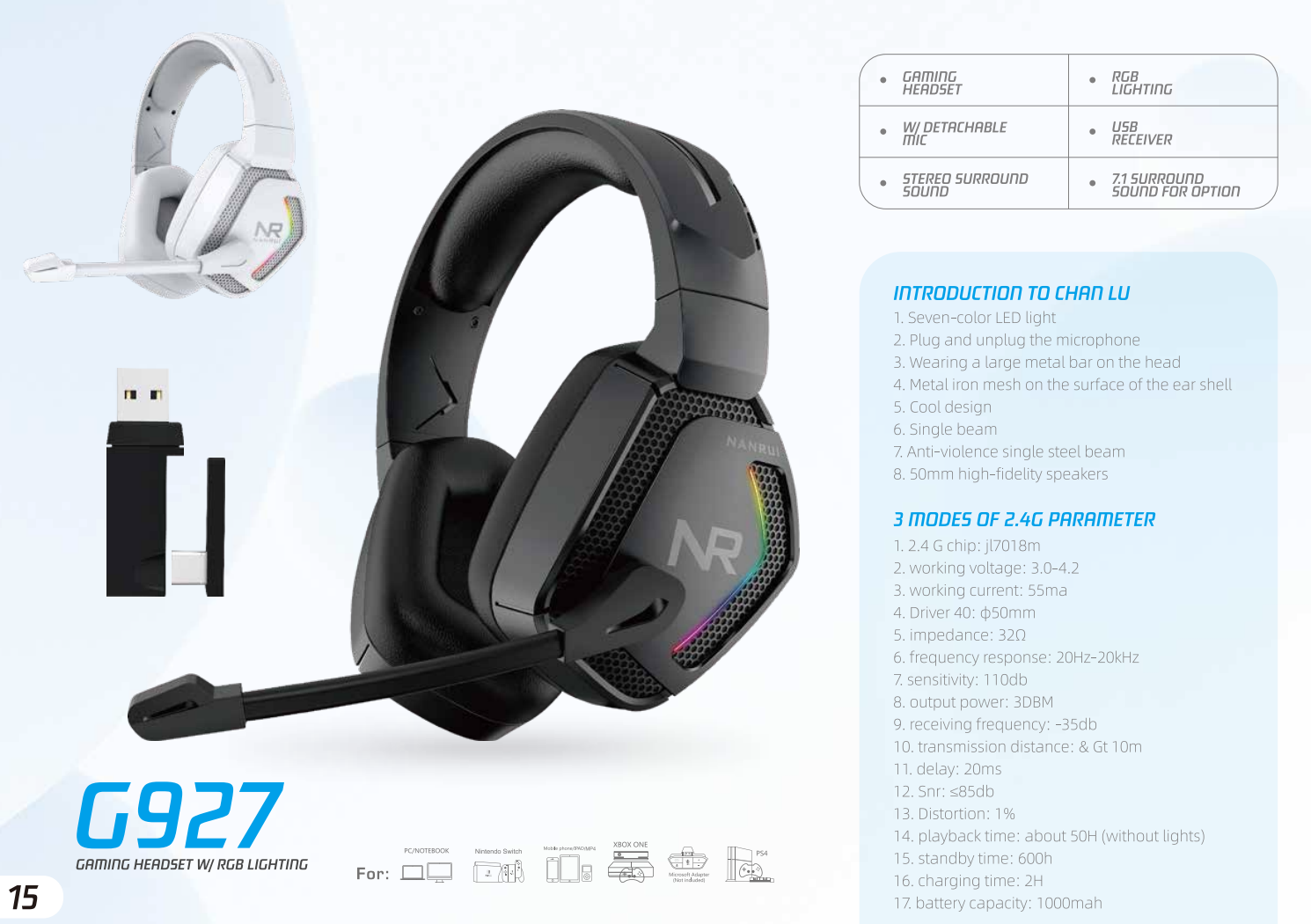
The confirmed G927 configuration lists an included USB receiver for the 2.4GHz connection and a JL7018M 2.4G chip platform. Its specification material lists 20ms delay and a 10m transmission distance for the 2.4G path. Those figures belong to the stated configuration and should not be extended to Bluetooth, wired use or every host without separate validation.
The acoustic baseline includes a 50mm driver, 32-ohm impedance, 20Hz-20KHz frequency response and detachable microphone. Driver diameter is one design input; it does not independently prove tuning quality, positional detail or production consistency. The product also confirms RGB or seven-color LED direction, stereo surround sound and 7.1 surround sound as an option.
The power reference is a 1000mAh battery, about 50 hours of playback without lights, 600 hours of standby and two hours of charging. RGB-on runtime needs separate validation; MOQ and lead time are project dependent after sample approval.
Building a PC-First Mode Hierarchy for One Retail SKU
The mode hierarchy should connect each connection to a target scenario, included accessory, required functions, evidence and customer-facing claim.
Start with the primary job. If the SKU is meant for PC gaming, specify the 2.4GHz receiver path as the first setup route. The brief should identify the supplied receiver, pairing state, reconnection behavior, audio output, microphone input, control operation, RGB state and any optional processing expected in this mode. G927 confirms an included USB receiver and lists 20ms delay in the 2.4G specification, giving the buyer a defined baseline for sample validation.
Next, assign Bluetooth a supporting job. It may extend the product into suitable mobile, tablet or daily wireless scenarios, but the brand should not assume that every 2.4GHz gaming function transfers to Bluetooth. Pairing, reconnection, call behavior, microphone path, controls, prompts and host support should be documented independently. The G927 data confirms Bluetooth but does not publish a Bluetooth version, codec or Bluetooth latency, so those claims must be omitted unless separately confirmed.
Then define the 3.5mm path. A wired connection can help the SKU address compatible controllers, mobile devices or fallback use, but the final cable, plug wiring, microphone route and powered features require confirmation. RGB, virtual processing or headset controls may depend on active power and should not be inferred from the presence of an analog jack.
The mode hierarchy must also control optional features. G927 lists stereo surround sound and a 7.1 surround sound option. The quotation, sample label and package should state whether the selected version includes the option, which mode and host path support it, and whether software or another requirement applies. Optional capability is not a standard retail claim until it is part of the approved configuration.
Translate the hierarchy into a retail claim matrix. Each line should identify the connection mode, target device group, required accessory, supported audio and microphone functions, controls, lighting, optional processing, test evidence and exact package wording. This protects a PC-first proposition from expanding into unsupported universal-compatibility language.
Finally, align service content with the same logic. The quick-start guide should lead with the PC receiver workflow, then explain Bluetooth and wired operation. Packaging should make the receiver and detachable microphone easy to identify. Troubleshooting should separate receiver pairing, Bluetooth pairing and wired checks instead of treating all connection problems as one issue.
This framework lets one hardware platform cover several scenarios while keeping one clear reason to buy. It also gives Amazon teams, distributors and retail buyers a defensible feature structure: PC gaming first, additional connection flexibility second, and optional functions only where confirmed.
The hierarchy should also fit the wider product portfolio. If a brand already sells a Bluetooth lifestyle headset or a wired entry model, G927 should not copy those promises. Its product name, comparison chart and sales training should emphasize the receiver-led PC role, while secondary modes explain flexibility. This reduces internal SKU overlap and helps channel buyers understand why the model exists. A future color or package variant can share the approved architecture, but each sellable SKU still needs controlled artwork, accessories and configuration records.
| Mode role | Primary buyer question | Required approval evidence | Packaging discipline |
|---|---|---|---|
| 2.4GHz primary PC path | Does the receiver deliver the approved PC audio, mic and control workflow? | Representative PC test, receiver and final sample | Lead setup route and included-receiver statement |
| Bluetooth secondary path | Which mobile or daily-use functions are actually supported? | Pairing, calls, controls and host test record | No unconfirmed version, codec or latency claim |
| 3.5mm supporting path | Which compatible devices receive audio and microphone support? | Final cable, plug wiring and device checks | Clarify whether powered features remain available |
| Optional processing | Is 7.1 included, and through which mode and host? | Approved configuration and functional test | Keep optional features out of standard claims until confirmed |
How 2.4GHz, Bluetooth and 3.5mm Support Different Product Jobs
2.4GHz, Bluetooth and 3.5mm should be selected by scenario, not ranked as universally better or treated as identical routes.
For this PC-first position, 2.4GHz is the dedicated receiver-based gaming route. The G927 specification supplies measurable references for that path, including the listed 20ms delay and 10m transmission distance. Buyers should verify these values using the final receiver, firmware, sample and target PC environment rather than treating them as a guarantee for every setup.
Bluetooth broadens suitable mobile or daily wireless use, while 3.5mm provides a direct path for compatible devices. Pairing, calls, controls, microphone routing, plug wiring and powered features still need separate checks. G927 material lists PC or notebook, Nintendo Switch, mobile phone, iPad or MP4, Xbox One and PS4 scenarios, but this does not prove identical functions through every mode and device revision.
USB Receiver and Dongle Planning for a PC Gaming Product
The receiver is part of the retail product, not a loose technical accessory, so it needs its own specification, packaging location, branding decision and replacement process.
G927 confirms that a USB receiver is included for the 2.4GHz connection. Buyers should record its approved physical version, pairing relationship, label content, packaging position and final compatibility scope. The source data does not identify the receiver connector type, so this article does not claim USB-A, USB-C or an adapter configuration.
Pack-out planning should protect the receiver and make it visible during unboxing. The manual should explain where it is stored, how to connect it, how pairing is indicated and what to do if the link is interrupted. A missing or unclear receiver can create a support problem even when the headset itself passes inspection.
For a private-label program, receiver branding and accessory-bundle planning can be evaluated with MACH. Feasibility, artwork area, package design and replacement planning remain subject to the selected configuration.
How to Evaluate the 50mm Driver and Detachable Microphone
A 50mm driver and detachable microphone define component and structural directions; the final acoustic and communication result still depends on tuning, enclosure, fit, electronics and production control.
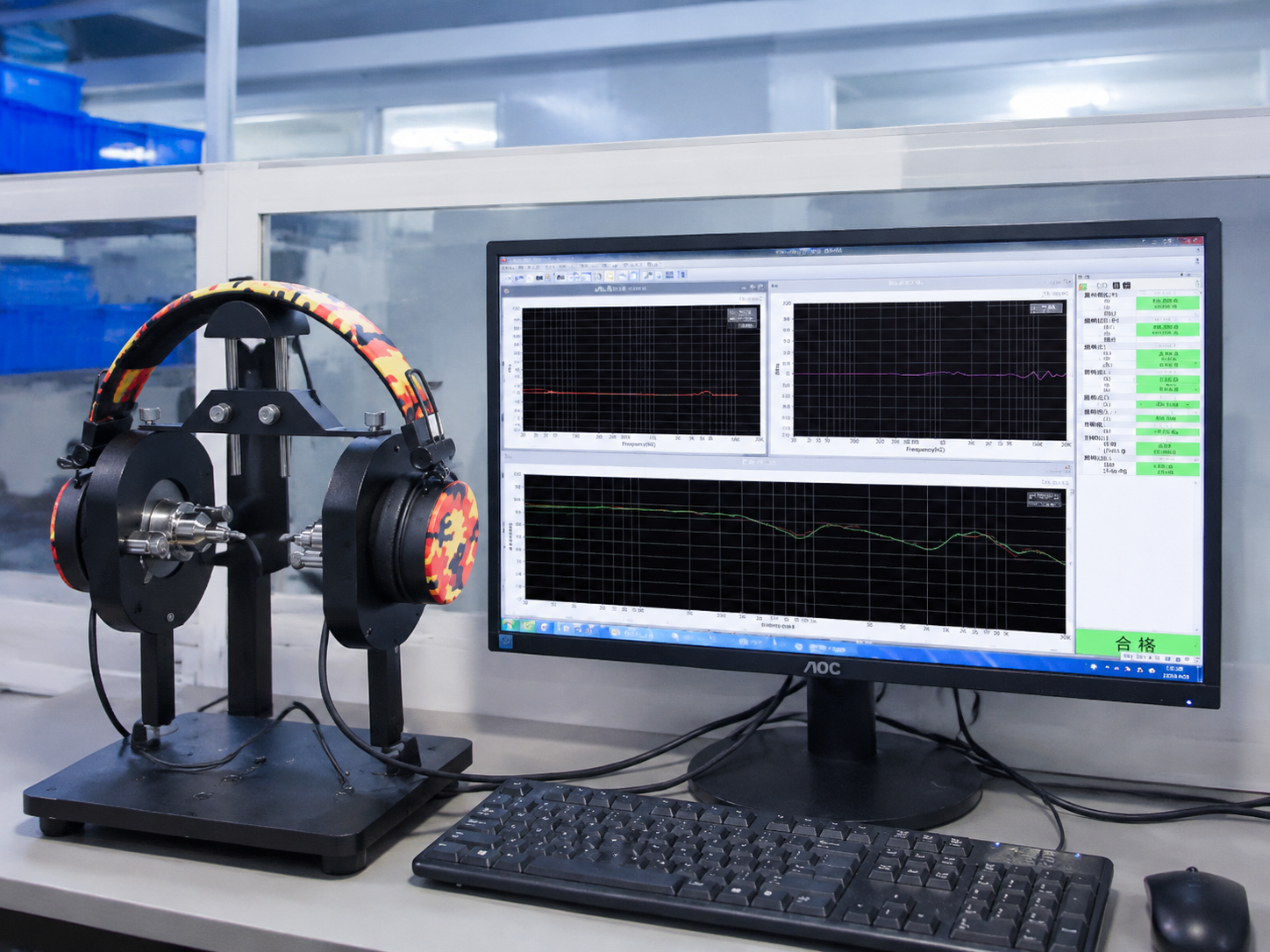
G927 lists a 50mm driver, 32-ohm impedance, 20Hz-20KHz frequency response and 110dB sensitivity. These values provide an engineering baseline, but a larger driver is not automatically better than a smaller one. Buyers should approve tonal balance, speech clarity, channel matching, distortion at useful levels, seal variation and unwanted mechanical noise on the finished sample.
The detachable microphone supports storage and replacement but adds a connector that needs fit, orientation, signal, movement-noise, insertion and packaging checks. Voice evaluation should cover only the connection paths confirmed to carry microphone audio; customization remains subject to engineering review and an approved BOM.
Who Should Consider a PC-First Tri-Mode Headset?
The platform is most relevant to buyers who need a recognizable PC gaming SKU with additional wireless and wired scenarios, rather than a Bluetooth lifestyle product with gaming added as a secondary label.
PC accessory, e-commerce, importer, distributor and private-label teams can use the receiver-led position to fill a PC gaming gap. They should balance RGB, metal structure, detachable microphone and the 50mm platform with packaging, support complexity and evidence-based claims.
OEM/ODM Buyer Checklist
A useful RFQ separates confirmed G927 facts from the brand decisions and validation work needed for the final private-label SKU.
- State the primary target: PC gaming through the included 2.4GHz receiver or another approved priority.
- List the exact Bluetooth and 3.5mm scenarios the secondary modes must support.
- Confirm the JL7018M baseline, required mode behavior and whether any firmware discussion is needed.
- Approve the 50mm acoustic target through finished-product samples, not driver diameter alone.
- Define detachable microphone fit, voice target, packing position and replacement expectations.
- Document battery claim conditions, including 2.4GHz or Bluetooth, volume, RGB state and endpoint.
- Specify seven-color RGB behavior and keep optional 7.1 separate until configuration approval.
- Build a compatibility matrix by device, connection, audio, microphone, controls and powered features.
- Freeze receiver, cable, microphone, charging accessory and printed materials in the pack-out list.
- Provide logo artwork, color or CMF direction, packaging language, barcode and channel requirements.
- Plan certifications for the final market and configuration without assuming every document is already issued.
- Define sample acceptance, reliability checks, golden sample, BOM control and production inspection.
- Request project-specific MOQ and lead time after branding, accessories and packaging are defined.
How MACH Supports G927 Development
MACH industry can evaluate G927 projects from platform and RFQ review through branding, sampling, packaging planning, engineering communication and production coordination.
MACH can evaluate logo, color and CMF, retail packaging, manuals, labels, barcodes, detachable microphone, receiver or 3.5mm accessories, RGB presentation and certification planning. All customization is subject to engineering and sample confirmation; certification support is not proof that every certificate is already issued.
From Sample Approval to Mass-Production Validation
The approved sample should become a controlled production reference covering modes, receiver, acoustics, microphone, lighting, battery, accessories, cosmetics and package claims.
Sample approval should identify the hardware and firmware version, receiver, microphone, cables, battery, RGB behavior, optional-feature status, colors, logos and package contents. Mode tests should record the representative device and required result rather than use a single general pass mark.
Production checks and packaging copy should follow the accepted mode matrix, approved components and final pack-out so engineering approval matches the customer-facing promise.

Conclusion
A PC-first tri-mode headset succeeds when the primary receiver path is clear, secondary modes have defined jobs and every retail claim follows the approved configuration.
G927 provides a concrete platform for this planning method through its confirmed 2.4GHz receiver connection, Bluetooth, 3.5mm support, JL7018M baseline, 50mm driver, detachable microphone, RGB direction and defined battery references. Its value for a brand comes from organizing these elements into one coherent SKU, not from presenting every feature as universally available.
Use a mode hierarchy, receiver plan, claim matrix, buyer checklist and production reference to keep the project understandable from RFQ to retail. Product managers can review the G927 platform or contact MACH industry to discuss a PC gaming headset OEM/ODM evaluation.
Share your target PC use case, secondary devices, mode requirements, branding, accessories, packaging, certification plan and expected quantity for a G927 OEM/ODM evaluation.
Contact MACH IndustryFrequently Asked Questions
What is a PC-first tri-mode gaming headset?
It is a headset positioned primarily around a receiver-based PC gaming connection while also providing Bluetooth and 3.5mm paths for clearly defined secondary scenarios. Each mode should have its own supported-function and device matrix.
Why use 2.4GHz as the primary mode for a PC gaming headset?
A supplied receiver can provide a dedicated product and setup path for PC gaming. The final delay, audio, microphone, controls and host behavior must still be validated with the approved receiver and sample.
Is Bluetooth the same as 2.4GHz wireless in a gaming headset?
No. They are separate wireless paths and may support different hosts, functions and operating behavior. G927 confirms Bluetooth but does not publish a Bluetooth version, codec or Bluetooth latency.
Why include a 3.5mm connection in a tri-mode PC headset?
It can provide a direct wired path for compatible devices or fallback use. Buyers should confirm the final cable, plug wiring, microphone support and whether powered features remain available.
What should buyers specify for a gaming headset USB receiver?
Specify the approved physical version, pairing and reconnection flow, label, packaging position, required host functions, inspection method and replacement policy. G927 confirms an included receiver but does not identify its connector type.
Does a 50mm driver guarantee better gaming audio?
No. Driver diameter is one input. Tuning, enclosure, electronics, ear-pad seal, wearing position and production consistency determine the finished result.
Can the G927 detachable microphone and packaging be customized?
MACH can evaluate detachable microphone, receiver and accessory configuration, logo, color, packaging, manuals, labels and barcodes according to the RFQ and engineering review.
Is 7.1 surround sound standard on every G927 configuration?
The G927 source lists stereo surround sound and 7.1 surround sound as an option. Buyers should confirm whether it is included and which connection and host path support it before using a retail claim.
What MOQ applies to a G927 private-label headset?
MOQ depends on the final configuration, branding scope, accessories and packaging requirements. MACH evaluates each project based on the buyer's target specification.
What should be validated before G927 mass production?
Validate connection behavior by mode, receiver pairing, target devices, acoustics, microphone, controls, RGB, battery claims, optional features, branding, accessories, packaging and the approved production reference.
Related Resources
Need OEM/ODM gaming audio solutions?
Contact MACH Industry to discuss your gaming headset, gaming earbuds, or private-label audio project.
Contact MACH Industry