Home > Resources > Gaming Headset Guide
How Private-Label Buyers Should Evaluate Battery Life in an RGB Tri-Mode Gaming Headset
A buyer-focused guide to validating battery-life claims, RGB power consumption, wireless modes, charging, and private-label requirements for tri-mode gaming headsets.
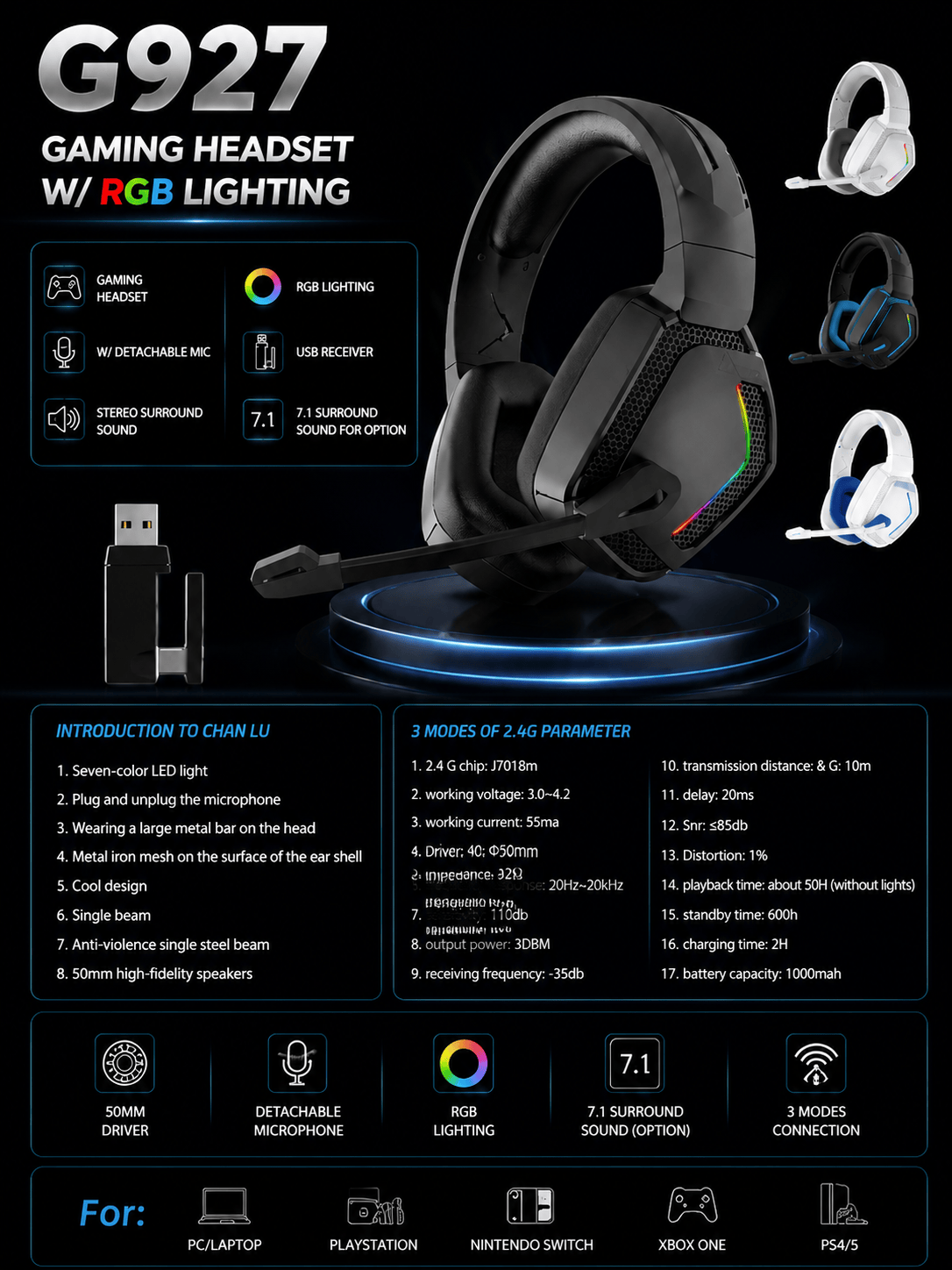
Private-label buyers should evaluate wireless gaming headset battery life as a test condition, not a standalone number. A credible runtime statement must identify the wireless mode, volume level, RGB state, microphone use, firmware version, battery condition, temperature, and shutdown endpoint. Without those conditions, two suppliers can publish similar hour claims for products that deliver very different real-world experiences.
The G927 Black platform provides a practical example. Its confirmed configuration combines J7018M-based 2.4GHz wireless, Bluetooth, and 3.5mm connection with seven-color RGB lighting, a 50mm driver, a detachable microphone with ENC support, and a 1000mAh battery. The supplied specification lists approximately 50 hours of playback without lighting, 600 hours of standby, and a two-hour charging time. These figures are useful sourcing references, but they do not remove the need to validate the final branded configuration.
Understanding the Market Need
Brands choose tri-mode gaming headsets to cover gaming, mobile, general wireless, and wired scenarios with one platform, but battery expectations change with the selected mode and feature state.
A private-label gaming headset is rarely evaluated in only one usage scenario. A PC player may use the supplied 2.4GHz receiver for a dedicated wireless route. A mobile or laptop user may choose Bluetooth. Another user may connect through 3.5mm when a compatible analog source or wired fallback is preferred. RGB lighting may stay on for retail appeal and gaming use, while a buyer focused on long sessions may switch it off.
This flexibility creates a sourcing problem: a single battery-life number can be technically correct under one laboratory condition but misleading across the complete product story. Runtime in 2.4GHz mode does not automatically represent Bluetooth runtime. A result measured with lighting off does not describe continuous RGB use. Standby duration does not predict active playback, and battery capacity alone does not reveal system efficiency.
Procurement teams therefore need a use-case matrix defining target users, devices, modes, feature states, and claims, plus a repeatable battery test plan that converts those scenarios into measurable conditions. Together they give packaging, sales, support, and the OEM supplier one controlled reference.
| Buyer scenario | Likely connection route | Battery question to validate |
|---|---|---|
| PC gaming | 2.4GHz receiver | Runtime with the approved volume, microphone state, RGB setting, receiver, and final firmware |
| Mobile or laptop listening | Bluetooth | Playback and reconnect behavior under the supported Bluetooth profiles and target devices |
| Wired fallback | 3.5mm | Whether powered functions remain active and whether the battery is required for the intended analog use |
| Retail RGB demonstration | Wireless with lighting enabled | Lighting consumption, brightness, and realistic demo duration |
G927 Product Platform Overview
G927 Black is a private-label tri-mode platform with 2.4GHz, Bluetooth, and 3.5mm connectivity, supported by a 1000mAh battery and a defined black RGB product direction.
The confirmed G927 Black configuration uses a J7018M 2.4GHz solution with a USB receiver, Bluetooth connection, and a 3.5mm jack. The supplier specification lists a 10-meter transmission distance and 20ms latency for the 2.4GHz route. That latency value belongs to the specified 2.4GHz configuration; it should not be extended to Bluetooth or every host device without separate evidence.
The acoustic platform uses a 50mm driver with 32-ohm impedance, 110dB sensitivity, and a stated 20Hz to 20kHz frequency response. A detachable microphone with ENC support provides a removable voice-input format. ENC refers to microphone signal processing for the approved configuration and should not be confused with active noise cancellation for the listener.
Its visual direction combines a black housing, metal ear-cup mesh, steel-reinforced head beam, and seven-color RGB. The confirmed 1000mAh battery has stated references of approximately 50 hours without lighting, 600 hours standby, and two hours charging. Virtual 7.1 is optional rather than standard and requires separate confirmation.
| Platform item | Confirmed G927 Black direction | Buyer control |
|---|---|---|
| Connectivity | J7018M-based 2.4GHz, Bluetooth, and 3.5mm | Validate each intended device, function, accessory, and mode transition |
| Battery | 1000mAh | Approve the cell, protection, charging, aging, and runtime method |
| Published runtime reference | Approximately 50 hours without lighting | State the lighting condition and confirm firmware and volume |
| Microphone | Detachable microphone with ENC support | Check mode-specific voice quality, connector durability, mute behavior, and replacement handling |
| Appearance | Black housing with seven-color RGB lighting | Approve physical samples, light behavior, surface quality, logo process, and cosmetic limits |
| Audio | 50mm driver | Evaluate the complete acoustic system rather than treating driver diameter as a sound-quality guarantee |
Why '50 Hours Without Lighting' Is Not the Same as Real-World Tri-Mode Runtime
A runtime measured without RGB is a valid conditional result, but buyers need separate evidence before using that number to describe illuminated gaming, Bluetooth use, microphone-heavy sessions, or a customized production configuration.
The phrase approximately 50 hours without lighting contains an important test boundary. It tells the buyer that RGB was disabled during the referenced playback condition. LEDs, their control circuit, brightness pattern, and firmware timing consume power. The effect can vary with the selected color sequence and implementation, so an unlit result should not be shortened by an assumed percentage or reused as an RGB-on claim without measurement.
Wireless mode is another variable. The 2.4GHz and Bluetooth routes use different radio behavior, connection management, and host interactions. Reconnect attempts, poor signal conditions, receiver placement, interference, and firmware power management can influence consumption. A responsible specification either identifies the tested mode or provides separate mode results under comparable conditions.
Volume also matters because amplifier demand changes with output level, content, driver load, and tuning. A test at moderate volume may support a repeatable marketing reference, but it should not be presented as a guaranteed maximum-volume result. The test plan should state the input signal or playlist, host volume, headset volume, EQ or virtual processing state, and whether microphone transmission is active.
Microphone use can change the power profile, particularly when voice processing is active. A playback-only test does not necessarily describe multiplayer sessions with the microphone and ENC function operating. Buyers do not always need a separate claim for every possible combination, but they should understand which combinations are commercially important and test the ones used in packaging or channel copy.
Cell age, storage, cutoff, temperature, and production tolerance also influence results. Runtime approval should use production-representative components and define whether the endpoint is a low-battery prompt, feature loss, or automatic shutdown.
Standby and charging require separate methods. The listed references are 600 hours standby and two hours charging, but buyers should document the standby state, wake events, cable, power source, indicators, endpoint, and whether use during charging is intended.
A practical approval plan uses a small claim matrix rather than one headline number. At minimum, buyers can validate the intended headline playback condition, an RGB-on gaming condition, low-battery warning behavior, charging time, and a production-aging checkpoint. The resulting evidence makes product copy more accurate and gives quality teams measurable acceptance criteria.
| Test condition | What it can support | What it cannot prove by itself |
|---|---|---|
| 2.4GHz playback, RGB off | A defined unlit 2.4GHz playback claim | Bluetooth runtime, RGB-on runtime, or maximum-volume gaming |
| 2.4GHz gaming, RGB on, microphone active | A representative illuminated gaming scenario | Every RGB pattern, host environment, or future firmware revision |
| Bluetooth playback | A mode-specific Bluetooth result on named test devices | 2.4GHz latency, receiver behavior, or analog operation |
| Two-hour charging verification | Charging performance with the approved cable and power condition | All third-party chargers or simultaneous use scenarios |
Technical Considerations for Gaming Headset Buyers
Battery performance should be reviewed together with radio stability, acoustics, microphone behavior, RGB, charging, mechanics, firmware, and production controls because these systems share the final power budget.
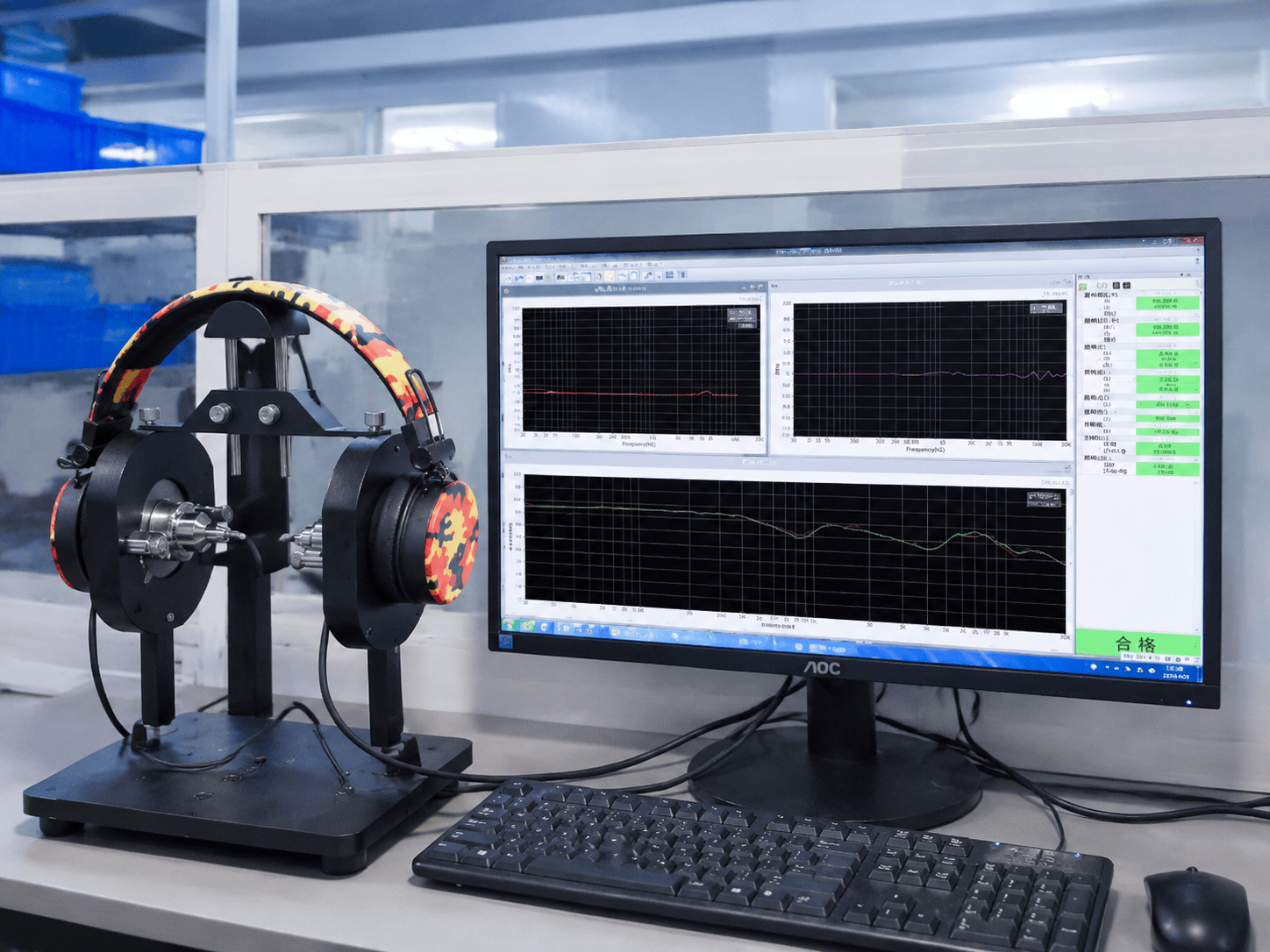
Begin with a controlled battery test method. Record the sample hardware revision, firmware, battery cell and lot, charge preparation, rest period, test temperature, connection mode, host, signal content, headset volume, RGB state, microphone state, processing features, start time, warning points, and shutdown endpoint. Automated logging is useful, but a clear manual protocol can also produce comparable results when operators follow the same steps.
For 2.4GHz, verify receiver recognition, reconnect, range, interference, audio, microphone, and the specified 20ms latency with a documented method. Battery testing should not hide wireless instability.
Bluetooth tests should name supported devices and profiles. Bluetooth does not guarantee the same latency, microphone path, controls, or power result as 2.4GHz. Check pairing, reconnect, prompts, volume synchronization, and intended microphone scenarios.
For 3.5mm, confirm whether analog audio works with the battery depleted, which powered features remain active, which controls operate, and what jack or adapter is required.
Acoustic review should cover response, distortion, channel balance, noise, usable level, seal, and listening references. The 50mm driver is one component; enclosure, damping, electronics, tuning, and fit determine the final sound.
Test detachable-microphone insertion cycles, retention, continuity, positioning, ENC behavior, and mute logic. For RGB, review brightness, sequence, uniformity, controls, startup default, and power-state memory.
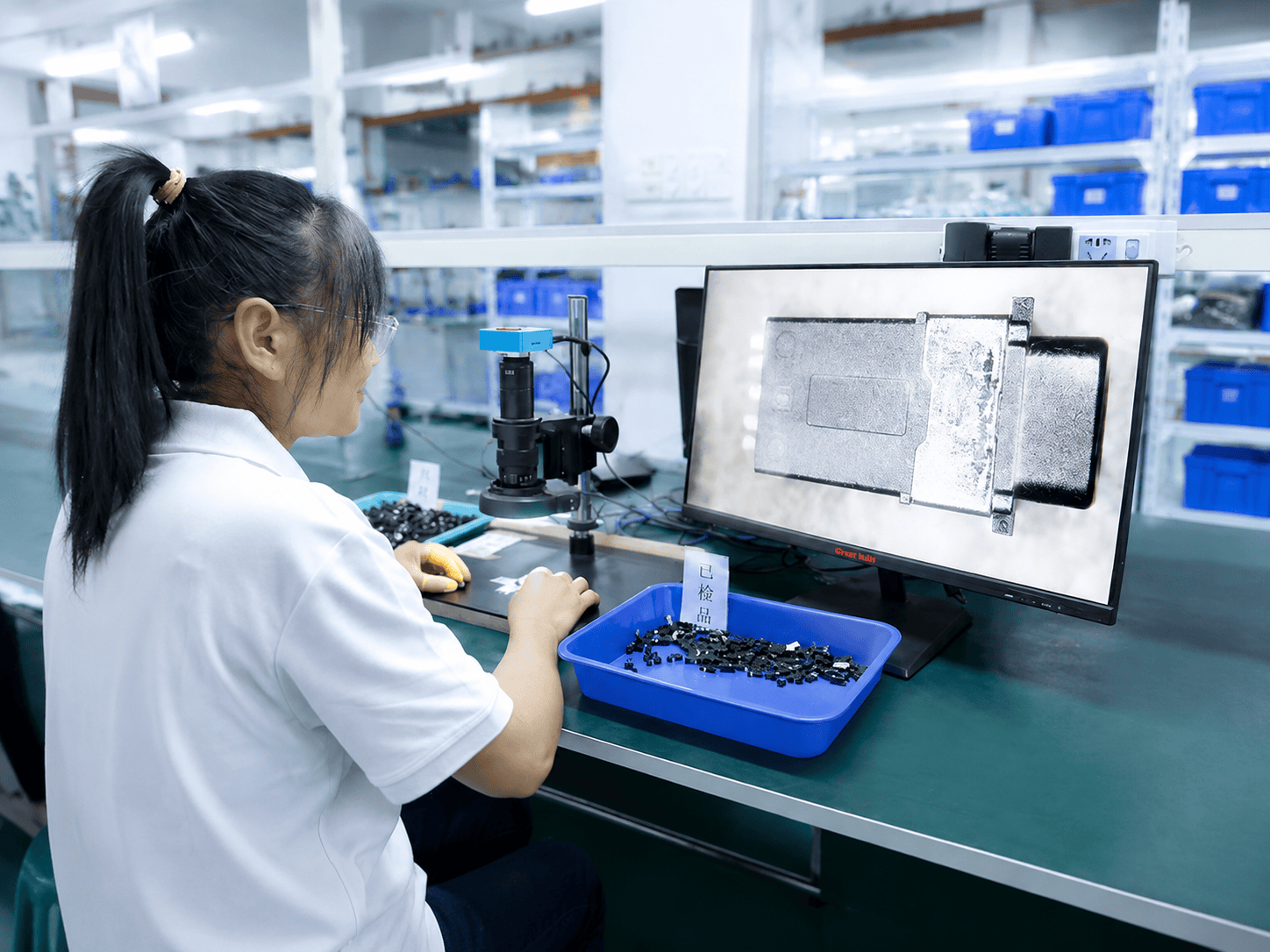
Production controls can include battery voltage and resistance, charging and operating current, RGB, firmware, receiver pairing, low-battery prompts, and sample runtime verification.
OEM/ODM Development Opportunities
A ready G927 platform lets brands focus on identity, channel fit, evidence-based claims, accessories, and controlled customization without treating every private-label project as a new electrical design.
The platform can support evaluation of logo, colors, packaging, manuals, labels, receiver presentation, and accessories. Each option needs feasibility, MOQ, cost, schedule, sample, and compliance review.
A different RGB default, firmware, microphone, receiver, cable, or battery source can change the test scope. Packaging claims must remain linked to the approved BOM and firmware. Optional Virtual 7.1 needs separate functional, compatibility, and claims review.
A strong RFQ identifies markets, channels, priority devices, mode requirements, battery claim condition, RGB, microphone scenarios, branding, packaging, accessories, compliance ownership, forecast quantity, and timing.
During sampling, maintain a decision log for battery claims, firmware, radio, acoustics, microphone, RGB, CMF, accessories, and artwork. Pilot production confirms whether the approved definition can be reproduced at scale.
| Customization area | Typical private-label option | Validation impact |
|---|---|---|
| Brand identity | Logo, black color direction, packaging, labels, manuals | Physical approval, durability, artwork control, and batch consistency |
| RGB | Lighting behavior or presentation where feasible | Appearance, user controls, startup state, and battery retest |
| Firmware | Prompts, device name, selected behavior where feasible | Version control, mode regression, battery, and compatibility review |
| Accessories | Receiver, charging cable, analog cable, adapters, microphone handling | Exact BOM, fit, labeling, packaging, and device-level testing |
| Optional Virtual 7.1 | Separately evaluated configuration | Software, host compatibility, audio, claims, and support documentation |
Buyer Checklist
Before approving an RGB tri-mode headset, buyers should freeze the use cases, runtime claim conditions, final configuration, test evidence, artwork, quality limits, and change-control process.
Start with the commercial claim. Decide whether the packaging will state one qualified playback figure or multiple mode-specific results. Write the condition beside the number, including RGB state where relevant. Avoid converting a battery-capacity value into an estimated runtime claim without a representative test.
Align the specification, BOM, firmware, compatibility matrix, battery protocol, golden sample, packaging, marketplace copy, and inspection plan. Later component or firmware changes require impact review.
Before release, review pilot evidence for wireless, audio, microphone, RGB, charging, battery warnings, runtime sampling, cosmetics, accessories, labels, and packing.
- Define the target users, devices, markets, channels, and connection priorities
- State mode, volume, RGB, microphone, firmware, and endpoint for each runtime claim
- Confirm the 1000mAh cell, supplier, protection, tolerance, and traceability
- Validate headline playback, RGB-on use, low-battery warnings, charging time, and selected aging checkpoints
- Test 2.4GHz receiver, range, microphone, controls, interference, and latency
- Verify Bluetooth profiles, pairing, reconnect, controls, and mode-specific power behavior
- Confirm 3.5mm pinout, microphone path, battery dependency, powered features, and adapter needs
- Approve 50mm-driver acoustic targets and detachable ENC microphone durability criteria
- Freeze logo, CMF, RGB, firmware, receiver, cables, packaging, manual, and optional features
- Link packaging and marketplace claims to the approved sample and test report
- Complete pilot production, compliance planning, inspection limits, traceability, and change control
Conclusion
The right battery-life claim is not the largest number available; it is the result that accurately describes the approved headset, survives production variation, and matches how the target customer will use the product.
G927 Black offers a defined private-label foundation with 2.4GHz, Bluetooth, 3.5mm, RGB, a 50mm driver, detachable ENC microphone, and a 1000mAh battery. Its approximately 50-hour playback reference is specifically stated without lighting, which gives buyers a useful starting point and a clear reason to define additional real-world conditions.
Brands that control test conditions before artwork approval can make clearer claims, compare suppliers more fairly, reduce avoidable returns, and give the OEM partner measurable acceptance criteria for samples and mass production.
Request OEM Consultation
Share your target devices, battery-life claim, RGB direction, branding scope, packaging, quantity, and launch market for a G927 private-label project evaluation.
Contact MACHFrequently Asked Questions
How should buyers test wireless gaming headset battery life?
Define hardware, firmware, battery, mode, host, volume, RGB, microphone use, temperature, content, charge preparation, and endpoint. Repeat the method on production-representative samples.
Does RGB lighting reduce gaming headset battery life?
Yes. The effect depends on LED implementation, brightness, pattern, firmware, and the complete product. Measure RGB-on and RGB-off conditions.
What battery life is specified for G927 Black?
The specification lists approximately 50 hours without lighting, a 1000mAh battery, 600 hours standby, and two hours charging. Validate final branded claims.
Is 2.4GHz gaming headset runtime the same as Bluetooth runtime?
Not necessarily. The modes use different radio behavior. Identify the tested mode or publish separate, documented results.
Does a 1000mAh battery guarantee 50 hours of playback?
No. Runtime also depends on efficiency, volume, mode, RGB, microphone processing, firmware, cell condition, temperature, and endpoint.
What should a private-label brand include in a battery-life claim?
State the tested wireless mode and RGB condition, supported by a controlled method, approved sample, firmware, battery specification, and tolerance.
What should buyers verify about gaming headset charging time?
Confirm the cable, power condition, starting state, indicator, cutoff, temperature, endpoint, and simultaneous-use policy. G927 lists two hours.
Can a 3.5mm gaming headset mode work without battery power?
It depends on the design and device. Test analog audio, microphone, controls, RGB, ENC, and battery dependency.
Can G927 Black be customized for a private-label brand?
Logo, colors, packaging, manuals, receiver presentation, and accessories can be evaluated. Firmware, RGB, and optional features require separate review.
What production controls protect an approved battery claim?
Use approved battery sourcing, electrical and current checks, firmware control, runtime sampling, aging checkpoints, traceability, and component-change review.
Related Resources
Need OEM/ODM gaming audio solutions?
Contact MACH Industry to discuss your gaming headset, gaming earbuds, or private-label audio project.
Contact MACH Industry