Home > Resources > Gaming Headset Guide
How Buyers Should Validate a Tri-Mode Wireless Gaming Headset Before Launch
A procurement and engineering guide to validating 2.4GHz, Bluetooth, and 3.5mm operating modes, compatibility claims, audio, microphone, RGB, battery, and ODM scope before launch.
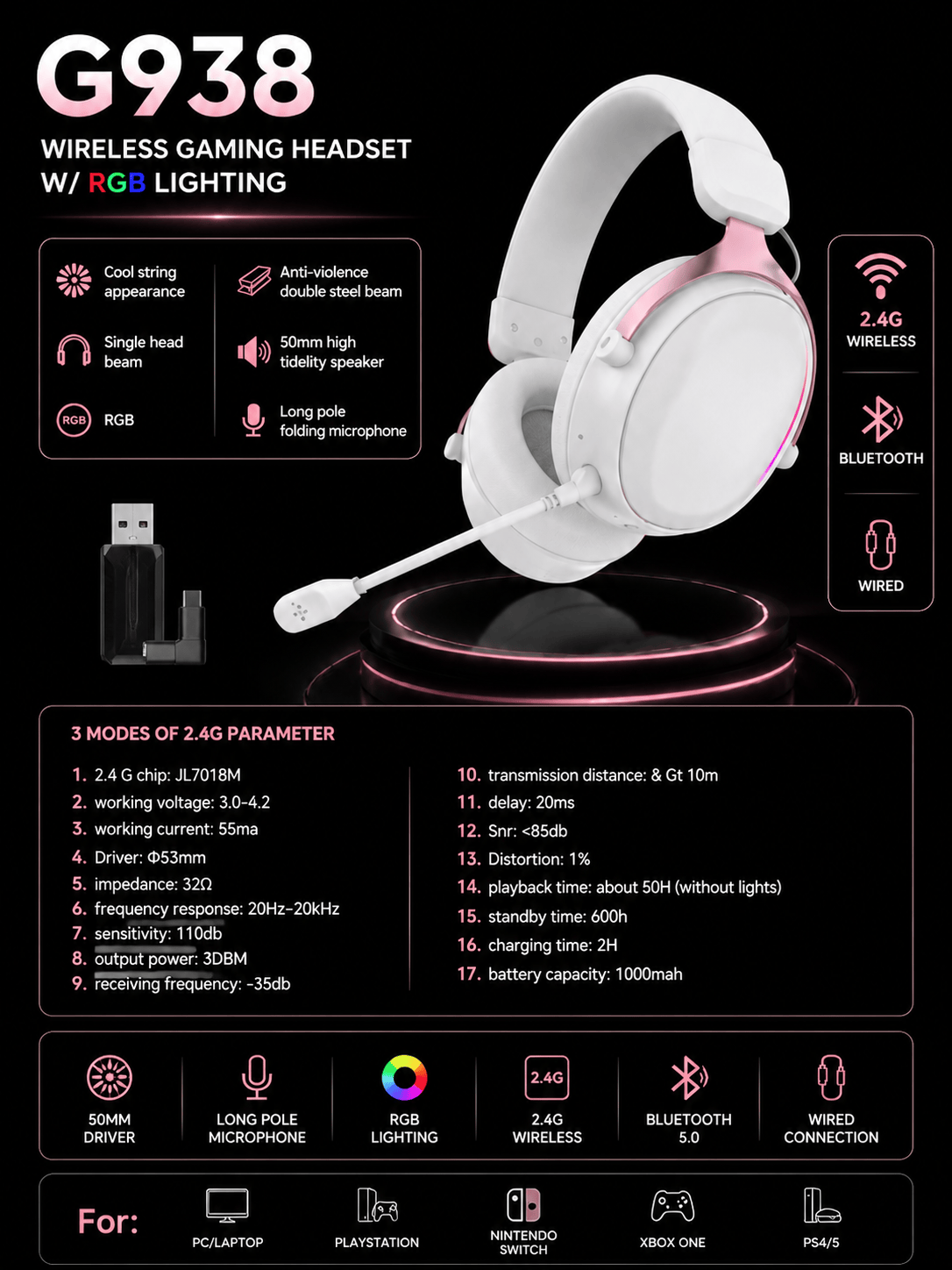
Buyers evaluating a tri-mode wireless gaming headset should not approve the product from a feature list alone. They need a mode-by-mode validation plan covering 2.4GHz, Bluetooth, and 3.5mm behavior on the intended devices, including audio, microphone, controls, power, indicators, RGB lighting, accessories, packaging claims, and recovery from switching or pairing errors.
The G938 White RGB ODM platform is a useful sourcing reference because its confirmed configuration combines a JL7018M-based 2.4GHz route, Bluetooth 5.0, 3.5mm connection, a 50mm driver, folding long-pole microphone with ENC support, RGB lighting, and a 1000mAh battery. The supplier specification lists more than 10 meters transmission distance and 20ms latency for the 2.4GHz route. This article explains how procurement teams can validate those product routes without repeating the transactional product page or assuming that every function behaves identically in every mode.
Understanding the Market Need
Brands choose tri-mode gaming headsets to serve different devices and usage scenarios with one product platform, but the commercial value depends on clearly validated behavior for each connection route.
A gaming accessory brand may sell to PC users, console players, mobile users, hybrid workers, and buyers who still value a wired fallback. A 2.4GHz USB receiver can support a dedicated wireless route for compatible gaming devices. Bluetooth can serve supported phones, tablets, laptops, and other consumer devices. A 3.5mm connection can provide a wired path where the target device and cable configuration support it.
The sourcing risk is that the phrase tri-mode sounds more universal than the real product. A device may accept audio but not microphone input through a particular route. Controls, RGB lighting, ENC processing, volume synchronization, or power behavior may differ by mode. USB-A and USB-C receivers, adapters, combined audio jacks, console controllers, operating systems, and Bluetooth profiles can also create different user experiences.
Procurement teams should therefore treat tri-mode as three related configurations inside one headset rather than one feature that needs a single pass/fail test. The commercial brief must name intended devices, user scenarios, supplied accessories, supported functions, and excluded claims before packaging artwork or marketplace listings are approved.
| Buyer objective | Why tri-mode helps | What still needs validation |
|---|---|---|
| Gaming use | Dedicated 2.4GHz route for supported devices | Receiver type, audio, microphone, controls, range, interference, and stated latency |
| Mobile and general use | Bluetooth connection without the gaming receiver | Profiles, pairing, call and microphone behavior, controls, and device compatibility |
| Wired fallback | 3.5mm connection for supported analog sources | Cable pinout, combined or separate jack needs, microphone path, power, and lighting behavior |
| One retail SKU | Broader application story | Accurate compatibility matrix, accessories, instructions, support scripts, and channel claims |
G938 Product Platform Overview
G938 White is an ODM tri-mode platform built around 2.4GHz wireless, Bluetooth 5.0, and 3.5mm connectivity with RGB styling and a folding ENC microphone format.
The confirmed white configuration uses a JL7018M-based 2.4GHz solution, Bluetooth 5.0, and a 3.5mm jack. The supplied specification identifies a transmission distance greater than 10 meters and 20ms latency for the 2.4GHz route. These are configuration-specific supplier values that should be checked with the final receiver, firmware, antenna, enclosure, and target devices; they are not a promise that all Bluetooth or analog use has the same latency.
Acoustic information includes a user-confirmed 50mm driver, 32-ohm impedance, 110dB sensitivity, and a 20Hz to 20kHz frequency range. Driver diameter alone does not determine sound quality. Enclosure volume, damping, cushion seal, electronics, tuning, distortion, channel balance, and microphone performance all need representative-sample evaluation.
The product direction also includes a long-pole folding microphone with ENC support, white housing with pink accents, RGB lighting, and a 1000mAh battery. Virtual 7.1 was not selected in the source Product Card, so it should not be added to the article, packaging, or sales claims for this configuration without a separately approved change.
| Platform item | Confirmed G938 White direction |
|---|---|
| Connection | 2.4GHz wireless, Bluetooth 5.0, and 3.5mm |
| 2.4GHz specification | JL7018M-based route, greater than 10m distance, and 20ms specified latency |
| Audio | 50mm driver, 32 ohms, 110dB sensitivity, and 20Hz-20kHz range |
| Microphone | Long-pole folding microphone with ENC support |
| Appearance | White and pink ODM direction with RGB lighting |
| Battery | 1000mAh capacity; runtime should be confirmed for the final configuration and test method |
| Excluded claim | Virtual 7.1 is not selected for the confirmed configuration |
The Tri-Mode Validation Matrix: What Buyers Must Confirm Before Launch
A tri-mode validation matrix maps every intended device and function against each connection route, creating a factual basis for packaging, product listings, manuals, customer support, and final QC.
Start with rows for actual target devices, not broad labels such as PC, console, and mobile. Record the operating system or hardware generation where relevant, the physical interface, receiver or adapter, expected audio path, microphone requirement, controls, RGB state, power source, pairing or connection procedure, and pass criteria. The same headset can produce different results when connected through a USB-A receiver, USB-C adapter, controller jack, combined laptop jack, or Bluetooth profile.
For 2.4GHz, validate receiver recognition, stable audio, microphone operation, controls, mute indication, reconnection, startup order, range under the agreed environment, interference behavior, and latency using a documented method. The listed 20ms value belongs to the specified 2.4GHz solution and should be treated as a test target for the approved configuration, not casually extended to Bluetooth or every application.
For Bluetooth, verify pairing visibility, device name, reconnect priorities, supported profiles, music playback, calls or microphone use where intended, control mapping, volume behavior, prompt language, and switching between previously paired devices. Bluetooth 5.0 identifies a version direction but does not by itself prove gaming latency, microphone quality, multipoint behavior, or compatibility with every host.
For 3.5mm, confirm whether the cable and target device use a combined headset connector, audio-only output, or another pinout. Check stereo audio, microphone path where supported, inline or headset controls, powered functions, RGB behavior, and whether the headset needs battery power in analog mode. If an adapter is required for a target device, decide whether it is included or clearly stated as optional.
Mode switching deserves its own test sequence. Evaluate switching while audio is playing, receiver insertion and removal, Bluetooth reconnect after wired use, low-power states, charging during operation where intended, factory reset, mute recovery, and behavior after an interrupted pairing attempt. A product that passes each mode separately can still create support problems if transitions are confusing.
The final matrix should become a controlled project document. Approved results feed the quick-start guide, compatibility table, packaging icons, e-commerce copy, customer-support scripts, inspection plan, and firmware revision record. Claims that do not have evidence should be removed or narrowed before launch.
| Validation area | 2.4GHz | Bluetooth | 3.5mm |
|---|---|---|---|
| Connection setup | Receiver recognition and reconnect | Pairing, stored devices, and reconnect | Cable, jack type, and adapter requirement |
| Audio | Playback, stability, range, and documented latency | Playback, profile behavior, and synchronization | Stereo path, level, noise, and channel assignment |
| Microphone | Input, mute, ENC direction, and target applications | Profile- and device-dependent input behavior | Jack and device support for microphone input |
| Controls | Volume, mute, prompts, and receiver state | Host mapping, volume sync, and prompts | Confirm which controls remain active |
| RGB and power | Lighting state, consumption, and charging behavior | Lighting state and battery effect | Confirm whether powered features operate |
| Claims output | Named compatible devices and measured target | Named profiles and device behavior | Cable and jack compatibility statement |
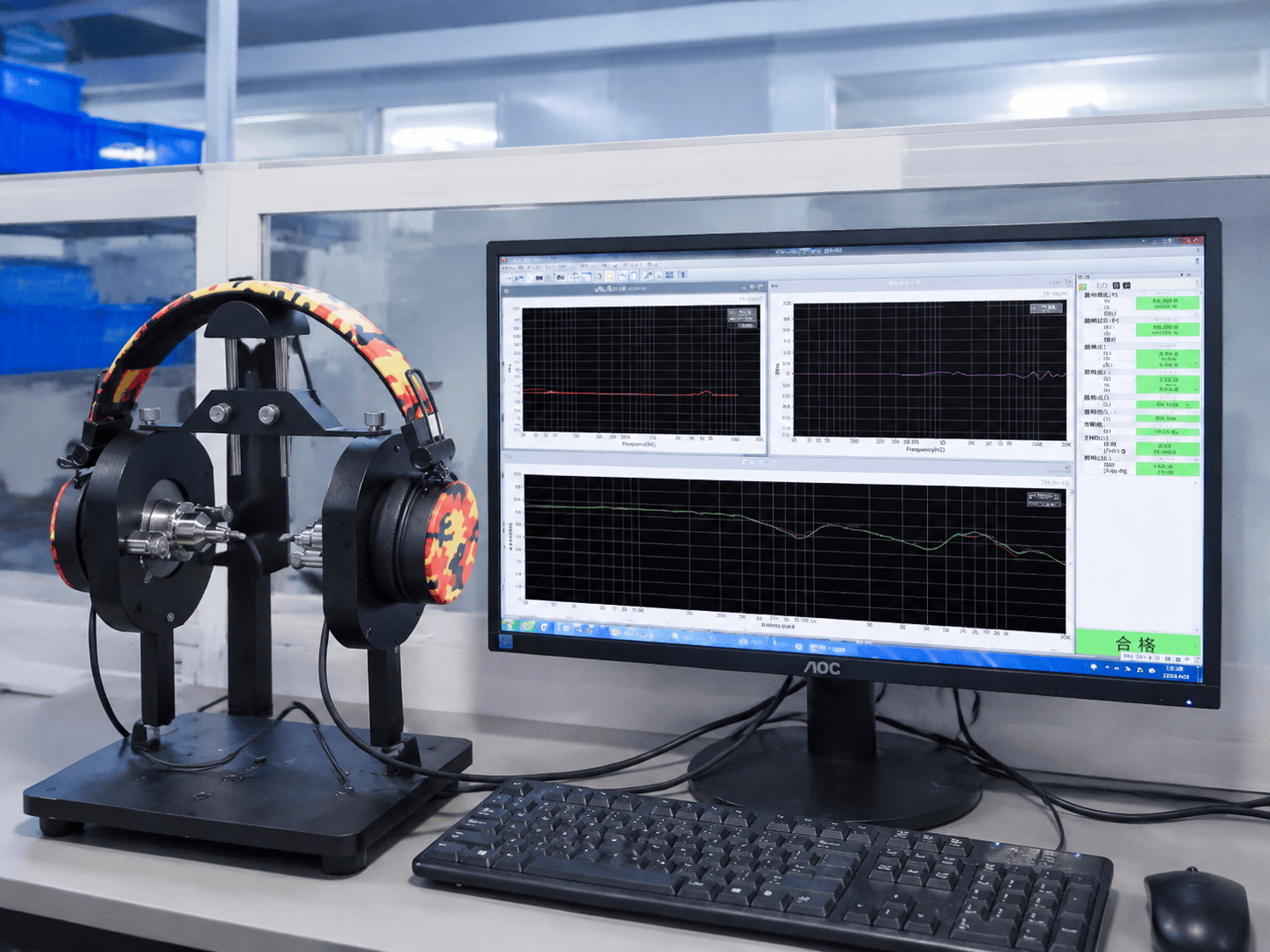
Technical Considerations for Gaming Headset Buyers
Wireless mode, acoustics, microphone design, mechanical comfort, battery behavior, RGB, and firmware must be evaluated as one final product rather than isolated specifications.
Wireless validation should use production-representative housing, antenna placement, receiver, firmware, and accessories. Range results depend on the environment, body blocking, nearby radios, USB placement, host noise, and test method. Buyers should define an indoor test layout and failure criteria instead of relying only on a maximum-distance statement.
Audio review should include frequency response, sensitivity, distortion, channel balance, maximum level, noise, tuning, and listening references across modes. Analog and digital routes may not have identical output. The 50mm driver is a platform component, while the final acoustic result depends on the complete enclosure and signal path.
The folding microphone needs checks for position, hinge consistency, voice level, noise handling, mute logic, ENC operation in supported modes, and repeated movement. ENC should be described as microphone signal processing for the approved configuration, not confused with active noise cancellation for the listener.
A 1000mAh battery specification is not a complete runtime claim. Runtime depends on volume, RGB state, wireless mode, microphone use, firmware, cell condition, temperature, and the test endpoint. Buyers should agree on charge time, runtime method, low-battery prompts, charging indication, protection, aging, and shipment state before publishing hours.
Compatibility Claims Need Device-Level Evidence
A reliable compatibility claim names the device, connection route, required accessory, supported functions, limitations, and tested configuration instead of using an unrestricted platform logo.
Retail buyers and marketplace customers often interpret a console or device icon as full support for audio, microphone, controls, chat, lighting, and plug-and-play operation. In reality, support can vary by receiver interface, controller jack, operating-system settings, Bluetooth profile, and adapter. The compatibility table should distinguish full tested behavior from audio-only or conditional use.
This evidence also reduces after-sales cost. Customer-service teams can diagnose the connection route, host device, receiver, cable, sound settings, microphone permissions, and mode indicator rather than treating every report as a hardware failure. Packaging and manuals should use the same compatibility revision as the firmware and accessory bundle.
When a brand changes receiver housing, USB adapter, firmware, Bluetooth name, cable, microphone, battery, or electronics, it should identify which compatibility tests must be repeated. ODM speed is useful only when configuration changes remain under change control.
OEM/ODM Development Opportunities
A ready tri-mode platform lets brands concentrate development on identity, channel fit, approved functions, packaging, firmware configuration, and quality requirements while retaining a validated technical base.
Project-dependent customization can include logo application, housing and accent colors, RGB direction, packaging, manuals, labels, barcodes, accessory bundles, receiver presentation, Bluetooth device name, prompt language, and selected firmware behavior. Every option should be reviewed for feasibility, tooling, MOQ, cost, sample approval, compliance, and schedule impact.
The white-and-pink G938 direction demonstrates how CMF can target a distinct retail audience without inventing a new hardware category. Buyers should still validate color on physical materials, gloss and texture relationships, logo process, RGB appearance, surface durability, and batch consistency. A digital rendering is not a production color standard.
Brands should separate must-have changes from optional differentiation. Compatibility, microphone behavior, and quality evidence usually deserve priority over a long list of cosmetic or firmware variations. A controlled ODM scope makes sample review clearer and reduces late changes after packaging or certification preparation.
| Customization area | Typical buyer decision | Required control |
|---|---|---|
| Brand identity | Logo, white/pink CMF, RGB presentation | Physical samples, process selection, color and defect limits |
| Firmware | Device name, prompts, mode behavior where feasible | Version control and compatibility retest |
| Accessories | Receiver, cables, adapters, documentation, bundle | Exact BOM, fit, labeling, and target-device validation |
| Packaging | Claims, icons, compatibility, positioning | Evidence-based copy aligned with the approved configuration |
| Quality | Tests, inspection level, golden sample, traceability | Pilot evidence and production release criteria |
From Sample Approval to Mass-Production Control
Sample approval becomes meaningful when the approved hardware, firmware, accessories, CMF, packaging, test methods, and quality limits are locked together for production.
An engineering sample may prove basic function but still differ from the production firmware, antenna, battery lot, receiver, microphone, finish, or packaging. Buyers should define sample stages and avoid using one early unit as evidence for every commercial claim. Changes need revision records and impact review.
Trial production should exercise the compatibility matrix on a representative quantity while also checking assembly, wireless yield, acoustic results, microphone operation, RGB, charging, cosmetics, labeling, and packing. Failure analysis should distinguish design, component, process, test-fixture, and operator causes.
Mass-production QC can use critical mode checks at appropriate stages, with full compatibility and reliability verification based on the agreed sampling plan. Golden samples, firmware checksums or version identifiers, receiver pairing control, accessory verification, and carton traceability help keep shipped units aligned with the launch configuration.

Buyer Checklist
Before sourcing a tri-mode headset, buyers should freeze the target-device matrix, mode functions, claims, configuration, customization scope, validation plan, compliance responsibilities, and production controls.
Begin with target markets, sales channels, user profiles, devices, operating systems, connection priorities, and required microphone scenarios. Define what 2.4GHz, Bluetooth, and 3.5mm must each support, including adapters and any limitations that must appear in customer-facing copy.
Then confirm acoustic targets, microphone and ENC behavior, mechanical comfort, RGB, battery test method, charging, controls, prompt language, receiver, cables, packaging, manuals, labels, and customization. Link every claim to a test, document, or approved sample.
Before purchase release, approve the BOM, firmware, artwork, CMF master, compatibility matrix, certification scope, packaging, golden sample, pilot report, defect criteria, inspection plan, traceability, and engineering-change process.
- List exact target devices and the intended connection route for each
- Define audio, microphone, controls, RGB, and power behavior by mode
- Confirm receiver interfaces, cables, adapters, and accessory inclusion
- Document 2.4GHz range and latency methods for the approved configuration
- Validate Bluetooth profiles, pairing, reconnect, prompts, and host behavior
- Verify 3.5mm pinout, microphone support, powered features, and limitations
- Approve 50mm-driver acoustic targets and folding ENC microphone criteria
- Define battery runtime, charging, RGB state, and test conditions before claims
- Freeze logo, CMF, packaging, compatibility copy, firmware, and quality masters
- Complete pilot production, compliance review, traceability, and change control
Conclusion
A tri-mode platform is suitable for a private-label brand when its three connection routes are clearly defined, verified on target devices, supported by accurate accessories and instructions, and controlled through production.
G938 White combines a useful ODM foundation: 2.4GHz, Bluetooth 5.0, 3.5mm, a 50mm driver, folding ENC microphone, RGB, and a white-and-pink identity. Its sourcing value comes from validating how those elements work together, not from presenting the longest possible specification list.
Brands that build a mode-by-mode compatibility matrix before packaging approval can make more accurate claims, reduce avoidable support cases, and give the OEM supplier measurable acceptance criteria for samples and mass production.
Frequently Asked Questions
What is a tri-mode wireless gaming headset?
It is a headset with three connection routes. For G938 White, the confirmed routes are 2.4GHz wireless, Bluetooth 5.0, and 3.5mm. Functions and compatibility must be confirmed separately for each mode.
Why do brands choose tri-mode gaming headsets?
Tri-mode platforms can serve supported gaming, mobile, general wireless, and wired scenarios with one SKU, provided the brand accurately validates devices, functions, accessories, and limitations.
What should buyers test in 2.4GHz mode?
Test receiver recognition, audio, microphone, controls, mute, reconnect, startup order, range, interference, latency method, indicators, charging, and the exact target devices.
Does Bluetooth 5.0 guarantee low-latency gaming?
No. A Bluetooth version does not by itself prove gaming latency, profile behavior, microphone quality, multipoint, or compatibility. Buyers need configuration- and device-specific tests.
Does the 3.5mm mode support every headset function?
Not necessarily. Audio, microphone, controls, RGB, ENC, and power behavior depend on the cable, jack pinout, target device, and headset design. These functions require explicit validation.
What is confirmed for the G938 White microphone?
The source product information identifies a long-pole folding microphone with ENC support. Buyers should confirm mode-specific operation, positioning, voice targets, mute logic, and durability.
How should buyers validate the G938 White battery claim?
The confirmed capacity is 1000mAh. Runtime should be measured using an agreed wireless mode, volume, RGB state, microphone use, temperature, endpoint, and final firmware before publishing hours.
Can G938 White be customized for a private-label brand?
Project-dependent ODM options may include logo, CMF, RGB presentation, packaging, documentation, labels, accessories, Bluetooth name, prompts, and selected firmware behavior, subject to feasibility and approval.
What makes a headset platform suitable for private-label launch?
It needs a stable technical base, clear customization boundaries, target-device evidence, controlled firmware and BOM, compliance planning, production-representative samples, pilot validation, and measurable QC criteria.
Is virtual 7.1 confirmed for this G938 White configuration?
No. Virtual 7.1 was not selected on the source Product Card and should not be claimed for this configuration unless a separately evaluated and approved version is developed.
Related Resources
Need OEM/ODM gaming audio solutions?
Contact MACH Industry to discuss your gaming headset, gaming earbuds, or private-label audio project.
Contact MACH Industry