Home > Resources > Gaming Headset Guide
How to Build a Differentiated Private-Label Wireless Gaming Headset on a Ready Platform
A procurement guide to differentiating a ready wireless gaming headset platform through CMF, branding, firmware, packaging, accessories, and controlled engineering changes.
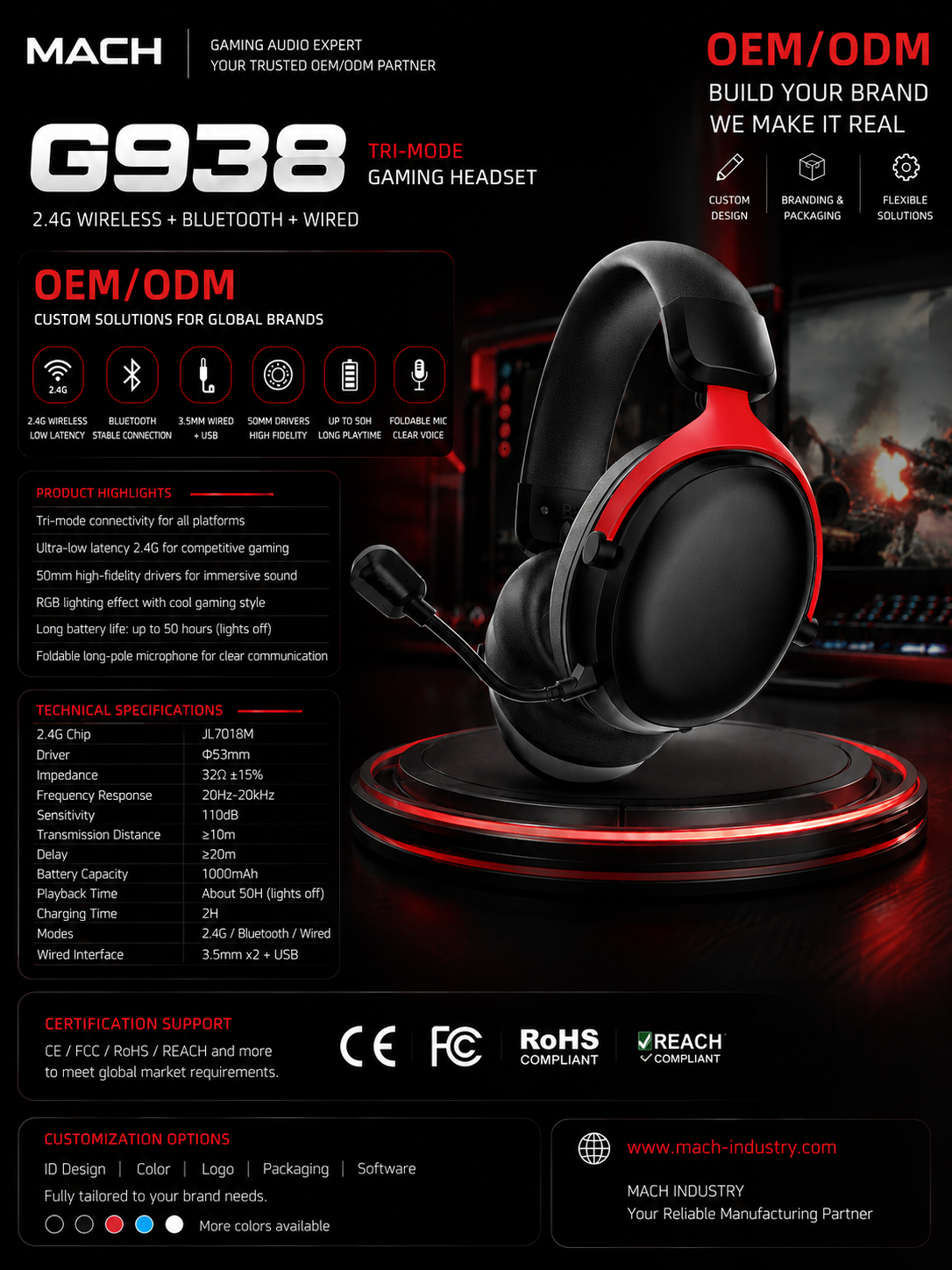
A gaming brand does not need to develop an entirely new headset structure to create a differentiated private-label product. A mature wireless platform can be adapted through CMF, branding, firmware, packaging, and accessories, provided the changes remain technically and commercially feasible. The important decision is not whether a product is fully custom, but whether every customization supports a coherent market position without creating unnecessary RF, tooling, quality, or production risk.
The G938 Red Edition illustrates this approach. It is a dual-mode wireless gaming headset platform with 2.4GHz and Bluetooth connectivity, a 50mm dynamic driver, detachable noise-reduction boom microphone, USB-C charging, and private-label options covering logo, CMF, packaging, firmware, Bluetooth device name, boot prompts, manuals, labels, accessories, and bundles. Battery direction is up to approximately 30 hours, depending on the final configuration and use conditions. This article uses the platform as a sourcing example rather than repeating its product page.
What Makes a Private-Label Gaming Headset Different From a Standard OEM Product?
Private-label differentiation comes from a coordinated product identity and controlled specification, not from placing a logo on an unchanged standard headset.
A standard product is normally selected from an existing specification with little change. Basic logo customization adds brand ownership but may leave the user experience, packaging, accessories, and retail story nearly identical to competing offers. A private-label program goes further by coordinating visual, functional, and commercial details around a defined customer and channel.
Semi-custom ODM development starts from a mature gaming headset platform and changes selected elements such as CMF, logo processes, firmware behavior, packaging, manuals, and accessory bundles. Full private tooling introduces new enclosure parts, mechanisms, electronics, or other proprietary engineering. Each level can be valid; the correct choice depends on how much differentiation the brand needs and which risks it can justify.
Buyers should identify the smallest set of changes that creates meaningful distinction. A consistent color system, recognizable logo placement, named Bluetooth identity, branded prompts, clear packaging hierarchy, and a useful accessory bundle can create a stronger private-label experience than a long list of disconnected features.
G938 Red Edition Platform Overview
G938 Red Edition is a ready dual-mode wireless platform designed for gaming, consumer-electronics, retail, distributor, and e-commerce private-label programs.
The platform combines a dedicated 2.4GHz wireless path for transmitter-based gaming scenarios with Bluetooth for compatible mobile devices and general wireless audio. A 50mm dynamic driver and detachable noise-reduction boom microphone provide the acoustic and communication foundation, while USB-C supports charging. Compatibility direction includes PC, compatible consoles, mobile devices, and gaming handhelds, but each target configuration must be verified against its transmitter, connector, firmware, and platform requirements.
Customization can cover product color, surface treatment, logo, retail packaging, firmware configuration, Bluetooth device name, boot voice prompt, user manual, barcode and market labels, accessories, and bundle structure. Certification and compliance support can be coordinated for CE, FCC, RoHS, UKCA, and KC according to the target market and final product configuration; support should not be read as automatic certification of every variant.
| Platform item | G938 Red Edition direction |
|---|---|
| Product type | Private-label wireless gaming headset platform |
| Connectivity | 2.4GHz wireless and Bluetooth |
| Driver | 50mm dynamic driver |
| Microphone | Detachable noise-reduction boom microphone |
| Charging | USB-C charging |
| Battery direction | Up to approximately 30 hours; project-dependent and based on final configuration |
| Compatibility direction | PC, compatible consoles, mobile devices, and gaming handhelds, subject to configuration validation |
| Brand customization | CMF, logo, firmware, device name, voice prompts, packaging, manuals, labels, accessories, and bundles |
Why Use a Mature Wireless Gaming Headset Platform?
A mature platform can reduce structural and tooling exposure while providing an established basis for sampling, production, and focused brand customization.
Starting from a ready platform avoids rebuilding every enclosure, headband mechanism, antenna location, PCB, assembly fixture, and production instruction. This can make project planning more predictable and direct engineering attention toward the changes buyers and users will actually notice. It also gives procurement teams a physical baseline for fit, controls, accessories, and packaging discussions.
Lower development scope does not mean zero validation. A custom coating may affect material behavior, a new logo process may change adhesion requirements, firmware changes require regression checks, and a different dongle or accessory may alter compatibility. Sampling still needs approved specifications, issue tracking, functional checks, and pilot-production verification.
A ready platform is most useful when its basic structure, wireless architecture, comfort direction, driver format, and microphone arrangement already fit the planned market. If the brand's central value proposition requires a new mechanism, PCB, antenna, or industrial design, a semi-custom or private-tooling path may be more appropriate.
Color Is Not Enough: Building a Complete Private-Label Gaming Headset Identity Through CMF, Firmware and Packaging
Color can create recognition, but a complete private-label identity coordinates CMF, logo, firmware, packaging, documentation, accessories, photography, and retail positioning.
Red can support a lifestyle gaming collection, creator-focused product line, coordinated desktop-accessory family, youth-oriented retail program, or a high-visibility e-commerce presentation. It does not automatically improve sales or conversion. Its value depends on whether the color fits the audience, brand system, competitive set, photography, packaging, and the rest of the range.
CMF means color, material, and finish. Product teams should define the color direction, material appearance, gloss or matte treatment, surface texture, logo size and placement, and lighting behavior if the final configuration supports lighting. Digital swatches are not enough: mass-production approval needs a physical color standard, agreed lighting conditions, surface-gloss reference, material lot controls, acceptable batch tolerance, scratch and wear expectations, UV-stability considerations, printing adhesion, and production-yield review.
The product identity continues after the headset is switched on. A customized Bluetooth device name and boot voice prompt can align the interaction with the brand. Packaging design, manuals, barcodes, market labels, cable or dongle configuration, accessories, and retail bundle strategy determine how the product is understood, set up, and presented. Product photography should use the approved color and bundle rather than the same generic images used by competing private-label listings.
This is why changing a standard unit to red and printing a logo may still look generic. The strongest result uses one product language across color, logo, packaging, firmware, voice prompts, accessories, photography, and market position. The same mature platform can then support different brand audiences without pretending that the underlying engineering must be completely new.
Before sampling, product managers should create one identity brief that connects the approved color standard, surface references, logo artwork, digital device name, prompt script, package hierarchy, included accessories, product photography direction, and retail claim language. This gives engineering, sourcing, design, and marketing teams the same definition of the finished SKU.
Common platform-level changes include logo, color, surface finish, packaging, manuals, Bluetooth device name, prompts, and accessory bundles. Risk rises when a request introduces a new enclosure, headband mechanism, PCB, antenna layout, major battery change, microphone structure, unverified console claim, or new tooling. Buyers should separate identity-building customization from architecture-changing development before quotation and sampling.
Planning a private-label gaming headset with a distinctive color and brand identity?
Share your audience, color direction, logo files, firmware needs, packaging concept, target devices, and expected quantity for a feasibility review.
Discuss the project2.4GHz and Bluetooth: Why Dual Wireless Modes Matter
2.4GHz supports dedicated transmitter-based gaming use, while Bluetooth adds convenient connectivity for compatible mobile and general-audio scenarios.
A 2.4GHz gaming link normally uses a USB transmitter and can be developed around lower-latency PC and compatible-console scenarios. The brand must confirm dongle connector, host support, microphone return, controls, firmware, and platform restrictions. One transmitter should never be assumed to work with every console or handheld.
Bluetooth is useful for phones, tablets, laptops, and everyday wireless audio. Its latency and two-way audio behavior depend on the supported mode, codec, profiles, firmware, and host device; not every Bluetooth path is a low-latency gaming path. Dual-mode architecture broadens the use cases, but also adds mode switching, pairing, prompts, indicators, support documentation, and testing responsibilities.
Technical Deep Dive: Why CMF Changes Must Be Reviewed Together With RF, Materials and Mass Production
CMF changes can affect antenna behavior, mechanical tolerance, printing adhesion, durability, consistency, and production yield, so they must be validated as engineering changes rather than treated as decoration.
Different resins, pigments, paint systems, coatings, and surface treatments can change wall behavior, assembly fit, scratch resistance, UV response, color repeatability, and process yield. Metallic effects, conductive coatings, or metal badges placed near the antenna can also influence wireless performance. The final antenna surroundings should therefore be reviewed after CMF and logo decisions, not only on an uncoated engineering sample.
Logo processes must match the substrate, geometry, desired finish, and durability target. Options may include silk-screen printing, pad printing, UV printing, laser engraving, a molded logo, or a metal badge, but not every method is appropriate for every G938 surface. Adhesion, edge definition, color, abrasion, curvature, and possible RF impact should be checked on representative parts.
Color approval should record a Pantone reference or physical master, material, surface texture, gloss, viewing light, wear criteria, and permitted batch tolerance. The team should compare samples from the intended production process rather than relying on a monitor. Incoming-quality checks and production samples then need a consistent reference for color and logo acceptance.
Packaging, accessories, firmware, device naming, prompts, labels, and manuals should be frozen with the product because they describe and support the final configuration. Even on a mature platform, MACH can coordinate RF validation, functional inspection, aging testing, reliability checks, incoming-quality control, and pilot-production verification according to the approved project specification.

Is a 50mm Driver Automatically Better?
No. Driver diameter is one design variable; the acoustic chamber, ear-pad seal, tuning, amplification, source, fit, and production consistency determine the complete result.
A 50mm dynamic driver is common in over-ear gaming headsets and can support suitable output and bass direction when integrated correctly. Diameter alone does not establish sound quality or product tier. Diaphragm material, motor structure, impedance, sensitivity, matching, and distortion also matter.
The driver works with the front and rear chamber, vents, damping, grille openings, ear pads, clamping force, and distance to the ear. Wireless amplification and the source path affect available performance, while production tolerance affects left-right and batch consistency. Buyers should approve the assembled headset against a defined acoustic target rather than selecting by diameter alone.
Ready Platform vs Semi-Custom ODM vs Full Private Tooling
Choose the development level that creates commercially useful differentiation with an acceptable tooling, engineering, RF, firmware, and production burden.
The three paths are not quality rankings. A well-executed ready-platform project can be more coherent and reliable than an under-resourced private-tooling program. Procurement teams should compare scope against the brand's actual value proposition, validation resources, quantity expectations, and ability to manage design changes.
| Decision factor | Ready platform | Semi-custom ODM | Full private tooling |
|---|---|---|---|
| Development scope | Brand and configuration changes | Selected mechanical, firmware, CMF, or accessory changes | New product architecture and proprietary parts |
| Tooling exposure | Usually limited | Depends on changed parts | High when new molds and fixtures are required |
| Engineering risk | Lower baseline; customization still validated | Moderate and change-dependent | Highest due to new architecture |
| Brand differentiation | CMF, logo, firmware, packaging, and bundle | More distinctive product and interaction changes | Potentially unique structure and system |
| RF and firmware work | Regression checks around final configuration | Targeted validation and development | Broad architecture development and validation |
| Suitable buyer | Brands prioritizing controlled launch and identity execution | Brands needing defensible changes on a mature base | Brands with unique requirements and resources for full development |
Not sure which development route fits your project?
Share your target market, feature list, color direction, and expected quantity with MACH for a ready-platform, semi-custom ODM, or private-tooling discussion.
Request a platform reviewOEM Buyer Checklist for a Private-Label Wireless Gaming Headset
A structured RFQ helps the supplier separate brand-level customization from changes that affect tooling, electronics, RF, certification, and production risk.
Provide commercial context as well as technical preferences. Target retail price, expected quantity, channel, countries, and launch schedule help determine whether a ready platform is suitable. Device and compatibility requirements should name real connection scenarios instead of asking for universal support.
For CMF, provide physical or Pantone direction, finish, logo artwork, placement, and durability expectations. For firmware and packaging, define device name, prompts, languages, labels, barcodes, accessories, and bundle contents. Certification planning should use the target market and final configuration.
- Target market, retail channel, and target price
- Expected order quantity and launch schedule
- 2.4GHz and Bluetooth requirements
- Target devices and dongle connector
- Driver and acoustic positioning
- Microphone type and communication needs
- Battery target with defined use conditions
- Color standard, material, and surface finish
- Logo artwork, placement, and process
- Firmware, Bluetooth name, and voice prompts
- Packaging, manuals, labels, and barcodes
- Accessories and retail bundle
- Destination-market compliance scope
Common Mistakes Brands Should Avoid
Most avoidable problems come from making visible promises before material, compatibility, firmware, packaging, and compliance feasibility are confirmed.
Do not select a color before confirming material and process feasibility, and do not assume that one USB transmitter supports every console. Driver size should not replace acoustic approval. Firmware naming and prompts should not be left until the user manual is already designed, and packaging should not wait until mass production because it controls accessories, labels, protection, and customer setup.
Avoid adding too many custom features in one round. Each structural, electronic, firmware, and CMF change creates interactions and validation work. Certification claims should remain conditional until the final market configuration is reviewed. Product photography should show the approved color, logo, accessories, and bundle rather than reusing images that make the offer indistinguishable from competitors.
How MACH Supports Private-Label Gaming Headset Projects
MACH supports requirement review, platform evaluation, CMF sampling, branding, firmware configuration, packaging development, testing, trial production, QC, and mass-production coordination.
The process begins by mapping target users, markets, devices, commercial constraints, and differentiation priorities to a suitable platform. MACH can then coordinate color and finish samples, logo methods, firmware requirements, Bluetooth naming, prompts, accessories, packaging, manuals, and labels against one approved product specification.
Manufacturing support can include incoming-quality control, functional inspection, reliability and aging testing, trial-production review, packaging checks, production coordination, and shipment preparation. The scope and acceptance criteria remain project-dependent. Certification and compatibility work are planned around the final product configuration rather than assumed from the base platform.
Key Takeaways for Private-Label Buyers
Use a mature platform when its core architecture fits the market, then invest customization effort where buyers can see, hear, understand, and consistently receive the difference.
A coherent private-label program aligns brand identity with technical feasibility. Freeze the target devices and connection modes before making compatibility claims, approve physical CMF standards before production, control firmware and documentation versions, and validate every change that may affect RF, mechanics, quality, or compliance.
- Choose platform fit before choosing cosmetic options
- Treat CMF, firmware, packaging, and accessories as one identity system
- Separate low-risk brand changes from architecture-changing requests
- Approve physical samples and controlled specifications
- Keep compatibility and certification claims configuration-specific
Conclusion
A brand can create a recognizable private-label wireless gaming headset without rebuilding the complete structure by coordinating CMF, logo, firmware, packaging, accessories, and market positioning on a technically suitable platform.
The G938 Red Edition shows how a custom-color gaming headset can become more than a color variant. The platform provides dual wireless connectivity, a 50mm driver, detachable microphone, USB-C charging, and a production foundation; the brand creates distinction through disciplined product identity and carefully selected changes.
The practical goal is not maximum customization. It is a coherent product that can be sampled, validated, described accurately, manufactured consistently, and presented clearly to its intended buyer.
Discuss Your Private-Label Gaming Headset Project
Send your market, product brief, target devices, CMF direction, logo files, firmware needs, packaging concept, accessories, quantity, and compliance destinations for an OEM/ODM discussion.
Contact MACHFrequently Asked Questions
What is a private-label gaming headset?
It is a headset platform configured and presented for a specific brand through approved specifications such as CMF, logo, firmware, packaging, documentation, accessories, labels, and bundle strategy.
Can a gaming headset be differentiated without a new mold?
Yes. A mature platform can be differentiated through coordinated color, finish, logo, firmware, Bluetooth name, prompts, packaging, manuals, accessories, and photography when those changes fit the platform.
What can be customized on the G938 platform?
Project-dependent options include logo, CMF and color, packaging, firmware configuration, Bluetooth device name, boot prompt, manuals, labels, barcodes, accessories, and bundle configuration.
What is CMF customization?
CMF means color, material, and finish. It covers the physical color standard, substrate, texture, gloss, coating, durability, logo interaction, batch tolerance, and production feasibility.
Can MACH customize the Bluetooth device name and voice prompts?
Firmware configuration can support Bluetooth device-name and boot-prompt customization, subject to platform feasibility, language files, version control, and testing for the final project.
What is the difference between 2.4GHz and Bluetooth?
2.4GHz normally uses a dedicated USB transmitter for gaming-oriented connections. Bluetooth provides convenient direct pairing for compatible mobile and consumer devices. Performance and compatibility depend on the final configuration.
Can the headset work with PC, consoles, and mobile devices?
The platform is directed toward PC, compatible consoles, mobile devices, and handhelds, but support must be verified for the selected transmitter, connector, firmware, and host platform. Universal compatibility should not be assumed.
Is a 50mm driver always better than a 40mm driver?
No. Driver diameter is only one variable. Chamber design, ear-pad seal, tuning, amplification, impedance, source, fit, and production consistency determine the complete acoustic result.
Can MACH customize retail packaging and accessories?
Yes. Packaging, manuals, labels, barcodes, cables, dongles, accessories, and retail bundles can be planned around the approved product configuration and target channel.
What certifications may be required for a wireless gaming headset?
Requirements depend on the destination market and final radio, battery, charger, accessory, label, and packaging configuration. MACH can coordinate support for markets involving CE, FCC, RoHS, UKCA, KC, or other applicable requirements.
What information should a buyer prepare before requesting a quotation?
Prepare target markets, channels, price direction, expected quantity, devices, wireless modes, dongle type, acoustic and microphone requirements, battery target, CMF, logo, firmware, packaging, accessories, compliance needs, and schedule.
When should a brand choose full private tooling instead of a ready platform?
Private tooling is appropriate when the brand requires a distinctive structure, mechanism, electronics, RF architecture, or other feature that cannot be achieved responsibly through controlled platform customization.
Related Resources
Need OEM/ODM gaming audio solutions?
Contact MACH Industry to discuss your gaming headset, gaming earbuds, or private-label audio project.
Contact MACH Industry