Home > Resources > Gaming Headset Guide
What Should Brands Specify for a 2.4GHz Gaming Headset USB Receiver?
A technical buyer guide to receiver architecture, pairing, host compatibility, latency, RF validation, packaging, replacement support, and production control for 2.4GHz gaming headset OEM programs.
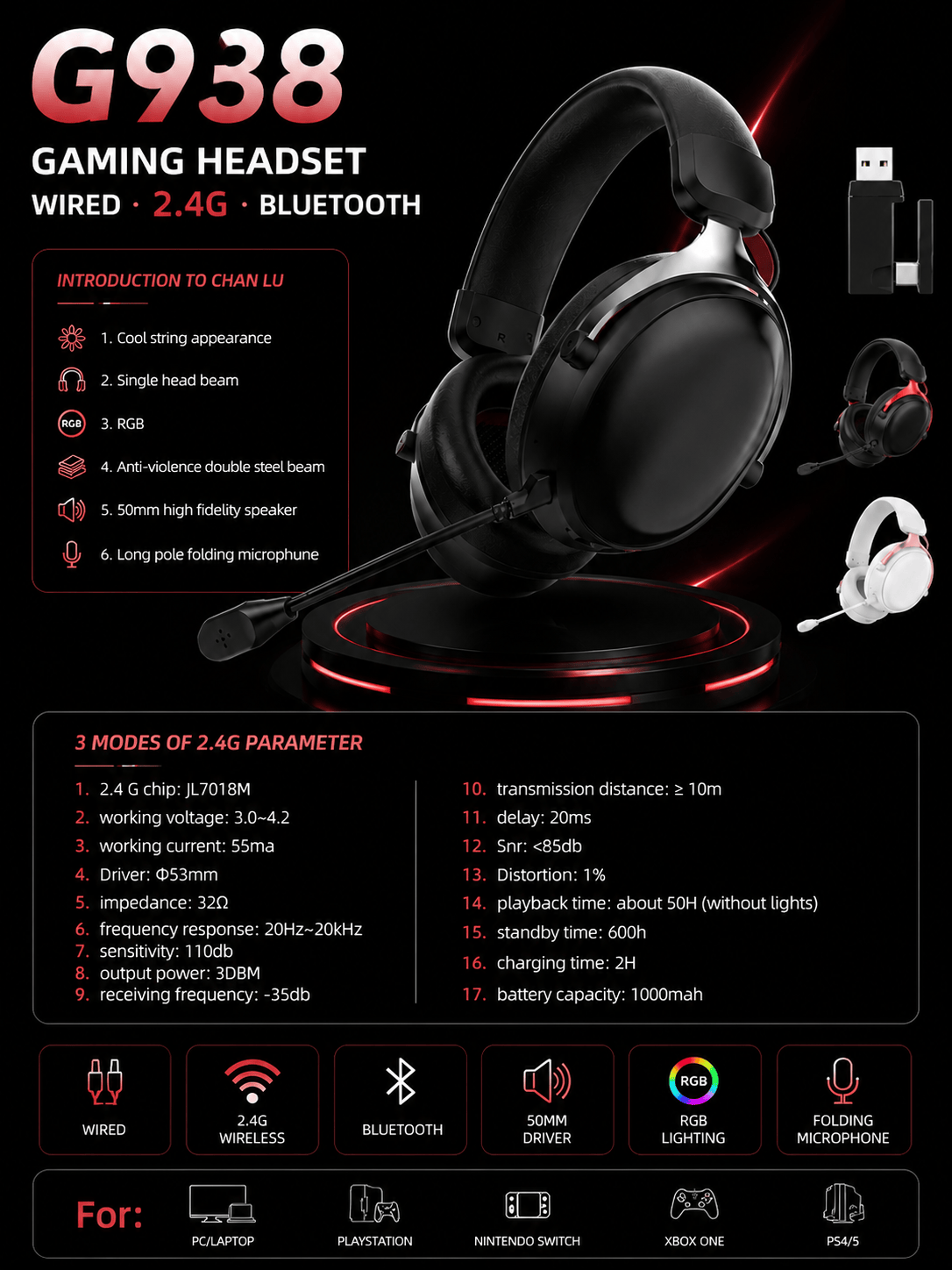
Gaming brands should specify a 2.4GHz gaming headset USB receiver as part of the complete wireless system, not as a generic accessory. The sourcing brief should define the receiver chipset and connector, approved hosts, audio and microphone behavior, pairing method, latency test conditions, range, reconnect logic, firmware identity, labeling, packaging protection, replacement procedure, and mass-production controls.
This matters because the dongle is the bridge between the headset and the host. A headset can have acceptable speakers, microphone, battery, and industrial design yet still produce returns if the receiver is difficult to identify, poorly protected in the box, incorrectly paired, inconsistent across production lots, or marketed for devices that were never validated. Buyers therefore need evidence for the headset-and-receiver combination rather than isolated component claims.
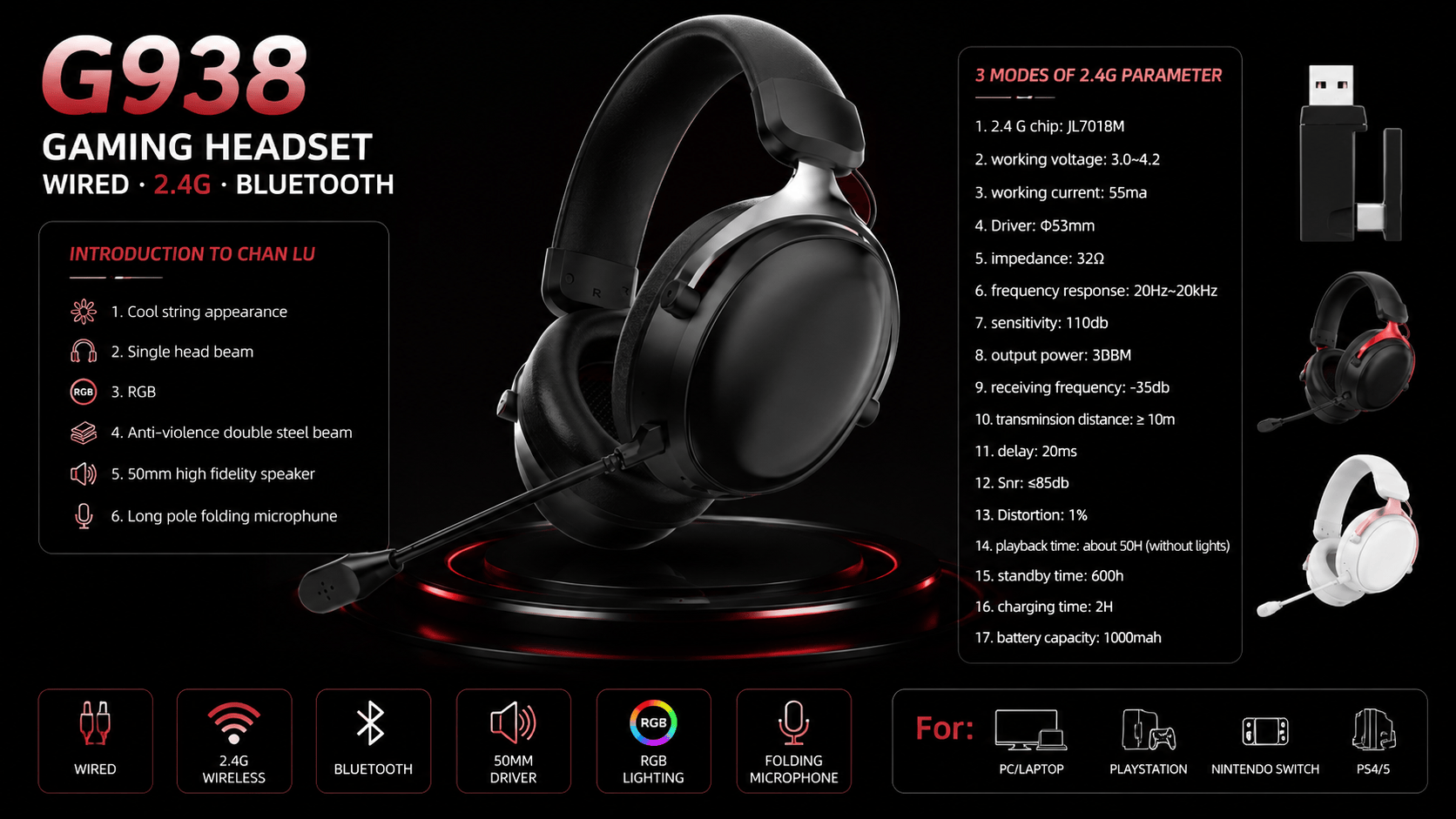
The G938 Black platform provides a documented reference for this discussion. Its confirmed configuration combines a JL7018M-based 2.4GHz route with an included dongle, 20ms specified latency, and at least 10m transmission distance. It also provides Bluetooth and 3.5mm audio, Virtual 7.1, a buyer-confirmed 50mm driver, a folding boom microphone with ENC support, RGB, and a 1000mAh battery. This guide explains how OEM buyers can turn those features into a controlled private-label product specification.
G938 Product Overview
G938 Black is a wireless gaming headset platform built around an included 2.4GHz dongle, Bluetooth, 3.5mm audio, Virtual 7.1, a confirmed 50mm driver, ENC microphone support, RGB, and a 1000mAh battery.
The dedicated gaming route uses the JL7018M 2.4GHz chipset. The published specification identifies 20ms latency and a transmission distance of at least 10m. Those values establish a reference for project evaluation; the brand should still agree on the latency method, host, distance conditions, interference environment, firmware, and pass criteria before using them in market claims.
Bluetooth provides an additional wireless route, while the 3.5mm jack provides an analog wired option. The product source does not claim USB Audio, so the included dongle should not automatically be described as a generic USB sound card. Its functions and supported hosts need to be documented for the approved project configuration.
The acoustic platform uses a buyer-confirmed 50mm driver with 32-ohm impedance, 110dB sensitivity, and a listed 20Hz-20kHz frequency response. Communication is handled by a long folding boom microphone with ENC support. Virtual 7.1 and RGB support the gaming position, while the 1000mAh battery is specified for approximately 50 hours of playback with lighting off, 600 hours standby, and two hours charging.
For an OEM buyer, the platform is valuable because it combines several established product functions with room for brand, CMF, RGB presentation, dongle and accessory configuration, packaging, manuals, labels, and firmware evaluation. Final compatibility, Virtual 7.1 behavior, accessories, and compliance scope must be confirmed through project review and sample validation.
| System area | Confirmed G938 Black reference | Procurement implication |
|---|---|---|
| Wireless gaming route | JL7018M 2.4GHz with included dongle, 20ms specified latency | Approve the headset, dongle, firmware, host list, and test method together |
| Additional connections | Bluetooth and 3.5mm audio | Create a separate feature and compatibility matrix for each mode |
| Audio and voice | 50mm driver, Virtual 7.1, folding boom microphone with ENC support | Validate tuning, surround behavior, voice quality, and mode-specific operation |
| Power and appearance | 1000mAh battery and RGB | State runtime conditions and verify charging, lighting, and production consistency |
Why Gaming Brands Choose This Type of Gaming Headset Platform
Brands choose a receiver-based wireless headset platform when they need a controlled gaming connection, broader use through Bluetooth and 3.5mm, and a practical base for private-label development.
A dedicated 2.4GHz link can be engineered and validated as a headset-and-receiver system for approved gaming hosts. This gives product teams more control over pairing, reconnect behavior, microphone transport, controls, and latency than a broad wireless claim without a defined route. It does not make every device compatible; the value comes from testing a specific matrix and communicating it accurately.
The additional Bluetooth route can address compatible phones, tablets, laptops, communication, and general listening scenarios. Bluetooth profiles, codecs, host implementations, call states, and microphone routing can affect behavior, so a 2.4GHz latency result must not be transferred to Bluetooth marketing. The 3.5mm option can provide a wired audio path for matching analog ports, subject to plug wiring, microphone routing, cable behavior, and host validation.
Virtual 7.1 can provide a differentiated PC gaming audio position when its processing path, activation method, channel mapping, level, noise, microphone interaction, and supported operating environment are defined. A 50mm driver offers an acoustic platform, but diameter alone does not establish sound quality. Enclosure volume, diaphragm behavior, cushions, seal, damping, amplifier headroom, DSP, and production variation all influence the result.
For private-label programs, a mature platform can shorten the path from concept to approved sample because the basic structure and electronics already exist. Buyers can concentrate on the commercial specification, brand presentation, accessory bundle, user instructions, packaging, tuning or firmware scope, validation, and compliance. Any change affecting RF, firmware, power, acoustic volume, antenna conditions, or mechanics should be treated as engineering work rather than a cosmetic option.
Technical Deep Dive: Why the Wireless Dongle Must Be Treated as Part of the Product
The dongle is a paired radio, audio, firmware, compatibility, packaging, and after-sales component; its specification must be controlled with the headset from sampling through replacement support.
Receiver architecture begins with the physical interface and the target host. Procurement teams should identify the connector, required adapter if any, insertion clearance, neighboring-port interference, mechanical strain, housing dimensions, status indication, and storage location. They should also document how the host recognizes the receiver and which audio output, microphone input, controls, and surround functions are available. G938 Black includes a dongle, but USB Audio is not a published product claim; the approved manual and packaging must describe only verified behavior.
Pairing is a product lifecycle requirement. Samples may arrive pre-paired, but production needs a repeatable method for linking the correct headset and receiver, verifying the pair, preventing lot mix-ups, and recovering from a lost pairing state. The firmware version and radio configuration on both sides should be traceable. If the buyer plans to sell replacement dongles, engineering must define whether field pairing is supported, how users enter pairing mode, which revisions remain compatible, and how replacement stock is labeled.
Latency also belongs to the complete system. A 20ms specified value is useful only when the measurement point, audio path, host, firmware, codec or processing state, Virtual 7.1 state, RF conditions, and repetition method are known. Marketing should avoid presenting the value as universal across Bluetooth, analog mode, every host, or every software configuration. Sampling should combine a defined measurement with real-use checks for synchronization, transient response, interference, reconnect, and stability.
Range is equally conditional. The listed distance of at least 10m should be reviewed in a stated environment, then challenged with body blocking, desk placement, nearby wireless traffic, receiver orientation, USB-port location, and realistic movement. A long open-space result does not guarantee stable behavior beside a desktop chassis or congested router. The approval plan should therefore include both controlled and scenario-based RF checks.
Packaging can create failures before the headset is used. The dongle needs a fixed, visible position that protects its connector and prevents movement or loss. The quick-start guide should show where it is located, which port or adapter to use, how to select audio and microphone devices, what the indicator means, and how to reconnect. Packaging artwork should not display unsupported platform icons merely because the connector physically fits.
Mass-production control should lock the receiver housing, PCB, radio configuration, firmware, identification, label, accessory quantity, pairing procedure, and functional test. Final inspection should confirm that the correct dongle is present, paired, recognized by the approved host, and able to carry audio and microphone functions. Change control is essential because an apparently small receiver or firmware substitution can alter latency, range, compatibility, regulatory scope, user instructions, and after-sales support.
Treating the dongle as part of the product gives the brand a more reliable launch package. It aligns engineering, packaging, quality, customer support, and replacement planning around one approved wireless system instead of leaving a critical component outside the product specification.
| Receiver decision | Weak specification | Buyer-ready specification |
|---|---|---|
| Compatibility | Works with gaming devices | Named host, port or adapter, operating environment, audio, microphone, controls, and limitations |
| Latency | 20ms low latency | Measurement path, host, firmware, processing state, RF conditions, repetitions, and acceptance limit |
| Pairing | Pre-paired at factory | Production pairing, verification, recovery, revision compatibility, and replacement procedure |
| Packaging | Dongle included | Protected location, quantity check, quick-start steps, labeling, and supported-platform claims |
| Production | Functional test | Locked BOM and firmware, traceability, host recognition, audio and microphone test, and change control |

Technical Specifications Explained for OEM Buyers
Technical specifications become useful sourcing criteria only when buyers connect each number or feature to a test condition, user scenario, manufacturing tolerance, and approved claim.
The JL7018M chipset identifies the 2.4GHz solution used in the confirmed G938 Black configuration. For procurement, the chipset name is a configuration-control reference, not proof of finished-product performance. Antenna layout, PCB implementation, firmware, power design, mechanical housing, receiver placement, interference, and host behavior also influence the wireless result.
The 20ms specified 2.4GHz latency should be translated into an agreed test protocol. Buyers should define whether the result covers audio output only or a wider end-to-end path, whether Virtual 7.1 is active, and which firmware and host are used. Bluetooth latency requires separate evidence. Analog 3.5mm operation follows a different signal path and should not inherit wireless claims.
A transmission distance of at least 10m establishes a project target under the documented configuration. RF testing should record line of sight, obstacles, receiver orientation, host placement, nearby radios, packet stability, audio interruption, microphone continuity, and reconnect behavior. Use conditions relevant to the intended customer rather than relying on distance alone.
The buyer-confirmed 50mm driver is listed at 32 ohms, 110dB sensitivity, and 20Hz-20kHz response. These numbers help define the component and electrical load but do not prove tonal balance, positional detail, maximum clean level, channel matching, or unit consistency. Review frequency response against a target, distortion at useful levels, seal variation, sample spread, listening references, and production limits.
Virtual 7.1 is a processing feature rather than seven physical speaker positions in each ear cup. Buyers should specify where processing occurs, how it is enabled, whether software or firmware is required, which hosts are supported, how level and noise change, and whether microphone or control behavior is affected. Documentation should distinguish verified virtual-surround use from general stereo operation.
The folding boom microphone with ENC support should be evaluated for speech intelligibility, background-noise handling, microphone position, folding durability, movement noise, wireless transport, analog routing, mute state, sidetone if applicable, and consistency. ENC refers to microphone-side noise processing and should not be confused with active noise cancellation for the listener.
The 1000mAh battery is specified for approximately 50 hours of playback with RGB off, 600 hours standby, and two hours charging. A buyer-ready runtime claim states the connection mode, volume, lighting state, microphone use, processing state, battery condition, temperature, test endpoint, and sample count. Battery aging, charge protection, indicator accuracy, low-battery behavior, and production cell traceability also matter.
RGB lighting affects appearance and power consumption. Approval should cover color behavior, brightness, diffusion, leakage, mode control, memory state, cosmetic consistency, and runtime impact. The final black CMF, logo, receiver, microphone, cable, and packaging should be reviewed as one retail presentation.
OEM/ODM Development Opportunities
A G938-based OEM/ODM program can evaluate branding, black CMF, RGB presentation, dongle and accessories, packaging, manuals, labels, firmware, Virtual 7.1, and microphone requirements within an approved engineering scope.
The project should begin with a written requirements matrix covering target market, sales channel, host devices, connection modes, receiver interface, Virtual 7.1 expectations, audio target, microphone use, battery and RGB claims, brand identity, packaging, accessories, quantity, schedule, and applicable compliance. Required, preferred, and optional items should be separated so feasibility decisions are clear.
Logo and color work may be relatively contained when the existing structure and materials are retained, but the brand still needs approved artwork, location, process, color masters, surface-finish limits, durability, and cosmetic acceptance criteria. Packaging and manuals should use the same tested mode-and-device matrix as engineering. Receiver placement, adapters, cable, microphone, charging accessories, and labels must match the final bill of materials.
Firmware, Virtual 7.1, receiver, microphone, RF, battery, or structural changes can alter test scope, schedule, compliance, and production risk. MACH can evaluate these requirements against the platform, prepare samples, coordinate functional and reliability validation, and align the approved golden sample with the BOM, firmware, accessory set, packaging, and inspection criteria.
Before mass production, the brand should approve the final headset and dongle pair, firmware identity, host matrix, acoustic and microphone limits, battery and RGB behavior, cosmetics, packaging, manuals, labels, compliance plan, and change-control process. Incoming inspection, pairing control, functional testing, aging or reliability checks, final inspection, traceability, and corrective action should reflect the agreed risk level.
2.4GHz Gaming Headset Buyer Checklist
A useful RFQ defines the wireless receiver and headset as one controlled system, then adds mode-specific performance, branding, packaging, compliance, and production requirements.
Use the following checklist before requesting a quotation or sample. Attach a host list and mark every item as required, preferred, or optional.
- Name every target host, operating environment, port, required adapter, and connection mode.
- Define receiver connector, housing, indicator, storage, pairing, reconnect, firmware, labeling, and replacement policy.
- Set latency and RF test methods, conditions, sample quantity, repetitions, and acceptance limits for 2.4GHz.
- Document Bluetooth profiles and use cases separately; do not reuse the 2.4GHz latency claim.
- Confirm 3.5mm plug wiring, microphone route, powered functions, cable behavior, and compatible host ports.
- Define audio tuning, channel match, distortion, useful output, Virtual 7.1 behavior, and production tolerances.
- Set microphone speech, noise, position, fold durability, mute, routing, and ENC validation requirements.
- State battery-runtime conditions, charging, indicator behavior, RGB state, aging, and cell traceability.
- Specify logo, black CMF, lighting, accessories, packaging protection, manuals, labels, and artwork approval.
- Identify market-specific radio, EMC, battery, materials, labeling, documentation, and testing requirements.
- Approve the golden sample, headset and dongle firmware, BOM, host matrix, packaging, QC plan, and change control.
Conclusion
The right 2.4GHz gaming headset platform is not defined by a dongle icon or a latency number alone; it is defined by a controlled headset-and-receiver system that can be validated, manufactured, explained, and supported.
G938 Black offers a documented reference with JL7018M-based 2.4GHz, an included dongle, 20ms specified latency, at least 10m transmission distance, Bluetooth, 3.5mm audio, Virtual 7.1, a 50mm driver, folding ENC microphone support, RGB, and a 1000mAh battery. Its suitability for a private-label launch depends on the buyer's host matrix, claims, customization, packaging, test plan, compliance scope, and after-sales requirements.
Brands that define pairing, firmware, receiver handling, mode-specific behavior, replacement support, and production controls early can reduce ambiguity between engineering, marketing, quality, and customer support. That makes the receiver specification a practical part of product development rather than a late-stage accessory decision.
Share your target hosts, receiver interface, connection modes, latency and range requirements, Virtual 7.1 expectations, branding, packaging, quantity, and market with MACH.
Contact MACH IndustryFrequently Asked Questions
What is a 2.4GHz gaming headset USB receiver?
It is the dedicated host-side radio component used to connect a compatible gaming headset over a 2.4GHz wireless link. The receiver, headset, firmware, pairing, supported hosts, audio, microphone, and controls should be specified as one system.
Is a gaming headset dongle the same as a generic USB sound card?
Not necessarily. A dongle may contain a dedicated wireless receiver and may expose audio and microphone functions to approved hosts, but its exact USB behavior must be documented. G938 Black does not publish a separate USB Audio claim.
How should brands test 2.4GHz gaming headset latency?
Define the measurement points, host, firmware, RF environment, processing and Virtual 7.1 state, sample count, repetitions, and acceptance limit. Do not apply a 2.4GHz result to Bluetooth, analog mode, or untested hosts.
What is the specified wireless latency of G938 Black?
The confirmed G938 Black specification lists 20ms latency for its JL7018M-based 2.4GHz route. Final claims should use an agreed measurement method and approved production configuration.
Can a replacement dongle be paired with an OEM gaming headset?
Only when the approved hardware and firmware support a documented field-pairing procedure. Brands should decide replacement policy, revision compatibility, labeling, instructions, and spare inventory before launch.
How should a gaming headset receiver be packaged?
Place it in a fixed and visible location that protects the connector and prevents loss. The quick-start guide should identify the receiver, approved ports or adapters, audio-device selection, indicator behavior, and pairing or reconnect steps.
Does 2.4GHz receiver compatibility mean the headset works with every USB device?
No. Physical connector fit does not prove audio, microphone, controls, Virtual 7.1, power, or operating-system support. Compatibility claims should follow a tested host-and-mode matrix.
What should be controlled during gaming headset dongle mass production?
Control receiver housing and PCB, radio configuration, firmware, identification, labeling, accessory quantity, pairing, host recognition, audio and microphone functions, traceability, and engineering changes.
Can MACH customize the G938 Black wireless gaming headset?
MACH can evaluate branding, black CMF, RGB presentation, dongle and accessories, packaging, manuals, labels, firmware, Virtual 7.1 configuration, and microphone requirements according to the final project scope.
What should an OEM buyer include in a 2.4GHz gaming headset RFQ?
Include target hosts and markets, receiver interface, required modes, latency and range test conditions, audio and microphone targets, battery and RGB requirements, customization, packaging, quantity, schedule, compliance, and quality criteria.
Related Resources
Need OEM/ODM gaming audio solutions?
Contact MACH Industry to discuss your gaming headset, gaming earbuds, or private-label audio project.
Contact MACH Industry