Home > Resources > Gaming Headset Guide
What Should Brands Test Before Approving Virtual 7.1 in a Gaming Headset?
A sourcing guide to validating Virtual 7.1 availability, signal paths, positional-audio behavior, mode differences, packaging claims, and production controls in an OEM gaming headset.
Before approving Virtual 7.1 in a gaming headset, brands should verify where the processing occurs, which connection modes and host devices support it, how users enable it, whether microphone and control behavior changes, and whether the audible result remains consistent across approved samples. A Virtual 7.1 label is not enough: it must be connected to a defined signal path, user scenario, test method, and packaging claim.
This question is especially important for a tri-mode wireless gaming headset. Receiver-based 2.4GHz, Bluetooth, and 3.5mm routes may use different audio paths. Spatial processing available through one USB route may not exist in another mode, and a 50mm driver does not create surround processing by itself. Buyers need a feature-support matrix that separates confirmed behavior from assumptions.
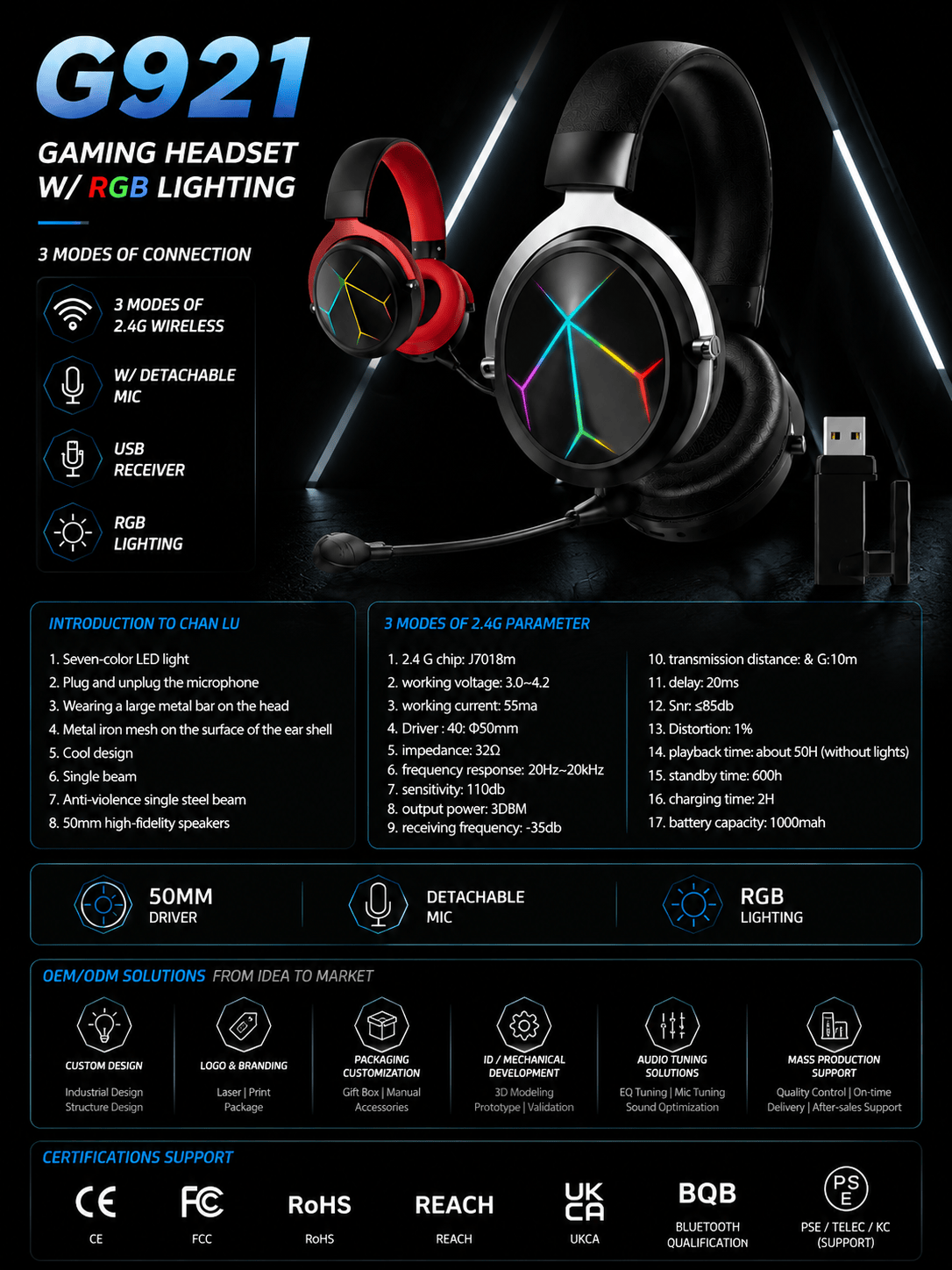
G921 provides a useful OEM reference because its confirmed platform combines J7018M-based 2.4GHz wireless, Bluetooth, 3.5mm connection, Virtual 7.1, a 50mm driver, detachable ENC microphone, seven-color RGB, and a 1000mAh battery. This guide uses those facts to explain how procurement teams can evaluate a Virtual 7.1 feature without turning the article into a product advertisement.
The Challenge Gaming Brands Face When Selecting a Gaming Headset Platform
Gaming brands must match product features to real devices and user scenarios, then confirm that every retail claim is supported by the approved hardware, firmware, accessories, and instructions.
A sourcing shortlist often begins with visible specifications: connection modes, latency, driver size, microphone type, RGB, battery capacity, and surround-sound support. These fields are useful, but they do not reveal whether the complete product experience works on the brand's target devices. Virtual 7.1 is a good example because its availability may depend on the receiver, operating system, processing location, driver or application, firmware, and selected mode.
The buyer should first define the commercial use case. Competitive PC gaming may prioritize positional cues, stable receiver performance, clear communication, and repeatable controls. Console or handheld use may require a different connector or may not support the same processing path. Bluetooth can be valuable for mobile and general listening, while a 3.5mm cable can provide analog fallback. These scenarios should not be merged into one universal compatibility statement.
A brand also needs to decide what Virtual 7.1 means in its product brief. The acceptance target might cover activation method, channel test behavior, directional perception, tonal changes, output level, noise, latency, and return to stereo. Without agreed criteria, one team may approve a dramatic effect while another expects subtle spatial positioning.
Finally, procurement must connect the feature to packaging and support. The box, product page, quick-start guide, and customer-service notes should state compatible modes and activation steps. A technically functional feature can still create returns when the user cannot identify how or where it works.
| Buyer question | Useful evidence | Risky shortcut |
|---|---|---|
| Where is Virtual 7.1 available? | Mode-and-device feature matrix with activation steps | Placing a 7.1 icon beside all connection modes |
| Does it improve the intended game experience? | Controlled positional tests, listening references, and user scenarios | Assuming stronger processing always means better positioning |
| Can the claim be repeated in production? | Locked firmware, receiver, BOM, golden sample, and QC checks | Approving one engineering sample without version control |
Understanding Different Gaming Headset Connectivity Options
Wired, Bluetooth, and receiver-based 2.4GHz routes solve different sourcing needs, and their Virtual 7.1 support must be verified separately.
A wired analog headset receives the signal produced by the host. A 3.5mm connection can offer practical compatibility where the jack and cable wiring match, but the headset may not provide its own spatial processing through that route. Host-side software could still create a processed stereo signal, but that is a host capability and should not automatically be presented as a headset feature.
Bluetooth is convenient for supported phones, tablets, laptops, and general wireless listening. Profiles, codecs, call states, host systems, and implementations can change latency, bandwidth, microphone behavior, and audio processing. Buyers should not assume that a Virtual 7.1 function or low-latency reference from the 2.4GHz path also applies to Bluetooth.
Receiver-based 2.4GHz gives the supplier and brand a defined headset-and-dongle system to evaluate. It is commonly used for gaming where latency, microphone transport, stable reconnection, and host recognition matter. G921 identifies J7018M, a USB receiver, a 10-meter transmission distance, and 20ms specified latency for its 2.4GHz route. The final claim still needs an agreed method and production-representative validation.
Tri-mode combines these routes in one platform, but it does not make them technically identical. Buyers should document audio, microphone, controls, RGB, power, Virtual 7.1, and accessory requirements for each approved mode.
| Route | Primary sourcing value | Virtual 7.1 question |
|---|---|---|
| 2.4GHz with receiver | Controlled wireless gaming path | Is processing available in this path, and how is it enabled and verified? |
| Bluetooth | Built-in wireless access for supported mobile and computer devices | Is the feature supported, host-provided, unavailable, or changed by the active profile? |
| 3.5mm | Analog compatibility and fallback | Does the headset provide processing, or would any spatial effect come from the host? |
Why Tri-Mode Gaming Headsets Are Becoming a Flexible OEM Solution
A tri-mode platform can support several user scenarios with one physical design, but its OEM value depends on accurate mode definitions, accessories, instructions, and validation.
Gaming brands often sell to customers who move between a PC, mobile device, controller, or laptop. Combining 2.4GHz, Bluetooth, and 3.5mm can broaden the intended use of one headset and help a private-label brand build a more versatile SKU. It can also consolidate visual identity, packaging development, and accessory planning around one product platform.
This flexibility introduces more approval work. The receiver connector and adapter strategy must match target devices. Pairing, switching, prompts, volume, microphone, mute, lighting, and battery states need clear behavior. If Virtual 7.1 is available only through a particular path, the product instructions and channel claims must make that boundary visible.
A ready OEM/ODM platform can reduce development effort because its basic structure and electronics already exist. Logo, CMF, packaging, manuals, receiver presentation, and accessory bundle can be evaluated around the approved base. Changes to firmware, acoustic parts, microphone, battery, antenna-related structure, or feature logic can expand the engineering and compliance review.
The best platform is therefore not the one with the longest feature list. It is the one whose confirmed functions fit the target market and can be explained, tested, manufactured, and supported consistently.
| OEM objective | Tri-mode opportunity | Control required |
|---|---|---|
| Serve multiple use cases | Receiver gaming, Bluetooth listening, and analog fallback | Tested host list and mode-specific claims |
| Create a differentiated SKU | RGB, detachable microphone, spatial-audio direction, branding, and bundle | Feature dependency review and clear instructions |
| Use a ready platform | Shorter path to sampling than full architecture development | Engineering review for every change affecting function or compliance |
G921 Platform Overview
G921 is a tri-mode RGB gaming headset platform that gives buyers a concrete configuration for studying Virtual 7.1 validation without treating the model as the article's search target.
The confirmed connection set includes J7018M-based 2.4GHz wireless with a USB receiver, Bluetooth, and 3.5mm. The source lists 20ms latency and 10-meter transmission distance for the 2.4GHz path. Those values should remain tied to that specified route and the final test method.
The acoustic configuration lists a 50mm driver, 32-ohm impedance, 110dB sensitivity, and a 20Hz-20kHz response. Virtual 7.1 is selected for the platform, but the 50mm driver should not be described as the source of surround processing. Driver performance, acoustic tuning, processing, fit, and production tolerance contribute different parts of the experience.
The product direction also includes a detachable microphone with ENC support, seven-color RGB, a metal ear-shell mesh, a single steel headband, and a 1000mAh battery. Runtime references are approximately 50 hours without lighting, 600 hours standby, and two-hour charging. Final brand claims require defined conditions and sample verification.
OEM/ODM evaluation can cover logo and branding, color and CMF, packaging and manuals, ID or mechanical development, audio and microphone tuning, receiver configuration, and accessories. The validation scope should follow the final change list.
| G921 item | Confirmed direction | Buyer validation |
|---|---|---|
| Wireless platform | J7018M 2.4GHz, Bluetooth, 3.5mm, USB receiver | Host list, mode behavior, RF, reconnect, microphone, and controls |
| Spatial-audio direction | Virtual 7.1 selected | Processing path, activation, supported modes, output, positioning, and claims |
| Audio and voice | 50mm driver and detachable ENC microphone | Tuning, channel matching, voice clarity, connector durability, and mode behavior |
| Power and appearance | 1000mAh battery and seven-color RGB | Runtime conditions, charging, aging, lighting behavior, and cosmetic standard |
Technical Deep Dive: Why Virtual 7.1 Is a Signal-Path Feature, Not a Driver Specification
Virtual 7.1 is created by audio processing that maps multichannel or positional information into a two-channel headphone output; driver diameter alone neither creates nor proves the effect.
A gaming headset normally has one driver per ear. Virtual surround processing uses filtering, level, timing, and frequency cues to create a spatial impression through those two channels. The processing may be supplied by a USB audio solution, firmware, host software, an operating system, or another part of the signal chain. Buyers should identify the actual path for the approved product instead of assuming where it occurs.
Activation is part of the specification. The team should document whether the feature uses a button, prompt, driver application, host setting, or fixed state. It should also define the default after power cycling, mode switching, receiver reconnection, or firmware update. If the feature is unavailable through Bluetooth or 3.5mm, that limitation belongs in the matrix, instructions, and retail claim review.
Evaluation should begin with channel identification and repeatable positional material. Confirm that front, side, and rear cues move in the intended direction and that left-right orientation is correct. Then compare Virtual 7.1 with stereo at matched perceived level. Stronger bass, extra treble, or a volume jump can sound impressive but should not be mistaken for better spatial accuracy.
Buyers should also listen for tonal coloration, hollow voices, unstable center images, reduced dialogue clarity, pumping, noise, or excessive reverberant character. Competitive-game positioning, cinematic immersion, music, and voice chat may prefer different balances. The approval brief should state the primary use rather than ask one processing profile to win every scenario.
Latency and microphone checks belong in the same plan. Verify whether enabling the feature changes delay, receiver stability, maximum level, control response, microphone transport, sidetone if applicable, or power consumption. Test on every host and mode claimed by the brand, using production-representative receiver and firmware versions.
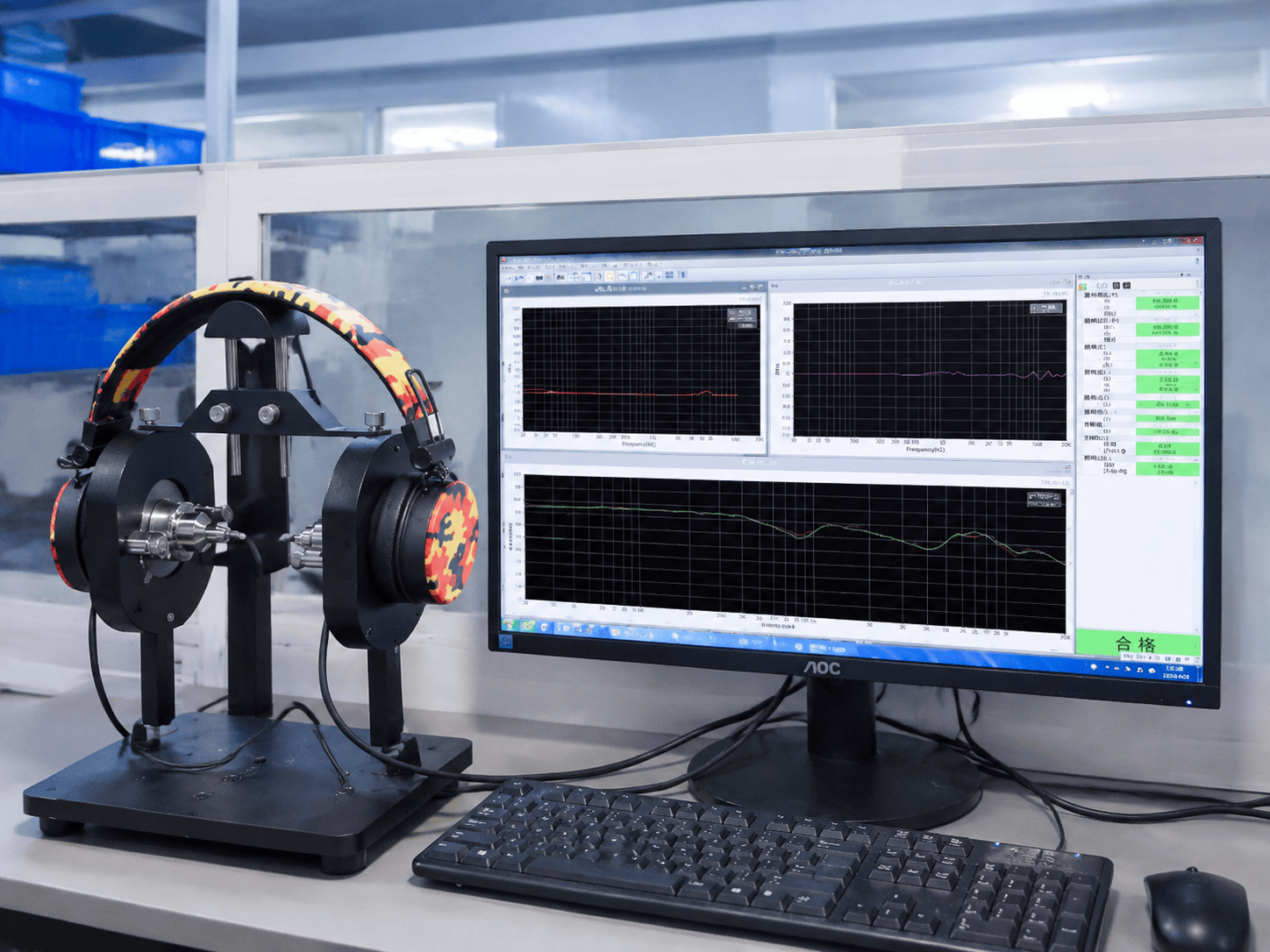
For mass production, freeze the processing version, relevant parameters, receiver, audio components, and approved sample. Quality control can verify activation, channel behavior, output, noise, microphone function, and mode switching. Periodic acoustic audits help detect component or assembly drift that a simple power-on test cannot reveal.
| Validation layer | What to check | Acceptance evidence |
|---|---|---|
| Feature path | Processing location, supported modes, hosts, activation, and default state | Approved feature-support matrix and instructions |
| Spatial behavior | Channel order, front-side-rear cues, center stability, and stereo comparison | Repeatable test material and listening record |
| Audio quality | Tonal change, level, noise, dialogue, fatigue, and use-case fit | Golden sample plus measurable limits where practical |
| System impact | Latency, controls, microphone, RF, power, switching, and recovery | Device matrix and regression test report |
| Production | Firmware, receiver, BOM, activation, channel output, and sample spread | Version lock, change control, QC plan, and periodic audit |
OEM/ODM Considerations Before Developing a Wireless Gaming Headset
OEM buyers should freeze the target market, feature-support matrix, customization scope, test plan, compliance route, and change-control process before mass-production approval.
Platform selection starts with required devices and scenarios. Identify which hosts must support 2.4GHz, Bluetooth, or analog use, and whether Virtual 7.1 is essential, optional, or host-provided. Confirm the receiver and adapter bundle before packaging work begins.
Customization should be divided into identity changes and engineering changes. Logo, packaging artwork, manuals, and labels require approval and durability checks. Color, RGB presentation, firmware, audio tuning, microphone tuning, driver, cushion, battery, receiver, or mechanical changes can affect performance, reliability, claims, and compliance.
Testing should cover acoustic response, channel matching, Virtual 7.1 behavior, microphone clarity and ENC direction, RF stability, latency method, switching, controls, battery, charging, RGB, durability, and packaging. Use multiple samples and freeze a golden sample, firmware version, bill of materials, and acceptance limits.
Certification support depends on the target market and final configuration. Radio, EMC, materials, battery, labeling, and documentation requirements should be reviewed for the approved product. Do not treat certificates from a different model or configuration as automatic evidence.
Production control should include incoming components, assembly, firmware programming, receiver pairing, functional tests, microphone and acoustic checks, cosmetics, accessories, packaging, traceability, and final inspection. Post-approval changes require documented impact and revalidation.

Buyer Checklist: Questions to Ask Before Choosing a Gaming Headset Manufacturer
A qualified supplier should be able to connect every feature claim to a confirmed configuration, test method, sample, production control, and target-market requirement.
Use the following questions during RFQ review and sampling. Written answers reduce ambiguity between procurement, engineering, marketing, quality, and the factory.
- Which connection modes, host devices, and adapters are included in the approved compatibility matrix?
- Where is Virtual 7.1 processed, how is it activated, and in which modes is it available?
- How are latency, RF range, reconnect behavior, and interference performance tested?
- What acoustic, positional-audio, channel-matching, noise, and microphone criteria define approval?
- Which features remain available in Bluetooth and 3.5mm modes?
- What conditions support battery-runtime, charging-time, and RGB power claims?
- Which logo, CMF, packaging, firmware, acoustic, microphone, receiver, and accessory changes are feasible?
- Which changes require new reliability, compatibility, RF, acoustic, battery, or compliance tests?
- How are firmware, receiver version, BOM, golden sample, and production limits controlled?
- Which target-market certificates, labels, reports, and documentation apply to the final configuration?
- What are the sample, pilot-production, corrective-action, final-inspection, and traceability processes?
Conclusion
Virtual 7.1 should be approved as a documented system behavior, not as an isolated icon or a consequence of driver size.
The practical sourcing workflow is to define the use case, identify the processing path, build a mode-and-device support matrix, compare the effect with stereo, test system impacts, align packaging claims, and freeze production controls. This gives engineering, marketing, quality, and customer support the same definition of the feature.
G921 illustrates how this method applies to a real tri-mode OEM platform with J7018M 2.4GHz, Bluetooth, 3.5mm, Virtual 7.1, a 50mm driver, detachable ENC microphone, RGB, and a 1000mAh battery. Final suitability still depends on the buyer's target devices, approved configuration, customization, validation, and market requirements.
Share your target devices, Virtual 7.1 requirements, connection priorities, customization scope, and market. MACH can review the G921 platform against a project-specific validation plan.
Contact MACH IndustryFrequently Asked Questions
What is Virtual 7.1 in a gaming headset?
Virtual 7.1 uses audio processing to map multichannel or positional information into a two-channel headphone output. The processing path, supported host, activation method, and tuning depend on the approved product implementation.
Does a 50mm driver create Virtual 7.1 surround sound?
No. Driver diameter is an acoustic design input. Virtual 7.1 comes from signal processing elsewhere in the audio path, while the driver and enclosure reproduce the processed two-channel output.
Does Virtual 7.1 work in 2.4GHz, Bluetooth, and 3.5mm modes?
Not necessarily. Availability depends on where processing occurs and how each signal path is implemented. Buyers must verify every mode and host separately and state supported routes in the instructions.
How should buyers test Virtual 7.1 gaming headsets?
Confirm processing and activation, channel order, positional cues, center stability, tonal changes, level, noise, latency, microphone behavior, mode switching, host compatibility, firmware, and repeatability across multiple samples.
Is Virtual 7.1 always better than stereo for gaming?
No. The result depends on processing, game content, user preference, and the target scenario. Compare stereo and Virtual 7.1 at matched perceived levels using repeatable positional and listening material.
What Virtual 7.1 information should appear in an OEM gaming headset RFQ?
Specify target hosts, supported connection modes, processing location, activation, default state, user controls, positional-audio target, acceptable tonal change, latency method, instructions, and production acceptance tests.
What G921 specifications are relevant to Virtual 7.1 validation?
G921 combines Virtual 7.1 with J7018M-based 2.4GHz, Bluetooth, 3.5mm, a 50mm driver, detachable ENC microphone, seven-color RGB, and a 1000mAh battery. Mode-specific behavior requires final validation.
Can an OEM supplier customize Virtual 7.1 tuning?
Audio or feature tuning can be evaluated when supported by the selected platform and project scope. Any change should be tested for sound, latency, controls, compatibility, power, firmware stability, and production repeatability.
What certifications are needed for a wireless gaming headset?
Requirements depend on the target market and final radio, battery, materials, accessories, labeling, and configuration. Buyers should confirm the applicable radio, EMC, safety, materials, battery, and documentation requirements.
How can a factory control Virtual 7.1 consistency in production?
Lock the firmware, processing parameters, receiver, BOM, and golden sample; verify activation and channel behavior; run microphone and mode tests; maintain traceability and change control; and perform periodic acoustic audits.
Related Resources
Need OEM/ODM gaming audio solutions?
Contact MACH Industry to discuss your gaming headset, gaming earbuds, or private-label audio project.
Contact MACH Industry