Home > Resources > Gaming Headset Guide
How Buyers Should Evaluate a 50mm Driver Wireless Gaming Headset Platform
A technical sourcing guide to evaluating 50mm drivers, acoustic tuning, wireless modes, microphone integration, and OEM controls in tri-mode gaming headsets.
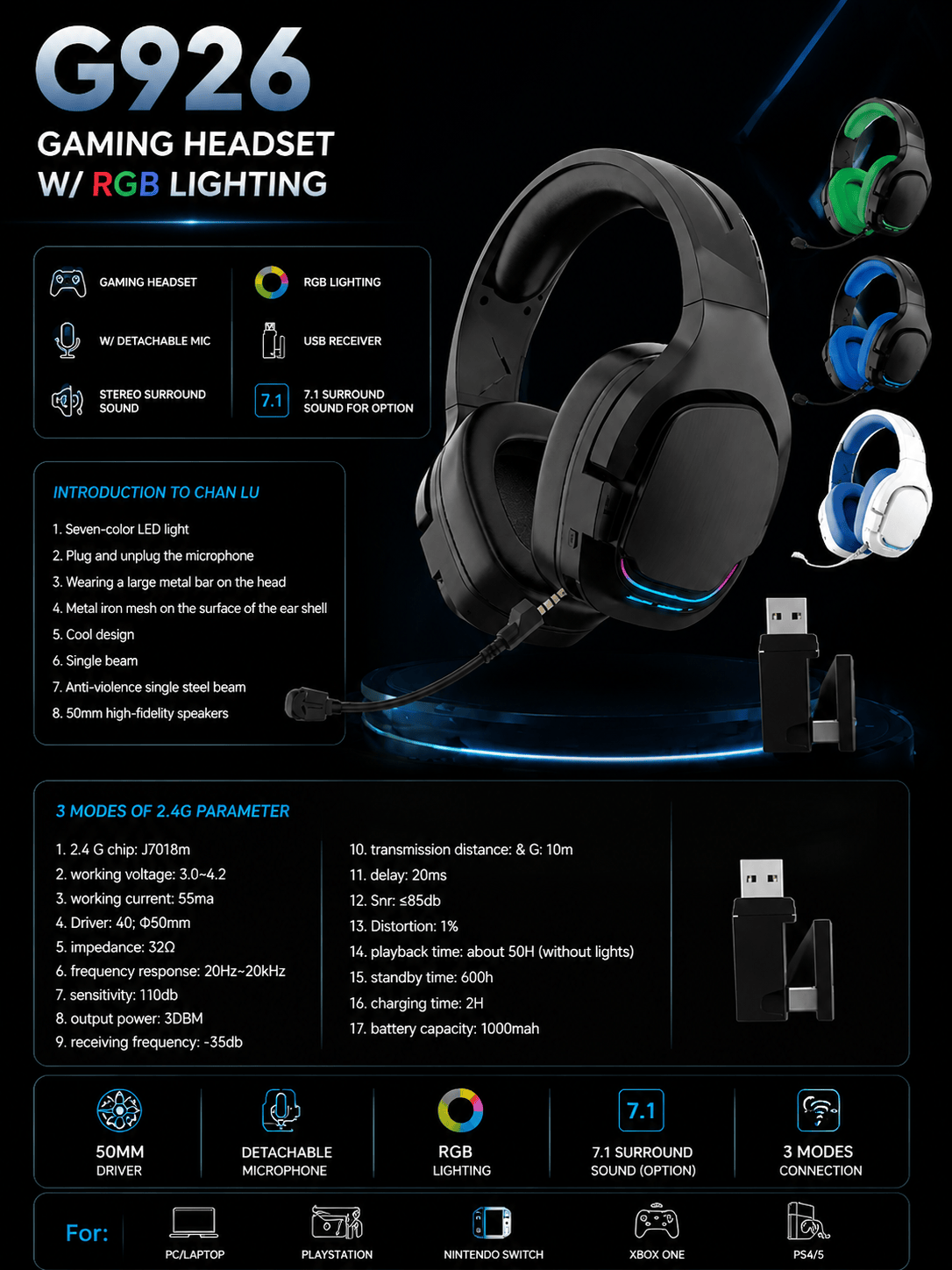
Buyers should evaluate a 50mm driver wireless gaming headset by measuring the complete acoustic system, not by assuming that a larger driver automatically delivers better sound. Driver size matters, but enclosure volume, diaphragm and magnet design, damping, cushion seal, amplifier output, DSP or analog tuning, microphone integration, production tolerance, and the selected wireless mode all influence the final result.
The G926 Black platform provides a useful sourcing example. Its confirmed configuration combines a 50mm driver with J7018M-based 2.4GHz wireless, Bluetooth, and 3.5mm connection, plus a detachable microphone with ENC support, RGB lighting, and a 1000mAh battery. This guide explains how gaming brands can translate those specifications into acoustic targets, sample tests, OEM requirements, and repeatable mass-production controls.
Understanding the Market Need
Gaming brands use 50mm drivers to support a full-size product position, but procurement value comes from controlled sound, comfort, consistency, and mode-specific performance rather than diameter alone.
Retail buyers often compare gaming headsets through visible specifications: driver diameter, wireless modes, battery capacity, microphone type, RGB, and stated latency. These fields help organize a shortlist, but they do not show whether footsteps remain clear during dense effects, voices sound natural, bass masks midrange detail, the left and right channels match, or the same tuning is maintained across 2.4GHz, Bluetooth, and 3.5mm.
A 50mm driver can support a convincing gaming-audio design when the transducer, enclosure, cushions, electronics, and tuning are developed together. It can also produce weak results when a supplier treats diameter as the main selling point while leaving resonance, seal variation, distortion, or production spread uncontrolled.
The buyer should therefore begin with use cases. Competitive gaming may prioritize positional cues, controlled bass, speech clarity, and long-session comfort. Cinematic or lifestyle positioning may place more emphasis on low-frequency impact and a fuller presentation. A retail range may need one balanced profile that avoids fatigue across games, music, chat, and general use.
Turn these priorities into measurable acceptance criteria before comparing samples. A defined target reduces subjective disagreement and prevents artwork approval before the acoustic configuration is stable.
| Buyer objective | Useful evaluation | Weak shortcut |
|---|---|---|
| Competitive gaming | Positional clarity, channel balance, transient behavior, voice separation, and comfort | Selecting the largest driver number |
| Immersive gaming | Controlled extension, impact, distortion, enclosure behavior, and repeatable tuning | Assuming more bass always means better sound |
| Multi-use headset | Games, music, chat, mode transitions, and wired versus wireless consistency | Testing one playlist in one mode |
| Private-label production | Golden sample, measurable tolerances, incoming controls, and batch verification | Approving one engineering sample without production limits |
G926 Product Platform Overview
G926 Black is a private-label tri-mode platform built around a confirmed 50mm driver, 2.4GHz wireless, Bluetooth, 3.5mm connection, detachable ENC microphone, RGB, and a 1000mAh battery.
The confirmed acoustic specification lists a 50mm driver, 32-ohm impedance, 110dB sensitivity, and a stated frequency response of 20Hz to 20kHz. The source also lists a 1% distortion rate and a signal-to-noise value of no more than 85dB. These supplier values should be reviewed against the measurement method, test fixture, frequency, output level, and final approved configuration before they become customer-facing claims.
The wireless platform uses a J7018M 2.4GHz solution with a USB receiver, plus Bluetooth and a 3.5mm jack. The specification identifies a 10-meter transmission distance and 20ms latency for the 2.4GHz route. The latency value belongs to that specified route and should not be presented as a Bluetooth or universal platform value.
A detachable microphone with ENC support provides the voice-input format. ENC describes microphone processing, not active noise cancellation for the listener. The product also includes RGB, a steel-reinforced head beam, metal ear-cup mesh, a 1000mAh battery, and optional Virtual 7.1.
| Platform item | Confirmed G926 Black direction | Buyer verification |
|---|---|---|
| Driver | 50mm, 32 ohms, 110dB sensitivity, stated 20Hz-20kHz response | Confirm method, complete tuning, channel match, distortion, and production tolerance |
| Connectivity | J7018M 2.4GHz, Bluetooth, and 3.5mm | Compare acoustic output and supported functions by mode and target device |
| 2.4GHz reference | 10m distance and 20ms specified latency | Validate the final receiver, firmware, environment, and method |
| Microphone | Detachable microphone with ENC support | Check voice target, connector durability, positioning, and mode-specific behavior |
| Power and appearance | 1000mAh battery and RGB lighting | Confirm power conditions, RGB behavior, comfort, cosmetics, and final claims |
Why a 50mm Driver Does Not Automatically Mean Better Gaming Audio
A 50mm diameter describes one physical dimension; better gaming audio depends on how the driver interacts with the enclosure, ear cushions, electronics, tuning target, user fit, and production process.
Driver diameter can influence the available radiating area and the mechanical options available to the acoustic engineer, but it does not define frequency balance, resolution, imaging, distortion, or perceived impact by itself. Two 50mm drivers can use different diaphragm materials, voice coils, magnets, suspensions, venting, tolerances, and acoustic loading, producing very different results.
The ear cup is part of the acoustic system. Internal volume, vents, damping material, grille resistance, driver position, and leakage paths shape resonances and low-frequency behavior. A driver that performs well in one enclosure may not maintain the same response after a housing, mesh, or internal structure change.
Ear cushions and fit are equally important. Cushion foam, covering material, opening size, depth, compression, clamp force, and glasses leakage affect the seal around the ear. Seal variation can change bass and tonal balance enough to make laboratory and user results disagree. Buyers should test representative head sizes and wearing conditions rather than relying only on a coupler graph.
Electronics and mode paths can also change the sound. The 2.4GHz and Bluetooth routes may use digital processing, gain settings, codec behavior, or volume mapping that differs from the analog 3.5mm route. The brand should decide whether closely matched sound across modes is required or whether mode-specific differences are acceptable and documented.
A stated frequency range such as 20Hz to 20kHz does not show how evenly the product reproduces that range. It also does not describe target response, resonances, channel matching, distortion at useful levels, transient behavior, or spatial perception. Buyers need curves and listening tests that connect measurement with the intended gaming position.
Sensitivity and impedance need the measurement voltage or power and complete signal chain. Higher sensitivity is not automatically better when noise, distortion, gain steps, or maximum-level control are poor.
Production consistency is the final test of the design. Driver matching, adhesive quantity, damping placement, cushion variation, enclosure sealing, screw torque, and component substitutions can move the acoustic result. A golden sample without numerical tolerances is difficult to enforce across lots.
Keep 50mm in the specification, but approve the product through an acoustic target, mode comparison, mechanical sample, listening reference, and production-control plan. Evidence must support the sound-quality claim.
| Evaluation area | What 50mm tells the buyer | What still requires evidence |
|---|---|---|
| Physical platform | Nominal driver diameter | Diaphragm, coil, magnet, suspension, venting, and tolerances |
| Frequency performance | Nothing conclusive by itself | Measured response, target curve, resonances, seal variation, and listening review |
| Gaming clarity | Nothing conclusive by itself | Positional cues, masking, transient behavior, channel balance, and game references |
| Bass impact | Potential design area, not a guaranteed result | Extension, level, distortion, enclosure damping, cushions, and user fit |
| Mode consistency | Same physical transducer | 2.4GHz, Bluetooth, and 3.5mm gain, processing, and output comparison |
| Mass production | Nominal component size | Golden sample, driver matching, assembly controls, limits, and periodic audits |
Technical Considerations for Gaming Headset Buyers
A reliable sourcing review combines objective acoustic measurements, controlled listening, mode-specific checks, microphone validation, mechanical comfort, and production-representative samples.
Start with an acoustic brief. Define target users, game genres, music and chat expectations, tonal priorities, acceptable maximum level, comfort goals, and whether the product should sound closely matched across all three modes. Provide reference products or approved listening notes where possible.
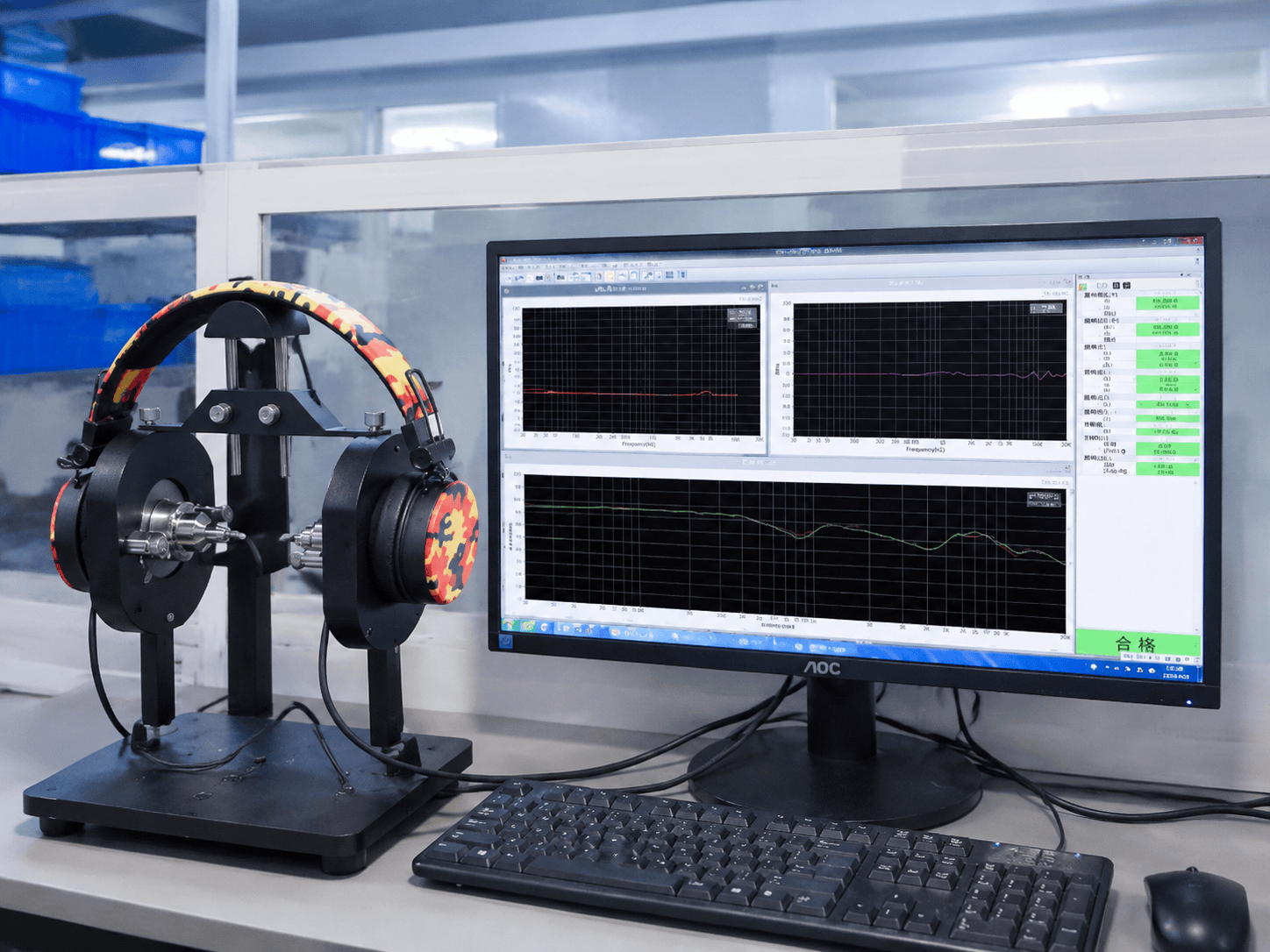
Measurement plans can include frequency response, left-right matching, sensitivity, distortion, noise, maximum usable level, and repeatability across multiple samples. Record the fixture, positioning method, seal procedure, input signal, output level, firmware, mode, and environmental conditions so later results are comparable.
Listening panels should use fixed source material and task-based questions. Instead of asking whether a sample sounds good, ask whether dialogue remains clear, footsteps are separated from low-frequency effects, sharp effects become tiring, bass loses definition, or imaging shifts between channels. Blind or level-matched comparisons can reduce bias.
Compare 2.4GHz, Bluetooth, and 3.5mm separately. Check gain, frequency balance, noise, controls, processing, microphone path, and switching behavior. Bluetooth version alone does not prove gaming latency or acoustic equivalence, while a wired path may bypass digital tuning used in wireless operation.
For the detachable microphone, verify insertion cycles, retention, signal continuity, positioning, voice level, ENC behavior, mute logic, and handling noise. Voice quality should be reviewed with the headset audio operating because sidetone, monitoring, wireless bandwidth, or firmware can influence the multiplayer experience.
Mechanical review should include headband range, clamp force, mass distribution, cushion compression, heat, glasses interaction, driver clearance, and repeated wear. Comfort changes how the headset seals and where the driver sits relative to the ear, so mechanical and acoustic approval should not be separated.
Use production-representative pilot samples to finalize limits. Mass-production checks can combine quick channel and frequency points, polarity, noise, microphone function, wireless mode tests, visual inspection, firmware verification, and periodic full acoustic audits according to risk.
OEM/ODM Development Opportunities
A ready G926 platform lets brands focus OEM development on the acoustic target, identity, accessories, packaging, and controlled feature choices while retaining an established tri-mode hardware base.
The confirmed platform can support project evaluation for logo application, color combinations, packaging, manuals, labels, receiver presentation, and accessories. Each change needs feasibility, MOQ, cost, schedule, sample, compliance, and validation review.
Acoustic customization should begin with a target rather than a request for more bass or louder sound. Depending on platform feasibility, development may involve driver selection, damping, vents, cushions, gain, or firmware tuning. Any approved change should be evaluated across modes and repeated on more than one sample.
A housing color or logo change may have little acoustic impact, but cushion materials, ear-cup mesh, internal parts, microphone, firmware, cable, receiver, and driver substitutions can affect performance. The change-control list should distinguish cosmetic changes from changes requiring acoustic or compatibility regression.
Packaging claims need the same discipline. The product can accurately state a confirmed 50mm driver, but broader claims about immersive sound, positional accuracy, studio quality, or universal compatibility require evidence and careful wording. Optional Virtual 7.1 should only be included after the selected configuration is approved.
A useful RFQ identifies target markets, channels, user scenarios, reference sound, required modes, microphone expectations, RGB direction, branding, packaging, accessories, compliance ownership, forecast quantity, and launch timing. This gives the OEM supplier enough information to propose a controlled development and test plan.
| OEM area | Possible project direction | Required control |
|---|---|---|
| Acoustics | Target response, damping, cushions, gain, or feasible tuning | Reference samples, measurements, listening approval, and mode regression |
| Brand identity | Logo, black RGB direction, colors, labels, packaging | Physical approval, durability, artwork, and cosmetic limits |
| Accessories | Receiver, charging cable, analog cable, adapters, microphone packing | Exact BOM, device testing, fit, labeling, and pack-out checks |
| Optional processing | Virtual 7.1 where separately configured | Software, audio, compatibility, claims, and support-document review |
| Production | Golden sample and acoustic control plan | Tolerances, pilot evidence, change control, and periodic verification |
Buyer Checklist
Before approving a 50mm driver gaming headset, buyers should freeze the sound target, mode behavior, microphone criteria, mechanical configuration, sample evidence, claims, and production limits.
Begin with the intended user and product position. Write a short acoustic brief that purchasing, product, engineering, marketing, and the supplier can all understand. Separate mandatory acceptance criteria from subjective preferences and optional enhancements.
Next, align the specification, BOM, firmware, driver lot, cushions, damping, enclosure, microphone, receiver, cables, RGB, packaging, and golden sample. A later change to any acoustically relevant item should trigger an impact review.
Before release, review pilot results across 2.4GHz, Bluetooth, and 3.5mm, plus microphone, comfort, wireless stability, RGB, charging, cosmetics, accessories, labels, and packing. Make sure customer-facing claims match the approved evidence.
- Define target users, game scenarios, sound priorities, comfort goals, and reference products
- Confirm the 50mm driver, impedance, sensitivity, response, and measurement methods
- Approve frequency response, channel matching, distortion, noise, and usable level limits
- Compare 2.4GHz, Bluetooth, and 3.5mm gain, tuning, noise, and supported functions
- Validate the J7018M receiver route, range, microphone, controls, and specified latency
- Test detachable ENC microphone quality, connector durability, positioning, and mute behavior
- Freeze cushions, damping, vents, enclosure, mesh, firmware, driver, and assembly details
- Approve logo, colors, RGB, receiver, cables, packaging, manuals, and optional features
- Link every sound or compatibility claim to a test, approved sample, or controlled specification
- Complete pilot production, golden-sample approval, tolerances, traceability, and change control

Conclusion
A 50mm driver is a useful platform specification, but the sourcing decision should be based on complete acoustic performance, mode consistency, comfort, microphone integration, and production repeatability.
G926 Black combines a confirmed 50mm acoustic platform with 2.4GHz, Bluetooth, 3.5mm, a detachable ENC microphone, RGB, and a 1000mAh battery. Those features create a practical OEM base, while the final commercial value depends on how well the complete configuration is tuned and controlled.
Brands that define acoustic targets before artwork approval can compare samples more fairly, make more defensible claims, and give the OEM partner measurable criteria for pilot and mass production.
Request OEM Consultation
Share your target users, sound references, required modes, microphone needs, branding, packaging, quantity, and launch market for a G926 OEM project evaluation.
Contact MACHFrequently Asked Questions
Is a 50mm driver always better for a gaming headset?
No. Diameter is one design input. Enclosure, diaphragm, magnet, damping, cushions, electronics, tuning, fit, and production tolerance determine the complete acoustic result.
What should buyers test on a 50mm driver gaming headset?
Test frequency response, channel matching, distortion, noise, sensitivity, usable level, seal variation, listening references, comfort, and consistency across multiple samples.
What 50mm driver specifications are confirmed for G926 Black?
The source lists a 50mm driver, 32-ohm impedance, 110dB sensitivity, and a stated 20Hz-20kHz response. Buyers should confirm the measurement methods.
Should a tri-mode gaming headset sound the same in every mode?
That is a product decision. Buyers should compare 2.4GHz, Bluetooth, and 3.5mm gain, tuning, noise, processing, and maximum level, then define acceptable differences.
Does a 20Hz-20kHz frequency range prove good gaming audio?
No. A range does not show tonal balance, resonances, channel matching, distortion, imaging, transient behavior, seal variation, or performance at useful listening levels.
How should OEM buyers approve gaming headset sound quality?
Use an acoustic brief, controlled measurements, level-matched listening, reference products, multiple samples, a golden sample, numerical tolerances, and pilot-production verification.
Can cushion or housing changes affect a 50mm driver headset?
Yes. Cushion seal, foam, covering, depth, enclosure volume, vents, mesh, damping, and assembly details can change frequency response and perceived bass.
What microphone is confirmed for G926 Black?
G926 Black uses a detachable microphone with ENC support. Buyers should validate voice quality, connector durability, positioning, mute logic, and mode-specific behavior.
Can G926 Black be customized for a private-label brand?
Logo, colors, packaging, manuals, receiver presentation, and accessories can be evaluated. Acoustic, firmware, RGB, and optional feature changes require separate validation.
What production controls help maintain gaming headset acoustic consistency?
Use approved drivers and materials, controlled assembly, channel and frequency checks, microphone and mode tests, golden samples, tolerances, traceability, and periodic acoustic audits.
Related Resources
Need OEM/ODM gaming audio solutions?
Contact MACH Industry to discuss your gaming headset, gaming earbuds, or private-label audio project.
Contact MACH Industry