Home > Resources > Gaming Headset Guide
How to Choose a Wireless Gaming Headset Platform for Your Brand
A technical OEM guide to evaluating 2.4GHz, Bluetooth, acoustics, RF design, customization, testing, and production readiness for a wireless gaming headset platform.
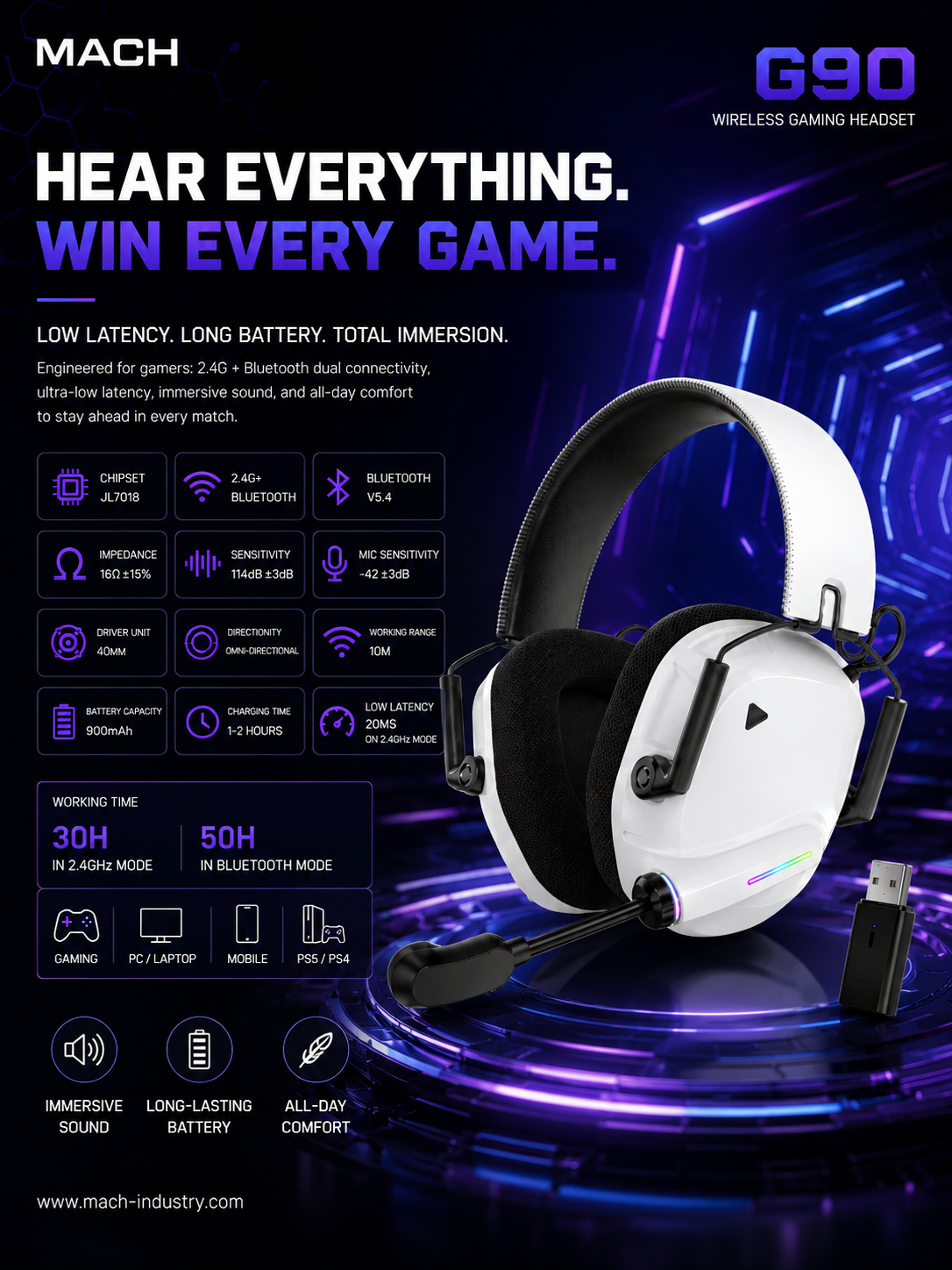
Choosing a wireless gaming headset platform requires more than comparing appearance and feature count. A gaming brand should evaluate the connection architecture, acoustic system, radio-frequency stability, firmware support, mechanical design, production readiness, and fit with its target market. These factors determine whether a platform can become a dependable retail product rather than an attractive but difficult specification sheet.
For most brand teams, the first strategic decision is whether to adapt a mature ODM platform or fund deeper custom development. The right answer depends on the intended users, sales channels, compatibility requirements, differentiation plan, budget, compliance scope, and launch schedule. This guide explains the questions buyers should resolve and uses the MACH G90 wireless gaming headset platform as a practical reference, not as a substitute for project-specific engineering review.
What Should Brands Consider Before Developing a Wireless Gaming Headset?
Start with the market, use case, connection priorities, price position, compliance markets, and acceptable level of customization. Feature selection should follow that product brief.
A useful product brief identifies who will use the headset and where. A PC-focused esports product may prioritize a dedicated USB transmitter and stable low-latency operation. A lifestyle gaming product may place more value on Bluetooth for phones and tablets. A cross-platform retail SKU may require both modes, but every additional mode introduces interface, firmware, accessory, testing, and customer-support decisions.
Price positioning should be expressed as a complete product target rather than a request for the lowest unit price. Buyers should account for the headset, transmitter, charging cable, microphone, packaging, manuals, certification preparation, inspection, and logistics. Premium CMF, a more complex structure, RGB lighting, firmware changes, and market-specific accessories can change both cost and development work.
Customization depth is another early decision. Logo, color, packaging, and voice-prompt changes can often be implemented on a qualified ODM platform. New industrial design, tooling, PCB architecture, wireless behavior, or acoustic targets require a broader OEM development program. A clear boundary between essential differentiation and optional features helps the supplier recommend a realistic route.
2.4GHz vs Bluetooth: Choosing the Right Wireless Connection
2.4GHz is generally selected for dedicated PC or console gaming, while Bluetooth is useful for mobile convenience and broad consumer-device compatibility. Dual-mode platforms can support both use cases when the product brief justifies the added complexity.
Bluetooth and proprietary 2.4GHz links may operate within the same broad spectrum, but they serve different product goals. Bluetooth follows widely supported consumer protocols and is convenient when users want to pair directly with phones, tablets, laptops, or other compatible devices. Its behavior also depends on the codecs, operating system, profile, and device implementation in the complete signal path.
A 2.4GHz gaming link normally uses a dedicated USB transmitter and a wireless protocol designed around the headset platform. This gives the engineering team more direct control over audio transport, pairing behavior, microphone return, and gaming-mode priorities. Compatibility must still be verified for each intended PC, console, USB interface, and adapter configuration; the words '2.4GHz' alone do not guarantee a particular performance result.
Buyers should therefore choose connection modes from actual usage scenarios. Adding Bluetooth can broaden everyday use, while a dedicated transmitter supports gaming-oriented operation. A dual-mode design also needs clear mode switching, indicators, voice prompts, reconnection logic, accessory labeling, and user instructions so that technical flexibility does not become customer confusion.
| Feature | 2.4GHz wireless | Bluetooth |
|---|---|---|
| Latency priority | Designed for dedicated gaming applications and controlled transmitter-to-headset communication | Varies by protocol, codec, host device, and operating system |
| Compatibility | Requires a compatible USB transmitter and verified host platforms | Broad support across compatible phones, tablets, computers, and consumer devices |
| Typical gaming use | PC and console scenarios where responsive game audio and microphone return are priorities | Casual gaming and devices where direct Bluetooth pairing is preferred |
| Mobile use | Possible with compatible transmitter and interface, but less universal | Convenient direct pairing for general mobile audio |
| Development focus | RF link, dongle behavior, USB compatibility, firmware synchronization, and antenna performance | Profiles, codecs, pairing behavior, multipoint requirements, and host-device variation |
G90 Wireless Gaming Headset Platform Overview
G90 is a dual-wireless OEM/ODM platform combining 2.4GHz and Bluetooth connectivity with a 50mm driver, detachable boom microphone, optional RGB lighting, and brand-level customization.
The G90 platform is intended for brands that want one headset architecture to cover dedicated gaming and general wireless use. Its 2.4GHz connection supports gaming-oriented applications, while Bluetooth adds direct compatibility for common consumer devices. The detachable boom microphone allows the product to shift between gaming communication and more casual listening without a permanent microphone arm.
A 50mm speaker driver provides a foundation for acoustic development, but the final sound depends on the complete system. MACH can support acoustic tuning alongside industrial design, mechanical development, PCB coordination, firmware customization, packaging, quality control, and mass-production planning. RGB is an option rather than a universal requirement; buyers should select it according to channel positioning, power strategy, and visual identity.
Brand customization can include logo placement, colors, CMF, retail packaging, and firmware voice prompts. The platform should still be reviewed against the buyer's intended countries, devices, accessories, labeling, certification scope, and commercial targets. A platform overview is the beginning of supplier evaluation, not final approval for production.
Need a customized wireless gaming headset platform?
Share your target market, connection modes, device list, feature priorities, and customization scope for a platform review.
Discuss the G90 platformTechnical Deep Dive: Why 2.4GHz Wireless Technology Matters for Gaming Headsets
Competitive gaming places greater emphasis on responsive audio, stable packet delivery, synchronized microphone communication, and predictable host-device behavior, making the complete 2.4GHz system more important than the radio label alone.
In gaming, audio carries time-sensitive information such as footsteps, directional cues, weapon actions, and team communication. A dedicated 2.4GHz link can be engineered around this workload through a matched transmitter, receiver, and firmware stack. Bluetooth remains valuable for mobile convenience and general audio, but a gaming brand should not assume that every Bluetooth configuration has the same latency or two-way audio behavior.
RF design begins at PCB level but does not end there. Antenna placement must account for the battery, driver magnets, metal reinforcement, cables, decorative parts, the user's head, and the enclosure geometry. A workable schematic can still perform poorly if the antenna is shielded or detuned after the mechanical design changes. Engineering review should therefore connect industrial design, mechanical layout, PCB placement, and over-the-air testing.
Interference control matters because real desks may contain Wi-Fi routers, wireless mice, keyboards, phones, USB hubs, and other 2.4GHz products. The headset system needs robust channel behavior, sensible reconnection logic, and testing in representative environments. Buyers should ask how the supplier verifies connection stability and how firmware revisions are controlled between samples and mass production.
Firmware coordinates pairing, mode switching, audio prompts, mute status, indicators, microphone transport, charging behavior, sleep states, and power management. Poorly defined state logic can create support problems even when the basic hardware works. Voice prompts should be reviewed for language, volume, timing, and consistency with the user manual and packaging claims.
Power management links user experience to RF and lighting choices. The team must define operating modes, idle behavior, charging protection, low-power prompts, and RGB behavior before battery expectations can be evaluated. MACH does not publish an unverified battery duration for G90 because runtime depends on the final battery, volume, wireless mode, lighting, microphone use, and firmware configuration.
A mature ODM platform can reduce engineering, compatibility, and production risk because its core architecture has already progressed beyond a blank-sheet concept. It does not remove the need for buyer-specific validation. Changes to structure, antenna surroundings, firmware, battery, transmitter, or accessories can create new risks, so customized samples and a controlled test plan remain essential.
Why 50mm Drivers Are Popular in Gaming Headset Development
A 50mm driver offers useful acoustic design potential and strong market recognition, but driver diameter alone does not determine sound quality or product tier.
Gaming brands often specify 50mm drivers because the format fits many over-ear structures and is familiar to retail buyers. A larger diaphragm may support the desired bass extension and output within a suitable design, yet two headsets using nominally identical driver sizes can sound very different. Diaphragm material, motor design, sensitivity, impedance, consistency, and tuning all influence the result.
The acoustic chamber controls how the driver interacts with enclosed air volume, vents, damping materials, grille openings, and leakage paths. Ear-pad geometry and compression affect seal, comfort, perceived bass, and variation between users. Mechanical tolerances can also change left-right consistency. For these reasons, acoustic review should evaluate the assembled headset rather than approving a driver from a component specification alone.
Brands should define a sound target in user terms and verify it with listening evaluation and appropriate measurements. Speech intelligibility, positional cues, fatigue, music playback, maximum usable volume, and microphone monitoring may matter differently across market segments. The G90's 50mm architecture is a starting point for tuning, not a claim that 50mm is automatically better than 40mm.
How OEM Brands Customize a Wireless Gaming Headset Platform
Effective customization aligns visible branding, user interaction, accessories, firmware, and packaging with one coherent product specification.
Logo customization begins with location, process, size, contrast, and durability. Color and CMF planning should define materials, textures, gloss levels, metal finishes, ear-pad surfaces, stitching, and lighting appearance using approved samples rather than screen colors alone. RGB should be considered together with control logic, power consumption, retail photography, and whether the target customer values lighting.
Firmware customization may include voice-prompt language, prompt wording, volume, mode names, indicator behavior, default settings, and control mapping. These details must match the quick-start guide and product claims. Changes that appear small to a marketing team can affect firmware testing and version control, so they should be frozen before pilot production.
The detachable microphone, USB transmitter, charging cable, adapters, protective parts, and documentation form an accessory system. Packaging should secure each item, communicate compatibility accurately, and fit the selected retail and logistics channels. Private-label packaging also requires barcode, model, importer, recycling, compliance, language, and carton information appropriate to the buyer's markets.
OEM Development Process for Wireless Gaming Headsets
A controlled project moves from requirements and platform selection through engineering review, prototypes, validation, compliance preparation, pilot production, and mass production.
Requirement review should document target users, countries, sales channels, target devices, connection modes, features, branding, packaging, commercial constraints, and launch timing. MACH then reviews whether an existing platform such as G90 fits the brief and identifies which requests are standard configuration, firmware adjustment, CMF work, structural modification, or new engineering.
During engineering review, industrial design, mechanics, electronics, RF, acoustics, microphone behavior, power strategy, and accessories are considered together. Prototype rounds should have a defined purpose and an issue list. Approval should cover both visible samples and controlled specifications so that the mass-production reference is unambiguous.
Testing plans can include functional operation, pairing and reconnection, representative device compatibility, RF stability, acoustic and microphone evaluation, charging, controls, indicators, mechanical reliability, packaging, and labeling. Certification preparation depends on product configuration and destination markets and should be discussed before final production. Pilot production verifies the manufacturing flow and inspection criteria before volume output.
- Requirement review
- Platform selection
- Engineering and risk review
- Prototype and issue tracking
- Functional and compatibility testing
- Certification preparation
- Pilot and mass-production control

Wireless Gaming Headset OEM Buyer Checklist
A complete RFQ gives the manufacturer enough information to recommend a platform, identify risks, and separate required features from optional ideas.
Buyers do not need a finished engineering specification before contacting a supplier, but they should provide a structured commercial and technical brief. Reference products are useful when the desired attributes are identified clearly; asking to 'make it like this' without explaining priorities can create conflicting assumptions.
For compatibility, list the actual PC, console, mobile, USB, and adapter scenarios that matter. For battery requirements, state the expected use conditions, including lighting and wireless mode, rather than requesting a headline number without a test method. For certification, specify every intended sales country and channel so the required scope can be reviewed with the final configuration.
- Target market and sales channel
- 2.4GHz, Bluetooth, or dual-mode connection
- PC, console, and mobile compatibility list
- Driver and acoustic positioning
- Microphone type and communication use case
- RGB requirements and control behavior
- Battery expectation with defined conditions
- Firmware, controls, and voice prompts
- Logo, CMF, accessories, and packaging
- Destination-market certification scope
How to Evaluate a Wireless Gaming Headset Manufacturer
Evaluate whether the supplier can explain tradeoffs, control revisions, validate the complete system, and support repeatable production, not merely provide a long feature list.
Ask the wireless gaming headset manufacturer to map your requirements to a specific platform and identify open risks. Useful answers explain what is already validated, what changes require testing, which devices need confirmation, and how samples will be approved. A reliable gaming headset supplier should be willing to distinguish confirmed capability from options that still need engineering work.
Review capabilities across industrial design, mechanical development, PCB and firmware coordination, RF, acoustic tuning, packaging, quality control, and mass production. Also examine document discipline: specification versions, sample records, change approval, inspection criteria, and packaging files affect production consistency as much as individual components do.
The decision between OEM and ODM is not binary. Many brands start with a mature ODM gaming headset platform, then add focused private-label customization where it creates customer value. Deeper OEM development is appropriate when the brand has a defensible product concept, sufficient validation resources, and requirements that cannot be met through controlled platform changes.
Discuss your gaming audio project with MACH.
Send your intended markets, device compatibility list, connection priorities, customization scope, and launch plan for an OEM/ODM platform discussion.
Contact MACHFrequently Asked Questions
What is the difference between Bluetooth and a 2.4GHz gaming headset?
Bluetooth is convenient for direct connection to compatible consumer devices, while a 2.4GHz gaming headset normally uses a dedicated USB transmitter and a platform-specific link designed around gaming audio and microphone use. Actual performance depends on the complete hardware, firmware, host device, and test conditions.
Why do gaming brands choose 2.4GHz wireless?
Brands often choose 2.4GHz for PC and console gaming scenarios that prioritize a dedicated connection, responsive audio transport, microphone return, and controlled transmitter-to-headset behavior. Compatibility still needs verification for the intended devices.
Can MACH customize the G90 wireless gaming headset?
Yes. G90 can support project-dependent customization such as logo, color and CMF, retail packaging, firmware voice prompts, and selected configuration options. Each request is reviewed for feasibility, testing, cost, and production impact.
What can be customized on an ODM gaming headset platform?
Common options include logo process, colors, surface finish, ear-pad materials, packaging, manuals, labels, accessories, firmware prompts, indicators, controls, and selected hardware configurations. The available scope depends on the platform and order requirements.
Is a 50mm driver better for gaming than a 40mm driver?
Not automatically. Driver diameter is one design variable. The driver construction, acoustic chamber, damping, ear-pad seal, tuning, impedance, sensitivity, and manufacturing consistency all influence the final listening experience.
How long does wireless gaming headset development take?
Timing depends on whether the project uses an existing ODM configuration or requires new mechanics, tooling, electronics, firmware, acoustics, packaging, testing, and certification preparation. A schedule should be estimated only after requirements and change scope are reviewed.
What certifications are needed for a wireless gaming headset?
Requirements depend on the final wireless and battery configuration, destination countries, sales channels, labeling, and packaging. Buyers should provide their complete market list so the applicable compliance scope can be reviewed before production.
Can private-label brands customize G90 packaging?
Yes. Packaging can be developed around brand graphics, product presentation, accessories, manuals, labels, barcodes, retail requirements, and logistics protection, subject to final project review.
What information should buyers prepare for a wireless gaming headset RFQ?
Prepare the target market, sales channel, estimated quantity, connection modes, device compatibility list, acoustic and microphone priorities, RGB preference, battery expectations, firmware needs, branding, packaging, certification markets, and launch plan.
Should a gaming brand choose OEM or ODM development?
ODM is often suitable when a mature platform can meet the product brief with controlled customization. Deeper OEM development makes sense when the brand needs distinctive mechanics, electronics, firmware, acoustics, or user interaction and has resources for broader validation.
Related Resources
Need OEM/ODM gaming audio solutions?
Contact MACH Industry to discuss your gaming headset, gaming earbuds, or private-label audio project.
Contact MACH Industry