Home > Resources > Gaming Headset Guide
How Should Brands Define 2.4GHz, Bluetooth, and Wired Modes in a Gaming Headset?
A buyer guide to defining the roles, switching behavior, device coverage, and acceptance tests for 2.4GHz, Bluetooth, and 3.5mm gaming headset modes.
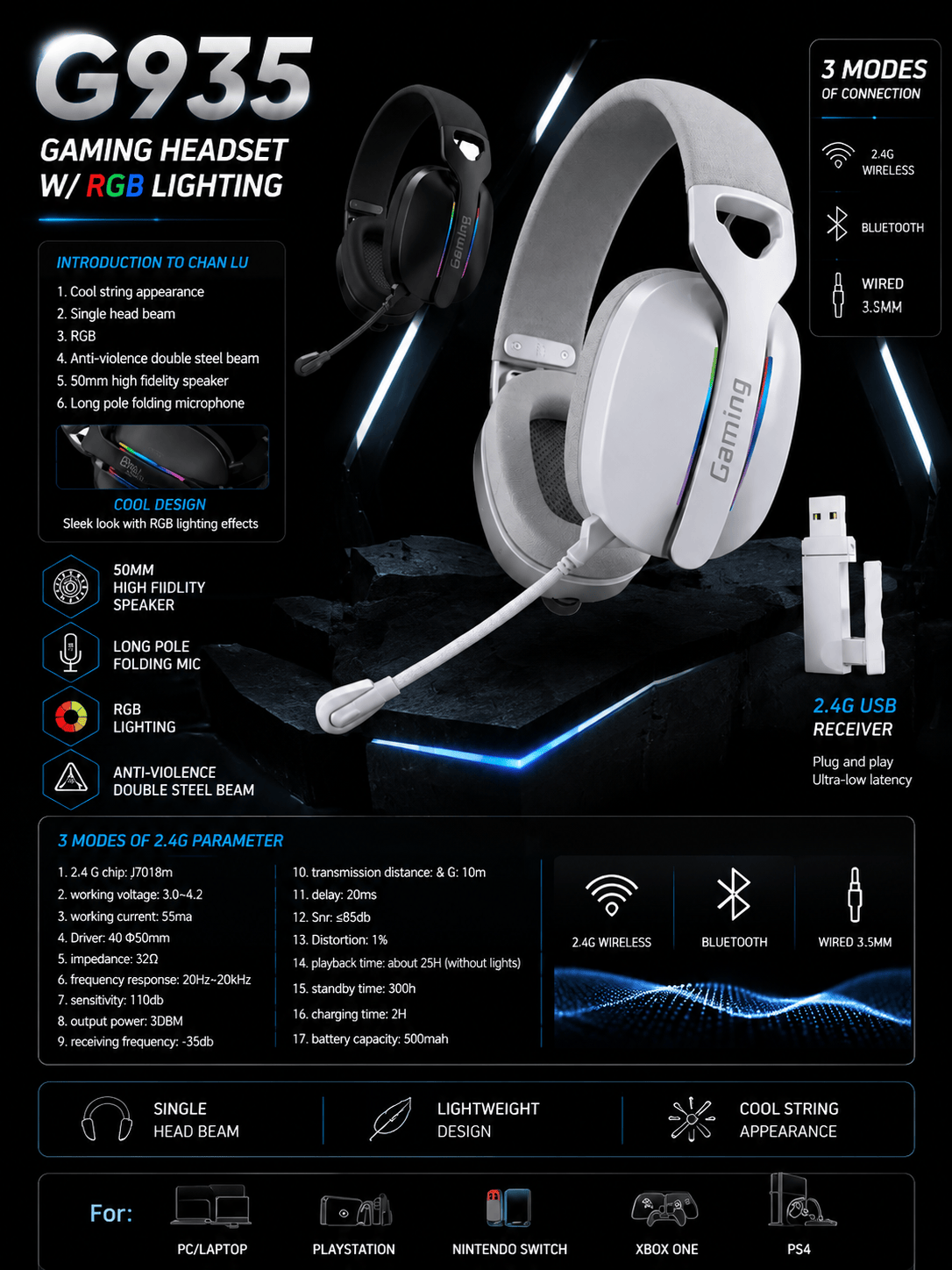
Brands should define each connection mode by its intended devices, audio path, microphone behavior, controls, power state, and acceptance tests before approving a tri-mode wireless gaming headset. The three labels alone do not guarantee a coherent product. A useful platform gives 2.4GHz wireless, Bluetooth, and 3.5mm wired connection distinct jobs while keeping the overall user experience understandable.
This matters because the same headset can behave differently by mode. A USB receiver may carry low-latency game audio and microphone data, Bluetooth may serve mobile or general wireless use, and a 3.5mm cable may provide a passive or powered fallback. Volume control, RGB, ENC processing, microphone availability, battery use, and device support can change between those paths. Buyers who document these differences early can write clearer packaging claims, build a more complete validation plan, and reduce late sample revisions.
G935 White provides a practical reference with J7018M-based 2.4GHz and a USB receiver, Bluetooth, 3.5mm, a 40mm driver, folding ENC microphone, RGB, and a 500mAh battery. This guide does not assume undocumented functions; it shows how a buyer can turn confirmed specifications into a mode responsibility matrix.
Understanding Modern Gaming Headset Connectivity
A tri-mode gaming headset normally combines a receiver-based 2.4GHz path, a Bluetooth path, and a 3.5mm analog path, but buyers must verify the exact device, audio, microphone, control, and power behavior of each route.
The 2.4GHz route is commonly selected for PC or console gaming where a dedicated USB receiver can support a controlled radio link. Its value is not simply that it is wireless. The buyer can validate the headset and receiver as one system, including latency, range, reconnect behavior, microphone transport, channel balance, and interference performance. The G935 specification identifies a USB receiver, a 10-meter transmission distance, and 20ms specified latency for its J7018M-based 2.4GHz route. That number should remain attached to the specified route and test method; it should not be extended to Bluetooth or every target device.
Bluetooth is useful for phones, tablets, laptops, and general listening where built-in wireless support matters more than a dedicated receiver. However, Bluetooth profiles, codecs, operating systems, and call states can affect latency, audio quality, microphone behavior, and control mapping. Buyers should not describe all Bluetooth use as low latency. They should identify what the final platform and target devices actually support, then validate those combinations.
A 3.5mm connection can provide broad analog compatibility and a backup when wireless power is unavailable. Yet wired does not mean every electronic feature works. RGB, ENC, controls, microphone routing, and amplification may depend on power and cable wiring. Buyers must confirm whether each target uses a four-pole headset jack, separate audio and microphone connectors, or an adapter.
| Connection route | Typical buyer role | Required validation |
|---|---|---|
| 2.4GHz with USB receiver | Low-latency gaming path for approved USB host devices | Latency method, receiver compatibility, range, reconnect, microphone, interference, and controls |
| Bluetooth | Mobile, laptop, communication, and general wireless listening | Profiles, codec behavior, call mode, microphone, controls, pairing memory, and target operating systems |
| 3.5mm wired | Analog compatibility and wireless fallback | TRRS wiring, microphone path, powered versus passive functions, cable controls, adapters, and output level |
Why Tri-Mode Gaming Headsets Are Becoming Popular for Gaming Brands
Tri-mode platforms can help brands cover gaming, mobile, and analog use cases with one physical design, but the commercial benefit depends on a disciplined compatibility and claim strategy.
Gaming-audio buyers serve mixed devices. A customer may use a receiver on a PC, Bluetooth with a phone, and 3.5mm with a controller. One tri-mode headset can support broader use cases while concentrating packaging, visual identity, accessories, and inventory around one platform.
That consolidation can be useful for private-label brands and distributors, but it should not be confused with universal compatibility. USB audio behavior differs among PCs, consoles, handheld devices, and mobile adapters. Bluetooth implementation differs by host and profile. Analog jack wiring also varies. A buyer should publish only tested compatibility and avoid broad symbols or claims that the approved samples do not support.
Tri-mode positioning also changes customer support. Instructions must explain pairing, receiver use, wired mode, microphone states, charging, switching, and connection recovery. The accessory tray should make the receiver and cables easy to identify. A ready platform can also accelerate private-label work around color, logo, packaging, manuals, and accessories, although feature or structural changes still require engineering review.
| Brand objective | Potential tri-mode value | Procurement risk to control |
|---|---|---|
| Broader device coverage | One headset can address receiver, Bluetooth, and analog scenarios | Overstating support for untested consoles, phones, adapters, or controllers |
| Simpler product range | Shared design, branding, packaging system, and accessory plan | Complex instructions and higher support load if mode behavior is unclear |
| Private-label differentiation | CMF, logo, packaging, receiver, and bundle choices around a ready platform | Assuming cosmetic approval also confirms firmware, RF, acoustic, and reliability performance |
Technical Deep Dive: How Multi-Mode Wireless Gaming Headsets Are Designed
Multi-mode headset development requires separate signal paths to behave as one product. The most useful buyer document is a mode responsibility matrix that defines what each path must do and what may legitimately differ.
The wireless architecture normally includes a headset-side controller, radio and audio circuitry, battery and charging management, microphone input, user controls, indicators, and a dedicated receiver for the 2.4GHz route. Bluetooth uses a host pairing process, while the analog route enters through the 3.5mm interface. The final hardware and firmware determine how these paths share the driver, microphone, controls, prompts, lighting, and power states.
Connection switching should be specified as a sequence. Define selection, confirmation prompts, reconnection, receiver removal, interruption priority, power cycling, and failure recovery. Automatic behavior can be convenient, but undocumented priorities create support problems.
Treat the dongle as part of the product. Verify its connector, adapter, labeling, packaging location, host recognition, reconnect time, microphone path, and RF behavior. Support latency claims with an agreed method and final firmware. G935 specifies 20ms for 2.4GHz, but approval still requires system testing.
Wired backup mode requires equal care. Procurement teams should confirm whether the headset works with an empty battery, whether the boom or folding microphone is available through the analog cable, which controls remain active, and whether RGB or ENC is disabled. These are not defects when they match the agreed design; they become defects when the package and instructions promise something different.
Audio may vary by mode because processing, gain, host volume, wireless profile, and power state differ. Use level-matched listening and measurements for every approved route, with limits for frequency balance, noise, channel matching, useful level, microphone clarity, and mute behavior.
Freeze the mode responsibility matrix with the approved sample and reference it in packaging, instructions, quality plans, and customer-service scripts. This is more reliable than noting only that all three modes work.
| Matrix field | 2.4GHz route | Bluetooth route | 3.5mm route |
|---|---|---|---|
| Target hosts | List approved USB host devices and adapters | List approved operating systems and Bluetooth use cases | List approved TRRS devices, controllers, and splitters |
| Microphone | Confirm transport, mute, ENC state, and sidetone if applicable | Confirm call profile, mute, and communication quality | Confirm cable wiring, host support, and powered-state dependence |
| Controls and indicators | Map buttons, volume, prompts, reconnect, and receiver status | Map pairing, media or call controls, volume, and prompts | Document cable controls and inactive electronic functions |
| Power and RGB | Measure current and runtime in agreed lighting conditions | Measure current and runtime in agreed profile and lighting conditions | Confirm passive or powered behavior and whether RGB is available |
| Audio acceptance | Measure latency, RF stability, output, tuning, noise, and channel match | Verify profile-dependent audio, output, tuning, and microphone state | Verify analog level, impedance interaction, microphone, and cable noise |
What Gaming Brands Should Consider Before Developing a Wireless Headset
Before sampling, buyers should freeze the target device list, mode functions, acoustic and microphone targets, power claims, industrial design, customization scope, packaging, and market compliance plan.
Start with target platforms rather than a generic claim such as console and PC compatible. List the exact device families, ports, operating systems, controllers, and adapters that matter commercially. Rank them as required, optional, or unsupported. The supplier can then build a compatibility matrix and sample plan around the actual launch market.
Define connection modes with user scenarios. For each scenario, state how the user enters the mode, which audio and microphone functions are expected, what controls work, and which accessory is needed. Include switching and failure recovery. This makes firmware review, manual writing, packaging claims, and customer support consistent.
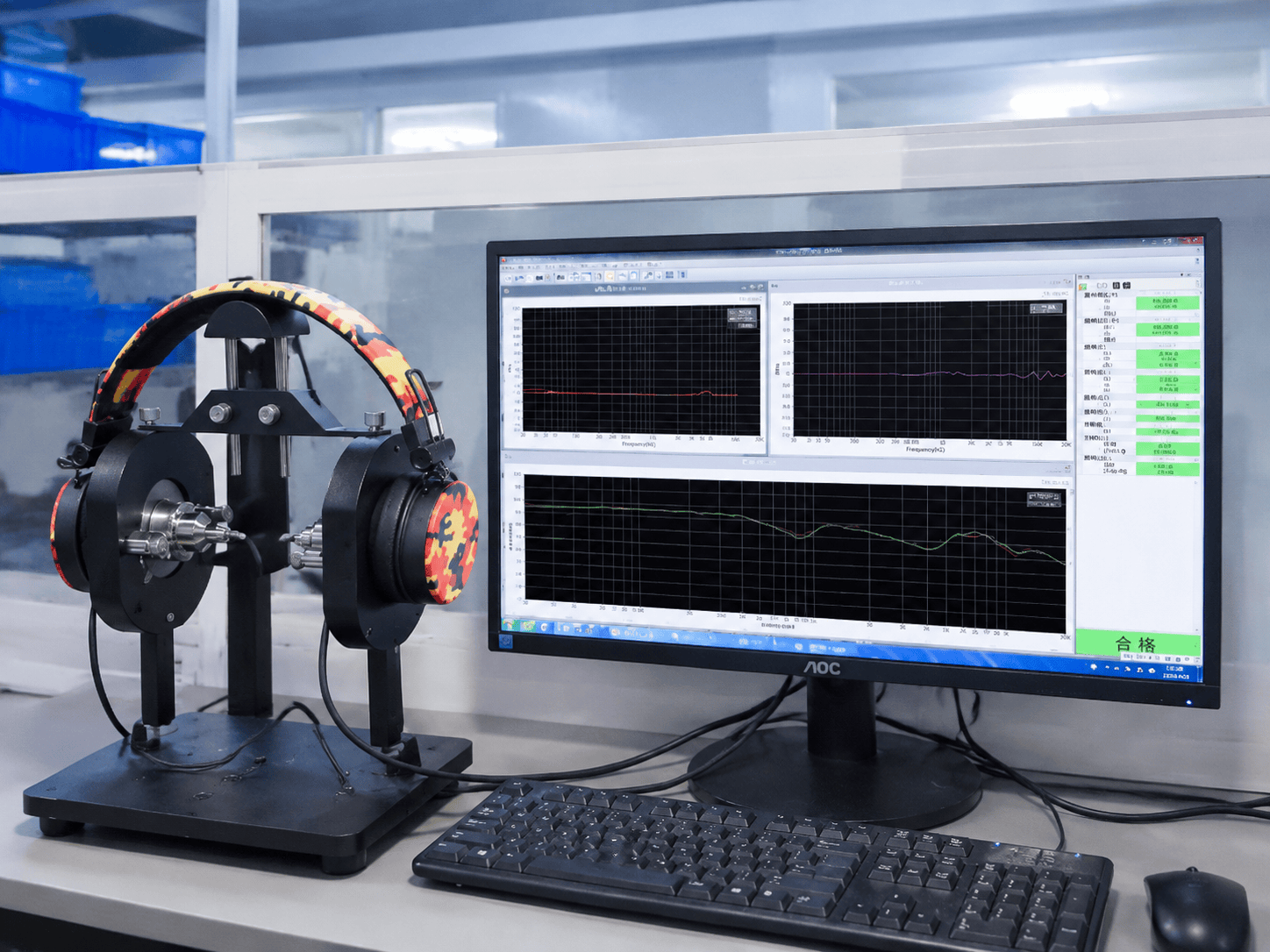
Audio approval should combine objective measurement with controlled listening. Define the tonal direction, channel balance, useful level, noise limits, distortion conditions, and mode-to-mode tolerance. The G935 White source confirms a 40mm driver, 32-ohm impedance, 110dB sensitivity, and a stated 20Hz-20kHz response. Those values are inputs for evaluation, not proof of the final listening result.
Microphone requirements need a voice target, not just an ENC label. Test voice intelligibility, tonal balance, plosive handling, background-noise behavior, folding position, mute logic, mechanical noise, and performance by mode. ENC describes microphone-side processing; it should not be presented as listener-side active noise cancellation.
Battery claims must name the conditions. G935 White lists a 500mAh battery, approximately 25 hours of playback without lighting, 300 hours of standby, and two-hour charging. The brand should validate final firmware, volume, radio mode, RGB state, temperature, sample spread, and end-of-test threshold before placing a runtime claim on retail packaging.
Industrial-design approval should cover white housing standards, RGB appearance, logo method, surface consistency, folding-microphone fit, headband structure, receiver labeling, cables, and packaging protection. Certification planning must follow the final market, wireless, battery, material, labeling, and accessory configuration.
- Name every required host device, port, controller, operating system, and adapter.
- Create a mode responsibility matrix covering audio, microphone, controls, prompts, RGB, and power.
- Define the switching sequence, connection priority, reconnect behavior, and recovery procedure.
- Approve acoustic and microphone targets in 2.4GHz, Bluetooth, and 3.5mm modes.
- Write the battery test conditions before approving runtime claims.
- Confirm white CMF tolerances, RGB appearance, logo method, receiver branding, and accessory bundle.
- Review packaging claims and user instructions against tested mode behavior.
- Plan market-specific radio, safety, material, battery, labeling, and documentation requirements.
- Freeze a golden sample, firmware version, bill of materials, and production acceptance limits.
OEM/ODM Considerations for Tri-Mode Gaming Headset Development
OEM/ODM work should separate low-risk identity changes from changes that affect RF, firmware, acoustics, structure, power, or compliance, because each group requires a different validation scope.
Logo, packaging graphics, manuals, labels, and receiver presentation can often be evaluated around an existing headset platform. Color development requires controlled master samples and production tolerances, especially for a white product where housing batches, painted parts, cushions, cables, and accessory plastics can reveal visible mismatch. RGB appearance should be reviewed in normal use conditions as well as controlled inspection.
Structural customization may affect tooling, assembly, durability, RF layout, cushion seal, acoustic volume, microphone movement, or packaging protection. Feature customization can affect firmware states, button mapping, prompts, battery current, connection priority, and certification. Buyers should request an engineering impact review before treating these changes as simple options.
MACH can support configuration review, branding, white CMF consistency, packaging and manuals, receiver and accessory planning, acoustic and connection testing, battery checks, reliability review, and production quality coordination. Confirm the exact scope in the project brief. Changes to firmware, receiver, driver, microphone, cushion, battery, cable, or housing after approval should trigger documented review.
| Customization request | Main review | Possible revalidation |
|---|---|---|
| Logo, labels, packaging, manual | Artwork, placement, durability, claims, language, and barcode control | Packaging tests and final inspection |
| White CMF and RGB direction | Master color, material, texture, light appearance, and batch tolerance | Cosmetic inspection, aging, and assembly consistency |
| Firmware, controls, prompts, or mode priority | State logic, user flow, power, compatibility, and documentation | Full function, battery, regression, and device-matrix testing |
| Structure, driver, cushion, microphone, or antenna-related change | Mechanical, acoustic, RF, durability, and tooling impact | Engineering, reliability, acoustic, RF, and compliance review |

G935 Product Platform Overview
G935 White is a tri-mode RGB OEM platform that can serve as a concrete reference for mode planning, provided buyers validate each route and keep claims within the confirmed configuration.
The confirmed connection set combines J7018M-based 2.4GHz wireless, Bluetooth, and a 3.5mm jack. A USB receiver is included for the 2.4GHz route. The source specifies a 10-meter transmission distance and 20ms latency for that route. Device-specific compatibility and control behavior are not assumed where no user manual or validated device matrix is available.
The acoustic configuration lists a 40mm driver, 32-ohm impedance, 110dB sensitivity, a 20Hz-20kHz response, and a folding ENC microphone. Validate sound and voice by mode because component values do not establish tuning or consistency.
The design includes a white housing, RGB, double steel beam reinforcement, and a 500mAh battery. References are approximately 25 hours without lighting, 300 hours standby, and two-hour charging; commercial claims need defined verification.
Private-label evaluation can cover branding, white CMF, packaging, manuals, receiver presentation, and accessories. Begin with a target-device list and mode matrix rather than treating tri-mode as universal compatibility.
| G935 White item | Confirmed direction | Buyer action |
|---|---|---|
| Connectivity | 2.4GHz, Bluetooth, and 3.5mm | Define and test each route separately |
| 2.4GHz platform | J7018M, USB receiver, 20ms specified latency, 10m distance | Confirm test method, target hosts, RF environment, and final firmware |
| Audio and voice | 40mm driver and folding microphone with ENC support | Approve acoustic and microphone targets in every supported mode |
| Power and appearance | 500mAh battery, white housing, and RGB | Validate claim conditions, CMF tolerance, lighting, charging, and aging |
| OEM scope | Branding, white CMF, packaging, manuals, receiver, and accessories | Separate identity changes from engineering changes and assign revalidation |
Conclusion
A successful tri-mode headset is defined by clear responsibilities for 2.4GHz, Bluetooth, and 3.5mm, not by placing three connection icons on a box.
The buyer's most valuable preparation is a mode responsibility matrix connected to a real device list. It should state how each route connects, what audio and microphone functions it carries, how controls and prompts behave, which features require power, and what acceptance tests apply. This creates one source of truth for engineering, quality, packaging, instructions, and customer support.
G935 White shows how a ready platform can support this process with confirmed tri-mode connection, receiver-based 2.4GHz, Bluetooth, analog fallback, RGB, a 40mm driver, folding ENC microphone, and private-label evaluation. The platform should still be validated against the final brand brief, firmware, device coverage, accessories, appearance standard, and market requirements.
Share your target devices, connection priorities, branding scope, packaging requirements, and expected validation plan. MACH can review the G935 White platform and help define a project-specific mode responsibility matrix.
Contact MACH IndustryFrequently Asked Questions
What is a tri-mode wireless gaming headset?
A tri-mode wireless gaming headset combines three connection routes, commonly receiver-based 2.4GHz wireless, Bluetooth, and 3.5mm analog. Exact audio, microphone, control, power, and compatibility behavior must be confirmed for each product.
Why do gaming brands choose 2.4GHz wireless headsets?
A dedicated 2.4GHz receiver can provide a controlled link for gaming audio and microphone transport. Buyers should validate latency, RF stability, host compatibility, reconnect behavior, and final firmware rather than relying on the connection label alone.
Is Bluetooth suitable for gaming headsets?
Bluetooth is useful for mobile devices, laptops, communication, and general listening. Gaming suitability depends on the implemented profiles, codec behavior, host device, latency, and microphone state, so not every Bluetooth connection should be described as low latency.
Does 3.5mm mode work when a wireless gaming headset battery is empty?
It depends on the electrical design. Buyers must verify whether the analog path is passive, whether the microphone works, and which controls, ENC, amplification, or RGB functions remain available without battery power.
What is a gaming headset mode responsibility matrix?
It is a buyer approval document that defines target devices, connection steps, audio, microphone, controls, prompts, RGB, power behavior, accessories, and acceptance tests for each connection mode.
How should buyers test switching between 2.4GHz, Bluetooth, and wired modes?
Test the user selection sequence, connection priority, indicators and prompts, reconnect time, stored pairing, receiver removal, power cycling, call interruptions where applicable, and recovery from failed connections.
What 2.4GHz specifications are confirmed for G935 White?
The source identifies a J7018M-based 2.4GHz route with a USB receiver, 20ms specified latency, and a 10-meter transmission distance. The final product and test method should be validated before commercial claims are approved.
Can the G935 White headset be customized for a private-label brand?
Logo and branding, white CMF consistency, packaging and manuals, receiver presentation, and accessory planning can be evaluated. Structural or feature changes require an engineering impact and validation review.
What should be included in a tri-mode gaming headset RFQ?
Include target markets and devices, required connection behavior, acoustic and microphone targets, runtime claim conditions, industrial design, logo and color scope, receiver and cable bundle, packaging, certification needs, forecast volume, and acceptance tests.
How can OEM suppliers support tri-mode gaming headset development?
Support can include platform and requirement review, mode-matrix definition, customization evaluation, sampling, cross-device function checks, acoustic and microphone testing, battery and reliability checks, packaging preparation, compliance coordination, and production quality control.
Related Resources
Need OEM/ODM gaming audio solutions?
Contact MACH Industry to discuss your gaming headset, gaming earbuds, or private-label audio project.
Contact MACH Industry