Home > Resources > OEM Knowledge
How to Close Unresolved Specifications Before a Gaming Headset Design Freeze
A buyer's guide to deciding which unresolved technical requirements block a custom gaming headset sample or production release, using GOT project specification examples.

Before authorizing a custom gaming headset sample, the brand and manufacturer should identify every missing, contradictory or unapproved requirement that could change the build. Confirm product architecture, electronics, acoustic targets, CMF, structural decorations, branding, accessories and certification responsibility, then decide what the proposed sample can actually prove. A design freeze is a documented release of a defined configuration for a specific development stage, not a statement that a concept image looks right.
The critical buyer question is not only what to specify, but what remains unresolved. Missing drawings or inconsistent material instructions can lead to repeated sampling, assembly changes, BOM revisions and delayed validation. This guide uses the supplied GOT technical brief to explain how to close those gaps. Recommended review methods below are buyer guidance, not a claim that every step was completed in the GOT project.
GOT as a Specification Review Reference
The GOT brief combines defined requirements with pending design inputs, making it useful for understanding the difference between a development specification and an approved production release.
The public GOT France OEM case study identifies a themed wireless gaming headset project. The supplied 13-page technology specification contains electronics requirements, annotated concept drawings, left and right decorative parts, color references, accessory details and responsibility assignments. Its concept visuals explicitly indicate that final approval is pending; several later notes still request additional design files.
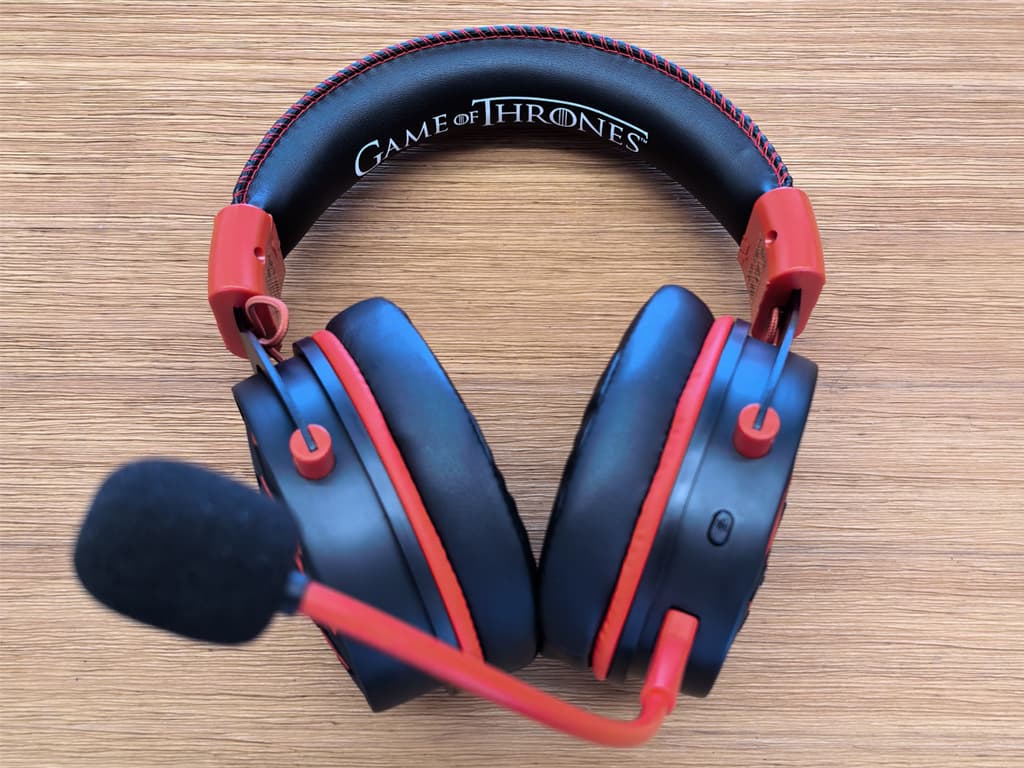
Page 2 specifies an ATS3031 platform, 2.4GHz plus Bluetooth 5.4, an 800mAh protected battery, a 50mm driver, a detachable directional microphone and single-color lighting. These are recorded project requirements, not independent test results. The supplied Hero image says Bluetooth 5.3, while the brief and case study say 5.4. This article preserves the original image and flags the discrepancy rather than declaring a final-build version.
The brief also references another platform for selected components. Such references identify dependencies; they do not supply missing drawings, material grades or approval evidence. This guide does not import specifications from that other project or infer intellectual-property authorization from branding visible in the images.
Decide What the Next Build Is Allowed to Prove
Classify each open item as a blocker for the intended build, a documented limitation for an exploratory sample, or a closed requirement with an identifiable approval.
A missing earcup drawing may block a representative decoration sample while leaving an electronics bench evaluation possible. Unconfirmed packaging artwork may not prevent early acoustic work, but it prevents complete retail-pack approval. Treating every unknown as equally urgent obscures the actual release decision.
For each gap, record the affected part or function, the missing decision, its owner, the next action and the build that depends on it. Avoid assigning a closure date without specifying the closure evidence. A supplier reply that a design is feasible is different from an approved drawing, a verified fit sample or a released inspection reference.
If a sample proceeds with a temporary part, identify that deviation and exclude the affected claims from approval. A prototype with substitute decoration cannot settle final lighting appearance. This is controlled learning, not permission to carry unresolved requirements into mass production.
From Pending Artwork to Release-Ready Parts: Closing the GOT Design Freeze Gaps
Follow each decorative element from artwork through material, color, finish, geometry, assembly and lighting, and close the missing input at each handoff before releasing the relevant part.
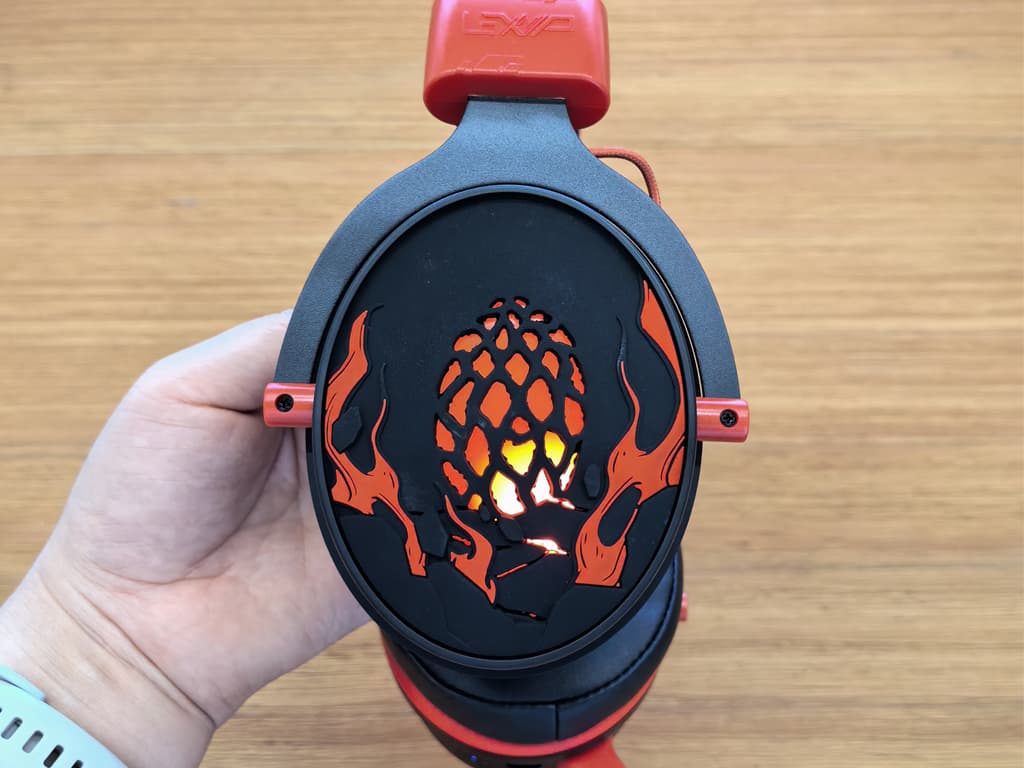
Start with what the GOT document actually leaves open. Pages 8 and 9 identify separate dragon and egg decorations as silicone parts, assign them to left and right earcup assemblies, and state that the 3D structure must first be completed. The drawings communicate visual intent and color zoning, but that instruction means the artwork itself is not the finished structural definition. A buyer should request the corresponding part drawings and clarify how each proposed shape attaches to the earcup before approving a representative build.
The next handoff is from material name to a reproducible component. Silicone is an explicit direction, but the supplied pages do not establish hardness, dimensional tolerances or a retention method. Those fields should remain open for engineering confirmation rather than being filled with convenient assumptions. The review should connect each drawing to its left or right position and identify which dimensions affect fit, appearance and the adjacent housing. Shared visual styling does not make the two decorations interchangeable. A release review should therefore ask for two identifiable component definitions, even when their visual references appear together on one presentation page.
Color then needs a location, not just a list. The annotated earcup pages assign Black 4C, Pantone 7626C and Pantone 138C to different regions; the egg page identifies the orange lighting zone. Buyers should distinguish the appearance of an unpowered surface from the illuminated appearance of the assembly. A printed Pantone reference does not by itself define LED brightness or the optical result through a decorative layer. Approve those states separately without inventing a brightness limit from a rendering.
Surface finish is another decision boundary. Page 6 calls out red metallic paint, red woven thread and an outer sealing line, while its fork annotation combines a steel-fork description with an anodized Black 4C direction. That wording warrants a substrate-and-process clarification. It should not be silently rewritten as an aluminum component or accepted as proof of a completed finishing process. Ask engineering to identify the actual substrate, treatment and approved reference for that part.
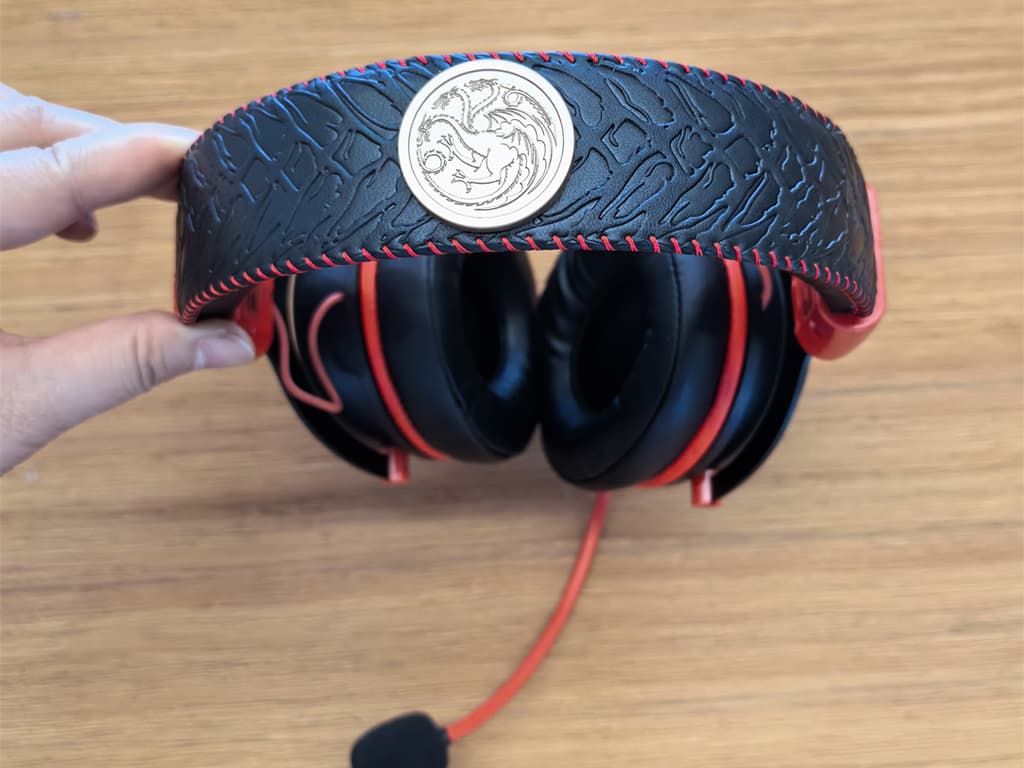
The headband introduces an asset-delivery dependency. Page 10 specifies Black 4C material direction and says the pattern document will be provided later. The concept views show branding and scale-like texture, but a picture cannot replace the missing production artwork. Close the file revision, pattern placement and application method before approving the relevant decorated sample. A visible texture in the supplied photograph is useful context, not a measurement of material construction or proof that every earlier instruction was implemented.
Finally, page 11 specifies an ABS crest with an 874C metallic-paint direction and explicitly says the stand and headset versions have different dimensions and assembly structures. The pattern may be shared; the physical part cannot simply be shared. Separate their drawing identities and do not add the stand to the supplied accessory set merely because it appears in a design note. Close each gap with the responsible owner's approval and the exact drawing, artwork or sample revision. The result is a stage-specific release package whose remaining limitations are visible, rather than a broad declaration that the whole design is frozen.
Technical Deep Dive: Separate Appearance Approval From Interface Approval
A decorative component needs approval of both its visible surfaces and its physical interfaces; passing one review does not establish the other.
For the GOT silicone decorations, ask which drawing defines the outer contour and which surfaces locate the component on its housing. Review the position relative to the fork, nearby controls and lighting region. The supplied brief does not provide enough dimensions to calculate a tolerance stack, so no numeric fit allowance can responsibly be inferred here.
As a recommended review, check whether the selected attachment approach, material behavior and assembly sequence can preserve the intended position. Review the actual assembled sample rather than only a flat artwork proof. Any agreed retention or durability test needs its own method and acceptance criteria; these are proposed requirements, not reported GOT test outcomes.
CMF means color, material and finish. Keep these separate in the part definition. A paint reference does not identify the underlying material, and a material name does not specify gloss or texture. The GOT transmitter annotation, for example, describes a Black 4C textured surface without paint. It should not inherit the red metallic-paint instruction used elsewhere merely because both parts belong to the same product.
Branding needs the same discipline. The document shows printed copyright placement and separately calls for transparent labels on both sides. Confirm whether these describe different markings or alternative revisions before issuing a production instruction. The engineering question is which released marking method applies to which surface, not which picture appears more polished.
Close Electronics and Acoustic Questions Without Inventing Results
Component selections establish a starting configuration; acceptance targets, operating conditions and supported update paths must still be agreed before a sample can validate them.
The brief's ATS3031, 800mAh battery and 50mm driver directions are useful inputs. They do not prove runtime, sound quality or compatibility. Its acoustic note uses Logitech G435 as a reference for the sound curve. Treat that as a target-reference instruction, not a claim of measured equivalence. Buyers should agree how the reference is evaluated and which sample, mode and settings define the comparison.
A directional detachable microphone requires confirmation of pickup orientation, connection, seating and the intended voice-evaluation method. Likewise, single-color lighting needs an approved operating behavior in addition to its appearance. These requirements affect what the engineering sample must contain; a cosmetic model cannot settle microphone performance or power behavior.
The PDF mentions remote upgrading, whereas the public case describes USB firmware upgrades. Do not interpret that combination as confirmed over-the-air consumer updating. Ask which service path is supported, who uses it and how the build is identified. Listed platform names also require a defined connection mode and function scope before approval. The Bluetooth-version discrepancy belongs in this same unresolved-specification review, not in a silently corrected marketing claim.
Freeze the Accessory Set and Responsibility Boundaries
Cables, the transmitter and buyer-supplied packaging must be specified early enough to support the intended sample and retail-pack approval.
The GOT brief requests a headset, detachable directional microphone, custom charging cable, custom audio cable and transmitter. Its cable directions include a 2m braided Type-C-to-3.5mm audio cable and a 1.5m braided USB-to-Type-C charging cable, 3mm diameter, gold-colored connector presentation and Pantone 7626C red. These are specification directions, not proof that any generic cable with matching connectors is electrically interchangeable.
Before ordering samples, confirm connector functions, wiring definition and the actual accessory revision with engineering. Length, braid and finish affect purchasing and pack layout; connector function affects validation and user instructions. A late accessory substitution can invalidate an earlier complete-set approval even when the headset body is unchanged.
Page 2 assigns the color box, inner card, manual, brochure, carton and sealing label to the customer. It also states that MACH provides samples and relevant certification materials while the customer arranges certification. That is a responsibility split, not evidence that approvals have been obtained. Specify the deliverables, recipient and configuration each document covers; do not convert a list of requested certifications into a certified-product claim.
| Specification Area | What the Brand Must Define | What the Manufacturer Must Confirm | Why It Matters |
|---|---|---|---|
| Connectivity | Required hosts and functions | Version and mode-specific implementation | Closes conflicting feature descriptions |
| CMF | Part-specific visual references | Substrate and finish compatibility | Prevents ambiguous process instructions |
| Structural parts | Artwork and left/right intent | Drawings and assembly interfaces | Makes decoration buildable |
| Acoustics | Reference target and priorities | Sample and evaluation conditions | Separates target from test result |
| Accessories | Complete bundle and cable direction | Electrical role and released item revision | Keeps function and packaging aligned |
| Certification | Market scope and arranging party | Samples and documentation to supply | Separates support from completion |
Recommended Workflow for Closing Specification Gaps
Review the intended build, identify its blockers, resolve them with named evidence, and release only the configuration that the approval actually covers.
First collect the brief, concept files and supplier responses without treating any one image as the complete specification. Compare conflicting values and mark missing assets. Next, assign each unresolved item to the build it affects: structural exploration, functional evaluation, appearance approval or production-representative validation.
Request a concrete closure deliverable for each blocker, such as a revised drawing, supplied pattern file, clarified finishing instruction or confirmed accessory function. Review the resulting sample against those deliverables. Record which limitations remain before authorizing the next stage. These are recommended buyer steps, not a reconstruction of GOT's approval history.
At production release, temporary materials and provisional drawings must either be replaced by approved definitions or formally resolved for the final configuration. A change after release should reopen the affected decisions. This prevents a previously approved photograph from being used to approve a materially different build.
Before You Ask for a Gaming Headset Sample
Ask the supplier to return a gap list alongside the sample proposal, with an owner and closure requirement for every unresolved item.
- Target market, intended user and purpose of this sample
- Product architecture and conflicting version statements resolved
- Acoustic reference and evaluation conditions defined
- Microphone configuration and connection confirmed
- Battery configuration identified without inferred runtime
- CMF references assigned to individual parts
- Material and finish wording reconciled
- Left/right decorations linked to their own drawings
- Branding and pattern files delivered and revision-controlled
- Lighting zones and powered appearance approval separated
- Cable and transmitter revisions included in the sample scope
- Packaging deliverables and certification responsibilities assigned
- Temporary parts and excluded approvals declared
- Release decision signed against the actual sample configuration
Release a Defined Build, Not an Unfinished Brief
A useful gaming headset design freeze review makes uncertainty explicit. The GOT brief shows why: an electronics list can coexist with pending artwork, unfinished structural drawings and part-specific manufacturing questions. Closing those items is different from collecting them in a checklist.
Choose an OEM/ODM partner that can explain what information is missing, which sample can proceed and what evidence will permit the next release. Share your current specification and open questions with MACH for an engineering evaluation, without treating the reference project's configuration as automatically approved for a new program.
Discuss Your Gaming Audio Project
Send your technical brief, artwork revisions and unresolved design questions for a project-specific review.
Request OEM/ODM EvaluationFrequently Asked Questions
Can sampling start while a decorative-part drawing is unfinished?
Only if the sample's purpose does not depend on that final part and the limitation is documented. A substitute decoration cannot approve final fit, appearance or lighting. Representative part approval requires the applicable structural definition.
What closes an instruction such as 'pattern file to follow'?
Receipt and approval of the actual file, its revision, placement and application requirements close the gap. A concept picture or a promised delivery date does not establish the production artwork.
How should buyers handle different Bluetooth versions in project documents?
Record the discrepancy and ask the responsible technical owner to confirm the intended build and supporting configuration. Do not select a version simply because it appears on the newest-looking image. The supplied GOT materials contain such a discrepancy.
Can the same crest artwork use one part on a stand and headset?
Not automatically. GOT's brief explicitly identifies different dimensions and assembly structures for those applications. Shared artwork does not establish interchangeable parts, and a stand illustration does not automatically define the supplied bundle.
Does a Pantone reference close the lighting requirement?
No. It describes a color direction, while illuminated appearance also needs review on the assembly. Define the powered state and acceptance reference separately from the unpowered surface appearance.
What if a finishing note is unclear about the substrate?
Keep that part's finishing instruction open until engineering confirms the material and applicable process. Do not infer aluminum, steel or another substrate from a metallic appearance or silently replace conflicting wording.
Does naming an acoustic reference prove matching performance?
No. A reference identifies a target for discussion. Agreement on evaluation conditions and review of the relevant sample are still needed; the GOT brief's reference is not a published equivalence test.
Should a custom cable substitution reopen sample approval?
Review the affected approvals. Connector function, length, construction and appearance may change functional validation, user instructions or pack layout. An unchanged headset body does not make the substituted bundle identical.
What does the GOT brief establish about certification ownership?
It assigns provision of samples and relevant certification materials to MACH and arrangement of certification to the customer. It does not establish completed approvals or authorize describing the project as fully certified.
Related Resources
Need OEM/ODM gaming audio solutions?
Contact MACH Industry to discuss your gaming headset, gaming earbuds, or private-label audio project.
Contact MACH Industry