Home > Resources > OEM Knowledge
How to Define a Gaming Headset Customization Specification Before OEM Sampling
A practical buyer guide for converting private-label gaming headset customization ideas into an approvable specification before OEM sampling begins.
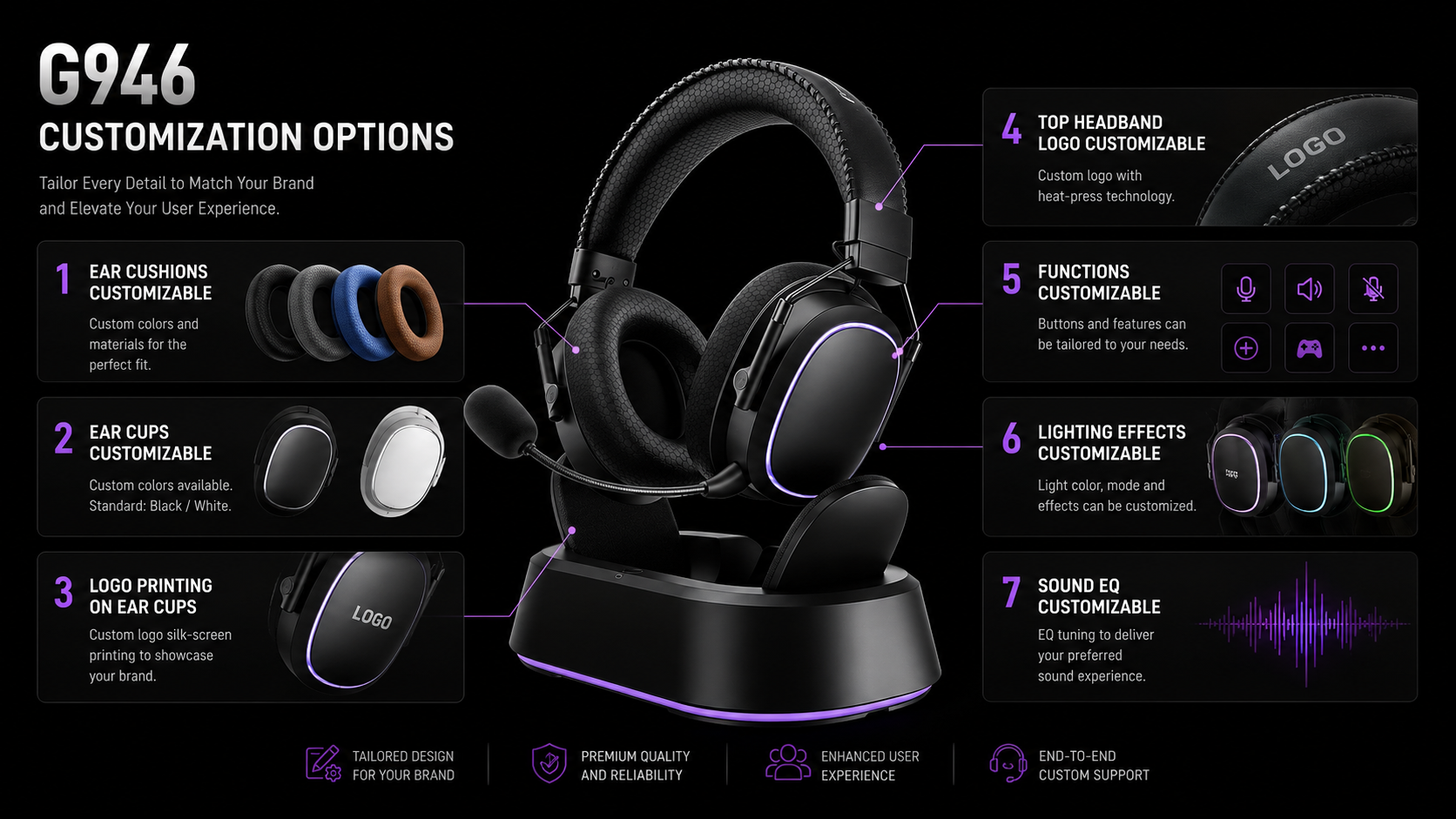
A gaming brand should define customization as a controlled product specification before requesting an OEM sample. The brief should identify what changes, where each change appears, how it will be manufactured, what the buyer will approve and which parts of the base platform must remain unchanged. At minimum, buyers should document ear-cushion materials, ear-cup colors and finishes, logo placement and process, headband branding, controls and functions, RGB behavior, acoustic targets, accessories and packaging.
This discipline matters because a request such as 'make it black, add our logo and tune the sound' is not production-ready. It leaves the supplier to interpret color, process, dimensions, user behavior and acceptance criteria. The G946 wireless gaming headset platform is a useful reference because its public materials combine a tri-mode headset, 50mm driver, detachable ENC microphone, RGB presentation and charging dock with several realistic customization layers. The goal of this guide is not to advertise that model, but to show how a sourcing team can turn customization ideas into an approvable sample specification.
Customization Is More Than Adding a Logo
Private-label customization becomes manufacturable only when every visual, functional and acoustic request has a defined process, location, reference and acceptance method.
Many sourcing briefs use customization as a broad label for unrelated decisions. A logo is artwork. Ear-cup color is a CMF decision. A different mute action is a control and firmware requirement. An RGB effect is a lighting-state specification. EQ is an acoustic target. Packaging is a separate physical and regulatory deliverable. Treating these as one request makes quotation and sampling ambiguous.
A useful specification separates the product into customization layers. For every layer, record the approved input, technical constraint, manufacturing route, sample type, responsible approver and pass criteria. This lets the supplier distinguish a simple private-label change from work that may require new materials, firmware changes, tooling evaluation, acoustic validation or additional production controls.
The base platform should also be frozen. Buyers need to identify the exact headset, connection architecture, receiver, microphone, battery, charging method and accessories being customized. Otherwise, an approved color or logo sample may be attached to a configuration that differs from the later functional sample. The result is avoidable rework at packaging and production-release stages.
| Customization request | Incomplete instruction | Approval-ready specification |
|---|---|---|
| Ear-cup color | Use our brand blue | Color reference, substrate, finish, approved tolerance and sample type |
| Logo | Put logo on both sides | Artwork revision, dimensions, coordinates, process, color and inspection reference |
| RGB | Match our brand | Zones, state table, colors, effects, brightness, controls and off behavior |
| Sound | More gaming bass | Use-case priority, target curve or references, test setup and approval method |
The Seven Customization Areas Buyers Should Define
A complete gaming headset brief should control seven areas: ear cushions, ear cups, product branding, headband branding, functions, lighting and sound tuning.
Ear cushions affect much more than color. The buyer should define contact material, foam construction when available, dimensions, attachment method, seam appearance and cleaning expectations. A material change can influence comfort, seal, perceived bass, heat and wear. It should therefore be reviewed on the actual selected structure rather than approved from a swatch alone.
Ear cups carry the main CMF and branding system. Specify substrate colors, coatings or textures, gloss level, decorative rings, left-right symmetry and protected areas around controls, microphone interfaces and lighting. If black and white are standard choices but a custom color is requested, confirm whether the change is a surface process, molded color or another approved route. Each route has different sample and consistency considerations.
Logo printing on ear cups and branding on the top headband require separate artwork instructions. Silk-screen printing and heat-press treatment, as illustrated in the supplied G946 customization visual, involve different surfaces and process controls. Define logo size, location, orientation, color, distortion limits, clean zones and durability expectations for each part.
Functional customization covers button mapping, press duration, mute logic, mode switching, prompts and indicators. Lighting customization covers illuminated zones, effects and states. Sound EQ customization covers the intended listening target. None of these should be approved only through a rendering; they need functional or acoustic sample evidence tied to a documented version.
| Area | Buyer decisions | Approval evidence |
|---|---|---|
| Ear cushions | Material, color, construction, fit | Physical sample on selected headset |
| Ear cups and CMF | Color, finish, texture, decorative zones | Approved CMF sample and visual standard |
| Branding | Artwork, process, size, position | Decorated part sample and artwork file |
| Functions | Control map, prompts, mode behavior | Functional sample and behavior table |
| Lighting | Zones, colors, effects, state logic | Lighting sample and state matrix |
| Sound EQ | Use case, tonal target, limits | Controlled listening and measurement review |
From Wish List to Specification: Building an Approval-Ready Customization Matrix
The unique deliverable before sampling should be a customization matrix that links every buyer request to a process, owner, sample, acceptance criterion and change status.
Begin with one row for each visible or functional decision. Do not group 'appearance' into a single line. Ear-cushion material, cushion color, ear-cup body color, trim color, ear-cup logo, headband logo and RGB behavior are separate requirements because they use different processes and may be approved by different evidence. Give each row an ID so feedback can refer to the requirement without relying on screenshots or chat history.
For each row, record the current target and the supplier's proposed implementation. The target may be a color standard, artwork file, behavior table or sound reference. The implementation identifies the relevant part, process, firmware behavior or tuning version. Add a feasibility status: standard, configurable, development required, tooling review required or not available on the selected platform. This prevents an attractive concept rendering from being mistaken for a confirmed production route.
Next define acceptance. Visual items need viewing conditions, reference samples and tolerance rules. Functional items need test steps and expected responses. RGB needs a state table, not only a video. EQ needs the same hardware, ear cushions, firmware and measurement or listening setup used for approval. Packaging needs dimensions, artwork revision, content list and a physical or print proof. The buyer should name who approves each family so supplier feedback reaches the correct decision maker.
Finally, add dependency and change-impact fields. A new cushion material may require acoustic review. A different ear-cup coating may affect logo adhesion. A control-map change may affect icons, prompts and the manual. A lighting change may affect runtime claims. A charging-dock color change may affect the bundle image and package tray. The matrix should show these links before a change is approved.
This matrix improves quotation because the supplier can see which requests use established processes and which require engineering work. It also improves sample review. Instead of saying that a sample 'looks wrong,' the buyer can identify the exact requirement, compare it with the approved reference and record the disposition. When the design is ready for production, the same matrix becomes an index for artwork, firmware, CMF, acoustic, packaging and inspection baselines.
| Matrix field | Purpose | Example |
|---|---|---|
| Requirement ID | Stable reference | CMF-EC-02 |
| Target | What the buyer wants | Approved blue cushion material reference |
| Implementation | How it will be made | Selected cover material on current cushion geometry |
| Acceptance | How approval is decided | Signed physical sample under defined lighting |
| Dependency | What else needs review | Comfort, seal and acoustic confirmation |
| Revision status | Which version is current | Rev C approved for pilot |
G946 as a Real Product Platform Reference
G946 demonstrates how visual, functional, acoustic and bundle-level customization can meet on one defined wireless gaming headset platform.
The published G946 charging-dock version uses three confirmed connection paths: dedicated 2.4GHz wireless through an included USB receiver, Bluetooth and dual 3.5mm wired plugs. It lists a 50mm driver, detachable microphone with ENC support, RGB lighting and a wireless charging dock with RGB base lighting and a USB 2.0 hub. The source specification also lists a 2000mAh battery and approximately 150 hours of playback with lighting off.
Those facts establish the platform reference; they do not mean every requested modification is automatically available. MACH publicly lists appearance evaluation, private-label branding, packaging, industrial and mechanical development, audio and microphone tuning, receiver and accessory configuration, and sampling coordination as areas for project review. Feasibility still depends on the final headset, dock, accessory, packaging and target-market requirements.
For a G946-based brief, buyers should identify whether they are customizing only the headset or the complete headset-and-dock bundle. The dock introduces additional CMF, logo, lighting, accessory, tray and packaging decisions. The approved product photography and retail claims must show the same bundle configuration that is sampled and released. This is a different decision from asking whether a charging dock is commercially useful; it is about controlling all customized parts as one sellable SKU.
- Confirm the exact G946 headset and charging-dock configuration
- Define which connection modes and accessories are included
- Separate headset CMF from charging-dock CMF
- Define logo placement on each physical part
- Specify RGB behavior for headset and dock independently
- Confirm the selected microphone and receiver configuration
- Link packaging artwork to the approved final bundle
Technical Decision Factors That Affect Cost and Complexity
Customization complexity increases when a request changes materials, tooling, firmware, acoustic behavior, test scope or the number of controlled parts in the bundle.
Buyers should classify requests before comparing quotations. A logo on an approved surface may use an established decoration route. A new ear-cup geometry can require mechanical development and tooling evaluation. A custom button action can require firmware work and regression testing. A new ear-cushion material can require sourcing, fit checks and acoustic review. These requests should not be treated as equivalent line items.
The selected production process also influences minimum quantities and consistency, but buyers should not assume one universal MOQ. Project requirements depend on materials, decoration, packaging, accessory selection and the final configuration. MACH lists G946 MOQ and lead time as project based, so both should be confirmed only after the customization matrix has been reviewed.
Certification planning must follow the final configuration. Support for CE, FCC, RoHS, REACH or other market requirements is not proof that a customized SKU is already certified. Changes to electronics, wireless configuration, battery, accessories, labels or packaging may affect the applicable evidence and marking review. The buyer should state target markets before sampling, not after retail artwork is complete.
| Customization level | Typical scope | Main buyer risk |
|---|---|---|
| Branding | Approved logo on existing surfaces | Artwork location or process mismatch |
| CMF | Colors, materials and finishes | Variation, adhesion, wear or acoustic side effects |
| Functional | Controls, prompts, lighting states | Firmware, documentation and regression impact |
| Structural | New parts or geometry | Tooling, fit, durability and schedule impact |
| Bundle | Dock, receiver, cables and packaging | Pack-out and configuration inconsistency |
How to Specify Branding, Controls, RGB and EQ
Artwork files define appearance, but behavior and acoustic requirements need separate functional specifications and approval evidence.
For branding, supply vector artwork and a placement drawing with dimensions and orientation. Confirm the decoration process for each substrate and protect moving interfaces, vents, lighting windows, controls and regulatory labels. Ear-cup silk-screen printing and headband heat press should have separate files because their surfaces, distortion risks and inspection methods differ.
For controls, create a table covering short press, long press and multi-press behavior in every relevant mode. Include power, pairing, volume, mute, lighting, prompt and mode-switching behavior. If no change is required, state that the base behavior is accepted. Silence should not be interpreted as approval because controls affect the manual and user support.
For RGB, define each illuminated zone and state: power-on, pairing, connected, muted, charging, low battery and powered off, where applicable to the selected platform. Identify static colors, effects, speed, brightness and user controls. For EQ, define whether the priority is competitive detail, balanced gaming, cinematic impact or another approved target. Evaluate EQ on the final driver, enclosure, cushion and firmware combination because those elements interact.
Sample Stages and Approval Evidence
Every sample should state what it proves; one early prototype should not be treated as simultaneous approval of function, CMF, sound, packaging and production consistency.
The following is a recommended buyer workflow, not a claim that every G946 project follows the same sequence. A feasibility review confirms which requests are standard, configurable or development work. A functional sample checks connectivity, controls, microphone, lighting and charging behavior. A CMF sample checks materials, colors, finishes and decoration. An acoustic sample freezes the relevant tuning version. A packaging sample confirms artwork, accessories and physical fit.
Before mass production, buyers should review a matched production-representative configuration. Record the hardware, firmware, CMF, artwork, accessories, dock, packaging and inspection references together. If an approved item changes later, reopen affected evidence instead of carrying forward the old approval automatically. This is particularly important where a visual change can affect adhesion, acoustics, runtime presentation or package photography.
| Stage | Primary purpose | Do not assume it approves |
|---|---|---|
| Feasibility review | Confirm proposed customization route | Final appearance or performance |
| Functional sample | Verify behavior and interfaces | Production CMF and packaging |
| CMF sample | Verify color, material and decoration | Final firmware or acoustics |
| Packaging sample | Verify artwork, fit and pack-out | Unrelated product performance |
| Production reference | Freeze matched release baseline | Future unreviewed changes |
Buyer Checklist Before OEM Sampling
A sample request is ready when the supplier can identify the exact platform, customization rows, evidence required and decision owner without guessing.
Prepare one controlled brief rather than distributing requirements across emails and image annotations. Use revision numbers for artwork and behavior tables. Mark open items explicitly and identify which sample will close them. This gives both parties a clear basis for quotation, schedule discussion and approval.
The checklist below is intentionally broader than logo placement. It addresses the technical and operational decisions that determine whether a private-label sample can become a stable production specification.
- Define target users, sales channels and markets
- Identify the exact base headset, dock, receiver and accessories
- List every customized part as a separate requirement
- Provide color, material, finish and artwork references
- Define logo process, dimensions, position and clean zones
- Approve ear-cushion material and fit on the selected structure
- Create a mode-by-mode control and indicator table
- Create an RGB zone and state matrix
- Define the acoustic or EQ approval target
- Specify microphone and accessory configuration
- Confirm packaging contents, artwork and labeling inputs
- State target-market compliance planning requirements
- Define each sample purpose and acceptance criteria
- Name approvers for CMF, function, acoustics and packaging
- Freeze a matched production-release baseline
Discuss Your Gaming Headset Customization Brief
Share your target platform, CMF, branding, control, lighting, audio and packaging requirements. MACH industry can review the specification and sampling scope for an OEM/ODM gaming audio project.
Request OEM/ODM EvaluationFrequently Asked Questions
What can a brand customize on an OEM gaming headset?
Depending on platform feasibility, a brand may evaluate ear-cushion materials and colors, ear-cup CMF, logo placement and process, headband branding, control functions, lighting behavior, acoustic tuning, accessories and packaging. Each item should be defined and approved separately.
What should be included in a gaming headset customization specification?
Include the target user and market, base platform, approved colors and materials, artwork files, logo processes and locations, control map, RGB states, EQ target, accessories, packaging, compliance planning, sample purpose and measurable acceptance criteria.
Why is logo artwork alone not enough for a private-label sample?
Artwork does not define its physical size, exact location, decoration process, substrate, color reference, surface preparation or inspection standard. Those production details determine whether the logo can be reproduced consistently.
Can ear cushions be customized for an OEM gaming headset?
Material, color, dimensions and construction may be evaluated when supported by the selected structure. Buyers should also review fit, sealing, comfort, durability, cleaning expectations and acoustic impact before approval.
How should RGB lighting be specified before sampling?
Define illuminated zones, colors, effects, brightness levels, startup state, mode transitions, off behavior, control method and any impact on power use. A visual reference should be paired with a written state table.
Can sound EQ be customized for a private-label gaming headset?
MACH lists audio tuning as an OEM evaluation area. The buyer should provide a sound target or use-case priority, then approve tuning through controlled listening and measurement review on the selected hardware configuration.
When should button and function customization be frozen?
The control map should be frozen before the sample build that is intended to validate user interaction. Late changes can affect firmware behavior, printed icons, voice prompts, the manual, testing and support documentation.
Does certification support mean the customized headset is already certified?
No. Certification support is planning and coordination. The applicable requirements and evidence must be confirmed for the final product configuration, target market, branding, packaging and supplied accessories.
How many sample stages does a custom gaming headset need?
The number depends on customization depth. Buyers commonly separate functional, CMF or appearance, packaging and production-representative approvals so that each sample has a clear purpose and acceptance standard.
What should be approved before mass production?
Approve the matched product configuration, bill of materials, firmware or function baseline, colors and materials, decoration artwork, RGB behavior, EQ target, accessories, packaging, labels, inspection criteria and production-representative reference sample.
Related Resources
Need OEM/ODM gaming audio solutions?
Contact MACH Industry to discuss your gaming headset, gaming earbuds, or private-label audio project.
Contact MACH Industry