Home > Resources > Gaming Headset Guide
How Gaming Brands Choose the Right Lightweight Tri-Mode Gaming Headset Platform
A buyer guide to evaluating headset weight, ergonomics, materials, tri-mode connectivity, audio, microphone, customization, and production controls for private-label gaming brands.
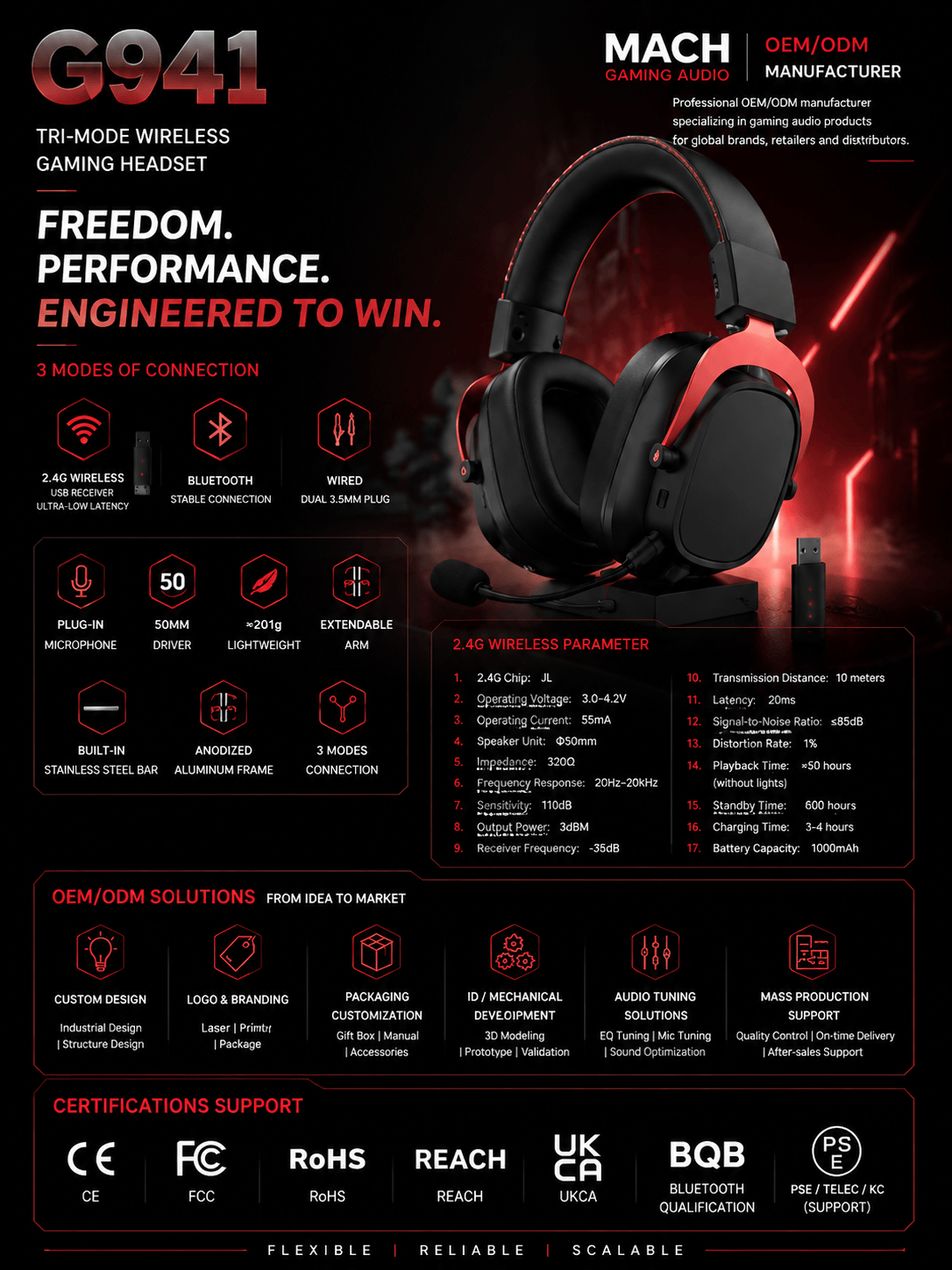
Gaming brands should choose a lightweight tri-mode gaming headset platform by evaluating the complete wearing system and connection strategy, not weight alone. A useful platform balances mass, clamping force, cushion contact, adjustment range, structural durability, 2.4GHz gaming performance, Bluetooth use, wired fallback, audio, microphone, battery, customization, and repeatable production.
The decision matters because adding wireless electronics, a battery, RGB, a large driver, microphone hardware, and reinforced structures can increase weight or change balance. Reducing grams without controlling pressure distribution or durability can create a headset that looks attractive in a specification table but performs poorly during long sessions. Buyers need a comfort-and-function brief linked to measurable sample checks.
G941 Red is used as a documented example. Its confirmed configuration is approximately 201g and combines 2.4GHz wireless, Bluetooth, dual 3.5mm connection, a 50mm driver, plug-in ENC microphone, RGB, a 1000mAh battery, stainless steel bar, anodized aluminum frame, and extendable arm. This guide explains how to evaluate that type of platform without copying or competing with the product page.
What Makes a Lightweight Gaming Headset Different?
A lightweight gaming headset reduces total mass, but real long-session comfort depends on how that mass interacts with clamp, headband load, cushion geometry, adjustment, heat, materials, and user fit.
Weight is one useful sourcing metric because it affects the load carried by the head and neck. It is also easy to compare across supplier specifications. However, two headsets at the same nominal weight can feel different when one concentrates pressure at the crown or jaw while another distributes it across a larger headband and cushion area.
Ergonomics should be reviewed through adjustment range, extension stability, ear-cup angle, cushion opening, cushion depth, clamp, headband contact, cable or microphone interference, and movement during use. Test several head sizes where possible. A single evaluator cannot represent the entire intended market.
Long gaming sessions add heat, moisture, repeated repositioning, and accumulated pressure. Buyers should use timed wear trials rather than a short showroom fitting. Record pressure points, slipping, seal changes, microphone position, glasses interaction, heat perception, and fatigue after representative use.
Lightweight positioning also affects product expectations. A value or portable gaming range may prioritize accessible comfort and flexibility, while a premium line may need visible material and finish cues. The platform should match the brand's price position and retail story without making unsupported medical or universal-comfort claims.
| Evaluation area | What buyers should check | Why weight alone is insufficient |
|---|---|---|
| Headband | Contact width, padding, adjustment, load distribution, and structure | A light headset can still create a crown pressure point |
| Ear cushions | Opening, depth, foam, covering, seal, heat, and glasses interaction | Cushion pressure and heat may dominate long-session comfort |
| Clamp and balance | Retention, jaw pressure, front-back balance, and movement | Poor balance can feel heavier than the measured mass |
| Durability | Extension, twist, drop, hinge or arm, cable, and microphone checks | Reducing material without validation can weaken field reliability |
Why Tri-Mode Connectivity Matters for Gaming Headset Brands
Tri-mode connectivity can address receiver-based gaming, Bluetooth devices, and analog wired scenarios with one headset, but each route needs a defined host list and feature matrix.
A dedicated 2.4GHz receiver can provide a controlled wireless path for approved gaming hosts. Buyers should validate host recognition, latency method, range, interference, reconnect behavior, microphone transport, controls, and firmware. G941 Red lists 20ms specified latency and a 10-meter transmission distance for its 2.4GHz route.
Bluetooth can support compatible phones, tablets, laptops, and general wireless use. Profiles, codecs, call states, and host implementations can affect latency, audio quality, microphone behavior, and controls. Brands should not transfer a low-latency reference from 2.4GHz to Bluetooth unless the Bluetooth route is separately documented and tested.
The wired route can provide an analog option for matching host jacks. G941 Red identifies dual 3.5mm connection. Buyers should confirm plug roles, wiring, target ports, any adapter, microphone route, powered or passive behavior, and which electronic features remain available.
Tri-mode flexibility is commercially useful when the packaging and instructions make these boundaries clear. One platform can support several scenarios, but it should not be marketed as universally compatible without device-specific evidence.
| Connection | Typical product role | Buyer validation |
|---|---|---|
| 2.4GHz receiver | Wireless gaming on approved USB hosts | Latency, RF, receiver, reconnect, audio, microphone, and controls |
| Bluetooth | Compatible mobile, laptop, communication, and listening use | Profiles, pairing, call behavior, microphone, controls, and expectations |
| Dual 3.5mm | Analog audio and microphone connection for matching ports | Plug roles, adapters, host jacks, microphone route, and powered functions |
Why Lightweight Tri-Mode Gaming Headsets Are Becoming a Strategic Choice for Gaming Brands
A lightweight tri-mode platform can combine a clear comfort position with broad connection scenarios, but brands gain strategic value only when engineering and manufacturing protect fit, durability, wireless performance, and claim accuracy.
User comfort is a portfolio decision as much as an ergonomic one. Gaming brands compete for users who may wear a headset through long matches, streaming, voice chat, work, or general listening. Lower mass can reduce the load that must be supported, yet perceived comfort still depends on clamp, balance, cushions, headband contact, heat, and individual fit. Procurement teams should define timed wear trials and target users rather than approve comfort from a weight number.
Long-session design requires trade-offs. Larger batteries, reinforcement, RGB, drivers, microphones, and wireless electronics all occupy space and add mass. Engineers must distribute those parts so the headset does not become front-heavy or create concentrated pressure. Cushion materials and seal influence both heat and acoustic response, while changes to headband force can alter retention and bass consistency. Comfort and sound therefore need joint evaluation.
Wireless flexibility expands the possible user journey. Receiver-based 2.4GHz can serve approved gaming hosts, Bluetooth can address compatible general devices, and wired connection can provide an analog route. This allows one lightweight platform to move across gaming and everyday scenarios. It also creates more test cases: pairing, switching, receiver storage, cable use, microphone routing, controls, battery states, and feature availability must be documented.
Multi-platform positioning can help a brand simplify its range, but only tested compatibility should appear on packaging. The accessory bundle must match the intended market. A desktop-PC audience may value dual analog plugs, while another channel may require a tested adapter. Broad icons without a host-and-mode matrix increase return and support risk.
OEM platform selection should consider how much change is necessary. A ready structure can support branding, CMF, packaging, manuals, dongle presentation, and accessories more efficiently than a new mechanical program. Structural, acoustic, firmware, antenna-related, battery, or microphone changes can affect weight, center of gravity, reliability, RF, sound, and compliance, so their engineering impact must be reviewed.
Manufacturing determines whether the lightweight promise survives mass production. Component substitutions, cushion variation, headband force, screw torque, cable routing, battery position, and assembly gaps can change weight, balance, durability, or comfort. The approved sample should be paired with a locked BOM, weight tolerance, cosmetic standard, functional limits, reliability plan, and change control.
The strategic advantage is therefore not simply a lower gram value plus three connection icons. It is a platform that gives the brand a distinct comfort story, useful connection coverage, manageable customization, and production controls that can be repeated across the launch.
| Decision layer | Buyer question | Approval evidence |
|---|---|---|
| User comfort | Who will wear it, for how long, and under what conditions? | Timed wear trials across representative head sizes |
| Engineering | How are battery, drivers, frame, controls, and microphone balanced? | Weight, center-of-gravity review, fit checks, acoustics, and reliability |
| Connectivity | Which hosts and functions belong to each mode? | Mode-and-device matrix with tested accessories |
| Manufacturing | How will fit, weight, structure, and function remain consistent? | Golden sample, BOM lock, tolerances, QC, traceability, and change control |
OEM Gaming Headset Platform Selection Checklist
The RFQ should translate target users, comfort, connectivity, materials, microphone, customization, packaging, compliance, and production into measurable requirements.
Use this checklist before requesting samples. Mark each item as required, preferred, or optional so the supplier can evaluate the platform without guessing which trade-offs matter most.
- Define target users, typical session length, head-size range, glasses use, climate, and sales channel.
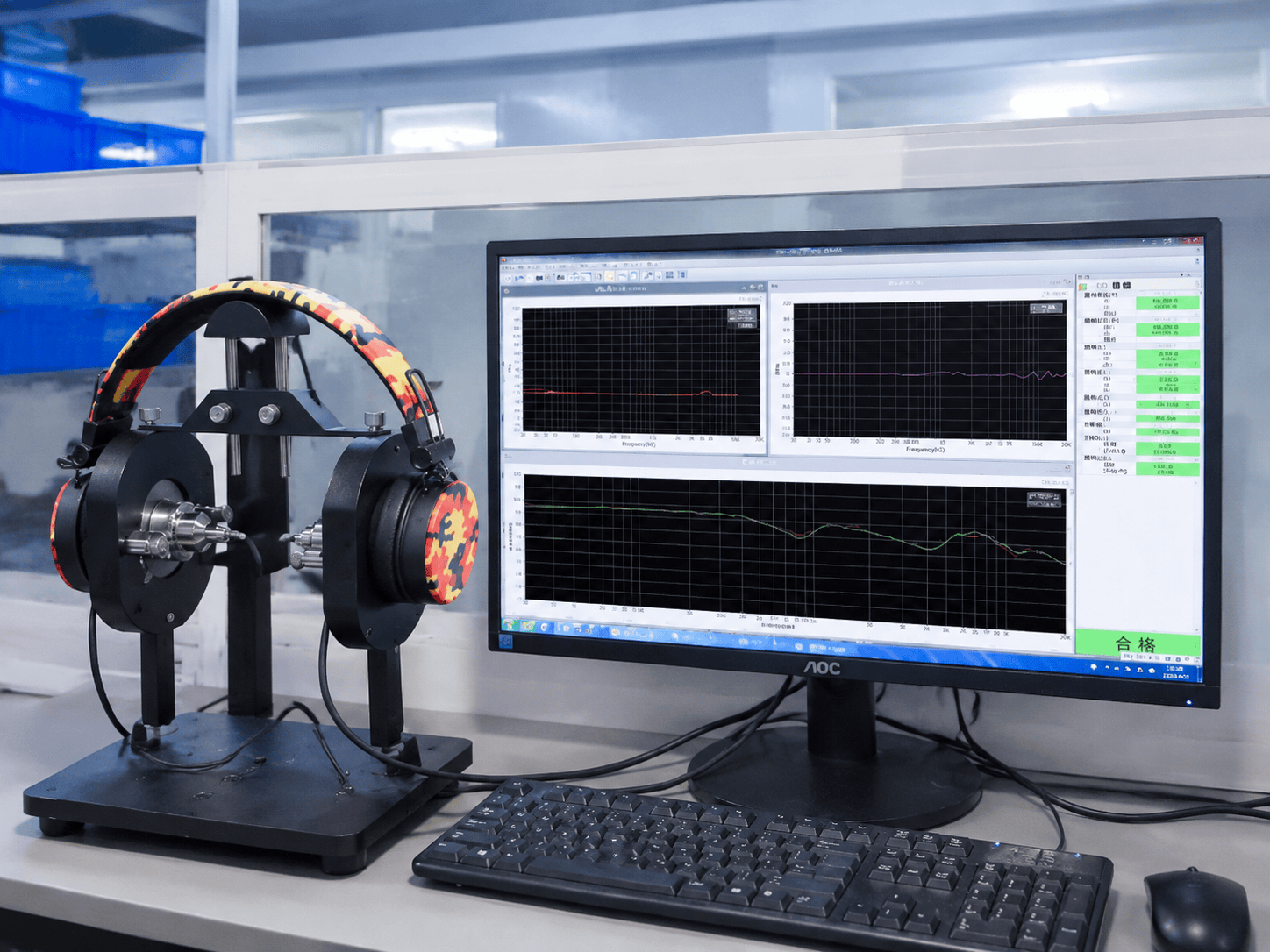
- Set a weight target and tolerance, then add timed comfort, clamp, balance, adjustment, cushion, and heat checks.
- List required 2.4GHz, Bluetooth, and wired hosts, ports, adapters, and mode-specific functions.
- Define acoustic tuning, useful output, channel match, noise, microphone voice target, and sample references.
- Confirm battery-runtime conditions, charging time, RGB state, radio mode, firmware, and aging criteria.
- Review frame, headband, extension arm, cushions, microphone connector, cable, receiver, and packaging durability.
- Separate logo, color, CMF, packaging, and manual work from structural, acoustic, firmware, RF, or electrical changes.
- Specify packaging protection, accessory placement, quick-start instructions, compatibility claims, and labels.
- Identify market-specific radio, EMC, battery, materials, labeling, and documentation requirements.
- Freeze firmware, receiver, BOM, golden sample, tolerances, inspection plan, traceability, and change control.
Technical Overview of a Tri-Mode Gaming Headset Platform
G941 Red combines confirmed lightweight positioning with a tri-mode connection set, 50mm acoustic platform, plug-in microphone, RGB, battery, and reinforced metal structure.
The headset is listed at approximately 201g. Its structure includes a built-in stainless steel bar, anodized aluminum frame, and extendable arm. These facts support lightweight positioning, but final comfort, fit, strength, and production tolerance still require sample validation.
Connectivity consists of 2.4GHz wireless with an included dongle, Bluetooth, and dual 3.5mm. The published 2.4GHz data identifies a JL solution, 20ms specified latency, and a 10-meter transmission distance. Bluetooth operating details and device-specific compatibility are not expanded where no user manual confirms them.
The acoustic specification lists a 50mm driver, 32-ohm impedance, 110dB sensitivity, and a 20Hz-20kHz response. Those values do not by themselves prove tuning, positional clarity, distortion at useful level, channel consistency, or comfort seal. Approval should combine controlled measurements and listening across final samples.
Communication uses a plug-in microphone with ENC support. Evaluate voice clarity, connector fit, movement noise, positioning, mute behavior, wireless transport, analog routing, and durability. ENC describes microphone-side processing and should not be presented as listener-side active noise cancellation.
The platform also lists RGB and a 1000mAh battery, with approximately 50 hours of playback without lighting, 600 hours standby, and three to four hours charging. Runtime and charging claims require defined test conditions and production-representative verification.
| Confirmed item | G941 Red reference | Buyer caution |
|---|---|---|
| Weight and structure | Approximately 201g, steel bar, anodized aluminum frame, extendable arm | Validate fit, balance, clamp, durability, and production tolerance |
| Connections | 2.4GHz, Bluetooth, dual 3.5mm | Verify every claimed host, adapter, mode, and feature |
| Audio and voice | 50mm driver and plug-in ENC microphone | Approve tuning, voice, connector, routing, and sample consistency |
| Power and appearance | 1000mAh battery and RGB | Define runtime conditions, charging, lighting, aging, and cosmetics |
Customization Options for Private Label Gaming Headset Projects
G941 Red can be evaluated for logo, branding, color and CMF, packaging, manuals, ID and mechanical work, tuning, dongle configuration, and accessories.
Logo and branding requirements should define method, location, size, color, durability, and artwork control. Color and CMF review should use approved masters and tolerances across red accents, housing, cushions, cable, microphone, dongle, and visible accessories.
Packaging and manuals should reflect tested connection modes, accessories, charging, controls, microphone use, RGB behavior, limitations, and compatibility. The tray should protect the lightweight structure and prevent cable, dongle, or microphone movement during transport.
ID and mechanical development can affect tooling, mass, balance, clamp, strength, acoustic volume, antenna conditions, and packaging. Audio, microphone, dongle, firmware, battery, or accessory changes may expand testing and compliance. Feasibility should be confirmed against the final project scope.
How MACH Supports Gaming Headset OEM/ODM Development
MACH can support configuration review, customization planning, sample validation, acoustic review, aging testing, packaging preparation, and mass-production quality coordination for an approved gaming headset project.
The process begins with the buyer's target market, users, connection requirements, weight and comfort direction, quantity, branding, packaging, accessories, test expectations, and compliance needs. A written brief helps align procurement, engineering, marketing, quality, and the factory.
Sample work can include appearance and CMF, weight and ergonomics, 2.4GHz and Bluetooth function, dual-3.5mm connection, acoustics, microphone, battery, charging, RGB, reliability, aging, and packaging. The exact plan should reflect confirmed features and requested customization.
Before mass production, approve the golden sample, firmware, dongle, BOM, materials, weight tolerance, color standard, packaging, and acceptance limits. Incoming checks, assembly control, functional testing, final inspection, traceability, corrective action, and change control help maintain the approved result.

Conclusion
The right lightweight tri-mode platform is the one that combines validated comfort, useful connection coverage, appropriate product positioning, feasible customization, and repeatable manufacturing.
Buyers should begin with target users and session conditions, then define weight, fit, materials, connectivity, audio, microphone, battery, appearance, packaging, compliance, and production controls. This converts lightweight from a marketing adjective into a measurable product requirement.
G941 Red provides a real reference with approximately 201g weight, 2.4GHz, Bluetooth, dual 3.5mm, a 50mm driver, plug-in ENC microphone, metal reinforcement, RGB, and a 1000mAh battery. Final suitability depends on the buyer's device matrix, comfort target, customization, validation, and market.
Discuss your gaming headset project with MACH. Share your target users, weight and comfort direction, connection requirements, branding, packaging, quantity, and market.
Contact MACH IndustryFrequently Asked Questions
What is a tri-mode gaming headset?
A tri-mode gaming headset combines three connection routes, commonly receiver-based 2.4GHz wireless, Bluetooth, and an analog wired connection. Exact devices, features, controls, and microphone behavior must be verified for each route.
Why do gaming brands choose lightweight headsets?
Lower mass can reduce the load carried during use and create a clear comfort position. Perceived comfort still depends on clamp, balance, cushions, headband pressure, adjustment, heat, glasses interaction, and individual fit.
Is a lighter gaming headset always more comfortable?
No. A lighter headset can still concentrate pressure, slip, become hot, fit poorly, or lack durability. Buyers should combine weight measurement with timed wear trials, fit checks, material review, and reliability testing.
What is the difference between 2.4GHz and Bluetooth gaming headsets?
Receiver-based 2.4GHz provides a dedicated wireless system that can be validated for approved gaming hosts. Bluetooth uses supported host profiles and implementations. Latency, microphone, controls, audio, and compatibility should be tested separately.
What lightweight specifications are confirmed for G941 Red?
G941 Red is listed at approximately 201g and uses a built-in stainless steel bar, anodized aluminum frame, and extendable arm. Final comfort and durability still require sample validation.
Can brands customize gaming headset appearance?
Logo, branding, color and CMF, packaging, manuals, and accessories can be evaluated for G941 Red. Product or structural changes require review against tooling, performance, reliability, and validation requirements.
How does OEM gaming headset development work?
A typical process covers requirement review, platform selection, customization definition, engineering samples, function and reliability validation, packaging approval, golden-sample confirmation, pilot or production checks, and mass-production quality control.
What should buyers prepare before starting a headset project?
Prepare target users and markets, device and connection requirements, comfort and weight targets, audio and microphone direction, customization, accessories, packaging, quantity, schedule, test criteria, and compliance needs.
How should a lightweight gaming headset be tested?
Measure mass and tolerance, then evaluate fit, clamp, balance, cushions, adjustment, long-session wear, heat, movement, acoustics, microphone, structure, drop or flex requirements, battery, connections, and packaging.
Which certifications are required for a wireless gaming headset?
Requirements depend on the target market and final radio, EMC, battery, materials, labels, accessories, and documentation. Buyers should confirm applicable requirements for the approved configuration.
Related Resources
Need OEM/ODM gaming audio solutions?
Contact MACH Industry to discuss your gaming headset, gaming earbuds, or private-label audio project.
Contact MACH Industry