Home > Resources > Gaming Headset Guide
How Should Brands Specify Dual 3.5mm Connectivity in a Tri-Mode Gaming Headset?
A procurement guide to dual 3.5mm audio and microphone plugs, TRRS adapters, tri-mode behavior, compatibility claims, packaging, OEM sampling, and production validation.
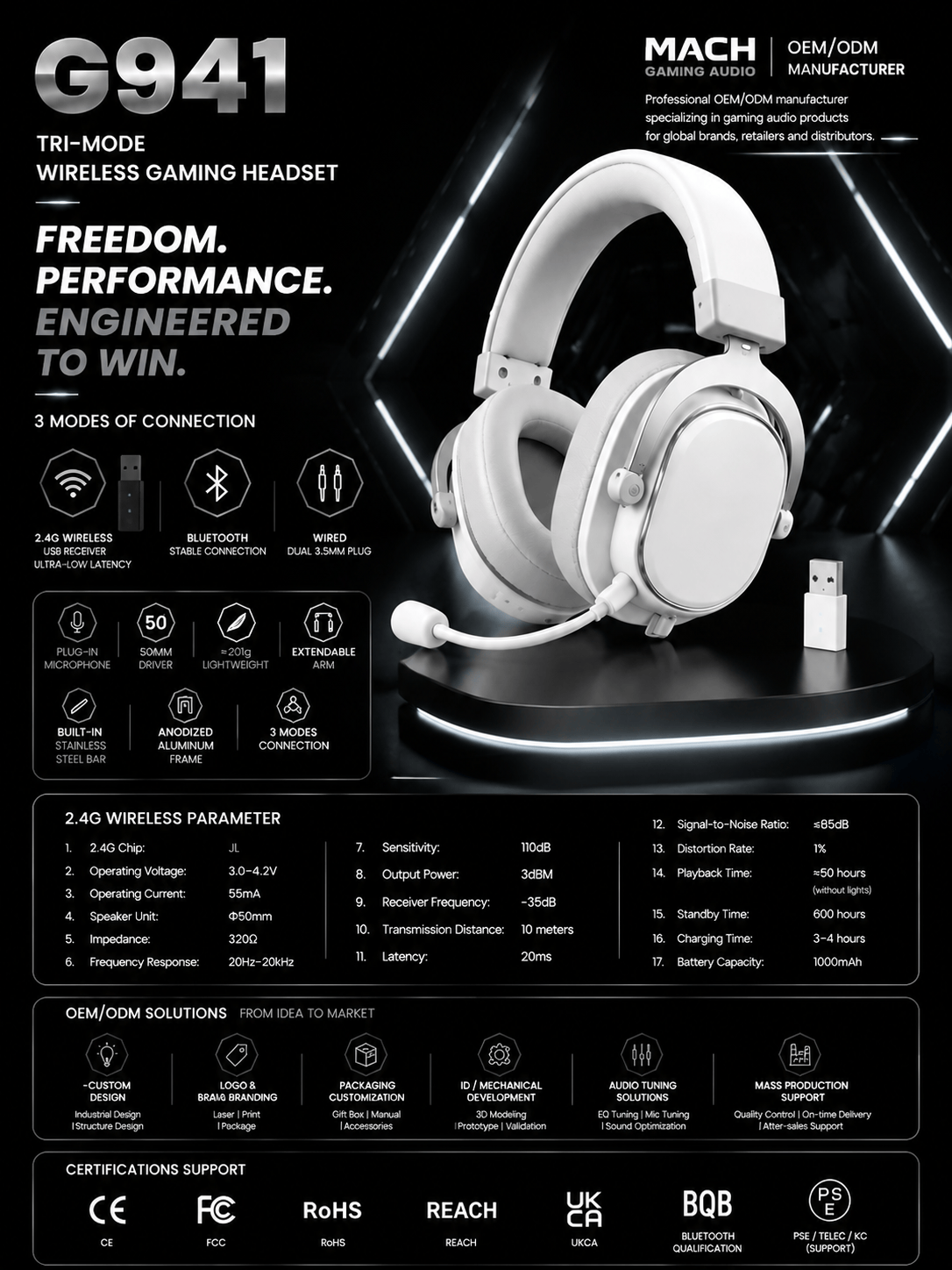
Brands should specify dual 3.5mm connectivity by defining the intended audio and microphone plugs, target PC ports, required adapters, wired-mode functions, microphone routing, labeling, and acceptance tests before approving a tri-mode gaming headset. The phrase dual 3.5mm is not a complete compatibility claim. Buyers need a documented cable and host matrix that explains how the wired route works beside 2.4GHz and Bluetooth.
This matters because desktop PCs often provide separate headphone-output and microphone-input jacks, while laptops, controllers, and mobile devices may use a single four-pole headset socket or no analog socket at all. A dual-plug cable can fit one environment directly but may require a combiner adapter in another. Incorrect symbols, wiring assumptions, or accessory choices can turn a technically valid headset into a support problem.
G941 White offers a useful sourcing reference. Its confirmed platform includes 2.4GHz wireless, Bluetooth, dual 3.5mm connection, an included dongle, Virtual 7.1, a 50mm driver, plug-in ENC microphone, RGB, and a 1000mAh battery. This article uses only those documented facts and focuses on how an OEM buyer can plan analog compatibility without competing with the G941 product page.
Understanding This Gaming Headset Platform
A dual-3.5mm tri-mode headset combines separate analog connection planning with receiver-based wireless and Bluetooth, giving brands several use cases but requiring mode-specific documentation.
Tri-mode describes three connection routes, not identical behavior. A USB receiver can provide a defined 2.4GHz wireless system for approved hosts. Bluetooth can support compatible built-in wireless devices. Dual 3.5mm provides an analog route intended for equipment with the matching ports or a suitable adapter. Audio, microphone, controls, RGB, Virtual 7.1, and power behavior may differ among those paths.
This platform can suit brands and distributors serving desktop-PC users while retaining wireless flexibility. The wired route fits separate audio and microphone jacks, while receiver and Bluetooth routes address other scenarios.
The OEM value comes from combining the established platform with a brand-specific visual and accessory system. Logo, white color direction, packaging, manual, dongle presentation, cable identification, and adapters can be evaluated against the confirmed structure. Engineering changes require a separate impact review.
Buyers should define the primary customer before choosing the package. A desktop-PC product may prioritize direct dual-plug use. A broader retail product may need a clearly specified combiner adapter or different cable strategy. The final bundle should follow tested devices rather than a generic claim of universal compatibility.
| User scenario | Likely connection need | Buyer decision |
|---|---|---|
| Desktop PC with separate jacks | Separate headphone and microphone plugs | Confirm plug identification, reach, jack matching, and microphone input |
| Laptop or controller with one headset jack | Single four-pole connection may be required | Confirm whether a tested combiner adapter is included or supported |
| USB-host gaming | 2.4GHz receiver and any required USB adapter | Validate host support, audio, microphone, reconnect, and controls |
| Mobile or general wireless use | Bluetooth where supported | Validate profiles, pairing, microphone state, controls, and latency expectations |
G941 Product Overview
G941 White is a white tri-mode OEM platform with 2.4GHz wireless, Bluetooth, dual 3.5mm, Virtual 7.1, a 50mm driver, plug-in ENC microphone, RGB, and a 1000mAh battery.
The confirmed wireless direction uses a JL 2.4GHz solution with an included dongle. The specification lists a 10-meter transmission distance and 20ms latency for the 2.4GHz route. These references should stay attached to that route and the final validation method; they do not establish Bluetooth or analog latency.
The acoustic data lists a 50mm driver, 32-ohm impedance, 110dB sensitivity, and a 20Hz-20kHz response. Virtual 7.1 is selected for the platform. Its availability and activation should be validated by mode and host because spatial processing is a signal-path feature, not a consequence of driver diameter.
The mechanical direction includes a white appearance, stainless steel bar, anodized aluminum frame, extendable arm, plug-in microphone with ENC support, RGB, and an approximate headset weight of 201g. These facts create a defined private-label platform without proving fit for every user or device.
The 1000mAh battery is listed with approximately 50 hours of playback without lighting, 600 hours of standby, and three to four hours of charging. Commercial runtime claims require confirmation under defined volume, radio mode, RGB, firmware, temperature, and end-of-test conditions.
| Platform area | Confirmed G941 White direction | Approval focus |
|---|---|---|
| Connectivity | 2.4GHz, Bluetooth, and dual 3.5mm | Host matrix, wired plug plan, adapter bundle, and mode behavior |
| Audio | 50mm driver and Virtual 7.1 direction | Tuning, channel match, mode differences, feature path, and production tolerance |
| Communication | Plug-in microphone with ENC support | Connector durability, voice quality, routing, mute, and mode support |
| Design and power | White structure, RGB, approximately 201g, and 1000mAh battery | CMF, comfort, lighting, runtime conditions, charging, and aging |
Buyer Challenge: Turning Dual 3.5mm Into a Clear Compatibility Plan
The buyer's challenge is to translate two analog plugs into an accurate device list, accessory bundle, user instruction, and quality-control plan.
Dual 3.5mm commonly indicates separate paths for headphone audio and microphone input, but the buyer should confirm the final cable, plug functions, contact arrangement, and target jacks with the supplier. Color conventions can help users, yet labels and icons should remain understandable if host colors differ.
Compatibility language needs discipline. A desktop PC may expose two matching analog jacks. A laptop or controller may expose one combined socket. Some modern devices provide USB only. The brand should list tested scenarios and the adapter required for each one rather than placing every platform logo on the package.
Microphone support is a frequent source of confusion. The headset may play audio when only the headphone plug is connected while the microphone remains unavailable. A combiner or splitter used in the wrong direction may physically fit but not route signals correctly. The manual should show the actual connection sequence with the approved accessory.
Tri-mode controls create another boundary. Electronic volume, mute, ENC, RGB, Virtual 7.1, prompts, or buttons may behave differently in analog mode or may require power. Buyers should document what remains active, what transfers to the cable, and what depends on the host. A feature being unavailable in one route is acceptable when it matches the specification and claim.
Packaging must protect the cable and make both plugs, dongle, adapters, and microphone easy to identify. Customer-service notes should mirror the manual so a user can distinguish a wrong port, missing adapter, muted host input, or unsupported function from a product defect.
| Procurement risk | What can happen | Preventive control |
|---|---|---|
| Unclear plug roles | Audio works but microphone is connected to the wrong jack | Durable plug labels, matching manual diagram, and final inspection |
| Incorrect adapter direction | Two plugs cannot be combined correctly for a single headset socket | Approve the exact adapter and verify audio plus microphone on target hosts |
| Overbroad compatibility claim | A platform logo implies functions not tested in that route | Claim matrix tied to host, connection, accessory, and supported features |
| Mode-feature mismatch | Users expect RGB, ENC, controls, or Virtual 7.1 in passive analog use | Document wired power state and every available or unavailable function |
How MACH Supports a Tri-Mode Headset Project
MACH can support requirement review, configuration and customization planning, sample validation, reliability checks, packaging preparation, and production quality control for an approved G941 White project.
Project review can begin with the buyer's target market, host devices, channel strategy, forecast quantity, brand identity, and required connection scenarios. For dual 3.5mm, the brief should identify desktop jacks, single-jack devices, required adapters, microphone expectations, and packaging claims.
Customization can include logo and branding, white color and CMF evaluation, packaging and manuals, ID or mechanical development evaluation, audio and microphone tuning evaluation, dongle configuration, and accessories. Each request should be classified by its effect on tooling, acoustics, RF, firmware, power, reliability, and compliance.
Sample validation can cover 2.4GHz and Bluetooth function, dual-3.5mm connection, adapters, audio and microphone routing, Virtual 7.1 configuration, acoustics, controls, RGB, battery, charging, mechanical reliability, appearance, and packaging. Tests should use production-representative parts and the final accessory set.
Before mass production, the approved firmware, dongle, bill of materials, cable, plugs, adapter, microphone, color sample, packaging, and acceptance limits should be frozen. Incoming checks, assembly controls, functional testing, final inspection, traceability, and documented change control help preserve the approved configuration.
Technical Deep Dive: Dual 3.5mm Plugs, TRRS Adapters, and Microphone Routing
Dual 3.5mm and single-jack TRRS connections can carry similar user functions through different physical arrangements, so OEM buyers must approve the exact plug, contact, adapter, and routing design.
A traditional desktop gaming setup may use one 3.5mm plug for stereo headphone output and another for microphone input. Each plug connects to a dedicated host jack. A laptop, controller, or portable device may instead use one TRRS headset socket that combines left audio, right audio, ground, and microphone on four contacts. These arrangements are not interchangeable without the correct cable or adapter.
An adapter must be specified by direction. A combiner can accept separate headphone and microphone plugs and present one combined headset plug. A splitter can take one combined headset plug and separate it for two PC jacks. They may look similar, but reversing the intended direction can cause missing microphone input, missing channels, low output, or no useful connection.
Contact standards also matter. Four-pole headset connections can use different microphone and ground arrangements. Buyers should confirm the standard used by the approved product and adapter, then test the real host list. This article does not assign an unpublished pinout to G941 White; the final wiring must come from the approved cable specification and samples.
Microphone routing should be tested as a complete chain: plug-in microphone, headset socket, internal wiring, outgoing cable, adapter if present, and host input. Verify voice level, noise, channel leakage, intermittent contact, insertion force, mute behavior, mechanical movement, and repeated insertion. ENC availability may depend on the powered electronic path and should not be assumed in passive analog use.
Mechanical details can affect reliability. Plug strain relief, cable exit, flex life, plating, contact tolerances, adapter retention, cable length, and packaging bends all influence field performance. The quality plan should define visual checks, continuity, channel assignment, microphone function, flex or insertion testing where required, and periodic verification against the golden sample.
The wired route must also be evaluated beside wireless modes. Confirm what happens when a cable is inserted, whether wireless disconnects, which controls remain active, whether battery power is required, and how the user returns to 2.4GHz or Bluetooth. These behaviors belong in the connection matrix, manual, sample report, and production test.
Finally, retail claims should describe tested outcomes rather than connector count alone. State the supported host scenario, required adapter, and available functions. Clear connection diagrams and labeled accessories often have more procurement value than adding another compatibility logo.
| Connection item | Technical question | Evidence for approval |
|---|---|---|
| Two analog plugs | Which plug carries headphone audio and which carries microphone input? | Cable drawing, labels, continuity result, and host test |
| Single TRRS host | Which approved combiner and contact standard are required? | Adapter specification and audio-plus-microphone test |
| Microphone path | Does the plug-in microphone work through the cable and adapter? | Voice, noise, movement, mute, and repeated-insertion results |
| Mode transition | What changes when analog cable is inserted or removed? | State diagram, instructions, controls, and regression test |
| Mass production | How are wiring and connection consistency controlled? | Locked BOM, golden sample, continuity and function tests, traceability |

Key Considerations When Developing a Gaming Headset Platform
Buyers should evaluate connectivity, audio, microphone, compatibility, customization, production, and compliance as one system rather than approving isolated specifications.
For connectivity, define every host, port, receiver, cable, adapter, mode-switching step, and supported feature. For audio, approve tuning, channel balance, useful level, noise, distortion conditions, and differences among 2.4GHz, Bluetooth, and analog routes.
For the microphone, verify the plug-in connector, voice target, ENC direction, mute, analog routing, adapter behavior, wireless transport, and durability. For compatibility, maintain a tested matrix and avoid universal wording where no device-specific evidence exists.
For customization, separate artwork and packaging changes from firmware, acoustic, electrical, RF, or structural changes. For production, freeze samples and versions, define inspection limits, and require impact review for changes to cable, adapter, microphone, dongle, driver, cushion, battery, or housing.
Compliance planning should follow the final market and configuration, including wireless, EMC, materials, battery, labeling, documentation, and accessories. Certificates or reports for another configuration should not be treated as automatic coverage.
- List every target device, port, controller, operating system, and required adapter.
- Confirm the role, contact specification, labeling, and cable length of both 3.5mm plugs.
- Approve the exact combiner or splitter direction and test audio plus microphone.
- Document wired power state, controls, RGB, ENC, Virtual 7.1, and mode transitions.
- Validate acoustic and microphone performance in every claimed route.
- Confirm receiver connector, adapter, host recognition, reconnect, RF, and latency method.
- Set runtime, charging, RGB, and battery-aging test conditions.
- Freeze firmware, dongle, BOM, cable, adapter, golden sample, and acceptance limits.
- Review packaging diagrams, platform claims, accessory labels, and customer-support guidance.
- Confirm market-specific compliance requirements for the final product and bundle.
OEM/ODM Customization Options
G941 White customization can be evaluated around branding, white CMF, packaging, ID and mechanical details, audio and microphone tuning, dongle configuration, and accessories.
Logo and branding work should define method, location, size, color, durability, and artwork control. White CMF needs an approved master and tolerance across housing, cushions, cables, microphone, dongle, adapters, and other visible parts.
Packaging and manuals should show the dual-plug connection, any approved adapter, receiver use, pairing, wired-mode limitations, charging, microphone, RGB, and Virtual 7.1 behavior. Barcode, compliance labels, languages, and accessory trays should follow the sales channel.
ID or mechanical changes can affect tooling, strength, weight, comfort, acoustic volume, microphone fit, cable routing, antenna conditions, and packaging. Audio, microphone, firmware, dongle, or accessory changes can affect performance and validation. MACH can evaluate feasibility according to the project scope and final sample requirements.

Conclusion
Dual 3.5mm adds value when the brand converts it into a tested analog connection plan, not when it appears only as two plugs in a specification.
A reliable sourcing plan defines plug roles, host jacks, contact standard, adapters, microphone routing, wired power state, mode transitions, packaging diagrams, and production tests. It then aligns those facts with the receiver and Bluetooth routes to create one understandable tri-mode product.
G941 White provides a real reference with dual 3.5mm, 2.4GHz, Bluetooth, Virtual 7.1, a 50mm driver, plug-in ENC microphone, RGB, and a 1000mAh battery. Final suitability depends on the buyer's target devices, approved accessory bundle, customization, sample validation, claims, and market requirements.
Share your target devices, dual-3.5mm requirements, adapters, branding, packaging, and market. MACH can review G941 White against a project-specific compatibility and validation plan.
Contact MACH IndustryFrequently Asked Questions
What is a dual 3.5mm gaming headset?
A dual 3.5mm gaming headset uses two analog plugs, commonly planned for separate headphone audio and microphone input paths. Buyers should confirm the exact plug functions, contacts, labels, and target host jacks for the approved product.
What is the difference between dual 3.5mm and a single TRRS headset plug?
Dual 3.5mm separates audio and microphone connections across two plugs, while a TRRS headset plug can combine left audio, right audio, ground, and microphone on four contacts. The correct arrangement depends on the host and approved cable or adapter.
Can a dual 3.5mm headset work with a laptop or controller?
It may require an approved combiner adapter when the host provides one combined headset socket. Buyers must test the exact headset, adapter, contact standard, and target device for both audio and microphone.
Does the microphone work if only the headphone plug is connected?
Normally the separate microphone path must also reach the correct host input. The exact result depends on the approved cable and host, so the manual should show the required plugs or adapter.
Do RGB, ENC, controls, and Virtual 7.1 work in 3.5mm mode?
Not necessarily. Electronic features can depend on power and the implemented signal path. Buyers must verify each feature in analog mode and state any limitations in packaging and instructions.
What wired specifications should be included in a gaming headset RFQ?
Specify plug functions, contact arrangement, cable length, labels, target jacks, adapter direction, microphone routing, powered or passive behavior, controls, supported features, durability, packaging, and acceptance tests.
What G941 White features are relevant to a dual-3.5mm OEM project?
G941 White combines dual 3.5mm with 2.4GHz, Bluetooth, an included dongle, Virtual 7.1, a 50mm driver, plug-in ENC microphone, RGB, and a 1000mAh battery.
Can MACH customize the G941 White cable and accessory bundle?
Dongle and accessory configuration can be evaluated with packaging and manual requirements. Cable, adapter, or functional changes require confirmation against the product structure and project validation scope.
How should a factory test dual 3.5mm connections in production?
Use locked cable and adapter specifications, continuity and channel checks, audio output, microphone input, movement or insertion checks where required, visual labels, accessory verification, traceability, and periodic golden-sample comparison.
Which certifications apply to a tri-mode wireless gaming headset?
Requirements depend on the final market, radio, EMC, materials, battery, labels, documentation, and accessory bundle. Buyers should confirm applicable requirements for the approved configuration rather than relying on unrelated product reports.
Related Resources
Need OEM/ODM gaming audio solutions?
Contact MACH Industry to discuss your gaming headset, gaming earbuds, or private-label audio project.
Contact MACH Industry