Home > Resources > Gaming Headset Guide
How Should Buyers Validate Acoustic Tuning in a 2.4GHz Gaming Headset?
A technical buyer guide to defining, measuring and approving gaming headset acoustic tuning across connection modes and mass-production samples.
Buyers should approve acoustic tuning through a defined sound target, repeatable measurements, controlled listening, mode-by-mode testing and a signed golden sample. Driver diameter alone does not prove sound quality.
A sourcing decision based only on 40mm or 50mm leaves the most important variables uncontrolled. The finished sound also depends on driver construction, chamber volume, vents, damping, ear-cushion seal, wearing position, amplifier, DSP and production variation. The buyer therefore needs an acoustic brief and acceptance plan that engineering, quality and the supplier can repeat.
Why Driver Size Is Not an Acoustic Target
Driver diameter is one mechanical variable; acoustic approval must evaluate the complete headset and its production consistency.
The diaphragm material and geometry, motor structure, impedance, sensitivity and unit variation influence the driver's behavior. The same nominal diameter can be used in drivers with very different construction and useful operating limits.
The headset changes that behavior through the front and rear chamber, vents, damping materials, grille, driver-to-ear distance, ear-cushion seal and clamping force. Amplifier output and DSP can further change level and balance. A specification sheet can identify components, but it cannot replace finished-headset measurement and listening.
Production variation matters as much as the approved sample. Driver batches, cushion foam, vent mesh, adhesive placement and assembly can shift the result. Buyers should define measurable limits and reference samples instead of treating diameter as evidence of quality.
| Variable | Why it matters | Buyer control |
|---|---|---|
| Driver construction | Diaphragm, motor, impedance and sensitivity affect response and level | Freeze supplier, model and approved ranges |
| Chamber and vents | Control loading, resonances and pressure release | Freeze geometry, mesh and vent condition |
| Damping | Changes resonances and tonal balance | Freeze material, position and quantity |
| Ear cushions and clamp | Change seal, driver distance and wearing variation | Approve material, geometry and fit range |
| Amplifier and DSP | Change gain, filtering and mode response | Freeze hardware and firmware versions |
| Assembly variation | Can create unit-to-unit and left/right differences | Set production sampling and tolerances |
Define the Target User and Gaming Scenario
A useful tuning target begins with the intended gamer, content and listening duration, not a generic request for more bass.
Competitive FPS users may prioritize clear directional cues, transient detail and separation under busy mixes. Story games may need dialogue intelligibility, ambience and impact. General PC or multi-platform products need stable performance across varied sources. Music-and-gaming products must balance game cues with tonal credibility, while streaming products also need comfortable monitoring and communication.
More bass is not automatically better gaming sound. Excess energy can mask midrange information and directional details, while an overly bright balance can create fatigue. Define priorities and acceptable tradeoffs for the intended retail position and long-session comfort.
| Use scenario | Possible priority | Validation focus |
|---|---|---|
| Competitive FPS | Directional cues and separation | Repeatable game scenes, imaging and masking |
| Story games | Dialogue, ambience and controlled impact | Voice clarity, tonal balance and scene transitions |
| General PC gaming | Balanced multi-title performance | Game, communication and music references |
| Multi-platform | Consistency across named hosts and modes | Source level, mode path and control differences |
| Streaming and communication | Voice monitoring and low fatigue | Microphone-active audio, comfort and long sessions |
Create an Acoustic Target Brief
The target brief translates subjective words into references, test conditions and approval decisions.
Use a brief before requesting tuning samples. Reference products help communicate direction, but the buyer should identify what to retain or avoid rather than ask for an unqualified copy.
| Field | Buyer entry | Approval evidence |
|---|---|---|
| Target user and main games | Audience, game genres and session length | Approved use cases |
| Reference headset | Named product and specific liked/disliked traits | Level-matched comparison notes |
| Bass | Desired weight, control and masking limit | Measurement plus game/music listening |
| Midrange and dialogue | Clarity and body target | Voice and dialogue references |
| Directional cues | Priority and test scenes | Controlled gameplay notes |
| Treble fatigue | Desired detail and fatigue boundary | Extended listening at defined level |
| Music requirement | Genres and tonal expectation | Reference tracks |
| Virtual 7.1 | Required path, hosts and on/off behavior | Separate measurement and listening |
| Main mode and volume | 2.4GHz/Bluetooth/3.5mm and range | Recorded source and volume condition |
| Ear cushion | Material, geometry and comfort direction | Approved fitted sample |
Evaluate the Complete Headset System
Tune and approve the driver only after it is installed in the final mechanical, cushion and electronic system.
A bare-driver curve does not include the front and rear chamber, vents, damping, grille, cushion, enclosure or headband clamp. These parts establish the acoustic load and the seal at the ear. Wearing position and user anatomy then add real-world variation.
Wireless signal paths, amplifier gain, codec behavior, DSP and Virtual 7.1 may create mode-specific results. Final approval should use production-intent hardware, cushions, electronics and firmware. Any temporary part must be identified so it is not mistaken for the production baseline.
Build a Repeatable Measurement Plan
Measurements are useful only when the fixture, setup, mode, level, revision and acceptance rules are controlled.
Frequency response should be compared with the agreed target and reference under the same fixture and placement method. Left/right matching checks symmetry; THD and abnormal-noise checks identify nonlinear or assembly issues at useful levels. Sensitivity and maximum usable level require a defined input and distortion context.
Measure more than one unit and record repositioning where fit affects the result. Specific tolerances and pass criteria should be agreed by buyer and supplier in advance according to the project, equipment and method. This guide does not impose invented universal limits.
| Test | Record | Acceptance definition |
|---|---|---|
| Frequency response | Curve, smoothing, fixture and placement | Project target and agreed bands |
| Left/right matching | Channel curves on the same unit | Agreed frequency-dependent tolerance |
| THD | Frequency, level and measurement setup | Project-defined usable-level limit |
| Sensitivity | Input condition and fixture output | Approved range |
| Maximum usable level | Level, distortion and abnormal sound | Project-defined criterion |
| Sample variation | Units, batches and repositioning | Approved statistical or sampling limit |
| Abnormal noise | Buzz, rattle, rub or intermittent sound | No unacceptable defect under agreed test |
| Traceability | Fixture, mode, DSP, volume and sample revision | Complete record linked to sample |
Test Every Connection Mode Separately
2.4GHz, Bluetooth, 3.5mm and DSP states can follow different signal paths, so one result cannot represent all modes.
Test 2.4GHz, Bluetooth and 3.5mm separately on named hosts. Repeat digital tests with Virtual 7.1 on and off, and test any EQ mode only if supported. Check microphone-active and microphone-inactive conditions because communication modes can change gain, routing or processing.
Record source output, host settings, firmware, codec or profile where relevant, volume and DSP state. Apparent tuning differences may come from source level, processing or communication routing rather than the driver itself.
| Condition | Why separate | Record |
|---|---|---|
| 2.4GHz | Receiver, firmware and digital path | Host, transmitter, versions and DSP state |
| Bluetooth | Profile, codec and host implementation | Named host, profile and volume |
| 3.5mm | Analog source and amplifier output | Source device, jack path and level |
| Virtual 7.1 on/off | Processing may change response, level and spatial cues | Activation method and software/firmware |
| Microphone active/inactive | Communication routing may alter playback | Application, microphone state and mode |
Use Controlled Listening Evaluation
Listening evaluates real use; measurement provides repeatability. Neither should replace the other.
Use the same content, host, mode and level when comparing revisions. Random impressions at different loudness are unreliable because louder samples can seem more detailed. Include short diagnostic scenes and long-session checks.
| Tester | Content/game | Reference | Mode | Volume | Bass | Midrange | Dialogue | Directional cues | Treble fatigue | Long-session fatigue | Abnormal sound | Result | Notes |
|---|---|---|---|---|---|---|---|---|---|---|---|---|---|
| Record name/role | Record scene or track | Record product | Record path | Record setting | Score/note | Score/note | Score/note | Score/note | Score/note | Score/note | Yes/no and detail | Approve/revise | Revision and observations |
Evaluate Ear Cushions, Seal and Fit
Cushion material and fit can change bass, consistency, comfort and the user's perception of tuning.
Protein leather can provide a different seal and thermal experience from fabric; hybrid materials combine surfaces but still require validation. Thickness, ear opening, foam compression and driver-to-ear distance change the acoustic volume and leakage path.
Clamping force and head shape affect seal. Glasses can create leakage, particularly at low frequencies, while wearing-position shifts can change response. Evaluate multiple users and placements, then freeze cushion material, geometry and foam specification with the golden sample.
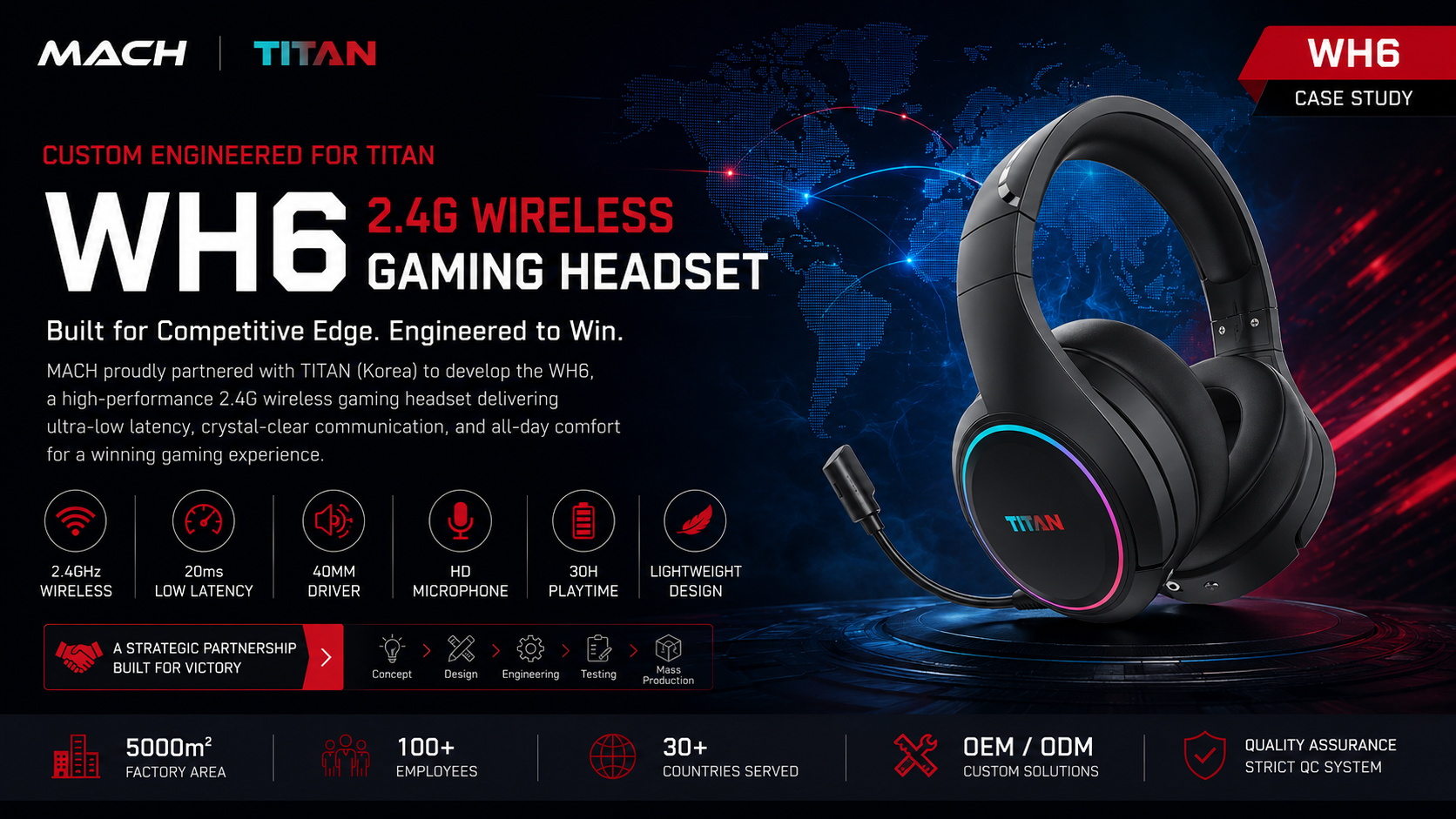
WH6 Korea OEM Acoustic Approval Example
WH6 shows why a 50mm driver must be approved as part of a complete headset rather than as an isolated specification.
The WH6 Korea project records a 2.4GHz wireless headset with a 50mm driver, 32-ohm impedance, Virtual 7.1, detachable microphone, final sample validation, trial production and mass-production control. The driver, enclosure, cushions, wireless path and processing therefore need one production-intent approval baseline.
The public project record does not include frequency-response, THD, channel-matching or EQ results, so this article does not claim a measured acoustic improvement or customer listening result. WH6 is used only to demonstrate the correct system-level approval method.
G90 40mm vs G946 50mm: What Buyers Can and Cannot Conclude
G90 and G946 confirm different driver diameters, but the published diameter alone cannot rank their sound quality.
The G90 platform lists a 40mm driver, while G946 lists a 50mm driver. Diameter can influence mechanical packaging, chamber design and driver-to-ear geometry. It does not prove that one model has stronger bass, better positional cues, lower distortion or better music performance.
Driver size is only one design variable. The finished result also depends on the driver construction, acoustic chamber, vents, damping, ear cushions, seal, amplifier, DSP and production consistency. Buyers should compare production-intent samples using the same target, fixture, modes and listening references.
| Confirmed fact | Permitted conclusion | Unsupported conclusion |
|---|---|---|
| G90 lists 40mm; G946 lists 50mm | The platforms use different driver sizes and mechanical directions | G946 automatically sounds better |
| Diameter affects packaging | Chamber and fit must be engineered around the unit | 50mm automatically has stronger bass |
| No shared public acoustic test record | Finished systems require controlled validation | Either model is automatically better for a game genre |
Freeze the Acoustic Golden Sample
The golden sample is useful only when its components, settings and test conditions are traceable.
Freeze the driver supplier and model, impedance and sensitivity range, chambers, vents, damping, cushion material and geometry, DSP/EQ version, firmware, approved sample, fixture, measurement conditions, listening references and production tolerances.
Changing the driver, cushion, damping, chamber, DSP or firmware may require renewed measurement and listening. Production checks should compare representative units with controlled limits, not assume that one approved sample represents every batch.
- Driver supplier and model
- Impedance and sensitivity range
- Front/rear chamber and vents
- Damping material and placement
- Cushion material and geometry
- DSP/EQ and firmware version
- Signed golden sample
- Fixture and placement method
- Measurement and listening conditions
- Production tolerances and sampling plan
Common Misleading Acoustic Claims
Replace broad marketing phrases with a target, test method, sample scope and evidence.
| Claim | Why insufficient | Evidence buyers should request |
|---|---|---|
| 50mm automatically sounds better | Diameter does not define the finished system | Controlled full-headset comparison |
| Hi-Fi gaming sound | No target or method is defined | Sound brief, measurements and listening record |
| Deep bass | Level, extension and masking are undefined | Target curve and reference comparison |
| Virtual 7.1 guarantees positional accuracy | Processing and game/host interaction vary | Named path, on/off test and game evaluation |
| 20Hz-20kHz proves quality | A bandwidth label does not show balance or distortion | Response, distortion and usable-level data |
| One approved sample represents production | Batch and assembly variation remain | Production sampling and tolerances |
| Driver specification equals headset performance | Enclosure, cushions, electronics and DSP alter the result | Finished-product validation |
Acoustic RFQ Checklist
Give the supplier a sound target and validation scope, not only a driver-size request.
Certification and compliance support can be coordinated according to the final product configuration, project scope and target market.
- Target users and session length
- Main game genres and communication use
- Reference headset and desired differences
- Driver direction without assuming performance
- 2.4GHz, Bluetooth and 3.5mm modes
- DSP and Virtual 7.1 requirements
- Cushion material, geometry and fit
- Desired bass, midrange and treble profile
- Measurement fixture, tests and sample count
- Controlled listening content and reviewers
- Signed golden sample
- Production tolerances and sampling
- Estimated quantity and launch schedule
Conclusion
A buyer-ready acoustic specification connects user needs to measurements, listening, mode validation and production controls.
Acoustic tuning should be approved as a complete system. Define the listener and games, establish a target brief, measure repeatably, listen under controlled conditions, test each connection and DSP mode, and freeze a traceable golden sample.
This process gives procurement a stronger basis for comparing 2.4GHz gaming headset platforms than driver diameter or broad sound claims alone.
Discuss Your Gaming Headset Acoustic Target
Send MACH your target users, game genres, references, connection modes, cushion direction, measurement scope and golden-sample requirements for project evaluation.
Contact MACHFrequently Asked Questions
Is a 50mm driver always better than a 40mm driver?
No. Driver size is one variable. Driver construction, chambers, vents, damping, cushions, seal, amplifier, DSP and production consistency determine the finished result.
What should buyers include in a gaming headset acoustic target?
Define users, game genres, references, bass and midrange direction, dialogue and cue priorities, fatigue limits, music use, connection modes, DSP states, volume and cushion direction.
How should frequency response be evaluated?
Use an agreed fixture, placement method, connection mode, DSP state, level, sample revision and project-specific target. Record repositioning and multiple samples where relevant.
Should 2.4GHz, Bluetooth and 3.5mm modes be tested separately?
Yes. They can use different source, amplifier, codec and DSP paths, so a result from one mode should not represent the others.
Can Virtual 7.1 change the tuning result?
Yes. Processing may change response, level, spatial cues or delay. Test it on and off through the supported path and approved hosts.
Why do ear cushions affect bass response?
Cushion material, geometry, compression and seal change leakage, acoustic volume and driver distance. Glasses and wearing position can add further variation.
What is an acoustic golden sample?
It is the signed production-intent reference linked to frozen drivers, mechanics, cushions, DSP, firmware and test conditions for production comparison.
How can buyers control acoustic consistency in mass production?
Freeze critical parts and settings, define measurement tolerances and sampling, retain traceable golden samples, and revalidate changes affecting the acoustic path.
Related Resources
Need OEM/ODM gaming audio solutions?
Contact MACH Industry to discuss your gaming headset, gaming earbuds, or private-label audio project.
Contact MACH Industry