Home > Resources > Gaming Headset Guide
How Should Brands Control Color Quality in a White Gaming Headset?
A B2B buyer guide to white gaming headset color standards, material matching, RGB interaction, cosmetic inspection, packaging protection, and mass-production CMF control.
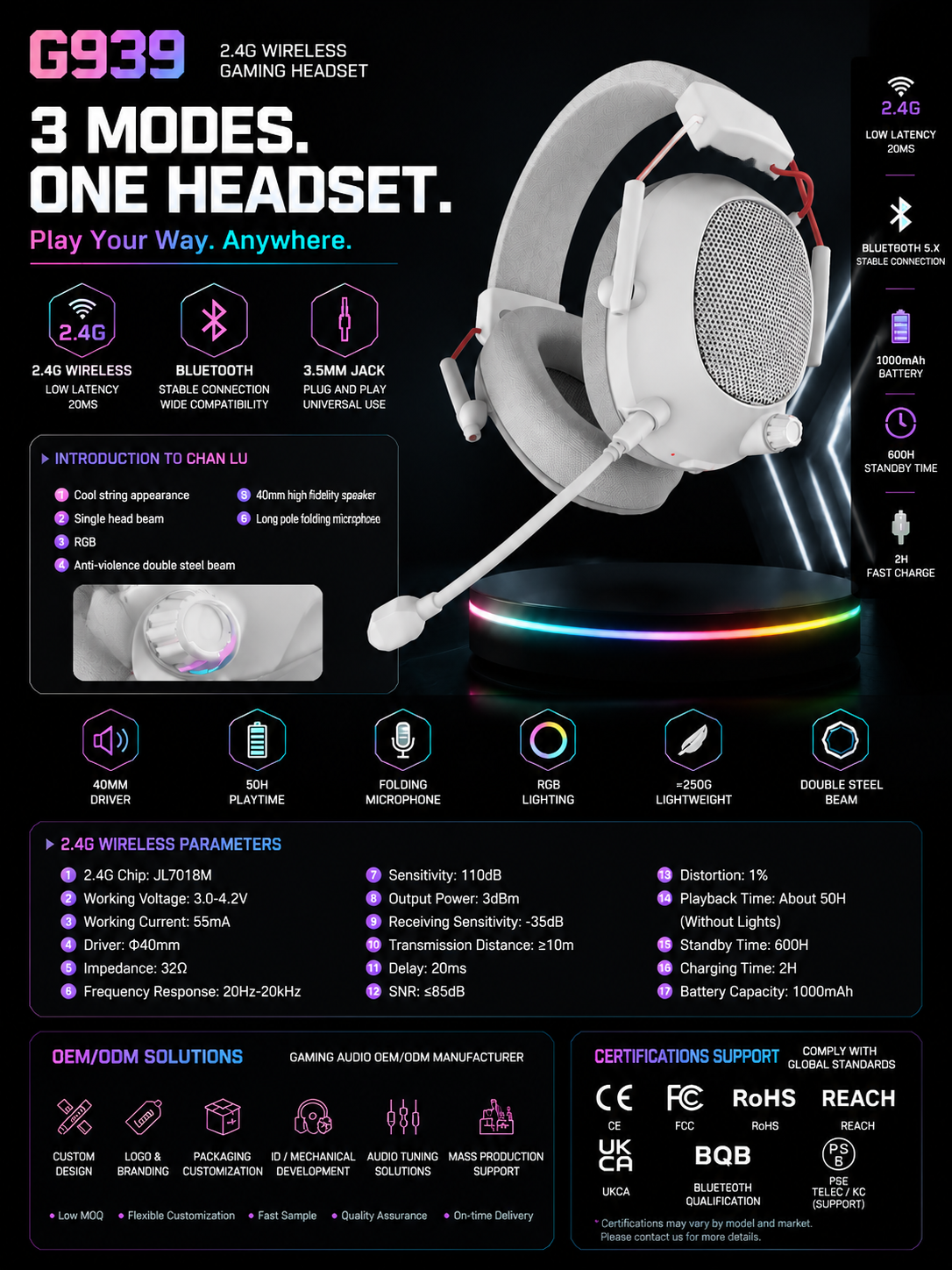
Brands should control a white gaming headset through an approved CMF standard, material-by-material color limits, controlled lighting conditions, defined cosmetic zones, RGB-on and RGB-off samples, packaging protection, production inspection, and formal change control. A color name such as white is not precise enough for OEM production because plastic resin, texture, gloss, coating, printing, cushions, cables, metal parts, and illuminated areas can appear different even when suppliers use similar color references.
This issue matters to private-label buyers because white products expose visual variation quickly. Color mismatch, fingerprints, particles, scuffs, yellow or blue undertones, uneven gloss, light leakage, or tray rubbing can weaken the intended retail position before the user evaluates audio or wireless performance. Procurement, design, quality, packaging, and marketing teams need one shared appearance standard.
G939 WH provides a documented reference for this buyer problem. It is a white private-label tri-mode gaming headset with dedicated JL7018M-based 2.4GHz wireless, Bluetooth, 3.5mm audio, a 40mm driver, RGB lighting, a folding microphone, double-steel headband structure, a 1000mAh battery, and approximately 250g product weight. This guide uses those confirmed characteristics to explain white-product control without modifying or repeating the product page.
Understanding the G939 Gaming Headset Platform
G939 WH is a white private-label tri-mode wireless gaming headset platform designed for gaming peripheral brands, importers, distributors, retailers, and e-commerce programs.
The platform provides three confirmed connection paths. Dedicated 2.4GHz wireless uses the JL7018M solution and is specified at 20ms latency with a transmission distance of at least 10m. Bluetooth provides a separate wireless listening path for compatible devices, while the 3.5mm connection provides a wired audio option.
The acoustic system uses a confirmed 40mm driver with 32-ohm impedance, 110dB sensitivity, and a listed 20Hz-20kHz frequency response. The standard configuration includes a long folding microphone, with ENC microphone support selected in the product data. Final acoustic and voice performance still depends on tuning, enclosure, cushion seal, electronics, microphone position, and production variation.
The 1000mAh battery is specified for approximately 50 hours of playback with RGB lighting off, approximately 600 hours standby, and approximately two hours charging. Runtime references should be supported by documented mode, volume, lighting, microphone, battery, temperature, and endpoint conditions before being used in market claims.
Its white housing, visible double-steel headband structure, RGB lighting, folding microphone, and approximately 250g weight establish the platform's product identity. MACH can evaluate product design and color, logo and private-label branding, retail packaging, industrial and mechanical development, audio tuning, sampling, and mass-production support for the approved project scope.
| Platform area | Confirmed G939 WH reference | Buyer approval focus |
|---|---|---|
| Appearance | White housing, RGB, double-steel headband structure | Color master, material matching, gloss, texture, light interaction, cosmetics, and packaging |
| Connections | 2.4GHz, Bluetooth, and 3.5mm audio | Host-and-mode matrix, latency method, range conditions, microphone route, and accessories |
| Audio and voice | 40mm driver and folding microphone with ENC support | Tuning, channel match, useful output, speech, positioning, and sample consistency |
| Power | 1000mAh battery and RGB lighting | Runtime conditions, charging, indicators, lighting state, aging, and production cells |
Buyer Considerations Before Choosing a Wireless Gaming Headset Platform
Buyers should evaluate commercial positioning, appearance feasibility, mode-specific compatibility, audio, microphone, battery, customization, compliance, packaging, and manufacturing control as one product decision.
Start with the range strategy. Define whether the white headset will be a core SKU, a color extension, a limited retail bundle, or part of a coordinated gaming-accessory family. The answer affects color matching, packaging imagery, accessory colors, inventory planning, sales-channel expectations, and how much customization is justified.
Connectivity should be documented by mode. For 2.4GHz, define the approved host, receiver, latency method, range conditions, audio, microphone, controls, and reconnect behavior. Bluetooth should have its own supported-device and function matrix; the source identifies Bluetooth 5.x but does not confirm a more precise version. The 3.5mm route should identify compatible ports, cable behavior, microphone routing, and which powered functions remain available.
Audio specifications are configuration references rather than complete quality evidence. A 40mm driver, 32-ohm impedance, sensitivity, and frequency range do not independently establish tonal balance, positional clarity, distortion at useful level, channel matching, or unit consistency. Buyers should set an acoustic target and compare production-representative samples.
The folding microphone should be evaluated for voice clarity, position, movement noise, folding durability, wireless and wired routing, mute behavior where applicable, and sample variation. ENC describes microphone-side noise processing and should not be presented as listener-side active noise cancellation.
Battery and RGB requirements need a shared test plan. The approximate 50-hour playback reference is specified with lighting off. Buyers should state connection mode, volume, lighting, microphone use, temperature, test endpoint, and sample count, then separately approve RGB color, brightness, diffusion, controls, memory state, and cosmetic consistency.
For a white private-label product, appearance feasibility should be reviewed before the project schedule is fixed. Logo method, white target, material mix, RGB interaction, packaging protection, inspection lighting, and acceptable cosmetic limits can influence samples, tooling work, supplier coordination, and production yield.
| Decision factor | Question for the supplier | Evidence before approval |
|---|---|---|
| White CMF | How will white parts, soft goods, printing, and RGB be matched? | Approved masters, boundary samples, lighting method, zones, and cosmetic limits |
| Connectivity | Which functions work on each target device and mode? | Tested host, mode, receiver or cable, audio, microphone, controls, and limitations |
| Performance | How are audio, voice, battery, latency, and range verified? | Defined methods, conditions, sample quantities, limits, and production checks |
| Manufacturing | How will the approved result remain stable? | Locked BOM, golden samples, inspection plan, traceability, and change control |
Why White Gaming Headsets Need a Dedicated CMF and Cosmetic Quality Plan
White gaming headsets need tighter appearance planning because color undertone, material, texture, gloss, lighting, handling, and packaging can make small production differences visible across the assembled product.
The first requirement is a physical color standard. A screen image, verbal description, or general white code cannot fully represent how a finished material appears. The project should approve master samples for each visible material or process and record viewing conditions. A molded housing, painted trim, printed logo, cable jacket, cushion covering, and exposed metal may require coordinated but not necessarily identical specifications.
Material metamerism and surface finish affect perceived matching. Two white parts can look similar under one light and different under another. Texture scatters light, gloss creates reflections, and curved surfaces produce highlights that change perceived tone. Buyers should review assembled samples under agreed lighting and viewing angles, while quality teams use the same method for production decisions.
RGB creates a second appearance state. Light can reflect from white surfaces, reveal gaps, produce local color casts, or make one material look brighter than another. Approve the headset with RGB off and through the intended lighting behavior. Define diffusion, brightness, visible hotspots, leakage, color transitions, and acceptable left-right consistency without assuming the lighting system will hide cosmetic variation.
Cosmetic zoning makes inspection practical. High-visibility areas such as ear-cup faces, headband covers, outer shells, and logo zones may need tighter limits than concealed or contact areas. The standard can define viewing distance, time, angle, illumination, and acceptance for particles, black points, scratches, sink marks, flow lines, gloss variation, print defects, gaps, steps, or marks. Limits should reflect the product position and realistic manufacturing capability.
Handling control is especially important for white parts. Gloves or clean-hand rules, protected fixtures, separated work surfaces, controlled bins, film or sleeves, and cleaning methods can reduce fingerprints, oil, dust, metal marks, and rubbing. The exact controls belong to the production plan; marketing should not claim a process that has not been implemented and audited.
Packaging must preserve the approved appearance. The tray and protective materials should prevent the white headset, folding microphone, cable, receiver, and accessories from rubbing or transferring color. Printed surfaces, dark foam, ties, bags, and coatings should be evaluated against the final materials. Transport testing should be followed by cosmetic inspection, not only a check that the product still functions.
Production approval needs master and boundary samples. A golden sample represents the target, while boundary samples show acceptable and unacceptable color, gloss, texture, printing, RGB, gaps, and cosmetic marks. Instrument readings can support control where appropriate, but the final decision method should correspond to how the assembled product is viewed.
Change control closes the system. Resin, pigment, coating, texture repair, tooling maintenance, supplier, soft goods, print process, RGB component, packaging material, or cleaning method can change appearance. The supplier should review affected samples against the approved standard before a change enters mass production.
For private-label buyers, a dedicated CMF plan converts white from a design preference into a manufacturable specification. It aligns design intent, supplier materials, production handling, quality inspection, packaging, marketing images, and customer expectations around one controlled product identity.
| CMF control | Insufficient requirement | Production-ready requirement |
|---|---|---|
| Color | Use white | Part-specific masters, tolerances or boundaries, materials, process, lighting, and viewing method |
| RGB | RGB lighting included | Off/on approval, zones, diffusion, hotspots, leakage, brightness, behavior, and symmetry |
| Cosmetics | No visible defects | Inspection zones, distance, time, angle, lighting, defect definitions, and boundary samples |
| Packaging | Protect the product | Material compatibility, contact points, rub prevention, accessory retention, and post-transport inspection |
| Changes | Use equivalent material | Documented risk review, comparison sample, revalidation, approval, and revision traceability |

OEM/ODM Opportunities for Gaming Brands
G939 WH can be evaluated for logo and private-label branding, product design and color, retail packaging, industrial and mechanical development, audio tuning, sampling, and mass-production support.
A clear project brief should state the target market, sales channel, required devices and connection modes, white and RGB direction, logo, packaging, accessories, quantity, schedule, acoustic target, validation, and compliance needs. Mark requirements as mandatory, preferred, or optional so feasibility and cost discussions are based on priorities.
Logo customization should define location, size, method, color, artwork, durability, and acceptance. Product color work should define approved masters for housing, trim, headband, cushions, cable, microphone, receiver, and other visible accessories. RGB and white CMF should be reviewed together on assembled samples.
Retail packaging customization should account for the white product's exposed surfaces. The tray, bag, ties, printed materials, cables, microphone, and receiver should be evaluated for rubbing, marking, transfer, and setup clarity. Final packaging imagery should match the approved product color and accessories.
Industrial or mechanical changes can affect appearance, structure, fit, internal space, antenna conditions, acoustics, tooling, reliability, and packaging. Audio tuning changes require their own targets and verification. MACH can evaluate these requirements, coordinate samples and testing, and align the final BOM, approved samples, packaging, inspection, and production plan.
Certification support depends on the target market and final configuration. The G939 source states support is available but does not include completed G939 WH certificates. Applicable radio, EMC, battery, materials, labeling, and documentation requirements should be confirmed for the approved product.
- Define target market, users, sales channel, product position, quantity, schedule, and required white-SKU role.
- Approve physical color and finish masters for every visible material, soft good, print, cable, and accessory.
- Set RGB off/on standards for zones, brightness, diffusion, leakage, hotspots, behavior, and consistency.
- Define cosmetic zones, inspection lighting, distance, angle, time, defects, and boundary samples.
- List required hosts and 2.4GHz, Bluetooth, and 3.5mm mode-specific functions and accessories.
- Set audio, microphone, latency, range, battery, charging, RGB, structural, and reliability criteria.
- Separate logo, color, packaging, and CMF work from tooling, structural, RF, electrical, or acoustic changes.
- Approve packaging contacts, protective materials, accessory retention, transfer risk, and post-transport cosmetics.
- Confirm market-specific compliance, documentation, testing, and certification responsibilities.
- Freeze BOM, firmware, masters, golden and boundary samples, QC plan, traceability, and change control.
Technical Specifications
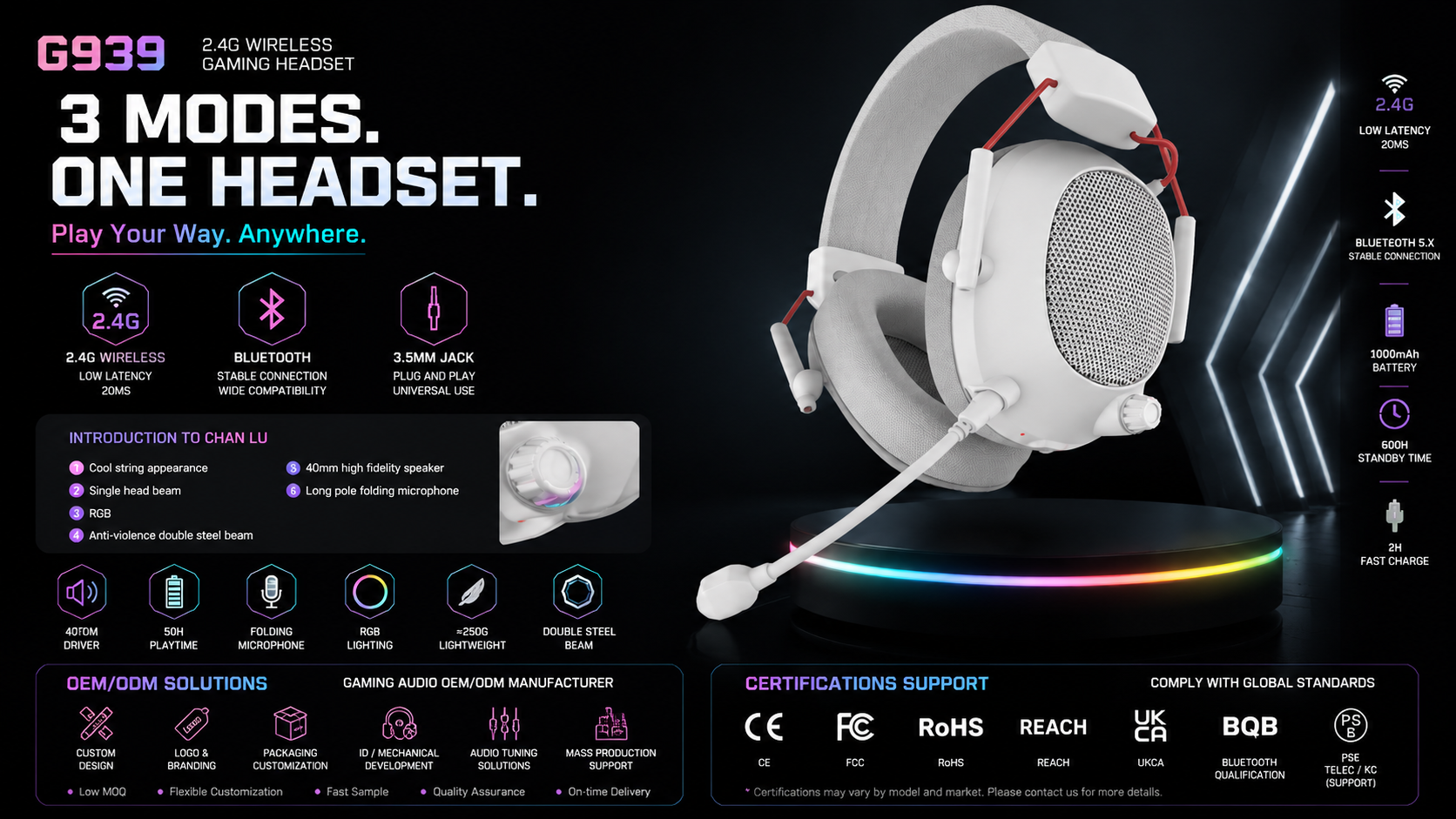
G939 WH combines confirmed tri-mode connectivity, a 40mm acoustic platform, folding microphone, RGB, double-steel headband, 1000mAh battery, and approximately 250g weight.
Dedicated 2.4GHz wireless uses the JL7018M solution with 20ms specified latency and at least 10m transmission distance. These values should be linked to an agreed host, firmware, measurement method, RF environment, sample quantity, and acceptance criteria. They should not be transferred to Bluetooth or 3.5mm operation.
Bluetooth is identified as Bluetooth 5.x without a more precise version. The 3.5mm connection provides wired audio for compatible devices. Buyers should confirm profiles, device support, controls, microphone behavior, cable, plug wiring, and powered features for the final mode matrix.
The 40mm driver is specified at 32 ohms, 110dB sensitivity, and 20Hz-20kHz frequency response. The standard platform includes a folding microphone and selected ENC support. Product approval should include acoustic target, channel match, distortion at useful levels, speech quality, microphone position, movement, and production variation.
The 1000mAh battery is specified for approximately 50 hours of playback without lighting, approximately 600 hours standby, and approximately two hours charging. The platform also includes RGB, a double-steel headband structure, and approximately 250g product weight. Fit, clamp, adjustment, structural reliability, charging, lighting, and cosmetics should be verified on final samples.
Conclusion
The right white private-label gaming headset platform combines a clear visual identity with verified connectivity, audio, microphone, battery, packaging, and repeatable production controls.
G939 WH provides a documented reference with white CMF, 2.4GHz, Bluetooth, 3.5mm audio, a 40mm driver, folding microphone with ENC support, RGB, double-steel headband, a 1000mAh battery, and approximately 250g weight. Its suitability depends on the brand's target market, appearance standard, host matrix, customization, validation, compliance, and quality requirements.
For buyers, the central lesson is that white is not merely a color selection. Physical masters, RGB review, cosmetic zones, handling, packaging, inspection, boundary samples, and change control help preserve the intended identity from project sample to production shipment.
Discuss your gaming headset project with MACH. Share your white CMF direction, target devices, connection modes, branding, packaging, quantity, and sales market.
Contact MACH IndustryFrequently Asked Questions
Why is color consistency difficult on a white gaming headset?
Different resins, coatings, textures, gloss levels, soft goods, cables, printing, curved surfaces, and lighting can make nominally white parts appear different. Buyers need physical masters and a controlled viewing method.
How should brands approve a white gaming headset color?
Approve assembled physical masters under defined lighting and viewing conditions, then create part-specific limits or boundary samples for color, gloss, texture, printing, RGB interaction, gaps, and cosmetic marks.
How does RGB affect white gaming headset appearance?
RGB can reflect from white surfaces, reveal gaps, create local color casts, and expose diffusion or brightness differences. Approve RGB-off and RGB-on states, including hotspots, leakage, behavior, and left-right consistency.
What connection modes does G939 WH support?
G939 WH supports dedicated JL7018M-based 2.4GHz wireless, Bluetooth 5.x as identified without a more precise version, and 3.5mm wired audio for compatible devices.
What is the specified 2.4GHz latency of G939 WH?
The product source lists 20ms for the dedicated 2.4GHz route. Buyers should define the host, firmware, measurement method, RF conditions, and acceptance limit before using the value in claims.
Can MACH customize the G939 WH logo and packaging?
MACH can evaluate logo and private-label branding, product design and color, retail packaging, industrial and mechanical development, audio tuning, sampling, and production support.
How should white gaming headsets be protected in packaging?
Evaluate tray contact, protective bags or films, ties, dark materials, printed surfaces, cables, microphone, receiver, movement, rubbing, and color transfer. Inspect cosmetics after transport testing.
What MOQ applies to a private-label G939 project?
MOQ is project based and depends on configuration, branding, color work, packaging, mechanical development, accessories, and order planning. Buyers should provide the intended scope for evaluation.
Which certifications are required for a tri-mode wireless gaming headset?
Requirements depend on the target market and final radio, EMC, battery, materials, labels, accessories, and documentation. MACH can coordinate support, but completed G939 WH certificates are not claimed without product-specific documents.
What should buyers approve before white gaming headset mass production?
Approve the BOM, firmware, physical color and finish masters, RGB standard, golden and boundary samples, connection matrix, acoustics, microphone, battery, packaging, compliance plan, QC criteria, traceability, and change control.
Related Resources
Need OEM/ODM gaming audio solutions?
Contact MACH Industry to discuss your gaming headset, gaming earbuds, or private-label audio project.
Contact MACH Industry