Home > Resources > Gaming Headset Guide
How Gaming Brands Create Unique Wireless Headset Designs Through CMF and OEM Development
A buyer-focused guide to CMF development, hydro dipping, surface engineering, and OEM manufacturing for differentiated wireless gaming headsets.
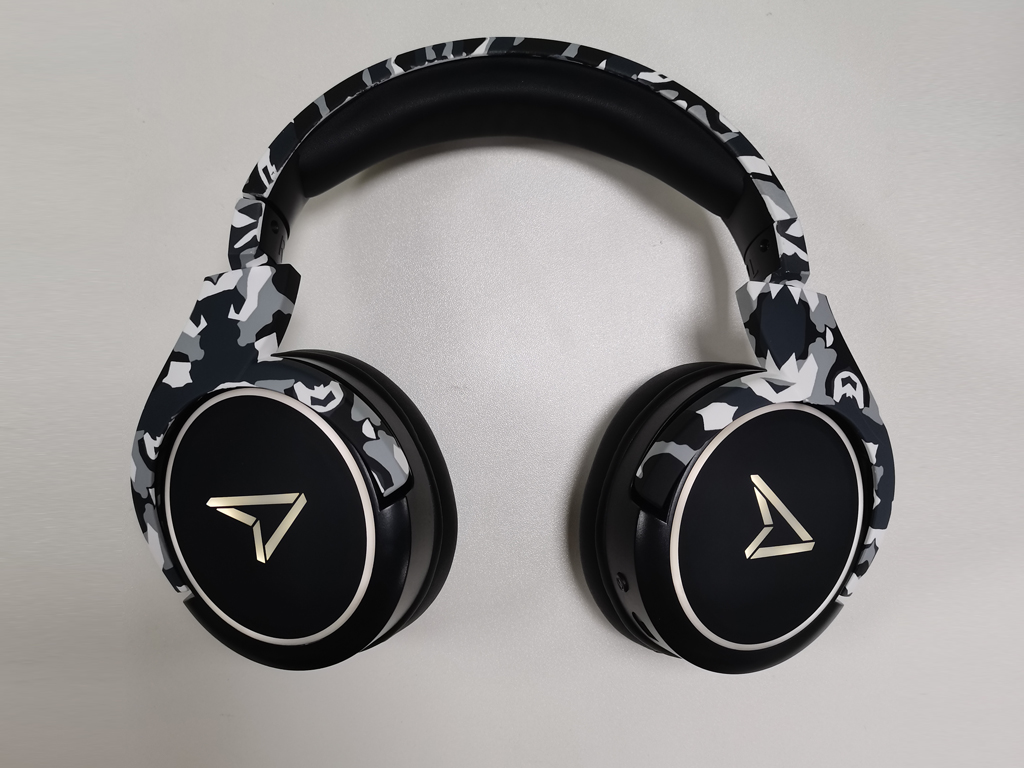
A successful gaming headset is not only defined by hardware specifications. For many brands, industrial design, surface finishing and customization capability determine whether a product can stand out in a crowded market. Color, material, finish, logo execution, part geometry, and visual consistency collectively shape what buyers recognize on a retail shelf or product listing.
The Impulse France OEM project provides a practical example. MACH supported Steelplay in developing a Bluetooth wireless gaming headset positioned for Nintendo Switch users, with a 50mm speaker driver, high-definition microphone, and a custom black, white, and gray camouflage finish created through hydro dipping, also known as water transfer printing. This guide uses that project to explain how brands can plan distinctive CMF without treating surface decoration as an isolated last step.
Why Product Design Matters in Gaming Headset Development
Product design gives a gaming headset a recognizable role in a brand portfolio; hardware specifications alone rarely create a coherent visual identity.
Gaming accessory categories are crowded with products built around comparable drivers, wireless chipsets, microphones, and controls. When several offers share a similar underlying platform, buyers notice proportion, color blocking, finish quality, graphics, lighting, logo placement, packaging, and how the product fits the rest of a brand's ecosystem. Design therefore affects recognition before a customer evaluates technical details.
For procurement teams, differentiation must be feasible rather than purely visual. A design proposal should connect target users, price position, sales channel, structure, material, process capability, quality standards, and packaging. This makes industrial design and CMF part of product planning, not artwork applied after engineering is complete.
Impulse France OEM Project Overview
Impulse combines a Bluetooth wireless headset platform with a distinctive camouflage CMF direction for a France gaming brand and Nintendo Switch-oriented accessory positioning.
The Impulse project was developed for Steelplay as a wireless Bluetooth gaming headset directed toward Switch users and gaming accessory buyers. Confirmed product elements include Bluetooth wireless connectivity, a 50mm speaker driver, a high-definition microphone, and a custom camouflage appearance produced through hydro dipping or water transfer printing.
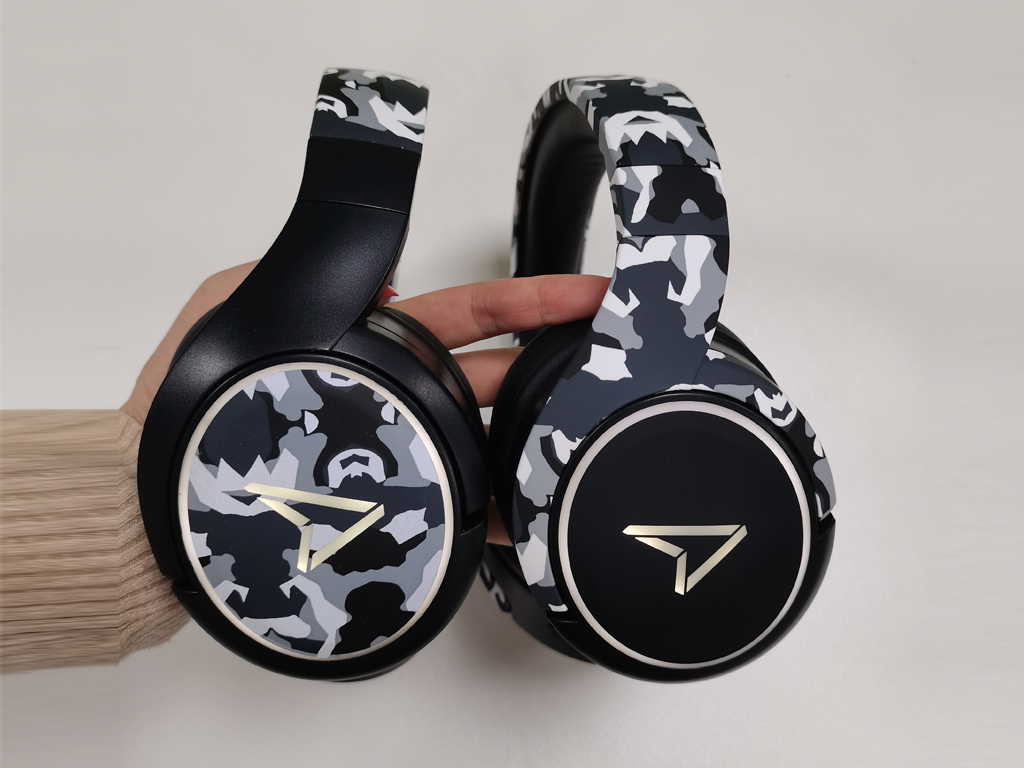
MACH's project support covered product customization, industrial design support, CMF development, surface finishing, prototyping, testing, and preparation for mass production. The value of the project is not the camouflage graphic alone. The pattern had to be translated onto curved headset parts while preserving assembly interfaces, recognizable brand areas, and a consistent visual relationship between the headband, yokes, and earcups.
This article focuses on those design and manufacturing decisions. It does not imply an official Nintendo partnership or universal platform compatibility. Brands developing products around Switch or any other platform should confirm the final Bluetooth behavior, microphone path, controls, labeling, packaging language, and target-market requirements for their approved configuration.
| Project element | Impulse direction |
|---|---|
| Brand and market | Steelplay, France gaming accessory market |
| Product | Wireless Bluetooth gaming headset |
| Platform positioning | Designed for Switch-oriented users and gaming accessory channels |
| Acoustic hardware | 50mm speaker driver |
| Communication | High-definition microphone |
| CMF feature | Custom camouflage hydro dipping / water transfer printing |
| OEM support | Design, CMF, prototype, testing, surface finishing, and mass-production preparation |
Beyond Logo Printing: How Hydro Dipping and CMF Create a Unique Gaming Headset Identity
A recognizable private-label headset coordinates color, material, finish, pattern coverage, geometry, logo, packaging, and production controls instead of relying on logo printing alone.
A logo identifies ownership, but it does not automatically create a distinct product. If the enclosure color, material impression, gloss, texture, earcup treatment, headband, controls, and packaging remain identical to competing private-label offers, the headset may still look generic. CMF provides a broader design language: Color defines palette and contrast; Material influences structure, touch, weight, and perceived quality; Finish controls texture, gloss, pattern, coating, and how the surface changes under light.
Hydro dipping transfers a printed film pattern onto a prepared three-dimensional part. It is useful for complex graphics, camouflage, organic patterns, and broad visual coverage on shapes that are difficult to decorate with a single flat print. Gaming accessories, limited editions, lifestyle gaming products, and brand-collaboration concepts may benefit when a repeated or flowing pattern is more important than precise placement of every graphic element.
The Impulse headset demonstrates how camouflage can become part of the product identity across the headband and selected outer components. The result is more visually specific than applying one small mark to an otherwise standard black platform. That does not mean hydro dipping is always better than painting, printing, in-mold decoration, laser marking, or molded color. Different brands require different finishing strategies according to visual goals, substrate, geometry, durability expectation, order structure, target cost, and production capability.
OEM development should define the pattern artwork, scale, orientation, coverage boundary, base color, logo relationship, substrate, primer, film system, protective topcoat, gloss, scratch criteria, and acceptable variation. Water transfer patterns can shift or stretch around compound curves, so buyers should approve representative parts rather than expecting every unit to match a flat artwork file pixel for pixel. The correct quality standard distinguishes acceptable pattern variation from defects such as voids, wrinkles, contamination, poor adhesion, exposed edges, or inconsistent coating.
Special finishes need early structural input. Surface area and curvature affect how the film lays down. Parting lines and decoration boundaries influence where the pattern stops. Assembly gaps may narrow after primer, transfer layers, and topcoat are added. Snap fits, screw interfaces, sliding surfaces, acoustic openings, buttons, hinges, and logo recesses may require masking or process exclusions. Plastic behavior and surface energy influence preparation and adhesion.
The strongest private-label result connects the headset finish to packaging graphics, accessories, manuals, retail photography, and the wider product family. A camouflage edition should have a defined role, such as lifestyle gaming, a seasonal collection, or a visually expressive accessory line. CMF then becomes a product strategy supported by engineering and manufacturing, rather than decoration added shortly before launch.
Planning a custom CMF direction for a wireless gaming headset?
Share your target audience, reference products, pattern artwork, color standards, logo files, sales markets, and quantity direction for a feasibility review.
Discuss a custom headset design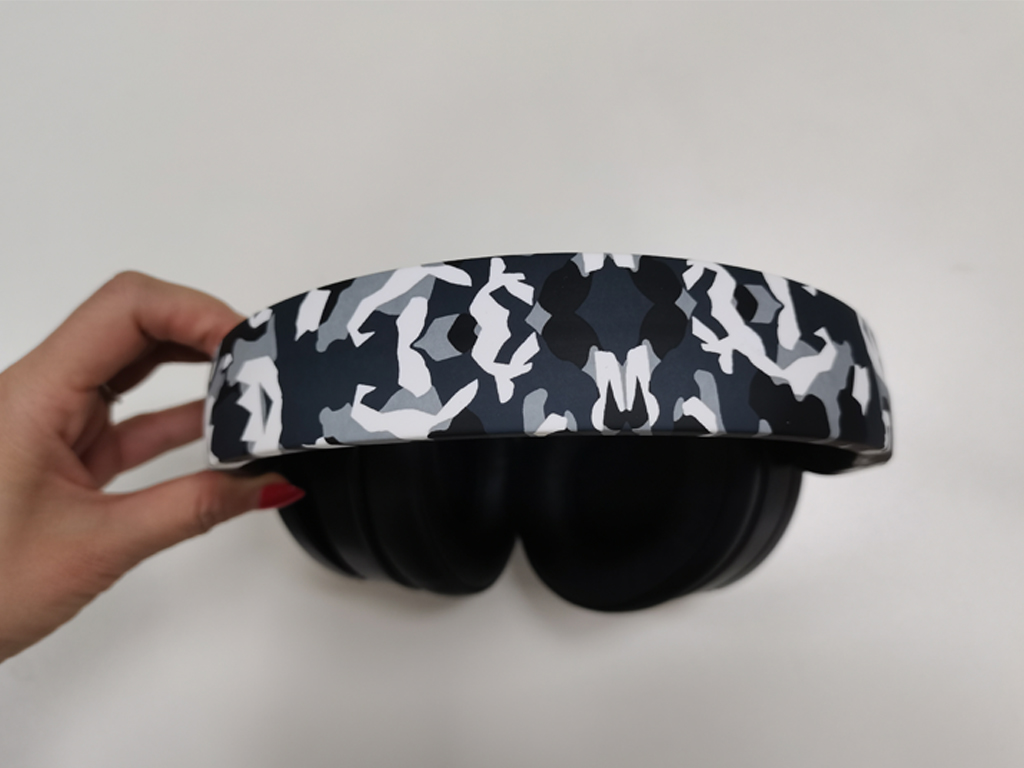
What Is CMF Design in Gaming Accessories?
CMF is the coordinated specification of color, material, and finish across visible and functional parts of a product.
Finish defines how a surface looks and feels: matte or gloss, smooth or textured, painted or molded, printed or engraved, patterned or solid. Brands should consider CMF early because finish thickness, masking, adhesion, seams, process temperature, geometry, and yield can affect design feasibility. Early CMF review gives engineering, suppliers, quality teams, and packaging designers one shared definition of the intended product.
Hydro Dipping vs Traditional Surface Finishing
Hydro dipping, painting, and printing solve different visual and manufacturing problems; the correct process depends on pattern complexity, geometry, durability, cost, and quality requirements.
Hydro dipping is strong where an organic or repeated pattern must wrap around curved surfaces. Painting supports solid colors, gradients, or selected effects depending on equipment and masking. Pad, silk-screen, or UV printing can place logos and defined graphics efficiently on suitable areas. Some products combine methods, such as molded base color, hydro-dipped headband parts, painted accents, and a printed or metal logo.
Buyers should compare processes by the finished design and control plan, not by a simple ranking.
| Consideration | Hydro dipping | Painting | Printing |
|---|---|---|---|
| Pattern complexity | Supports repeated, organic, camouflage, and complex patterns | Best suited to solid colors and achievable paint effects | Supports defined logos and graphics on suitable print areas |
| Surface coverage | Can wrap selected three-dimensional surfaces | Can cover broad areas with masking where required | Usually localized to accessible areas |
| Visual impact | Strong full-surface pattern identity | Controlled color and finish language | Clear graphic or brand communication |
| Variation | Pattern placement and stretching require agreed tolerance | Color, gloss, thickness, and contamination require control | Alignment, adhesion, opacity, and edge quality require control |
| Production considerations | Preparation, film activation, transfer, rinsing, drying, and topcoat | Preparation, paint application, curing, masking, and finish checks | Fixture, ink, alignment, curing, adhesion, and wear checks |
| Best-fit direction | Complex lifestyle patterns and broad decorative coverage | Solid-color ranges and controlled surface effects | Logos, labels, icons, and localized graphics |
Technical Considerations When Developing Custom Gaming Headset Finishes
Custom finishes must be evaluated against substrate compatibility, preparation, tolerance, durability, assembly sequence, and repeatability on production parts.
Material compatibility starts with the actual molded resin and any additives, texture, release residue, or recycled content used in production. Surface cleaning, flame or plasma treatment where appropriate, primer selection, and cure conditions may affect adhesion. Testing should use representative production material rather than an unrelated sample panel.
Decorative layers add thickness. Engineers need to protect snap fits, screw bosses, sliding rails, hinge interfaces, button openings, cushion attachments, acoustic vents, and electrical contacts. Masking boundaries should be intentional and hidden where possible. If finishing occurs before assembly, handling fixtures and work instructions must avoid scratches and pressure marks.
Durability requirements should reflect the use case and approved coating system; no generic result should be assumed for every substrate or headset design.
Technical Deep Dive: Why Surface Finishing Requires Manufacturing Expertise
Hydro dipping is a manufacturing sequence involving material preparation, film transfer, protective coating, tolerance management, inspection, and controlled rework, not merely a graphic-printing step.
The sequence typically begins with molded-part inspection and surface preparation. The substrate must be clean and suitable for the selected primer or basecoat. The printed film is prepared on water, activated, and transferred as the part enters at a controlled angle and speed. After transfer, residual carrier material is removed, the part is dried, and a protective clear coating may be applied according to the approved system.
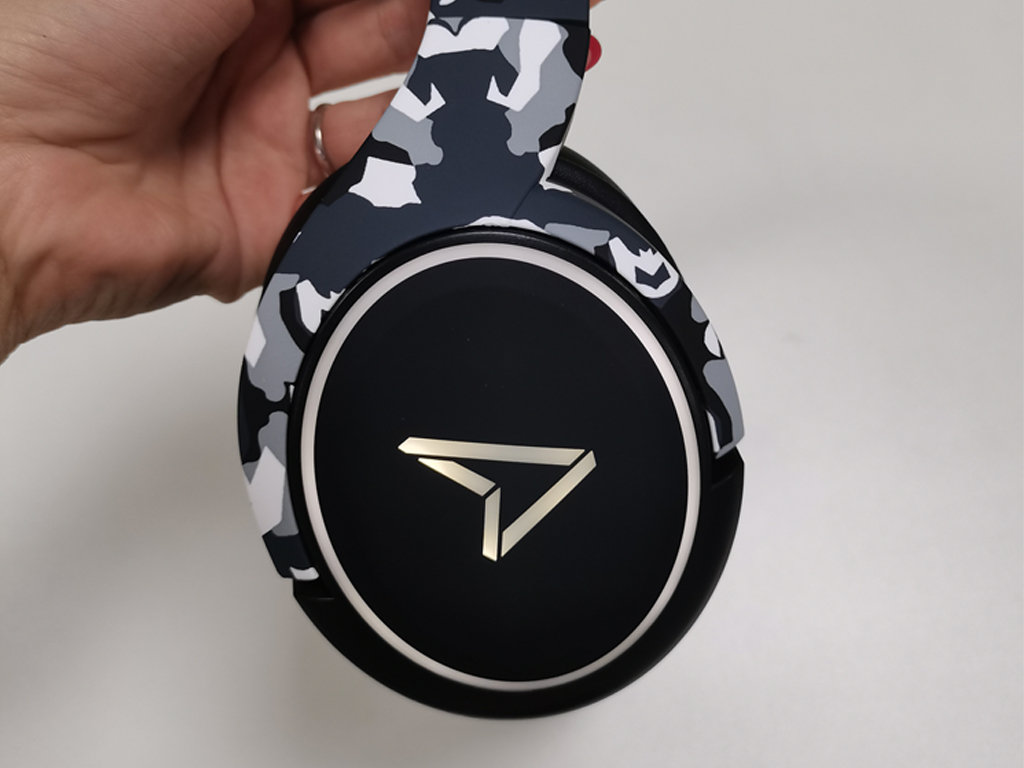
Pattern alignment behaves differently from flat printing. The film deforms around curves, openings, edges, and changes in cross-section. Fixtures, dip angle, film orientation, and operator or automated process control influence where the graphic lands and how it stretches. Product design should define the important visual zones and where normal pattern variation can be accepted.
Protective coating and surface preparation affect durability and appearance. Primer, base color, transferred film, and topcoat must work as a system with the plastic. Too little protection can expose the pattern to wear; excessive coating or poor masking can interfere with assembly gaps and moving parts. Cure conditions and part storage also need control before assembly.
Mass-production risks include color variation between lots, inconsistent pattern scale or orientation, wrinkles, voids, pinholes, trapped contamination, incomplete transfer, edge lifting, gloss variation, scratches, and assembly damage. Quality control therefore needs approved boundary samples, visual inspection lighting, defect definitions, coverage maps, color and gloss references where relevant, sampling rules, and traceability for material and process lots.
An OEM supplier must connect design intent with engineering, manufacturing, and quality control. Industrial designers define the visual priority; engineers protect interfaces and material behavior; production teams establish fixtures and process windows; quality teams turn the approved sample into measurable acceptance criteria. When these functions work separately, a beautiful prototype may be difficult to reproduce. When they work together, the finish becomes a controlled product specification.
Why Nintendo Switch Gaming Accessories Require Different Product Thinking
Switch-oriented accessories often need to balance portable use, lifestyle appearance, comfort, simple connectivity, and a visual fit with consumer gaming environments.
A Switch-oriented headset may be used away from a fixed desktop: on a sofa, while traveling, in handheld play, or alongside other lifestyle electronics. Size, weight distribution, cushion comfort, control access, microphone handling, storage, and packaging can therefore matter differently from a product designed only for a desktop PC setup.
Impulse was positioned for Switch users, but this does not imply official Nintendo authorization, licensing, or collaboration. Brand teams should separately confirm trademark use, compatibility wording, required notices, and any licensing obligations with their legal and channel partners.
Wireless Gaming Headset Hardware Platform Overview
The Impulse platform combines Bluetooth wireless connectivity, a 50mm speaker driver, and a high-definition microphone within a customized over-ear headset design.
Bluetooth provides direct wireless connectivity for compatible devices, but brands should verify supported profiles, microphone behavior, controls, and platform compatibility for the final configuration. This guide does not assign a latency, battery runtime, 2.4GHz mode, or universal device claim because those details are outside the confirmed article brief.
The high-definition microphone direction must also be validated as a complete voice path. Capsule selection, microphone opening, boom or structural position, wireless profile, processing, mute behavior, and host device affect communication performance. Appearance customization should never replace hardware and functional approval.
OEM Gaming Headset Development Process
A controlled custom headset program moves from requirement definition through design, CMF engineering, prototypes, testing, pilot review, and mass-production approval.
Requirement review defines target users, market, channel, platform positioning, hardware direction, industrial design, CMF, branding, packaging, accessories, compliance scope, quality expectations, and commercial constraints. The team then confirms whether a mature platform can support the intended identity or whether structural changes are needed.
During design and CMF development, artwork is translated into part coverage, color standards, material specifications, finish systems, logo methods, masking, tolerance considerations, and acceptance criteria. Prototype parts are reviewed for appearance and assembly, followed by functional and project-specific reliability evaluation on the final configuration.
Before mass production, the buyer and supplier should freeze samples, artwork, color references, finish boundaries, packaging, inspection standards, and change-control rules. Pilot production tests whether the process can reproduce the approved result at scale.
| Stage | Primary output |
|---|---|
| Requirement | Target user, platform, hardware, design, channel, quality, and project scope |
| Design | Industrial design direction, part selection, branding zones, and product architecture |
| CMF | Color, material, finish, pattern, process, masking, and acceptance specification |
| Prototype | Representative appearance and functional samples for review |
| Testing | Project-defined functional, finish, assembly, and reliability verification |
| Mass production | Approved standards, pilot validation, process control, QC, packaging, and change management |
Need an OEM partner that can review design and manufacturing together?
Send your reference images, CMF brief, target platform, hardware requirements, packaging direction, market, and forecast for platform evaluation.
Request an OEM design reviewOEM Buyer Checklist for Custom Gaming Headset Projects
A useful custom-headset RFQ connects brand identity to an approvable CMF, hardware, quality, packaging, and production specification.
- Define target users, price position, sales channel, geographic markets, and planned product role.
- List target devices and the exact compatibility and microphone scenarios that require validation.
- Provide design references, brand guidelines, product-family context, and features that must remain distinctive.
- Specify color standards, materials, gloss, texture, pattern artwork, scale, orientation, and coverage priorities.
- State preferred surface processes, while allowing engineering review of hydro dipping, painting, printing, molding, or combined methods.
- Provide logo artwork and define size, position, color, process, lighting interaction, and wear expectations.
- Define Bluetooth, 50mm driver, microphone, control, comfort, and other hardware requirements without unsupported claims.
- List packaging, manuals, labels, barcodes, accessories, protective tray, and retail presentation requirements.
- Identify destination markets so the final configuration can receive a project-specific compliance review.
- Agree appearance samples, boundary samples, test plan, pilot run, inspection lighting, defect criteria, sampling, and traceability.
- Provide expected quantity, forecast, target schedule, target cost direction, and change-control contacts.
Conclusion
A distinctive gaming headset is created when CMF, surface engineering, hardware, structure, quality control, and brand positioning are developed as one product system.
The Impulse France OEM project shows how a camouflage hydro-dipped finish can move a wireless Bluetooth headset beyond basic logo customization. Its value comes from coordinated pattern coverage, material preparation, geometry review, protective finishing, assembly control, and visual consistency, supported by a hardware platform with a 50mm speaker driver and high-definition microphone.
Hydro dipping is one option, not a universal answer. Gaming brands should choose a finish that supports their audience and can be reproduced under an agreed manufacturing and quality plan. MACH industry supports custom gaming headset projects from product and CMF evaluation through prototypes, testing, production preparation, and quality control.
Launch Faster With a Reliable OEM Partner.
Email: hardy.hu@mach-industry.com | WhatsApp: +86 18038083785
Contact MACH industryFrequently Asked Questions
What is CMF design for gaming headsets?
CMF means color, material, and finish. It defines the physical palette, substrate, texture, gloss, coating, pattern, logo relationship, durability expectations, production tolerances, and visual consistency of the headset.
What is hydro dipping used for in gaming accessories?
Hydro dipping transfers printed film patterns onto prepared three-dimensional parts. It can support camouflage, organic graphics, complex repeated patterns, and broad decorative coverage on suitable gaming accessory components.
Can gaming brands customize headset colors and patterns?
Yes. Project-dependent options may include molded color, painting, hydro dipping, localized printing, logos, textures, gloss levels, accents, cushions, cables, packaging, and coordinated accessory colors.
Is hydro dipping suitable for mass production?
It can be suitable when the material, preparation, primer, film, transfer process, topcoat, fixtures, tolerances, defect criteria, inspection, yield, and batch consistency are validated for the specific parts.
How can brands make OEM headsets look different?
Brands can coordinate industrial design, color blocking, CMF, surface process, pattern coverage, logo execution, controls, accessories, packaging, photography, firmware where applicable, and product-family positioning.
What is the difference between OEM and ODM gaming headsets?
Terminology varies, but ODM commonly adapts an existing supplier platform while deeper OEM development may involve more buyer-defined structure, tooling, electronics, or industrial design. The actual scope should be written into the project specification.
Can MACH customize Bluetooth gaming headsets?
Yes. MACH industry can support platform evaluation, industrial design, CMF, logo, packaging, accessories, prototyping, testing, production preparation, and quality control according to project feasibility.
Is the Impulse headset designed for Nintendo Switch?
The Impulse project was positioned for Switch users and gaming accessory channels. This does not imply official Nintendo licensing or endorsement, and final compatibility and marketing language should be verified for the approved configuration.
What hardware can brands customize?
Possible scope depends on the platform and may include driver direction, microphone, controls, wireless configuration, cables, cushions, accessories, structure, and packaging. Changes require engineering, cost, test, and production review.
What information should buyers prepare before developing a gaming headset?
Prepare target users, markets, channels, devices, hardware requirements, design references, CMF standards, finish expectations, logo, packaging, accessories, compliance scope, quantity, cost direction, schedule, and quality criteria.
Related Resources
Need OEM/ODM gaming audio solutions?
Contact MACH Industry to discuss your gaming headset, gaming earbuds, or private-label audio project.
Contact MACH Industry