Home > Resources > OEM Knowledge
How Brands Specify USB-C, 2.4G and Bluetooth Gaming Earbuds Without Overclaiming Compatibility
A B2B guide to defining USB-C, 2.4G and Bluetooth connection roles, RGB, ENC and compatibility claims before private-label gaming earbud production.
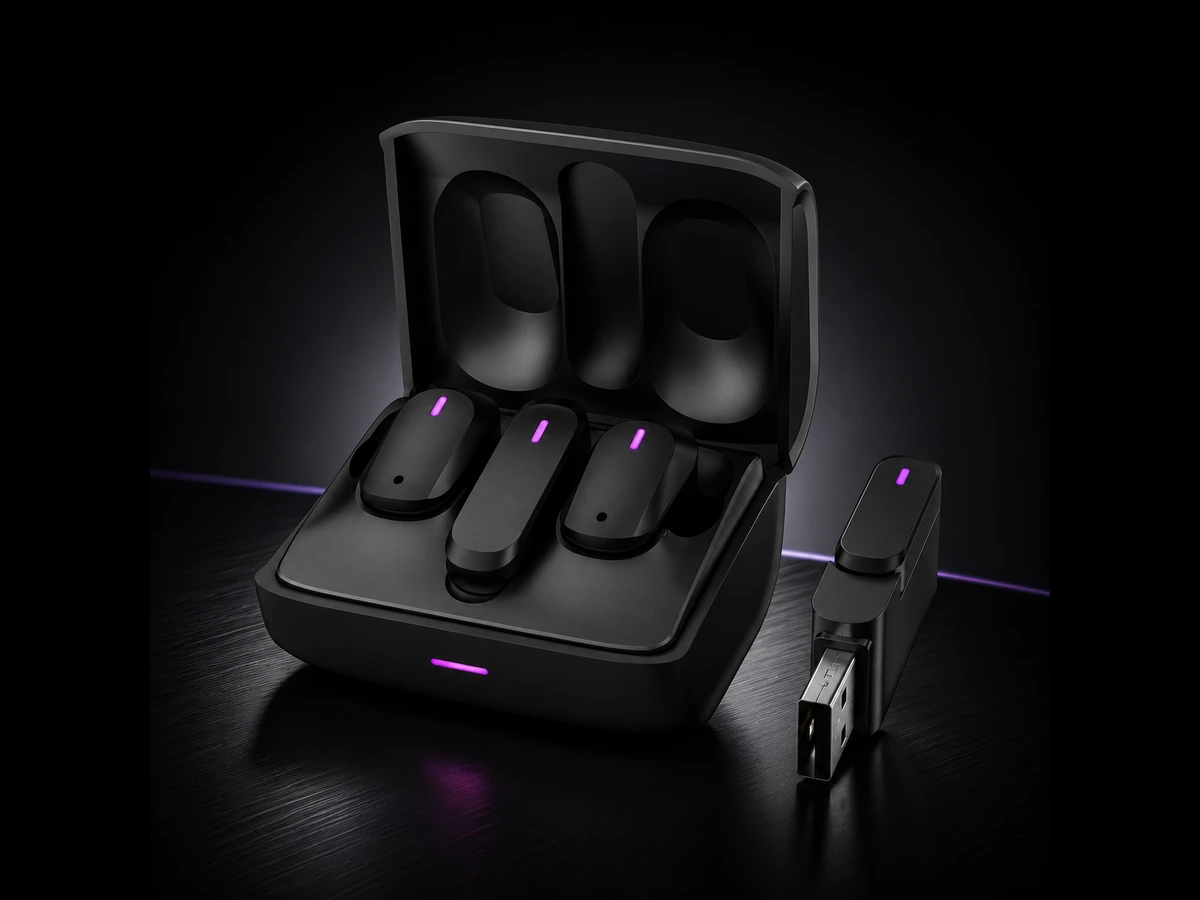
Brands developing multi-connection gaming earbuds should define what USB-C, 2.4G and Bluetooth each do before approving samples, packaging or compatibility claims. Three connectivity labels do not automatically mean three complete audio modes.
The buyer needs a connection-role matrix that identifies the host, accessory, audio path, microphone behavior, controls, charging function and limitations for every route. This prevents a USB-C connector from being mistaken for wired USB audio, a dongle from being assumed compatible with every console, or Bluetooth claims from inheriting unverified 2.4G behavior.
MACH G3 is a useful platform reference because its published information confirms USB-C / 2.4G / Bluetooth connectivity, RGB lighting, ENC voice communication, gaming-inspired design and customization for logo, packaging, color and firmware. The source does not publish connector roles, latency, driver, battery, charging or device compatibility details, so this article treats them as project questions rather than invented facts.
Understanding the Market Need
Gaming earbud buyers need connection-specific evidence because product listings often compress several different functions into a short compatibility claim.
Gaming brands compete on wireless freedom, visual identity, voice communication and device reach. Earbuds can serve mobile gaming, private-label audio lines and marketplace channels, but their compact form leaves little room for unclear accessories or controls. A user who chooses the wrong route may experience missing microphone input, unsupported controls or a connection that was never intended for that host.
The challenge begins with terminology. USB-C can describe a charging port, a digital audio connection, a dongle connector or more than one function. 2.4G generally describes a dedicated wireless route through a receiver, but the receiver interface and supported hosts still need confirmation. Bluetooth provides a separate wireless path whose profiles and functions vary by device.
Packaging and online listings often reduce this complexity to platform logos and short feature bullets. That creates risk when the engineering evidence is not equally concise. A responsible product manager should build claims from a verified mode-and-device table instead of asking engineering to support marketing language after artwork is complete.
Differentiation still matters. G3 combines gaming-inspired RGB and ENC voice positioning with multiple connectivity labels. The opportunity is stronger when the brand can explain which connection serves gaming, which supports mobile convenience and how users select the correct route.
| Buyer risk | Uncontrolled claim | Required definition |
|---|---|---|
| USB-C ambiguity | USB-C compatible | Charging, digital audio, dongle interface or another verified role |
| 2.4G assumption | Works with all gaming systems | Receiver connector, approved hosts and feature behavior |
| Bluetooth assumption | Same gaming performance in every mode | Profiles, device tests, microphone, controls and any latency condition |
| Platform logos | Universal compatibility | Exact mode, accessory and limitations for each platform |
G3 Wireless Gaming Earbuds Platform Overview
G3 is an RGB wireless gaming earbud OEM platform with USB-C / 2.4G / Bluetooth connectivity labels, ENC voice communication and confirmed logo, packaging, color and firmware customization.
The published product type is RGB Wireless Gaming Earbuds. Its positioning combines gaming-inspired lighting, ENC clear-call direction and wireless freedom for gaming earbud brands, private-label programs, Amazon gaming sellers and mobile gaming audio.
Connectivity is listed as USB-C / 2.4G / Bluetooth. The public source does not define whether USB-C carries charging, digital audio, receiver connection or multiple functions. It also does not publish the Bluetooth version, dongle connector, device list or mode-switching behavior. Those roles must be confirmed in the project specification.
ENC voice communication is confirmed, but microphone count, sensitivity, algorithm, test scenario and platform behavior are not published. RGB lighting is also confirmed, while effect sequence, controls, synchronization and power impact remain project details.
Confirmed customization options are logo, packaging, color and firmware. MOQ requires contact and lead time is project dependent. No battery, charging-case, driver, latency or certification figures are available in the public G3 data, so they should not appear in launch claims without matching documents.
Technical Deep Dive: Turning USB-C, 2.4G and Bluetooth Labels Into a Verifiable Connection Matrix
A connection matrix converts each connectivity label into a tested host, accessory, audio function, microphone function, control behavior, power state and approved claim.
Start with USB-C because the connector name alone does not define the signal. Ask whether the G3 project configuration uses USB-C for charging, digital audio, firmware access, a receiver interface or a combination. Record the direction of connection, required cable or dongle and whether the earbuds must be powered. A charging port should never be marketed as USB audio unless the selected configuration has been validated for that function.
Next, define the 2.4G path as a complete receiver system. The matrix should name the dongle connector, any adapter, target host, pairing method, recovery process and package location. Test audio, microphone, controls and indicators separately. The presence of a receiver does not establish console compatibility without host-specific evidence.
Bluetooth needs its own rows. Record target phones, tablets or computers, operating-system versions, pairing and reconnect behavior, audio, microphone, controls and any game mode supported by the released firmware. Do not transfer a 2.4G performance statement to Bluetooth. G3's public data does not publish a Bluetooth version or latency figure.
Then map transitions. Users need to know how to enter each route, which connection has priority, what happens when USB-C is attached, how the product returns from a charging or storage state and which prompt or indicator confirms the active mode. Firmware customization can help define behavior when supported, but the approved version must be tied to the test matrix.
Connect power and accessory requirements. Charging, wireless use, RGB and ENC may draw power differently. The public source does not provide battery or charging data, so mode-specific runtime and charging behavior require project tests. If a charging case, cable, dongle or adapter is included, the BOM and package sample should identify it precisely.
Compatibility claims are released only after the matrix is complete. A platform logo should point to a tested mode and accessory. If one route supports audio but not microphone or controls, the limitation should be visible in instructions and support material. 'Compatible' is too broad when functions differ.
Finally, preserve evidence. The matrix should reference hardware, firmware, dongle, cable, target-device and sample revisions. Changes return affected rows to validation. This creates traceability from engineering tests to packaging, marketplace content and customer support.
For buyers, the matrix is more useful than a long feature list. It shows exactly what the customer receives and gives the factory measurable criteria for production testing without turning uncertain connector labels into unsupported promises.
| Matrix field | USB-C | 2.4G | Bluetooth |
|---|---|---|---|
| Role | Charging, audio, receiver or firmware role to confirm | Dedicated receiver path | Compatible-device wireless path |
| Accessory | Cable, dongle or adapter to confirm | Released receiver and possible adapter | No dedicated receiver, unless project specifies otherwise |
| Functions | Audio, charging and controls tested separately | Audio, microphone, controls and indicators | Profiles, audio, microphone and controls |
| Claim | Name the verified USB-C function | Name approved hosts and receiver condition | Name approved devices and profile behavior |
| Evidence | Port, cable and function test | Dongle-host matrix and functional test | Device/OS pairing and functional test |
Key Technology Considerations for Gaming Earbuds Development
G3 development should coordinate connection roles, ENC voice scenarios, RGB behavior, firmware, power and accessories in one approved product configuration.
Wireless validation should use representative targets for 2.4G and Bluetooth. Buyers need pairing, reconnect, range, interference and mode-switching requirements under defined conditions. Latency should only be specified when the selected configuration has a documented method and result.
ENC should be tested against the intended voice environment. Define whether the product is for mobile game chat, calls or both, then identify target devices, background noise, speaking distance and comparison method. The ENC label does not prove identical performance across platforms.
RGB lighting requires approved zones, colors, animations, controls and visual limits. The effect should be evaluated with the final color and firmware. Battery impact cannot be quantified from the G3 public data because capacity and runtime are not published.
Audio performance requires the final driver, enclosure, fit and tuning specification. G3 does not publish driver size or acoustic parameters, so no numerical response or tuning claim should be inferred. A buyer can use reference products and listening scenarios during sample approval.
Charging and case requirements must be explicit. The public source does not confirm battery capacity, charging time, charging-case behavior or whether USB-C is charging-only. Product managers should obtain a project specification before designing package icons or instructions.
- Confirm the role of every connector and wireless mode.
- List target devices and required functions.
- Define ENC voice scenarios and acceptance method.
- Approve RGB effects and controls in released firmware.
- Confirm battery, charging and case specifications.
- Validate audio with final mechanical configuration.
- Control earbud, dongle, cable and firmware revisions.
OEM/ODM Opportunities for Gaming Earbuds Brands
G3 confirms logo, packaging, color and firmware customization, with final scope established through project review and sample approval.
Logo customization should define placement, dimensions, contrast and process on the available surfaces. Color selection should use named references and physical samples because housing color can affect logo visibility and the perceived RGB effect.
Packaging must explain the verified connection roles and included accessories. USB-C, 2.4G and Bluetooth icons should match the approved configuration, while platform logos require supporting tests. ENC and RGB language should reflect the released firmware and hardware.
Firmware customization can support controls, prompts, mode switching or lighting behavior when technically feasible. Every version needs regression testing against the connection matrix and matching instructions.
Accessories beyond the confirmed product information require review. Buyers should specify whether cables, dongles, adapters or a charging case are included. Hardware or acoustic requests not listed in G3's confirmed customization options need engineering evaluation.
MACH can review the product brief, connection matrix, customization, sample plan and production requirements. MOQ and lead time remain project dependent.
How Brands Evaluate a Gaming Earbuds Manufacturing Partner
A suitable partner should turn ambiguous connection labels into controlled specifications, samples, tests, packaging and production checks.
Technical capability begins with questions. A manufacturer should be able to explain each USB-C, 2.4G and Bluetooth role, identify required accessories and define how target devices will be validated. Generic compatibility statements are not a substitute for a matrix.
Development support should connect industrial design, firmware, RGB, ENC and packaging. Buyers need named approval stages and a golden sample that represents the final branded hardware, software and accessory set.
Quality control should test the released connection routes, pairing, audio, microphone, controls and indicators. Cosmetic checks cover logo, color and RGB limits. Package inspection confirms the correct dongle, cable, adapter and instructions.
Production capability includes revision and change control. A new receiver, firmware, cable, battery or component can affect claims. The supplier should identify impacted tests before the change enters mass production.
| Supplier capability | Evidence to request |
|---|---|
| Connection engineering | USB-C / 2.4G / Bluetooth role and device matrix |
| Firmware control | Released version, change log and regression results |
| ENC and RGB validation | Defined voice scenarios and visual limit samples |
| Customization | Approved logo, color, packaging and firmware references |
| Production QC | Golden sample, functional tests and accessory verification |
Conclusion
Multi-connection gaming earbuds are ready for OEM launch when every connector and wireless route has a verified role, target device, function and claim.
G3 provides a confirmed starting point with USB-C / 2.4G / Bluetooth connectivity labels, RGB lighting, ENC voice communication and logo, packaging, color and firmware customization. Its buyer value comes from turning those elements into a clear product system.
MACH industry can review your target devices, connection roles, ENC scenarios, RGB direction and private-label scope. A verified connection matrix protects the brand from compatibility overclaims and gives production a measurable release standard.
Frequently Asked Questions
What are G3 RGB wireless gaming earbuds?
G3 is an RGB wireless gaming earbud OEM platform with USB-C / 2.4G / Bluetooth connectivity labels, ENC voice communication and logo, packaging, color and firmware customization.
Does USB-C mean G3 supports wired USB audio?
The public G3 data lists USB-C connectivity but does not define its role. Charging, digital audio, dongle interface and firmware functions must be confirmed in the selected project configuration.
Does G3 work with every gaming console?
The public source does not publish a device compatibility table. Buyers should validate the exact connection, accessory, audio, microphone and control behavior for every target console or host.
What should a 2.4G gaming earbud dongle specification include?
It should include connector type, target hosts, adapters, pairing, recovery, audio, microphone, controls, indicators, firmware revision, branding and package location.
What Bluetooth version and latency does G3 provide?
The public G3 data confirms Bluetooth but does not publish a version or numerical latency. These details require project-specific specification and testing.
Does G3 use ENC microphones?
G3 confirms ENC voice communication, but public data does not publish microphone count, sensitivity, algorithm or test results. Buyers should define voice scenarios for validation.
Can G3 RGB gaming earbuds be private labeled?
Yes. Confirmed customization includes logo, packaging, color and firmware, subject to project review and sample approval.
What battery and charging specifications are confirmed for G3?
The public G3 data does not publish battery capacity, runtime, charging time or charging-case behavior. Buyers should confirm these before releasing claims.
How should brands prevent gaming earbud compatibility overclaims?
Create a device-by-connection matrix covering accessories, audio, microphone, controls, power behavior and limitations, then release claims only for tested rows.
What should a buyer prepare for a G3 OEM quote?
Prepare target devices, connection roles, dongle and adapter requirements, ENC scenarios, RGB behavior, customization, packaging, target markets, quantity and schedule.
Related Resources
Need OEM/ODM gaming audio solutions?
Contact MACH Industry to discuss your gaming headset, gaming earbuds, or private-label audio project.
Contact MACH Industry