Home > Resources > OEM Knowledge
When Should Brands Choose 2.4GHz Dongle Gaming Earbuds Instead of Bluetooth-Only?
A B2B buyer guide to choosing a 2.4GHz dongle plus Bluetooth gaming earbud platform and defining an end-to-end latency validation plan.
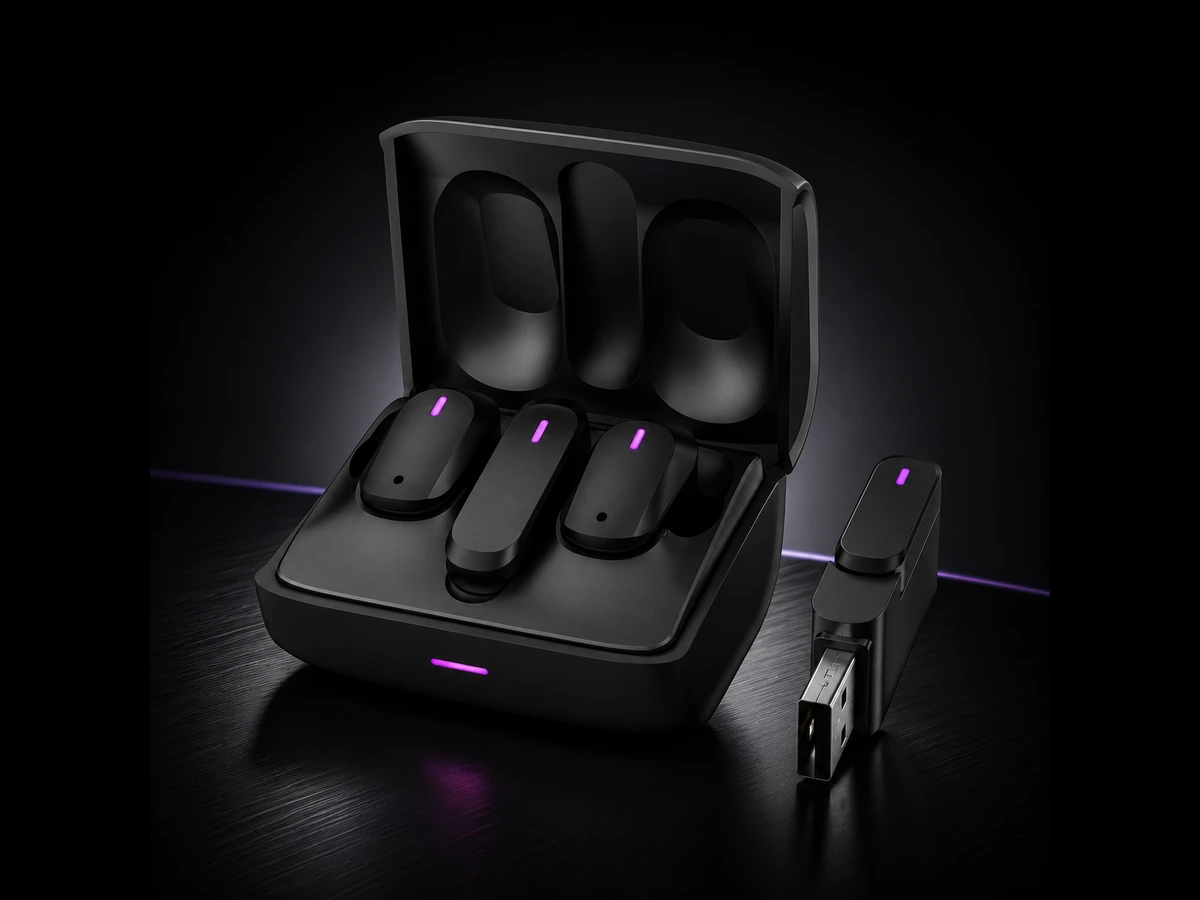
Brands should choose 2.4GHz dongle gaming earbuds when a controlled low-latency gaming route is central to the product promise, while retaining Bluetooth for compatible mobile and everyday wireless use. A Bluetooth-only platform may be simpler when portable convenience matters more than a dedicated gaming connection.
The decision should be based on target devices, latency requirements, microphone behavior, dongle handling, power expectations, package content and verified compatibility. Adding a 2.4GHz receiver creates a system, not just another feature: the earbuds, dongle, firmware, charging arrangement and instructions must work as one released configuration.
MACH G12 provides a confirmed platform reference with an ATS3031 earbud and ATS3031 dongle solution, 2.4GHz wireless, Bluetooth 5.3, under-20ms latency, dual-microphone ENC, LC3 audio, an 8mm driver and customization for logo, packaging, firmware, color and dongle branding. This article uses those published facts to explain the sourcing decision without rewriting the G12 product page.
The Buyer Problem: Bluetooth Convenience vs Dedicated Gaming Performance
The buyer must decide whether the product needs one convenient Bluetooth route or two distinct wireless routes with a dedicated 2.4GHz path for gaming.
Bluetooth-only earbuds can fit familiar mobile and daily-use behavior without requiring users to carry a receiver. That simplicity can benefit products centered on music, calls, casual play and portable use. A gaming brand may need more control over latency, pairing and host behavior than a general Bluetooth route provides.
A 2.4GHz dongle establishes a dedicated connection between the host and earbuds. It can support a more controlled gaming path because the receiver and earbud platform are developed together. G12 publishes an under-20ms latency figure for its 2.4GHz gaming positioning, but buyers still need to confirm the measurement method, target host and released firmware.
The additional route introduces practical obligations. The dongle needs a defined connector, supported host list, pairing and recovery behavior, storage and package position. The buyer must decide whether an adapter is needed, how the receiver is branded and what happens if it is lost. These details influence returns as much as a headline latency figure.
The right choice follows the product's commercial promise. A competitive mobile or multi-device gaming product may justify the dongle. A lifestyle earbud with occasional gaming may not. Product managers should document the primary user journey before selecting the architecture.
| Decision area | Bluetooth-only platform | 2.4GHz dongle + Bluetooth platform |
|---|---|---|
| Primary role | Portable wireless audio and compatible-device use | Dedicated gaming route plus a separate Bluetooth route |
| Accessory | No dedicated gaming receiver | Receiver must be specified, packaged and supported |
| Latency claim | Requires Bluetooth-specific validation | Requires end-to-end dongle-path validation |
| Compatibility | Depends on host Bluetooth behavior | Depends on both receiver interface and Bluetooth behavior |
| User education | Pairing and controls | Mode choice, dongle use, pairing, switching and recovery |
Why Dual-Wireless Architecture Matters for Gaming Brands
Dual-wireless architecture lets a brand assign dedicated 2.4GHz and Bluetooth different jobs instead of forcing one connection to serve every gaming and daily-use scenario.
A gaming earbud can move between phones, tablets, computers and other hosts, but those devices do not always provide the same wireless behavior. A dedicated receiver gives the manufacturer a defined interface for approved hosts. Bluetooth 5.3 gives G12 a separate wireless route for compatible devices where carrying a dongle may be unnecessary.
The two modes should not be marketed as identical. Latency, microphone support, control behavior, codec use, reconnect logic and power consumption may differ. The public G12 data confirms LC3 audio but does not assign every behavior or codec condition to a specific host. The project specification should identify exactly which claims belong to each mode.
Dual-wireless design can also support clearer product positioning. The package may present 2.4GHz as the intended gaming route and Bluetooth as the portable route, provided target-device tests support that hierarchy. Users then understand why the receiver is included and when to use it.
Brands should create a mode-by-device matrix before launch. Each row records connection method, required dongle or adapter, audio, microphone, controls, latency test status and limitations. The G12 public page does not publish a compatibility table, so universal console or computer support must not be assumed.
| Architecture question | Buyer definition | Release evidence |
|---|---|---|
| 2.4GHz role | Approved gaming hosts and latency target | Dongle-path device and latency tests |
| Bluetooth role | Approved portable and everyday hosts | Pairing, audio, microphone and control tests |
| Mode switching | Entry, prompts, memory and reconnect behavior | Released firmware and instructions |
| Accessories | Dongle, adapters, cable and package location | Approved BOM and package sample |
| Claims | Mode-specific latency and compatibility language | Specification and matching test record |
G12 2.4GHz Wireless Gaming Earbuds Platform Overview
G12 is a dual-wireless gaming earbud platform combining an ATS3031-based 2.4GHz dongle route with Bluetooth 5.3, under-20ms latency positioning, dual-microphone ENC, LC3 audio and an 8mm driver.
The product source specifies ATS3031 for the earbud platform and ATS3031 for the dongle. Connectivity is listed as 2.4GHz wireless plus Bluetooth 5.3, with a latency value under 20ms. The data does not publish the test setup, so buyers should confirm how the result applies to the final configuration.
Voice communication uses dual-microphone ENC. This confirms the microphone architecture direction but not microphone sensitivity, algorithm settings or performance in a named noise environment. Voice-chat requirements need an agreed test scenario on representative devices.
The acoustic specification confirms an 8mm driver and LC3 audio. It does not publish frequency response, sensitivity, tuning target or mode-specific codec behavior. Acoustic approval should therefore use reference listening, objective checks where specified and the final earbud fit and firmware.
Confirmed customization includes logo, packaging, firmware, color and dongle branding. The platform is directed toward private-label gaming brands, Amazon gaming audio sellers, retail audio brands and mobile gaming audio products. MOQ requires contact and lead time is project dependent.
Technical Deep Dive: Building an End-to-End Latency Budget for Dongle Gaming Earbuds
An end-to-end latency budget divides the complete audio path into measurable stages so a brand can validate the under-20ms gaming target on the actual G12 configuration and host.
Latency begins before radio transmission. The host application produces audio, the operating system and interface process it, and the dongle prepares the wireless stream. The earbuds then receive, decode, buffer and reproduce the signal through the acoustic driver. A marketing number is useful only when the test method defines where timing starts and ends.
First, identify the approved gaming path. Record the target host, operating-system version, dongle connector and any adapter. The public G12 data confirms an ATS3031 dongle but does not publish connector type or platform compatibility. Those details must come from the selected project configuration rather than assumption.
Second, define the source event and output event. A repeatable method may compare a visual or electrical trigger with acoustic output using suitable test equipment. The same method, sample rate, firmware, volume and environment should be used across candidate samples. Human perception or gameplay impressions can supplement measurements but should not replace a controlled test.
Third, separate average performance from variation. Record multiple runs, multiple earbud sets and both left and right channels where relevant. An isolated best result does not describe reconnect behavior, interference or production consistency. The acceptance range should include a maximum and a rule for outliers.
Fourth, test the wireless environment. Distance, obstruction and competing 2.4GHz traffic can affect stability even when latency remains low in a quiet laboratory. Define the intended use distance and a representative interference condition. G12's public source does not publish range, so range and stability targets need project confirmation.
Fifth, validate mode transitions. Users may move between 2.4GHz and Bluetooth 5.3, place the earbuds in the case or reconnect after interruption. The test matrix should cover mode entry, prompts, receiver pairing, recovery and which mode is active after restart. Firmware customization should remain traceable to the approved test results.
Battery and thermal conditions also belong in the plan. The G12 page does not publish battery capacity, charging time or runtime. Buyers should confirm whether latency or stability changes across battery states and document operating-time conditions separately. No battery claim should be inferred from the chipset or latency figure.
Finally, connect measurements to launch content. The under-20ms claim should name the 2.4GHz route and approved conditions where necessary. Bluetooth should have its own validated language rather than inheriting the dongle result. The final specification, firmware, dongle, package and support instructions must all reference the same released system.
| Latency-budget stage | Buyer must define | Evidence |
|---|---|---|
| Host and interface | Device, OS, application, connector and adapter | Approved test configuration |
| Dongle processing | Receiver hardware and firmware revision | Controlled receiver sample |
| Wireless link | Distance and interference condition | Repeated latency and stability results |
| Earbud processing | Earbud hardware, firmware and active mode | Released production configuration |
| Acoustic output | Measurement endpoint and channel method | Calibrated end-to-end test record |
| Claim release | Mode, conditions and approved wording | Matching specification, package and listing |
OEM/ODM Considerations for Gaming Earbuds Brands
OEM buyers should lock the dual-wireless architecture, dongle specification, customization, testing, package content and compliance plan before approving production.
Industrial design needs to include both earbuds and receiver. Dongle branding is confirmed for G12, so logo size, color, process and orientation should be approved alongside earbud and package branding. The receiver also needs an identified storage and handling strategy.
Hardware and firmware revisions should be controlled as one system. Changes to earbuds, receiver or firmware can affect latency, pairing, microphone behavior and compatibility. The golden sample and purchase specification should identify each released revision.
Packaging must teach the connection strategy. It should distinguish 2.4GHz and Bluetooth 5.3, list included accessories, explain supported routes and avoid universal platform claims without tests. Custom packaging and firmware are confirmed options, but final execution depends on project review.
Testing should cover end-to-end latency, wireless stability, pairing, mode switching, dual-mic ENC scenarios, audio, controls, charging and operating time for the final configuration. Certification support must be planned by target market; the public G12 source does not claim completed certifications.
Customization can include logo, color, firmware, packaging and dongle branding. Any mechanical, battery, charging or deeper hardware request beyond those confirmed options requires engineering evaluation. MOQ and lead time remain project dependent.
- Target devices and intended route for each device
- Dongle connector, branding, storage and adapter requirements
- Under-20ms latency method and acceptance range
- Bluetooth 5.3 pairing and daily-use requirements
- Dual-microphone ENC voice scenarios
- LC3 and acoustic approval requirements
- Earbud, dongle and firmware revision control
- Packaging claims and included accessories
- Target-market certification plan
How Brands Evaluate a Gaming Earbuds Manufacturing Partner
A suitable manufacturing partner should demonstrate system-level engineering, controlled samples, repeatable testing, customization management and production traceability for both earbuds and dongle.
Engineering review should start with the buyer's platform and latency requirements rather than a generic feature sheet. Ask how the supplier defines the 2.4GHz path, validates Bluetooth separately, controls firmware and documents compatibility.
Sample evaluation should use the intended dongle, earbuds, firmware, target hosts and branded configuration. A sample assembled from a different receiver or firmware cannot reliably support the final claim. Buyers should retain an approved golden sample and matching test records.
Quality control needs system-level checks. Pairing, audio, microphone, mode switching and receiver function should be verified together. Cosmetic checks should include logo, color and dongle branding, while package inspection confirms accessories and instructions.
Production capability also includes change management. Component, firmware or tooling changes should trigger review of affected requirements. MACH can support requirement analysis, customization coordination, sample development and manufacturing evaluation for G12-based projects.
| Supplier capability | Evidence to request |
|---|---|
| Wireless engineering | Mode architecture, firmware control and pairing test plan |
| Latency validation | Defined end-to-end method and repeated results |
| Voice evaluation | Dual-mic ENC test scenarios and approved samples |
| Customization | Logo, color, firmware, packaging and dongle references |
| Production control | Golden sample, BOM/revisions, functional QC and change records |
Conclusion
A 2.4GHz dongle plus Bluetooth platform is appropriate when the brand needs a controlled low-latency gaming route and can support the receiver, validation and user education that come with it.
G12 provides a confirmed example with ATS3031 earbuds and dongle, 2.4GHz wireless, Bluetooth 5.3, under-20ms latency, dual-mic ENC, LC3, an 8mm driver and private-label customization. Its value lies in the complete dual-wireless system, not one isolated specification.
MACH industry can evaluate your target devices, latency method, dongle requirements, customization and launch markets. A system-level requirement and test plan gives buyers a clearer path from platform selection to controlled OEM production.
Frequently Asked Questions
What are G12 2.4GHz wireless gaming earbuds?
G12 is a dual-wireless gaming earbud platform with ATS3031 earbuds and dongle, 2.4GHz wireless, Bluetooth 5.3, under-20ms latency, dual-mic ENC, LC3 audio and an 8mm driver.
Why choose 2.4GHz dongle earbuds instead of Bluetooth-only earbuds?
A dedicated dongle can provide a more controlled gaming route with platform-specific latency validation, while Bluetooth remains useful for compatible portable and everyday devices.
Is G12 latency under 20ms?
The published G12 specification states under 20ms. Buyers should confirm the measurement method, target host, dongle, firmware and production configuration before releasing the claim.
Does the under-20ms G12 claim also apply to Bluetooth 5.3?
The product positions the value with its 2.4GHz wireless gaming platform. Bluetooth performance should be validated separately rather than inheriting the dongle-path latency result.
Which gaming platforms are compatible with G12?
The public G12 data does not publish a platform compatibility table. Buyers should define target devices and validate audio, microphone, controls and dongle or adapter requirements for each one.
What microphone system does G12 use?
G12 confirms dual-microphone ENC. The public data does not publish microphone sensitivity, processing settings or test results, so voice requirements need project-specific validation.
What audio hardware is confirmed for G12?
The published source confirms LC3 audio and an 8mm driver. It does not publish frequency response, sensitivity or a tuning target.
Can the G12 dongle be customized?
Yes. Dongle branding is part of the confirmed G12 customization scope, together with logo, packaging, firmware and color.
What should buyers test before approving 2.4GHz gaming earbuds?
Test end-to-end latency, stability, pairing, mode switching, Bluetooth behavior, dual-mic ENC, audio, controls, charging and operating time on the final earbuds, dongle and firmware configuration.
What information should a brand prepare for a G12 OEM quote?
Prepare target devices, required connection routes, latency method, voice scenarios, dongle and adapter needs, customization, packaging, target markets, quantity and schedule.
Related Resources
Need OEM/ODM gaming audio solutions?
Contact MACH Industry to discuss your gaming headset, gaming earbuds, or private-label audio project.
Contact MACH Industry