Home > Resources > Gaming Headset Guide
How to Build a Tri-Mode Gaming Headset OEM Specification Matrix
A B2B guide to balancing tri-mode connectivity, chipset, 53mm acoustics, battery, RGB, microphone, compatibility and OEM scope before headset sampling.
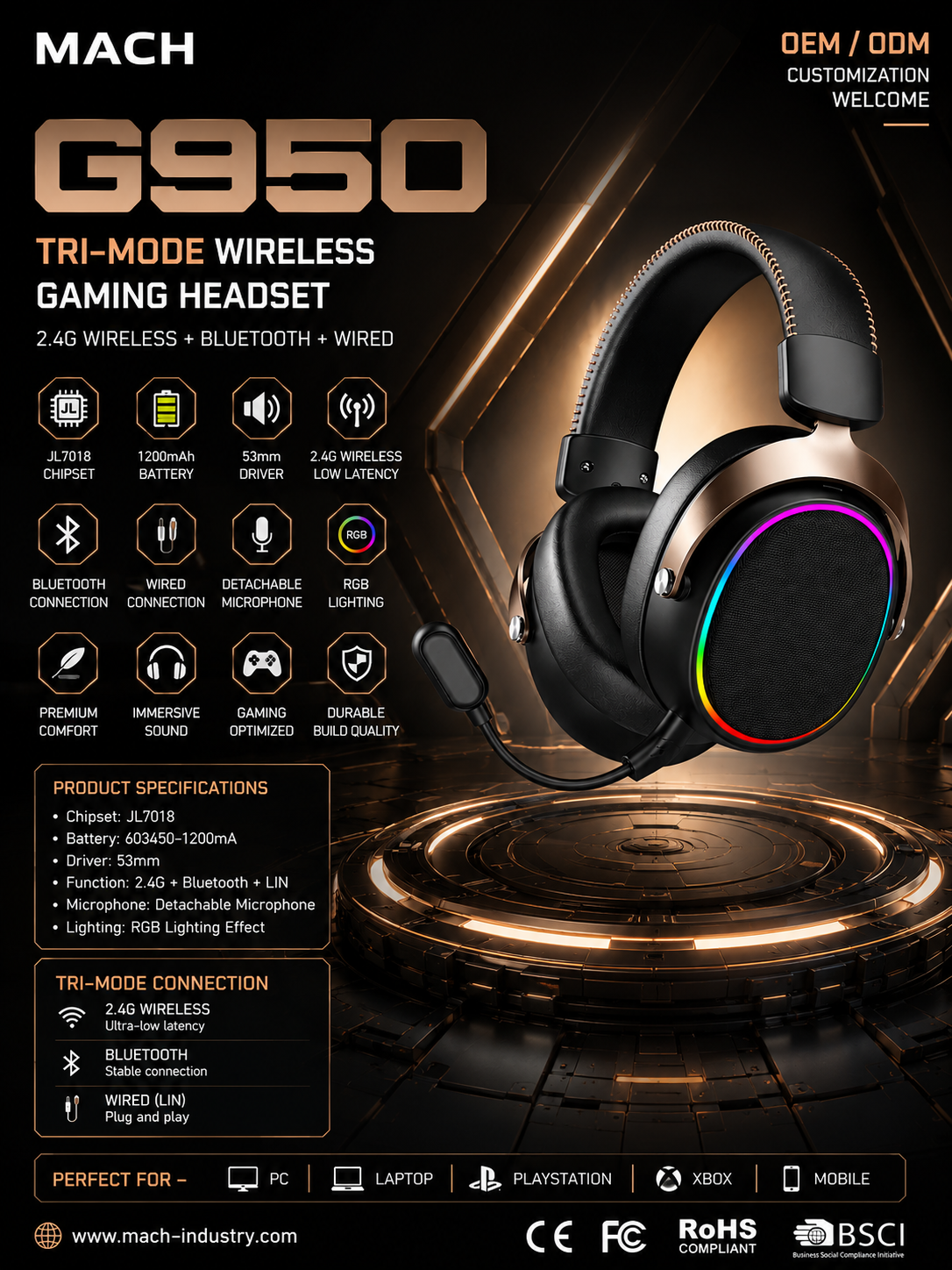
Before starting a tri-mode gaming headset OEM project, a brand should do more than confirm 2.4GHz wireless, Bluetooth and wired audio. The buyer should create one specification matrix that connects the chipset, dongle, driver and acoustic design, battery, RGB lighting, microphone, control logic, charging, accessories and platform behavior to each connection mode.
This system-level matrix prevents a common sourcing problem: individual features may be real, but their operating boundaries are not defined. Audio, microphone, controls, RGB, virtual surround and device recognition may behave differently in 2.4GHz, Bluetooth and 3.5mm modes. Every retail claim therefore needs a mode, target device, sample test and production acceptance method.
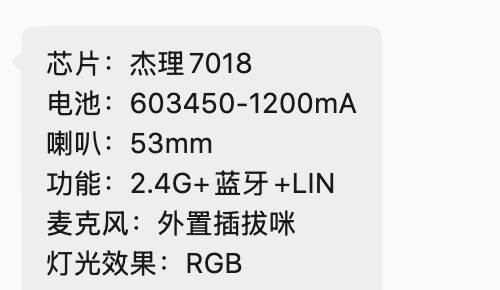
MACH G950 is a useful reference because its confirmed platform combines JL7018, 2.4G wireless with an included dongle, Bluetooth, 3.5mm wired support, a 53mm driver, a detachable microphone, RGB lighting and a listed 603450-1200mA battery.
Key Takeaways for OEM Buyers
A tri-mode platform should be approved as an integrated system, with every function mapped to a connection mode, target device, accessory, test case and final retail claim.
- Define the main job of 2.4GHz, Bluetooth and 3.5mm modes before selecting the platform.
- Confirm audio, microphone, controls, RGB and optional processing separately in every relevant mode.
- Evaluate chipset, dongle, battery, driver, cushions and firmware as interacting parts.
- Do not treat a 53mm driver or a battery number as a performance guarantee.
- Freeze standard functions, optional discussions, accessories and platform claims before packaging approval.
- Carry the approved mode matrix into reliability checks and mass-production inspection.
What Is a Tri-Mode Wireless Gaming Headset?
A tri-mode gaming headset provides three connection paths: dongle-based 2.4GHz wireless, Bluetooth and a wired audio connection.
The three modes are not duplicates. A 2.4GHz receiver is commonly used for dedicated wireless gaming links, Bluetooth supports suitable mobile and daily-audio scenarios, and wired mode can provide a direct connection or backup path where the target device supports it.
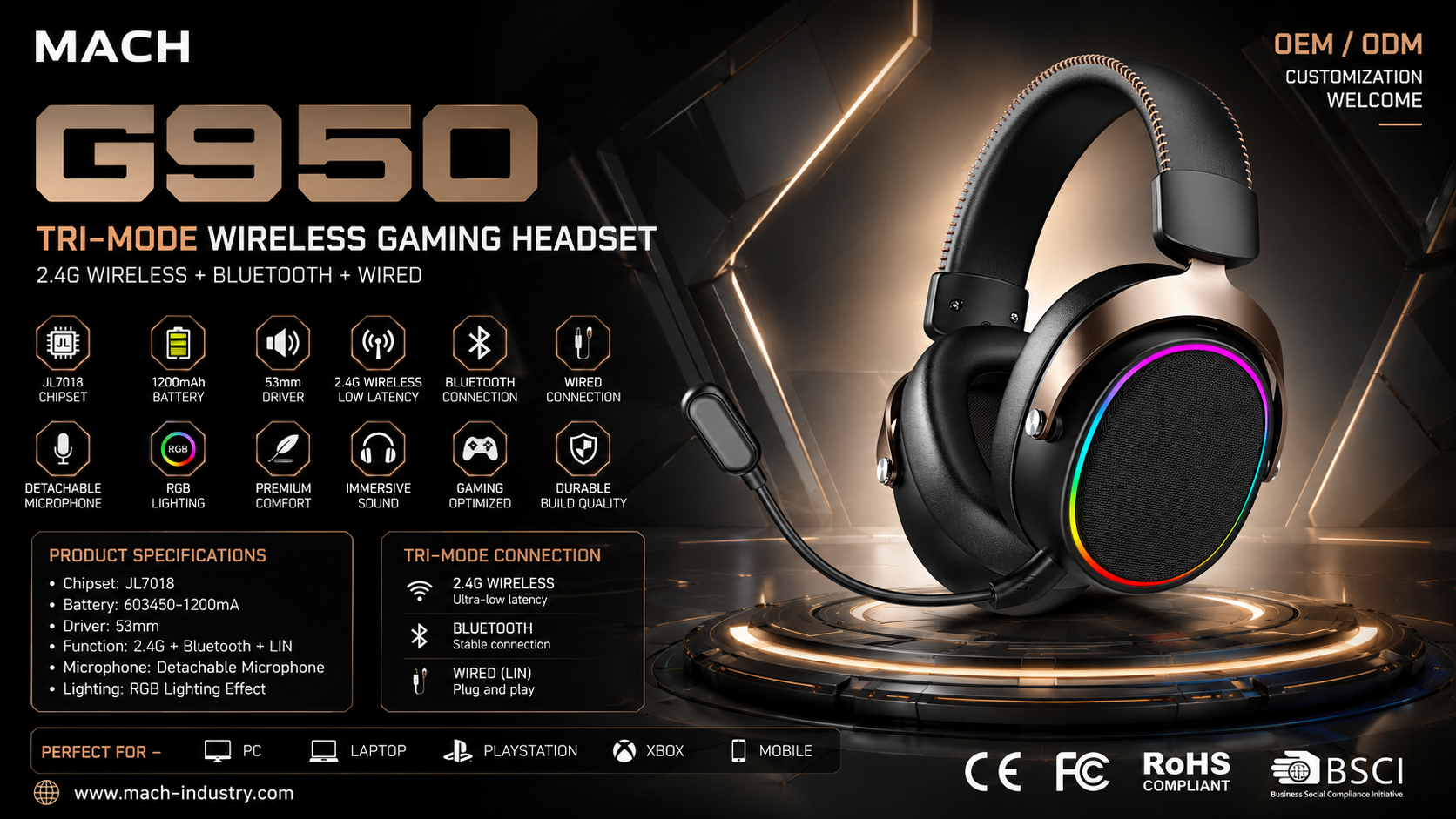
For G950, the published platform confirms 2.4G wireless, Bluetooth and a 3.5mm jack, with a dongle included for the 2.4G connection. The exact user flow, supported functions and device behavior should still be verified on the final sample.
Tri-mode should describe a defined operating architecture rather than three icons on a package. Buyers need a mode responsibility matrix showing which mode handles audio, microphone, controls, RGB and any processing feature on each named platform.
Why Gaming Brands Add Tri-Mode Headsets to Product Lines
Brands use tri-mode platforms to address dedicated gaming, daily wireless use and wired device access with one product concept, but the commercial value depends on verified mode coverage.
A single platform can support a broader product story than a wired-only or Bluetooth-only SKU. PC and console users may value a dongle-based connection, mobile users may expect Bluetooth, and a 3.5mm option can serve compatible wired devices or act as a backup.
For private-label planning, this can reduce the need to create separate industrial designs for every connection preference. It can also give distributors and e-commerce brands a higher-value feature structure for one retail model.
The trade-off is complexity. More modes add receiver management, switching logic, prompts, battery states, accessories, compatibility claims, manual content and customer-support questions. A tri-mode launch is successful when those responsibilities are deliberately specified, not when the feature list is simply longer.
2.4GHz, Bluetooth and Wired Modes Solve Different Problems
Each connection mode should have a primary use case and an explicit list of supported functions and limitations.
The matrix should avoid language such as all functions work on all platforms unless that statement has device-level evidence. Even when audio works, microphone input, volume controls, RGB or virtual processing may require a different power or software path.
G950 lists PC, laptop, PlayStation, Xbox and mobile-device scenarios. Buyers should not convert that list into universal compatibility. Each named device family, connection mode and required function should be confirmed on representative hardware.
| Connection mode | Typical use | Buyer evaluation points | Possible limitations |
|---|---|---|---|
| 2.4GHz wireless | Dongle-based gaming connection | Receiver recognition, pairing, audio, mic, controls and target devices | Depends on receiver interface and verified platform support |
| Bluetooth | Mobile or daily wireless audio | Pairing, reconnection, calls, controls and mode switching | Feature behavior may differ from 2.4GHz |
| 3.5mm wired | Compatible analog devices and backup use | Plug format, audio, mic path, cable and passive/active behavior | USB-powered features may not follow analog audio automatically |
The Engineering Checklist Behind a Tri-Mode Headset
A useful OEM specification links wireless architecture, acoustics, power, microphone, lighting, controls and mechanics instead of approving each headline parameter in isolation.
Start with the chipset and receiver architecture. G950 lists JL7018 and includes a dongle for 2.4G wireless. The buyer should document receiver interface, pairing and replacement process, mode selection, reconnection, prompts, control behavior and how the product returns from calls or wired use. The public data does not publish a latency figure, so no numerical latency claim should be created.
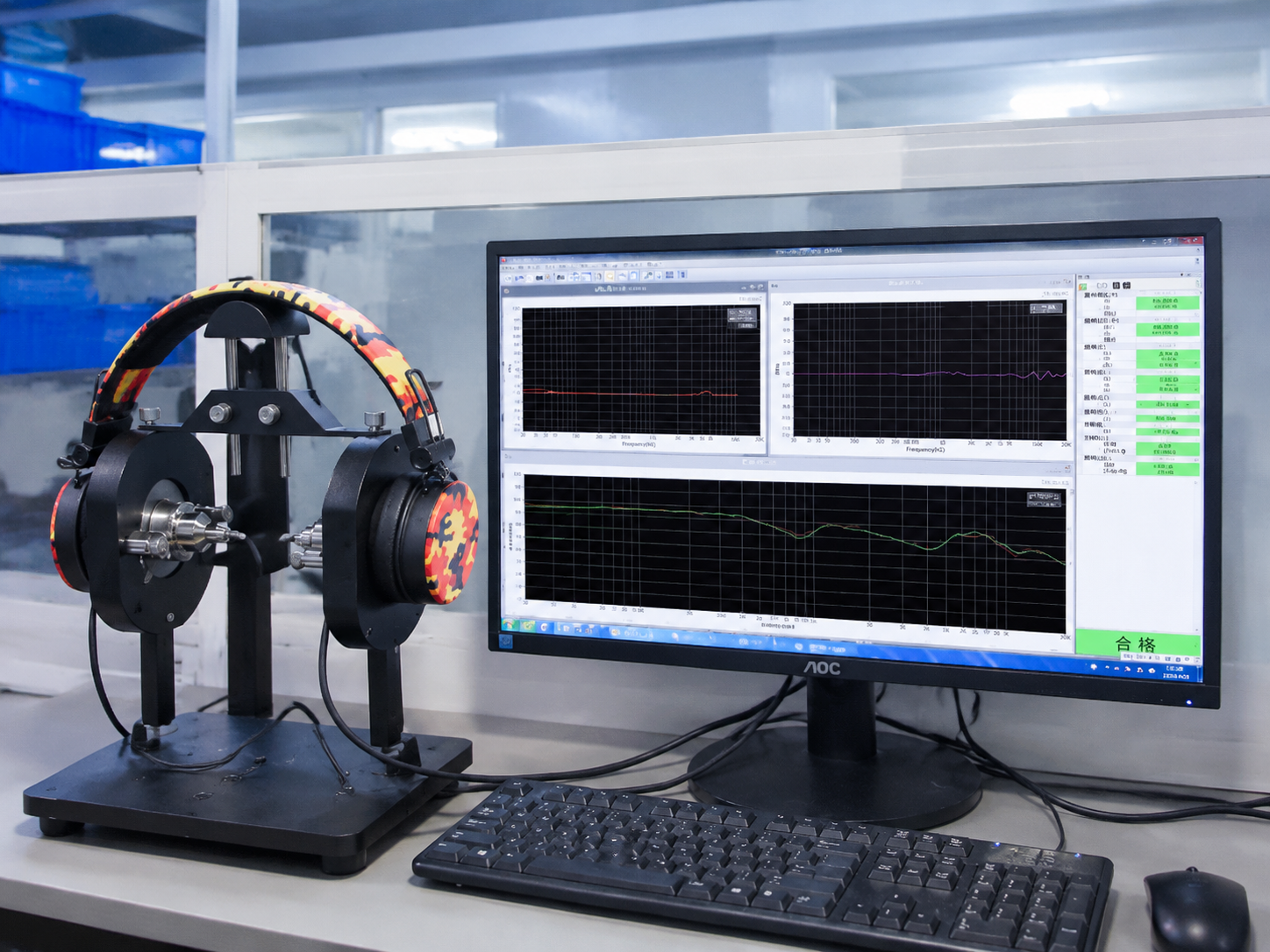
Next, define the acoustic target. The listed 53mm driver is a component dimension, not proof that the headset sounds better than a 40mm or 50mm design. Diaphragm behavior, acoustic chamber, vents, amplification, tuning, ear-pad seal, wearing position and production variation all affect the result. Samples should be checked for tonal balance, speech clarity, left-right matching, distortion and unwanted mechanical noise.
Power planning must connect the 603450-1200mA battery listing to actual modes. RGB, volume, 2.4GHz or Bluetooth use, microphone activity, chipset efficiency, firmware and protection design can affect runtime. Because G950 does not publish a confirmed runtime, the brand should build and validate its own claim conditions rather than derive hours from battery size.
The external detachable microphone creates another interface to validate. Buyers should review connector fit, insertion cycles, signal stability, orientation, mute or control behavior where present, packaging protection and replacement planning. Although the Product Card selects ENC as a feature direction, the final microphone and ENC behavior should be confirmed by mode and configuration before retail use.
RGB lighting affects visual positioning and may share power or control dependencies with wireless operation. The buyer should define expected effects, controls, indicators and whether lighting behavior changes by connection mode. RGB photography and packaging must represent the approved implementation accurately.
Mechanical and interface review includes headband adjustment, ear-pad seal, driver mounting, microphone socket, buttons, charging interface, 3.5mm jack, dongle storage or packaging and cable strain relief where applicable. The product page does not publish every mechanical tolerance, charging specification or control sequence, so these belong in the sample brief.
Finally, convert the system into firmware and accessory requirements. The mode switch, prompts, receiver, cables, detachable microphone, manual and package labels must describe one consistent product. A technically available feature that is not understandable to the user can still create returns and support cost.
Why Platform Compatibility Must Be Verified by Connection Mode
Compatibility is a matrix of device, connection and function, not a single yes-or-no label for the entire headset.
For each target platform, buyers should record whether audio output, microphone input, volume and mute controls, RGB, receiver recognition, Bluetooth connection and wired audio are required and verified. A check mark for audio does not automatically validate the microphone or controls.
Dongle recognition should be tested with the intended hardware and port path. Bluetooth should be tested only where the target device supports the required Bluetooth audio behavior. For 3.5mm use, the buyer should confirm plug type, cable, audio and microphone path, and whether powered functions remain available.
Virtual 7.1 is selected in the G950 Product Card as a feature direction. Buyers should establish which connection mode and host environment provide it, what software or processing is required and what stereo fallback occurs. This article does not claim that virtual 7.1 works identically in all three modes.
The final compatibility table should name tested device families and sample versions. Broad wording such as compatible with all consoles or all mobile devices should be avoided unless the evidence truly supports it.
| Compatibility item | 2.4GHz check | Bluetooth check | 3.5mm check |
|---|---|---|---|
| Audio | Receiver and host recognition | Pairing and playback support | Plug and channel behavior |
| Microphone | Input recognition and quality | Supported call or communication path | Plug wiring and host support |
| Controls | Volume, mute and mode logic | Media, calls and mode logic | Inline or headset behavior if supported |
| RGB and processing | Power and feature-state confirmation | Power and feature-state confirmation | Confirm whether active power is required |
Battery Capacity Is Only One Part of Wireless Headset Planning
Battery size provides a design reference, but runtime must be measured under defined connection, RGB, volume, microphone and firmware conditions.
G950 publishes a 603450-1200mA battery specification but does not publish an approved number of operating hours. Buyers should preserve that distinction. Converting the number directly into a runtime claim would ignore chipset efficiency, radio mode, amplification, lighting, user level and idle behavior.
A practical plan defines separate cases for 2.4GHz and Bluetooth, RGB on and off, representative volume, microphone use and standby. The test record should identify sample configuration, firmware, dongle, battery lot, environment and end-of-test rule.
Wired mode also needs clarification. Some analog functions may work without the same battery demand, while RGB, processing or controls may still require active power. This must be verified rather than inferred from the presence of a 3.5mm jack.
If a buyer requests battery, lighting or firmware changes, the team should review structure, weight distribution, charging, protection, compliance, runtime and package information together. Final feasibility is subject to engineering evaluation.
How the G950 Platform Fits a Private-Label Product Strategy
G950 suits brands that need a visually recognizable, large-driver tri-mode platform and are prepared to define its mode boundaries before launch.
The confirmed platform combines 2.4G wireless with a dongle, Bluetooth, 3.5mm wired support, JL7018, a 53mm driver, detachable microphone, RGB and the listed battery. This gives buyers several product-planning layers without requiring separate wired-only and wireless industrial-design stories.
Gaming headset brands, Amazon sellers, importers, distributors and PC accessory programs can evaluate G950 for a higher-feature private-label position. Its value is not that every function automatically works everywhere; its value is that the platform provides a concrete baseline for a brand-specific compatibility, accessory and package plan.
MACH industry can discuss logo placement, product colors, retail packaging, manuals, labels and microphone or dongle accessory configuration. The project should preserve confirmed platform facts and submit deeper changes for engineering review rather than promise unrestricted chipset, mold, battery or firmware modification.
Standard Platform vs Customized OEM Version
A standard-platform review confirms the existing architecture, while an OEM discussion defines brand-facing changes and identifies requests that require engineering validation.
Branding and packaging changes still need sample approval because colors, logos, inserts and accessories affect presentation and pack-out. Certification support should be described as coordination for the final market and configuration, not proof that every certificate has already been issued.
The G950 page lists MOQ from 2K and a 45-day lead time, but final commercial terms depend on customization, packaging and accessory scope. The quotation should state which configuration and assumptions those terms cover.
| Area | Standard platform review | Possible OEM discussion |
|---|---|---|
| Connectivity | 2.4G, Bluetooth and 3.5mm mode behavior | Feature or firmware requests subject to evaluation |
| Brand appearance | Current shell, RGB and component layout | Logo and color direction |
| Communication | Detachable microphone and included configuration | Microphone and accessory configuration discussion |
| Retail package | Current product and accessory set | Box, manual, barcode, compliance labels and warranty card |
| Core engineering | JL7018, 53mm driver and listed battery baseline | Chipset, battery, tuning, tooling or structure changes subject to engineering evaluation |
| Compliance | Review current project documents | Certification coordination for target market and final configuration |
Questions to Ask Before Requesting a Sample
A useful G950 sample request identifies the intended mode matrix, target platforms, standard functions, optional work and final package requirements.
- Which 2.4GHz, Bluetooth and 3.5mm functions are standard in the quoted sample?
- What receiver interface and dongle accessories are included?
- Which platforms and device versions have verified audio, microphone and controls?
- In which modes are RGB and virtual 7.1 available?
- How is the detachable microphone packed, connected and tested?
- What acoustic target and sample references apply to the 53mm driver platform?
- What test conditions will support any future battery-runtime claim?
- Which logo, color, packaging, manual and label files must the buyer provide?
- Which requests need firmware, tooling, battery or structural engineering work?
- What certification support applies to the target market and final configuration?
- How do customization and accessories affect MOQ, price and lead time?
- What unresolved items must be closed before mass-production approval?

From Sample Matrix to Production Control
The approved specification matrix should become the production test and inspection reference, not remain only in the sourcing email thread.
A golden sample and controlled document set should identify hardware, firmware, dongle, microphone, cables, RGB behavior, controls, branding, package and accessories. Revisions need traceable approval so a later sample does not silently change a previously accepted mode.
Production checks can cover pairing, audio, microphone, mode switching, controls, RGB, charging, wired operation and accessory count according to the agreed matrix. Acoustic and reliability sampling should follow project requirements and the approved configuration.
Packaging inspection should confirm that claims match the final function boundaries. A package that says tri-mode but does not explain mode-specific limits can create avoidable support issues even when the hardware passes inspection.

Conclusion
The strongest tri-mode OEM brief is a system specification that explains what each mode does, how the components interact and what evidence supports every platform claim.
G950 offers a confirmed starting point with JL7018, 2.4G wireless and dongle, Bluetooth, 3.5mm wired support, a 53mm driver, detachable microphone, RGB and a listed 603450-1200mA battery. Those specifications create a platform to evaluate, not automatic proof of runtime, latency, sound quality or universal compatibility.
MACH industry can review the brand's target market, mode matrix, platform requirements, logo, color, package, documentation, accessories and validation plan. A precise matrix helps the buyer move from feature selection to a controlled private-label product.
Frequently Asked Questions
What is a tri-mode wireless gaming headset?
It is a headset with three connection paths: dongle-based 2.4GHz wireless, Bluetooth and wired audio. The supported functions and devices should be documented separately for each mode.
What is the difference between 2.4GHz and Bluetooth in a gaming headset?
They use different wireless paths and often serve different product scenarios. Buyers should compare receiver requirements, target devices, audio, microphone, controls and mode behavior instead of assuming identical support.
Why should an OEM gaming headset include a wired mode?
A wired path can support compatible analog devices or provide a backup connection. Buyers must confirm plug wiring, microphone support and whether RGB or processing requires active power.
What should a brand check before selecting a tri-mode headset platform?
Check the chipset, dongle, mode logic, acoustics, battery plan, microphone, RGB, controls, mechanical design, target-device matrix, accessories, customization and compliance requirements.
Does a 53mm driver always mean better gaming audio?
No. Driver diameter must be evaluated with the diaphragm, chamber, amplification, tuning, ear-pad seal, wearing position and production consistency.
How does RGB lighting affect wireless-headset battery planning?
RGB adds a power condition that should be included in runtime tests. Connection mode, volume, microphone use, chipset efficiency, firmware and protection design also affect the result.
How should platform compatibility be verified?
Build a matrix by device and connection mode, then verify audio, microphone, controls, RGB, receiver recognition, Bluetooth behavior and wired support on representative hardware.
Can G950 branding, color and packaging be customized?
MACH can discuss logo placement, color direction, retail packaging, manuals, labels and microphone or dongle accessory configuration according to the project scope and sample approval.
Does G950 have a confirmed battery runtime or latency figure?
The public data lists a 603450-1200mA battery but does not publish an approved runtime or numerical latency. Buyers should define and validate claim conditions during sampling.
What information is required for a G950 OEM quotation?
Provide the target market, platforms, mode and function matrix, branding, colors, packaging, manuals, accessories, certification requirements, expected quantity and project schedule.
Related Resources
Need OEM/ODM gaming audio solutions?
Contact MACH Industry to discuss your gaming headset, gaming earbuds, or private-label audio project.
Contact MACH Industry