Home > Resources > Gaming Headset Guide
How Gaming Brands Develop Premium IP Collaboration Gaming Headsets
A B2B development guide to aligning IP-led industrial design with 2.4GHz, Bluetooth and wired user journeys across a multi-platform collaborative gaming headset.
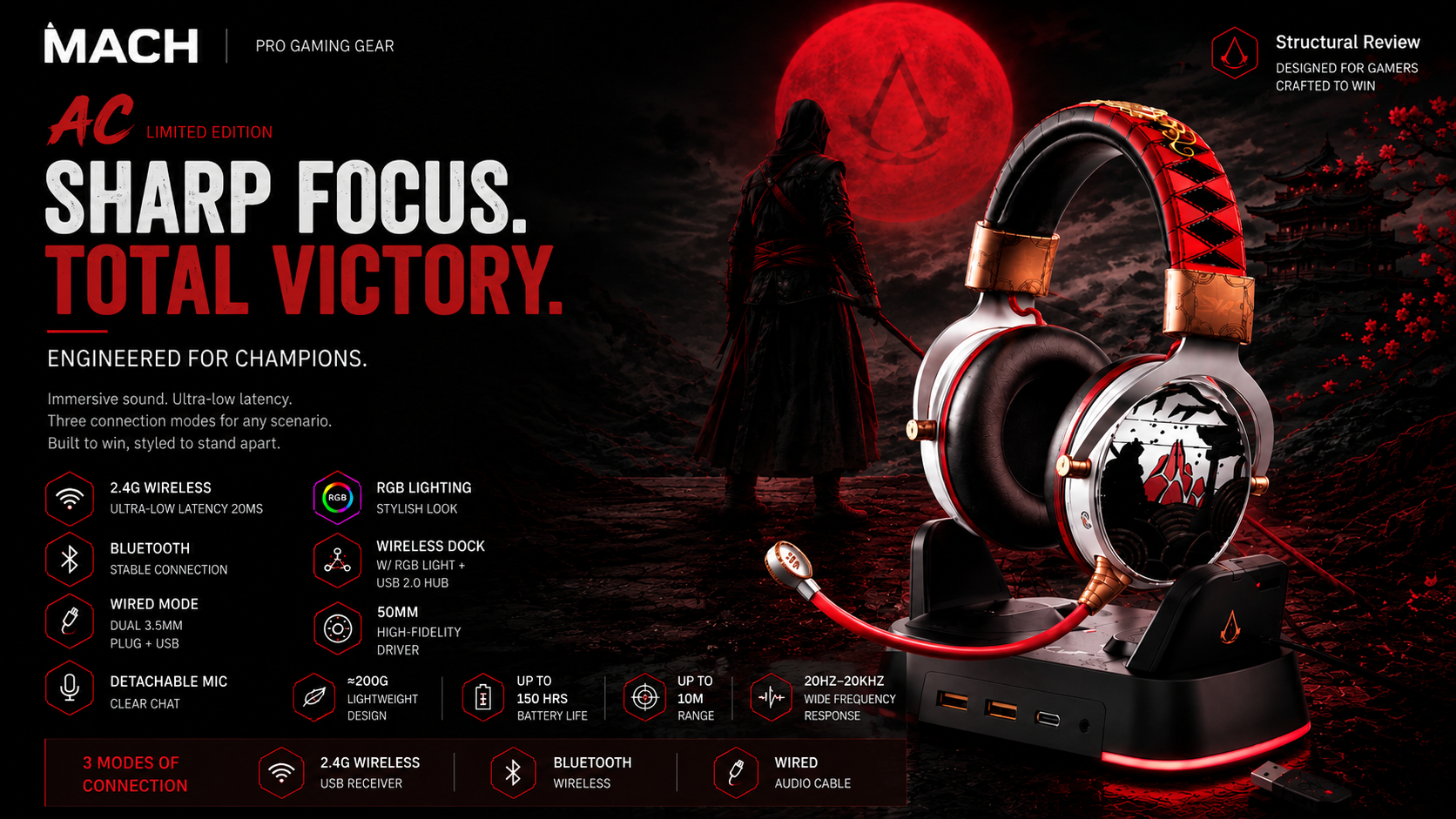
Gaming brands develop premium IP collaboration headsets by defining the creative identity and the multi-platform usage architecture at the same time. Successful collaboration hardware needs more than themed graphics: industrial design, CMF, structural details, connection modes, firmware behavior, accessories, packaging and quality standards must describe one coherent product.
This is especially important for a tri-mode headset. Dedicated 2.4GHz wireless, Bluetooth and 3.5mm wired audio can address different gaming ecosystems, but they do not automatically provide identical microphone, control, lighting or compatibility behavior. The brand story should remain recognizable while the product clearly explains which connection serves each target device.
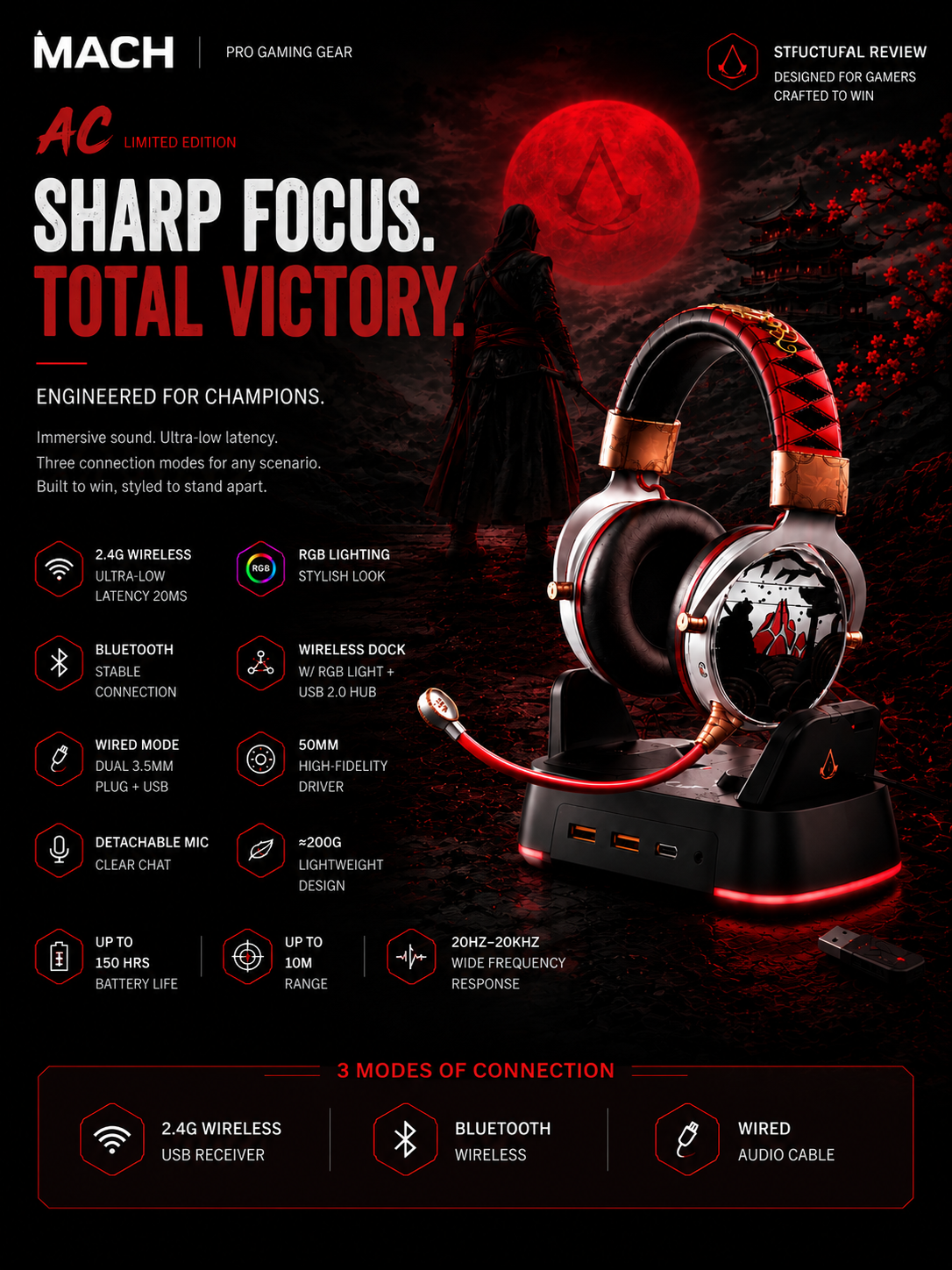
The AC collaborative gaming headset provides a confirmed reference. Its platform combines 2.4GHz wireless, Bluetooth 5.3 and 3.5mm wired audio with a JL7018M wireless solution, 50mm driver, detachable unidirectional microphone, 800mAh protected battery, red LED lighting and project-specific appearance development. This guide uses only the AC product data to explain an OEM/ODM development method rather than repeat the product page.
Why IP Collaboration Gaming Headsets Require More Than Traditional OEM
An IP collaboration headset combines authorized creative identity, product engineering and launch governance, while a traditional private-label project may require only a standard platform, logo and package.
A collaborative product must translate a visual world into physical hardware. Ear-cup graphics, decorative covers, colors, headband binding, cushion material, metal-effect parts, microphone, dongle, braided cables and packaging may all contribute to the identity. Each element needs an approved asset, material, production process and acceptance reference.
The technical platform remains equally important. A visually distinctive headset still needs predictable audio, microphone communication, mode switching, charging and accessory behavior. If the creative brief is developed separately from the connection and control architecture, packaging may promise experiences that the final mode or target device does not provide.
Brand governance introduces another layer. Buyers should supply artwork they are authorized to use, define copyright and market requirements, identify approval owners and preserve revisions. MACH can evaluate integration and manufacturing feasibility, but authorization and final brand approval remain part of the buyer's project governance.
A premium position is therefore created through consistency rather than feature count alone. The physical product, digital prompts, included accessories, instructions and package must all feel intentional and work together on the devices that define the commercial offer.
| Development area | Traditional private label | IP collaboration headset |
|---|---|---|
| Identity | Logo and basic color | Approved artwork, CMF, decorative components, digital and package identity |
| Platform | Existing standard configuration | Connection and device strategy aligned with the collaboration offer |
| Approval | Buyer sample approval | Buyer and brand approval tied to engineering and production revisions |
| Quality | General appearance and function | Physical limits for themed details plus mode-by-platform behavior |
| Launch assets | Standard product information | Product, accessories, instructions, claims and campaign assets from one source |
AC Collaborative Gaming Headset Project Overview
AC is a collaborative tri-mode wireless gaming headset platform designed for brands that need custom appearance development together with dedicated wireless, Bluetooth and analog wired routes.
The confirmed connections are 2.4GHz wireless through a transmitter, Bluetooth 5.3 and 3.5mm wired analog audio. The headset powers on in 2.4GHz mode by default. Its headset chipset is JL7018M and the transmitter uses JL7018M plus PA.
The acoustic system uses a 50mm 16-ohm driver with 110dB plus or minus 3dB sensitivity and a 20Hz–20kHz frequency response. Voice communication uses a detachable RF6027-C unidirectional microphone specified at -42dB plus or minus 3dB, 2.2-kilohm output impedance and 65dB signal-to-noise ratio.
An 800mAh battery with protection board and NTC is paired with XT4056 charging and LP5300 over-voltage and over-current protection. The source lists approximately two hours charging, about 18 hours use with the red backlight on and 40 hours with it off. USB-C supports play while charging.
The collaborative appearance direction includes custom decorative covers, headband binding colors, ear-cup and cushion details, gold and silver metal-effect parts, detachable microphone styling, braided cable colors, transmitter appearance and packaging. The formal specification confirms red single-color LED lighting rather than RGB.
From IP Concept to Production: Aligning Identity With the Usage Architecture
The most effective development process converts the IP concept into both a physical design system and a mode-by-platform product promise before engineering samples are released.
Start with the collaboration narrative. Product managers should define what the headset represents, which visual elements are essential, who the target user is and where the product will be sold. The brief should distinguish mandatory IP assets from flexible product styling. This gives industrial designers room to solve functional constraints without weakening the approved identity.
Translate the narrative into product zones. Map artwork and color to the ear cups, decorative covers, headband, cushions, support parts, microphone, transmitter, cables and packaging. Define keep-out areas around controls, joints, vents, cushions, ports and labels. A visual element becomes manufacturable only after it has a real part, process, tolerance and approval method.
Develop CMF on physical materials. Color references, binding material, leather direction and metallic effects look different across resin, textile, coating and plated or painted surfaces. Buyers should approve production-representative limit samples rather than screen renders alone. The AC source includes several customized material and color directions, making CMF control part of the product definition.
At the same time, define the user journey by connection mode. Decide why the collaboration needs 2.4GHz, Bluetooth and wired operation; which target devices matter; what accessories are included; and which microphone, control and lighting behaviors users should expect. The packaging hierarchy should explain the intended route without suggesting universal feature parity.
Connect physical and digital identity. Prompt sounds and firmware behavior can be evaluated for AC-type projects. Any customized behavior needs an approved firmware revision and should remain compatible with the mode-switching plan. The transmitter and cables also carry the product identity and must remain easy to identify and use.
Prototype by risk. Appearance samples settle artwork and CMF, engineering samples validate structure and electronics, and package samples confirm protection and presentation. A final golden sample should combine the approved visual identity, firmware, accessories and product behavior instead of mixing decisions from unrelated prototypes.
Plan production evidence before launch artwork is finalized. The BOM, drawings, CMF limits, firmware, mode matrix, accessory list, packaging, labels and inspection criteria should use one revision system. Changes to a decorative component, transmitter, firmware or package can affect both brand approval and technical claims.
This coordinated approach makes premium positioning credible. The product feels intentional because the user sees the same identity in appearance, accessories and instructions while receiving a clearly defined experience on the supported connection route.
| Translation layer | Creative question | Engineering output |
|---|---|---|
| Identity | Which assets define the collaboration? | Approved asset register and application map |
| Industrial design | Where should the story appear? | Part geometry, keep-out zones, tooling and attachment |
| CMF | How should the product look and feel? | Material, process, color references and limit samples |
| User journey | How will players use the product? | Mode-by-platform matrix, controls, accessories and instructions |
| Release | What represents the final product? | Golden sample, BOM, firmware, package and QC plan |

Why Multi-Platform Connectivity Matters for Gaming Accessories
Multi-platform connectivity expands a collaboration headset's use cases, but each connection method must have a defined role, target devices and limitations.
Dedicated 2.4GHz wireless uses the included transmitter as a controlled gaming route. The AC specification lists approximately 20ms latency and greater than 10 meters range for this mode. Those values should not be transferred to Bluetooth or wired operation.
Bluetooth 5.3 provides a separate wireless path for compatible computers and mobile devices shown in the AC manual. It can support everyday wireless listening and calls, but the buyer should confirm pairing, controls and microphone behavior on representative targets. The AC manual does not show Bluetooth support for PS4 or PS5.
The 3.5mm route provides analog left and right audio plus microphone support on compatible equipment. The manual shows this path for Xbox audio and microphone, while dongle and Bluetooth are not shown for Xbox. Cable and adapter requirements should be explicit in the package and listing.
Multi-platform positioning therefore depends on accurate route planning. A platform logo should be connected to the approved mode, accessory and feature set. This protects the brand from treating 'tri-mode' as a universal compatibility statement.
| Connection | Primary role in AC | Buyer validation |
|---|---|---|
| 2.4GHz | Dedicated wireless through transmitter | Target host, latency method, range, microphone and controls |
| Bluetooth 5.3 | Compatible computer and mobile wireless use | Pairing, reconnect, audio, calls and control behavior |
| 3.5mm wired | Analog audio and microphone route | Jack format, cable, adapter, microphone and powered features |
Technical Deep Dive: Building a Mode-by-Platform Experience Matrix
A mode-by-platform matrix records how each target device works through each approved connection, including audio, microphone, controls, lighting, accessories and limitations.
Begin with actual target devices rather than broad ecosystem names. The AC manual references Switch and Switch 2, PC and Mac, Android and iOS, PS5, PS4 and Xbox. For each one, the matrix should list the exact connection route, required transmitter, cable or adapter, and the tested hardware or software context.
Separate core audio from supporting functions. A device may receive audio while microphone input, volume control, track control, LED control or mode prompts behave differently. Recording individual results prevents a general compatibility mark from overstating the user experience.
Define connection priority and switching. AC powers on in 2.4GHz mode by default and includes mode switching through its control behavior. The matrix should describe how users reach Bluetooth, what happens when a cable is inserted, how the product reconnects and which indicators or prompts confirm the state.
Link power behavior to the route. The 800mAh battery, red lighting, volume and wireless mode affect use time. Wired audio may have different power and lighting behavior. USB-C play-while-charging support should be documented without implying that USB-C is an audio input because USB audio is not confirmed.
Treat accessories as part of compatibility. The transmitter, charging cable, audio cable and detachable microphone need approved identities and package positions. If one target requires a different connection, the user should be able to find the correct accessory and instruction immediately.
Use the matrix as a shared source for engineering tests, packaging icons, manuals, customer support and marketplace content. When firmware, transmitter, cable or target-device behavior changes, affected rows return to validation before claims are updated.
- List exact target devices and software context.
- Assign one or more approved connection routes to each target.
- Record audio, microphone, controls, LED and power behavior separately.
- Specify every transmitter, cable or adapter requirement.
- Document mode switching, reconnect and user feedback.
- Publish limitations next to the relevant platform claim.
- Revalidate matrix rows after hardware or firmware changes.
Engineering Considerations Behind Premium Gaming Headsets
Premium collaborative hardware requires controlled acoustics, microphone performance, materials, lighting, accessories and production consistency in addition to distinctive styling.
The confirmed 50mm driver and detachable unidirectional microphone provide measurable starting points, but final sound and communication depend on enclosure, cushions, tuning, microphone placement and assembly. Relevant material or decorative changes should be included in acoustic and voice evaluation.
The red LED is default-on and can be switched off. Optical uniformity and surface interaction should be evaluated on the final CMF. Battery claims must retain the distinction between approximately 18 hours with lighting on and 40 hours with lighting off.
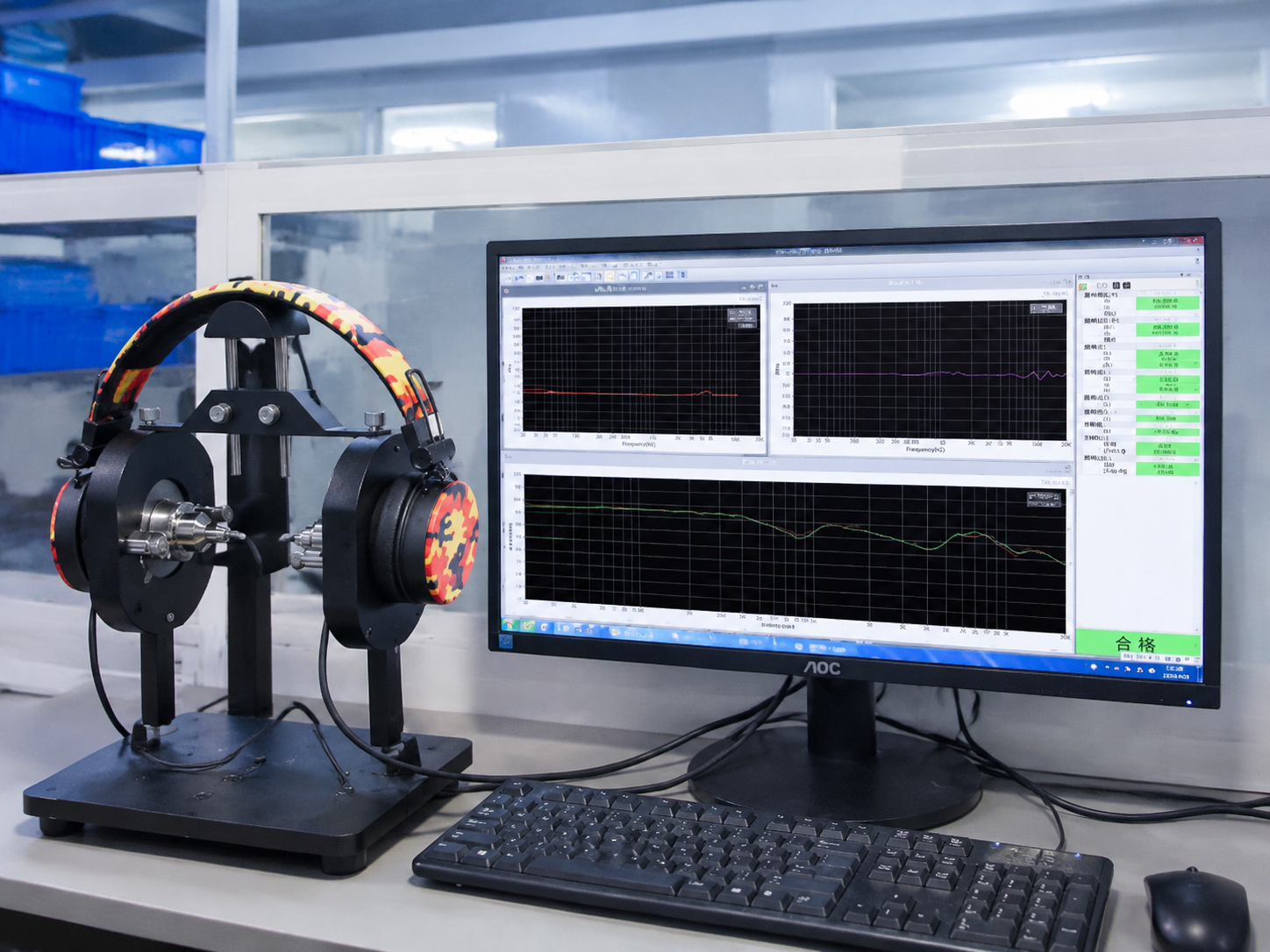
Manufacturing validation can cover incoming materials, wireless routes, microphone, controls, charging, lighting, acoustic checks, reliability, aging, packaging and final inspection against the approved configuration.
OEM Development Process for Collaborative Gaming Headsets
Collaborative headset development moves from authorized concept and platform definition through design, engineering, prototypes, testing and controlled production release.
Certification support should be planned according to the target market and final configuration. The AC source lists support requirements, not proof that every completed product certificate already exists.
Prompt sounds, firmware behavior and pairing identity are evaluated according to the project requirements. MOQ and lead time depend on the selected customization, packaging and approval scope.

How Brands Choose the Right Gaming Headset Manufacturing Partner
Brands should evaluate whether a supplier can coordinate design, engineering, wireless validation, CMF, accessories, packaging and production quality as one project.
Engineering support should cover the real connection architecture and mode-by-platform behavior. Buyers should ask how transmitter, Bluetooth, wired audio, microphone, controls, power and firmware are verified on representative targets.
Quality management should connect the golden sample and released documents to incoming inspection, assembly, functional testing, reliability, aging, packaging and final inspection. Change control should identify when technical or brand reapproval is needed.
MACH industry can evaluate AC-type collaborative projects through product review, CMF and accessory coordination, sampling, acoustic and wireless checks, packaging preparation and production follow-up against the approved configuration.
- Can the supplier translate approved visual assets into manufacturable parts?
- Can it define and test each mode on representative target devices?
- Does it control firmware, transmitter, cable and accessory revisions?
- Can it coordinate physical CMF samples and cosmetic limits?
- Does its sample plan separate appearance, engineering and packaging decisions?
- Are certification roles and target-market documents clear?
- Does production QC reference the final golden sample and specification?

Conclusion
Premium IP collaboration headsets succeed when visual identity and multi-platform product behavior are engineered and approved as one user experience.
AC demonstrates this approach through customizable appearance, accessories and a confirmed tri-mode platform.
For buyers, the essential tools are an asset-and-CMF map, a mode-by-platform experience matrix, traceable prototypes and one production release covering hardware, firmware, accessories, packaging and quality limits.
Gaming brands planning an authorized collaborative headset can contact MACH industry with their IP brief, target platforms, connection priorities, design direction, packaging scope and launch requirements.
Frequently Asked Questions
What is an IP collaboration gaming headset?
It is a headset developed around authorized creative assets and a defined technical platform, with coordinated industrial design, CMF, firmware behavior, accessories, packaging and production controls.
Why is an IP collaboration headset different from standard private labeling?
It usually requires deeper visual integration, brand approvals, custom parts or materials, a controlled product story and traceability across physical, digital and packaging assets.
Which connection modes does the AC headset support?
AC supports dedicated 2.4GHz wireless through a transmitter, Bluetooth 5.3 and 3.5mm wired analog audio.
Does every AC connection mode support the same gaming platforms?
No. Platform support differs by mode. The AC manual assigns connection routes by device and shows Xbox audio and microphone through 3.5mm rather than dongle or Bluetooth.
What driver and microphone are confirmed for AC?
AC uses a 50mm 16Ω driver and a detachable RF6027-C unidirectional microphone with -42dB ±3dB sensitivity and 65dB SNR.
Can MACH customize the AC headset appearance?
MACH can evaluate authorized artwork, decorative covers, color and CMF, headband and cushion direction, microphone, transmitter, braided cables, packaging and manuals.
How should brands validate multi-platform headset compatibility?
Create a matrix for each target device and mode covering required accessories, audio, microphone, controls, lighting, power behavior and limitations, then test representative devices.
What samples are needed for a collaborative gaming headset?
Projects may use appearance samples for artwork and CMF, engineering samples for structure and functions, and packaging samples for retail presentation and protection.
What certification support is available for AC-type projects?
Certification support is planned according to the target market and final configuration. Completed certification should only be claimed when matching product-specific documents are available.
What should buyers prepare before requesting an OEM quote?
Prepare authorized artwork, target markets and platforms, connection requirements, CMF direction, accessories, packaging scope, quantities, certification needs, launch timing and approval contacts.
Related Resources
Need OEM/ODM gaming audio solutions?
Contact MACH Industry to discuss your gaming headset, gaming earbuds, or private-label audio project.
Contact MACH Industry