Home > Resources > Gaming Headset Guide
How Can Brands Turn an IP Style Guide Into a Co-Branded Gaming Headset?
A buyer guide to translating approved IP artwork into a consistent gaming headset system across CMF, lighting, firmware identity, accessories, packaging and production controls.
Brands can turn an IP style guide into a co-branded gaming headset by converting each approved visual and verbal asset into a controlled product requirement for hardware, CMF, lighting, firmware identity, accessories, packaging and quality inspection. The process is not simply placing a logo on an existing shell. Every themed element needs an approved location, material, color reference, production method, tolerance and ownership record.
This matters because a collaborative gaming headset is judged as one brand experience. An accurate ear-cup graphic can still feel inconsistent if the LED color, cable, Bluetooth pairing name, decorative parts and package artwork follow unrelated directions. Procurement teams therefore need a system that keeps creative approval, engineering feasibility and mass-production control aligned.
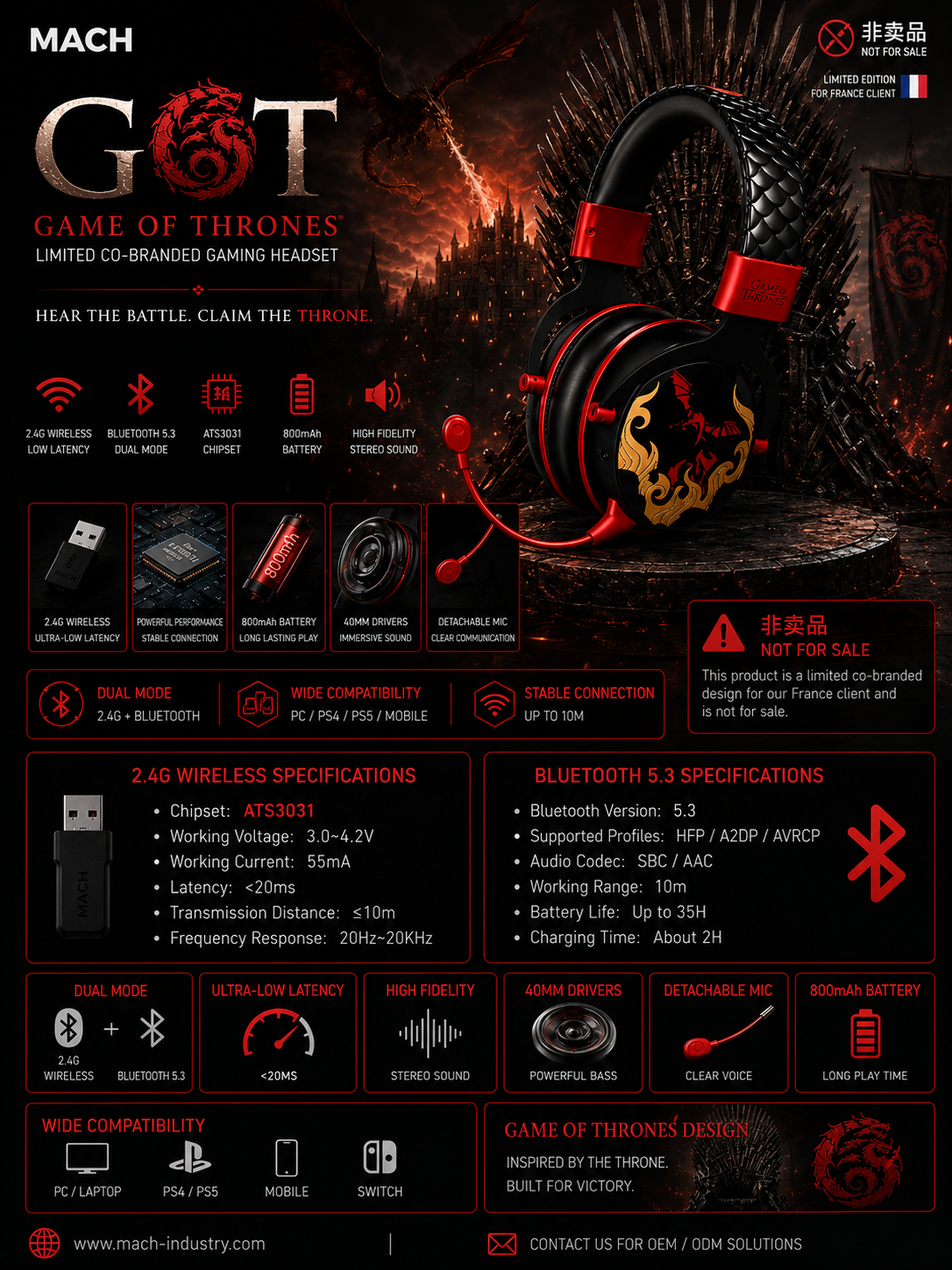
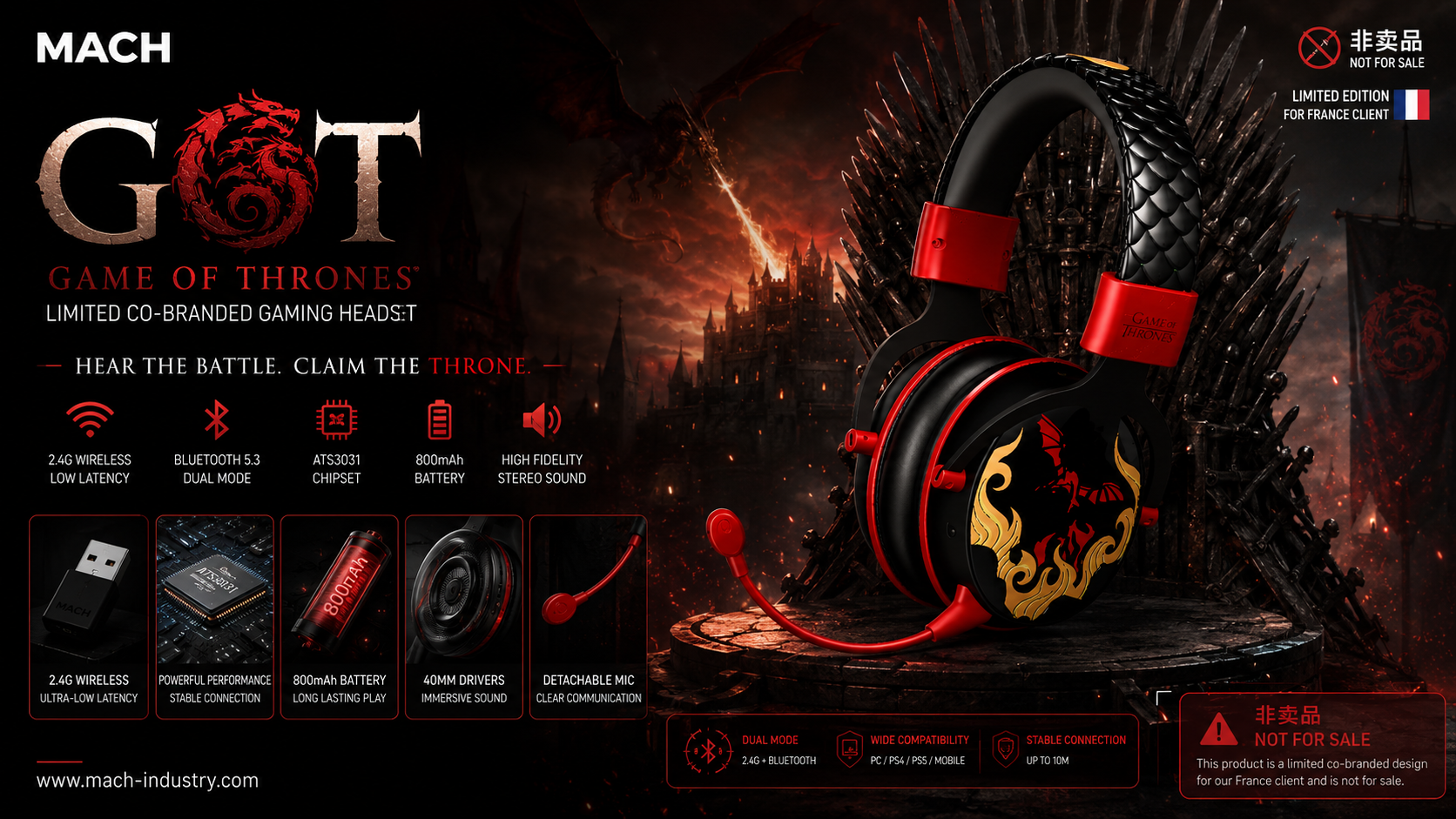
The published GOT co-branded tri-mode headset provides a detailed reference. It combines themed ear-cup artwork, dragon-scale headband direction, orange lighting, decorative components, custom cable colors and project-specific digital identity with 2.4GHz wireless, Bluetooth 5.3 and 3.5mm wired audio. This article uses only confirmed GOT product information to explain the buyer process without copying the product page or implying rights beyond buyer-approved artwork.
Product Background: What Is a Co-Branded Gaming Headset?
A co-branded gaming headset combines an approved technical platform with visual, material, digital and packaging elements developed for a specific brand or IP collaboration.
A standard private-label program may focus on a logo, color and retail box. A co-branded project can extend much further: themed graphics, custom textures, decorative parts, specified Pantone colors, lighting behavior, cable and dongle appearance, Bluetooth identity, prompt sounds, manuals, inserts and copyright placement may all contribute to the final product.
The GOT reference is built on a tri-mode platform. Confirmed connections include dedicated 2.4GHz wireless, Bluetooth 5.3 and 3.5mm analog audio. The headset uses an ATS3031 chipset, an ATS3031 plus PA transmitter platform, an 800mAh protected battery, a 50mm 16-ohm driver and a detachable unidirectional microphone.
Its collaborative direction is visible in the source requirements: themed ear-cup graphics, dragon-scale headband texture, silicone decorative elements, orange Pantone 138C lighting, project color references, custom braided cables, dongle appearance and coordinated retail assets. The published Bluetooth pairing identity is also project specific.
For buyers, the commercial objective is usually to create a recognizable accessory that supports a campaign, limited-edition range or collaborative product line while retaining the repeatability expected from manufactured electronics. That combination makes approval discipline as important as industrial design.
| Development area | Standard private label | Co-branded program |
|---|---|---|
| Visual identity | Logo and basic color | Approved artwork, copyright placement, themed surfaces and decorative details |
| Digital identity | Standard pairing and prompts | Project-specific pairing name, prompt review and firmware behavior where approved |
| Accessories | Standard cable and dongle | Coordinated cable color, connector direction, microphone and dongle appearance |
| Retail assets | Generic package template | Approved box, insert, manual, brochure, carton and seal artwork |
| Approval | Buyer sign-off | Buyer, brand or rights-holder artwork approval plus engineering and production release |
The Buyer Problem: Keeping Creative Intent and Production Reality Aligned
The central buyer problem is preventing approved creative assets from becoming inconsistent, impractical or untraceable when they are divided among engineering, suppliers, firmware, packaging and production teams.
Style guides are commonly created for digital or print use. Their colors, line weights, clear space and artwork proportions may not transfer directly to molded plastic, metal, synthetic leather, silicone, light guides or woven cable. Product teams must define how each asset changes across material and process without losing the intended identity.
The headset also has functional boundaries. Graphics cannot obstruct controls, joints, microphones or compliance labels. Decorative pieces need retention and durability. A textured headband must still bend, extend and remain comfortable. Lighting color must be evaluated through the real optical structure rather than approved only as a digital color swatch.
Several companies may own parts of the workflow. The rights holder controls approved assets, the gaming brand defines the commercial offer, MACH evaluates product integration, and print or component suppliers execute individual parts. Without one revision system, an old logo, unapproved color or obsolete copyright line can survive in one file after the main artwork is updated.
Timing creates pressure. Campaign launch dates may be fixed while structure, firmware, packaging and compliance planning still require samples and approvals. Buyers should identify long-lead custom parts and approval gates early instead of assuming all themed changes can be completed after the engineering sample.
The Brand Consistency Matrix: Linking Style-Guide Assets to the Complete Product
A brand consistency matrix maps every approved IP asset to its physical or digital application, production method, reference standard, sample, approver and inspection rule.
Start with an asset register. Each logo, symbol, character element, texture, color, copyright line, font, pairing name, prompt and package graphic receives an identifier and approved source file. The register should state permitted use, minimum size, orientation, clear space and any market or campaign restriction provided by the buyer or rights holder.
Map each asset to a product zone. The matrix can cover left and right ear cups, headband, cushions, microphone, transmitter, cable, connector, buttons, lighting, labels, box, inserts, manual and shipping marks. A single symbol may require different production files for printing, embossing, molding or packaging, but those files should remain linked to the same approved identity.
Define CMF and process together. A Pantone reference is a target, not a complete manufacturing instruction. The substrate, texture, gloss, base color, ink, coating and lighting conditions affect perception. The GOT project specifies color directions including orange Pantone 138C lighting and other project Pantone references. Buyers should approve physical limit samples on the actual material instead of relying only on monitor appearance.
Treat three-dimensional decorative elements as engineering parts. Silicone dragon and egg details or a dragon-scale headband direction need drawings, material definition, tooling or process review, attachment method, tolerance, wear assessment and package protection. The artwork approval establishes appearance; the part approval establishes manufacturability and durability.
Include digital touchpoints. The confirmed GOT source lists a project-specific Bluetooth pairing name and supports pairing-name and prompt-sound review according to customer requirements. Digital identity should be approved with the relevant firmware revision and checked after updates. It belongs in the same matrix as visible graphics because users experience both as part of the collaboration.
Extend the matrix to accessories. The GOT direction includes a custom Type-C to 3.5mm braided audio cable, a USB to Type-C braided charging cable, color directions, gold-color connector direction, a detachable microphone and a black transmitter. Each item needs an approved specification, package location and replacement identity so that a standard accessory is not substituted into a co-branded set.
Packaging completes the system. Color box, insert, manual, brochure, carton and seal artwork should use the released product image, included accessories, connection instructions, copyright text and market labels. Package approval should follow the final headset and firmware configuration, not an early appearance sample.
Finally, assign inspection criteria. Some requirements can be measured by location, size or color instrument; others require an approved visual limit sample. The matrix should identify the check method, frequency and decision owner. If an asset, material, supplier, firmware or package changes, affected rows return to approval before production continues.
| Matrix field | Buyer decision | Production control |
|---|---|---|
| Asset identity | Which approved source may be used? | File ID, revision, usage rule and approver |
| Application | Where and how should it appear? | Part, location, size, orientation and process |
| CMF | What physical appearance is acceptable? | Material, Pantone direction, gloss, texture and limit sample |
| Digital behavior | What should users see or hear? | Firmware revision, pairing identity, prompts and functional check |
| Release status | Is the application approved for production? | Sample reference, date, owner and change trigger |

Technical Deep Dive: Why Co-Branded Details Must Be Engineered as One System
Co-branded details interact with structure, radio hardware, power, acoustics, controls, firmware and packaging, so they must be validated as one product system rather than as isolated decorations.
Lighting demonstrates this interaction. The GOT specification defines a single-color orange backlight that is on by default and can be switched off by key. The optical result depends on LED selection, current, light-guide geometry, surrounding material and printed graphics. Lighting also affects power use: published operating time is approximately 18 hours with the backlight on and approximately 40 hours with it off.
Mechanical decoration can influence comfort and reliability. A dragon-scale headband treatment changes the user-contact surface and may affect flexibility, wear or assembly. Silicone decorations add mass and attachment requirements. Ear-cup artwork must tolerate handling while preserving acoustic openings, controls and joint movement. These changes should be present in representative samples used for durability and appearance approval.
Digital identity connects creative and firmware teams. Bluetooth 5.3, the published pairing name, default 2.4GHz power-on mode, USB firmware-upgrade support and automatic power-off after five minutes without use are confirmed project behaviors. Any customized pairing name or prompt must be tied to the approved firmware and checked alongside mode switching and host-device behavior.
Accessories affect both function and storytelling. The 2.4GHz transmitter uses an ATS3031 plus PA platform, while 3.5mm analog audio supports left and right channels and microphone input. Custom cable colors and dongle appearance cannot hide connector purpose or reduce usability. Manuals and package trays should make the correct route and accessory clear.
Acoustic and microphone performance still need protection. The base specification includes a 50mm 16-ohm driver, 20Hz–20kHz response, 110dB plus or minus 3dB sensitivity and a detachable unidirectional 6027 microphone. Decorative or material changes near the ear cup, cushion or microphone should be reviewed for their effect on fit, seal, pickup and assembly consistency.
The technical release therefore combines artwork, CMF, mechanical parts, electronics, firmware, acoustics, accessories and package contents. A complete golden sample should represent that released combination. Approving a graphic on one sample and firmware on another is not enough when the production product must deliver both together.
- Verify lighting color and behavior on the final optical structure.
- Include custom textures and decorative parts in mechanical testing.
- Link Bluetooth pairing identity and prompts to a firmware revision.
- Confirm themed accessories retain the required electrical and mechanical function.
- Repeat acoustic and microphone review after relevant material or structural changes.
- Approve one traceable product-and-package golden sample.

GOT Platform Reference
The GOT product is a confirmed tri-mode collaborative headset platform with defined wireless, audio, microphone, battery, lighting and themed-development specifications.
The platform reference gives buyers a controlled technical base for collaborative development. It does not mean every new artwork package, accessory set, firmware change or market configuration is automatically approved.
Compatibility, operating time and wireless performance should remain connected to the final configuration and documented conditions. Certification names should be treated as support requirements unless product-specific certificates matching that configuration are available.
OEM/ODM Development for Co-Branded Gaming Audio
A co-branded OEM process should coordinate rights-approved assets, technical requirements, samples and production records through defined approval gates.
The buyer should begin with proof of authorization where applicable, an approved style-guide package, target markets, launch timing, quantity expectations and the desired technical configuration. MACH can then evaluate how the artwork, colors, decorative elements, pairing identity, accessories and packaging fit the selected headset platform.
Concept translation converts assets into drawings, CMF references, firmware requirements, cable specifications and package layouts. Engineering review identifies tooling, process, durability, radio, acoustic or compliance implications before samples are ordered.
Sampling should be staged by risk. Appearance samples can settle artwork and physical color; engineering samples can verify mechanics, lighting, firmware and function; package samples can confirm protection and retail presentation. Each sample needs a revision and approval purpose.
Before mass production, the released BOM, firmware, artwork, CMF limits, accessories, package files, labels, inspection plan and golden sample should describe one configuration. Any later substitution or revision follows change control and, where required, renewed brand approval.

Buyer Checklist
Buyers should prepare authorization, assets, technical scope, approval ownership and production references before launching a collaborative gaming headset project.
- Confirm the right to use all supplied names, logos, artwork and copyright material.
- Provide master artwork, style-guide rules, fonts, Pantone directions and required legal text.
- Define the target tri-mode configuration, devices, firmware identity and accessory set.
- Map every asset to a product, digital, accessory or packaging application.
- Identify parts requiring tooling, texture, silicone decoration or special surface processes.
- Approve physical CMF samples on actual production materials.
- Define Bluetooth pairing name, prompt-sound and lighting requirements.
- Review custom cables, microphone, transmitter and package contents as functional parts.
- Plan target-market certification support for the final configuration.
- Assign approval owners and response times for artwork, samples and changes.
- Release a complete golden sample, BOM, firmware and packaging set before production.
- Retain traceable approval and inspection records for every production revision.
Conclusion
A successful co-branded headset turns approved creative identity into a controlled product system that remains consistent from firmware and materials to accessories and packaging.
The GOT reference shows the breadth of that system: themed surfaces, Pantone-led CMF, orange lighting, decorative elements, custom accessories and digital identity are integrated with a confirmed tri-mode platform, 50mm driver, detachable microphone and protected battery.
For procurement teams, the brand consistency matrix is the practical bridge between a style guide and mass production. It clarifies who approves each asset, how it will be made, which sample defines acceptance and what must be reviewed after a change.
Brands planning an authorized collaborative gaming audio product can contact MACH industry with their style guide, technical brief, target markets, package plan and approval workflow for an OEM/ODM project evaluation.
Frequently Asked Questions
What is a co-branded gaming headset?
It is a gaming headset developed around approved brand or IP assets across product appearance, materials, digital identity, accessories and packaging, using a defined technical platform.
What should a buyer provide before starting an IP gaming headset project?
Provide authorization where applicable, approved artwork and style-guide files, target markets, technical requirements, package scope, quantity expectations, launch timing and approval contacts.
Can MACH use any character or entertainment artwork on a headset?
No. Buyers should provide artwork they are authorized to use and the applicable approval requirements. MACH evaluates manufacturing integration based on buyer-approved assets.
Which connection modes does the GOT headset platform support?
The confirmed platform supports dedicated 2.4GHz wireless, Bluetooth 5.3 and 3.5mm wired analog audio.
Can the Bluetooth pairing name and prompt sounds be customized?
The GOT source includes a project-specific pairing name and supports pairing-name and prompt-sound review according to customer requirements. Final feasibility is confirmed during project evaluation.
How are IP colors controlled in mass production?
Buyers should define color targets with material, finish and process, then approve physical limit samples on production-representative parts. Inspection criteria should reference those approved samples.
Can themed decorative parts be added to a gaming headset?
The GOT reference includes silicone decorative elements and a dragon-scale headband direction. New parts require structural, material, tooling, attachment, durability and packaging review.
What packaging can be coordinated for a co-branded headset?
Depending on buyer-supplied assets and project scope, coordination can include the color box, insert, manual, brochure, carton, seal artwork and accessory layout.
How should brands approve co-branded headset samples?
Use traceable samples with a defined purpose: appearance samples for artwork and CMF, engineering samples for function and durability, and packaging samples for presentation and protection.
What certification support is available?
Certification support is planned according to the target market and final product configuration. Certificate completion should only be claimed when matching product-specific documents are available.
Related Resources
Need OEM/ODM gaming audio solutions?
Contact MACH Industry to discuss your gaming headset, gaming earbuds, or private-label audio project.
Contact MACH Industry