Home > Resources > Gaming Headset Guide
How to Choose a Tri-Mode Gaming Headset Platform for Multi-Platform Gaming
A B2B buyer guide to selecting 2.4GHz wireless, Bluetooth and 3.5mm connection routes for PC, console and portable gaming headset programs.
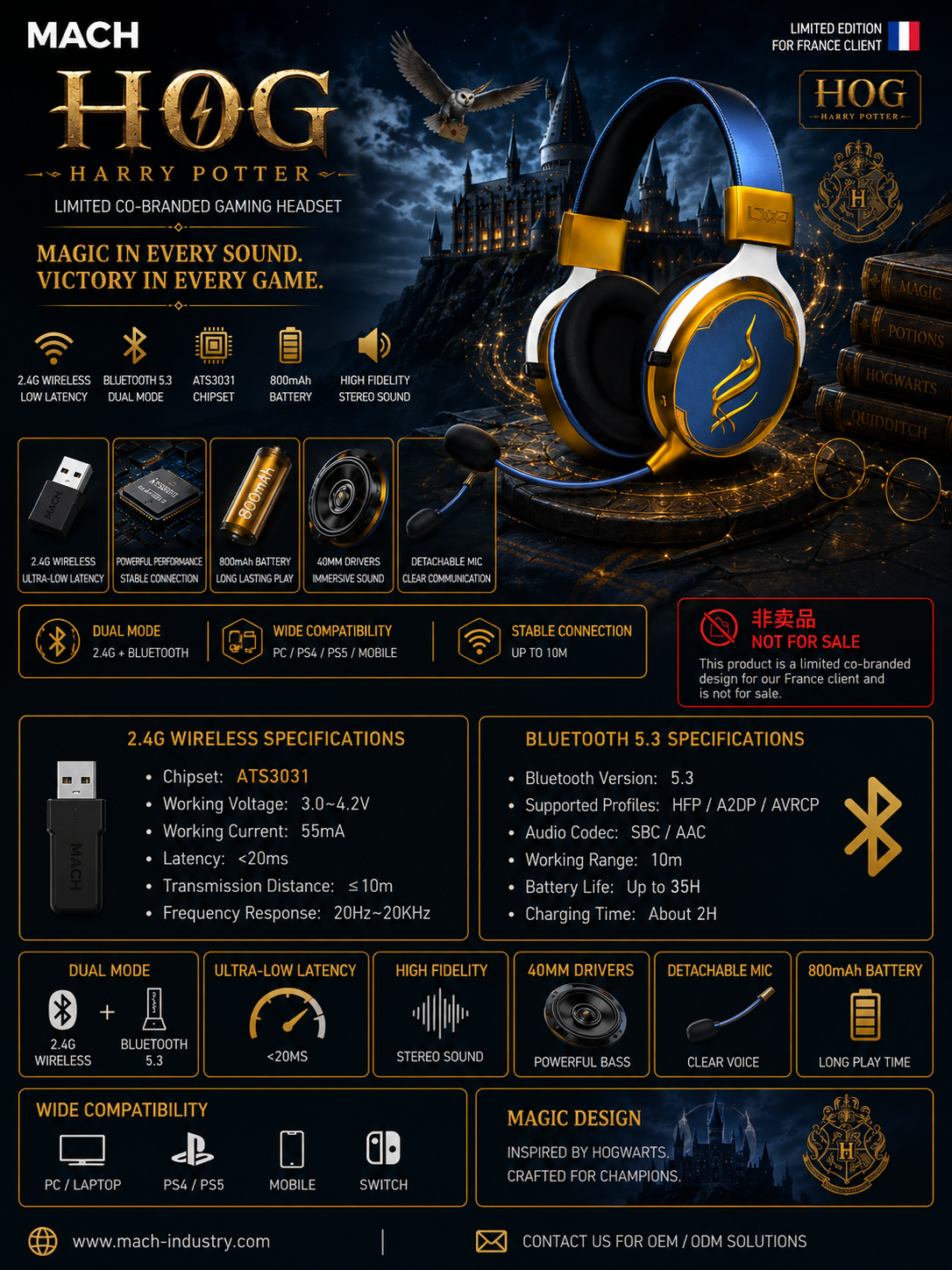
A modern gaming headset platform needs flexible connectivity to support different gaming environments, including PC, consoles and portable gaming devices. The practical answer is not simply to add more wireless modes. Brands should define which connection serves each target device, which functions remain available in that route, and how users will understand the difference.
A tri-mode gaming headset combines dedicated 2.4GHz wireless, Bluetooth and 3.5mm wired audio. These routes can broaden the commercial use of one platform, but they are not interchangeable. Latency, microphone support, controls, accessories and platform compatibility can change by mode. A buyer therefore needs a platform-mode decision map before approving product claims or packaging.
The HOG collaborative tri-mode gaming headset is a useful development reference. Its confirmed platform includes 2.4GHz wireless, Bluetooth 5.4, 3.5mm analog audio, an ATS3031 solution, 50mm driver, detachable unidirectional microphone and 800mAh protected battery. This article uses those published facts to explain the sourcing decisions behind multi-platform development without duplicating the HOG product page.
Why Multi-Platform Gaming Is Changing Headset Development
Multi-platform gaming changes headset development because a single product may need different connection routes for a gaming PC, console controller, mobile device and portable console.
A buyer can no longer treat compatibility as one yes-or-no field. PC users may prioritize a dedicated wireless transmitter, microphone communication and accessible controls. Console users may depend on a USB dongle for one system and a 3.5mm controller connection for another. Mobile and portable users may value Bluetooth because they do not want to carry a separate transmitter.
The same headset can address these scenarios only when the connection strategy is defined before artwork, accessories and package claims are released. A multi-platform label without a mode map can create avoidable support problems: users may choose the wrong connection, expect microphone operation where it is unavailable, or assume every control works in analog mode.
Product managers should begin with commercial use cases rather than a feature count. Identify the devices that matter to the planned channel, the connection users are expected to choose, and the functions required in each scenario. The resulting requirements become inputs for hardware selection, firmware behavior, cable and dongle planning, instructions, testing and after-sales support.
| Use environment | Typical connection question | Buyer decision |
|---|---|---|
| PC or Mac | Is dedicated wireless, Bluetooth or wired use central? | Define audio, microphone, controls and included transmitter |
| Console | Which route is supported by each console? | Validate the exact host, port, controller and accessory |
| Mobile or tablet | Is Bluetooth the intended portable route? | Confirm pairing, calls, controls and operating-system behavior |
| Portable console | Will users choose dongle, Bluetooth or 3.5mm? | Document mode-specific audio and microphone limitations |
HOG Tri-Mode Gaming Headset Platform Overview
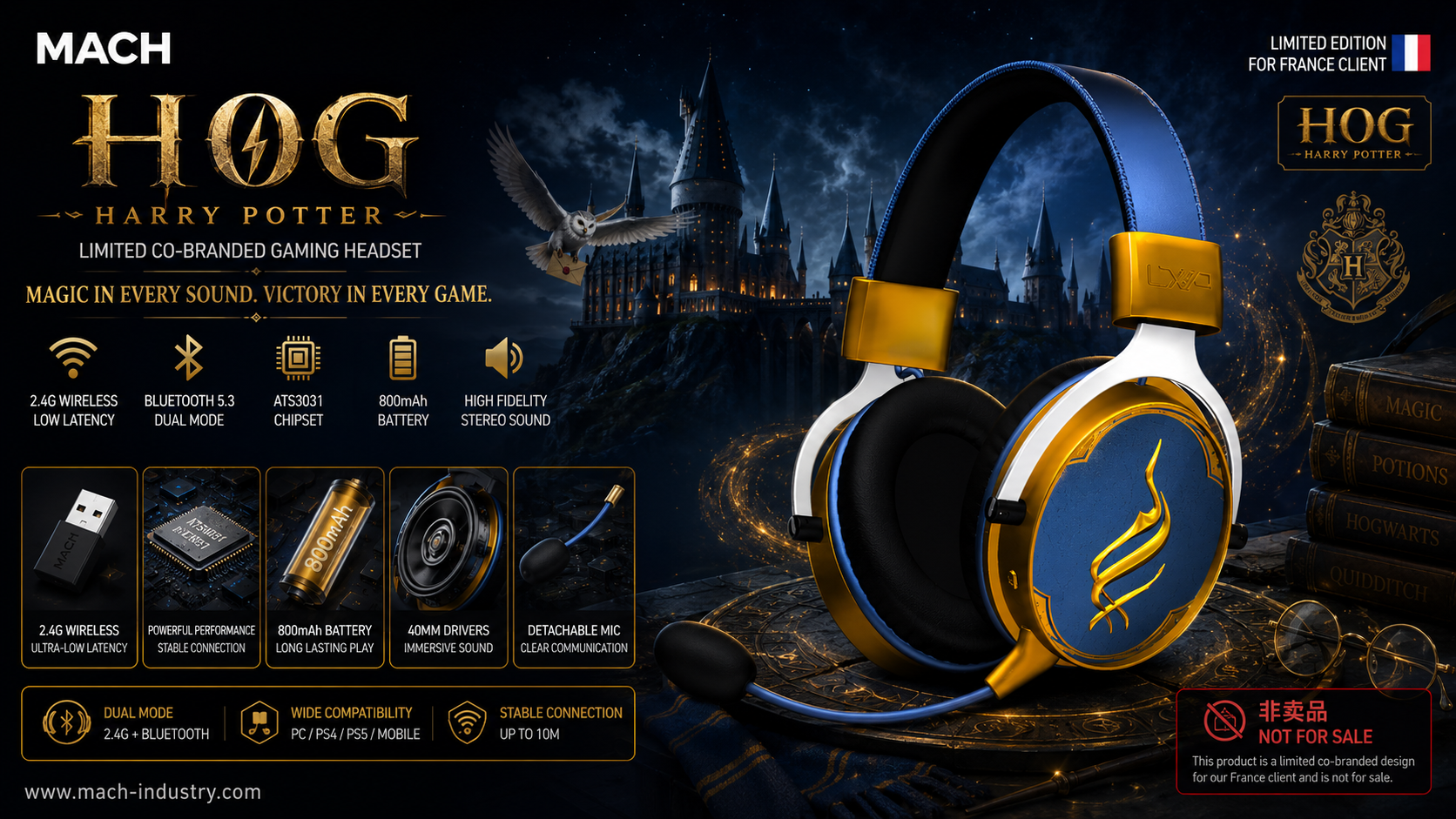
HOG is a collaborative gaming headset platform with 2.4GHz wireless, Bluetooth 5.4 and 3.5mm wired audio, designed for themed OEM/ODM programs that need multiple device routes.
The headset and transmitter use an ATS3031-based architecture, with ATS3031 plus PA specified for the transmitter. The default power-on mode is 2.4GHz. Published HOG data lists approximately 20ms latency and more than 10 meters wireless distance for that dedicated 2.4GHz route.
The acoustic platform uses a 50mm dynamic driver with 16-ohm impedance and a 20Hz-20kHz stated frequency response. Voice input is provided by a detachable RF6027-C unidirectional microphone specified at -42dB plus or minus 3dB sensitivity and 65dB signal-to-noise ratio.
Power comes from an 800mAh battery with an NTC protection board. The specification lists approximately two hours charging, about 18 hours operation with the orange backlight on and about 40 hours with it off. USB-C supports charging, play while charging and firmware upgrade.
Choosing the Right Connectivity Architecture: 2.4GHz Wireless, Bluetooth and 3.5mm in Modern Gaming Headsets
The right connectivity architecture assigns each mode a clear job: dedicated 2.4GHz for controlled wireless gaming, Bluetooth for convenient compatible-device use, and 3.5mm for analog routes where a cable is preferred or required.
Modern players move between gaming PCs, consoles, phones, tablets and portable systems. That behavior creates a sourcing challenge: the headset must feel like one product while the host devices expose different ports, wireless policies and audio functions. Tri-mode architecture provides three routes, but the buyer must decide which route represents the primary experience on each target.
Dedicated 2.4GHz wireless uses a transmitter that the headset manufacturer can design and validate with the product. It is normally selected when the program needs a controlled gaming route, predictable pairing and full headset functions on approved hosts. HOG specifies approximately 20ms latency in 2.4GHz mode, but that figure belongs to the confirmed HOG configuration and should not be generalized to every platform or wireless design. A transmitter also adds an accessory that must be stored, labeled, packaged and tested.
Bluetooth 5.4 gives HOG a convenient route for compatible computers and mobile devices. Bluetooth can reduce accessory dependence for everyday listening, calls and portable use. Its practical behavior still depends on the target device, Bluetooth profile, operating system and product firmware. Buyers should not describe all Bluetooth operation as low latency, and they should test microphone and control behavior rather than assume it matches the dedicated dongle route.
A 3.5mm wired connection provides analog audio and microphone pathways on compatible jacks. It can be valuable where a console controller or another host does not accept the product's wireless modes. HOG's manual, for example, shows Xbox audio and microphone through 3.5mm while its dongle and Bluetooth routes are not supported there. Analog mode can also reduce pairing complexity, but headset controls, lighting or other powered functions may not behave as they do wirelessly.
The advantages and limitations therefore need to be evaluated together. Dedicated wireless may provide the preferred gaming path but requires a transmitter and compatible USB host. Bluetooth improves portable convenience but is not a universal substitute for a gaming dongle. A 3.5mm cable offers a broad analog route but can limit on-headset control behavior and removes wireless freedom.
Connectivity architecture should be fixed early because it affects electronics, controls, indicators, firmware, accessories, package layout, manuals and customer-support scripts. A late decision to add a platform logo or promise a microphone function can require more than a copy change; it may require a different cable, transmitter, firmware branch or validation cycle.
For an OEM program, MACH can review target platforms, intended user journeys, the mode and accessory plan, control behavior, firmware requirements and validation scope. The buyer remains responsible for defining the commercial promise and target markets. The useful output is a signed platform-mode decision map that tells engineering, packaging and sales teams exactly what is supported.
No single connection is always best. The right architecture reflects the product position. A PC-focused competitive model may lead with dedicated 2.4GHz. A lifestyle-oriented portable product may emphasize Bluetooth. A console-accessory program may require a strong wired fallback. A multi-platform collaborative product such as HOG can combine all three, provided the route for every target device is explicit.
| Mode | Best-fit role | Main advantage | Limitation to validate |
|---|---|---|---|
| 2.4GHz wireless | Dedicated gaming route on approved hosts | Controlled headset-to-transmitter connection | USB host support, dongle handling and exact latency method |
| Bluetooth 5.4 | Compatible mobile, portable and computer use | Wireless convenience without the dedicated dongle | Profiles, latency, microphone and control behavior |
| 3.5mm wired | Analog route and console-controller connection | Simple cable-based audio and microphone path | Jack format, adapter needs and powered-feature behavior |

2.4GHz Wireless Gaming Headsets: Why Low-Latency Connection Matters
A dedicated 2.4GHz route matters when the product needs responsive wireless gaming and a controlled connection between the headset and its transmitter.
Competitive and timing-sensitive games expose delays between an on-screen event and the audio cue. HOG's published configuration lists approximately 20ms latency for its 2.4GHz route. Buyers should define how latency is measured, which host and transmitter are used, and whether production firmware matches the approved sample.
Platform support must remain specific. The HOG manual shows dongle audio, volume and microphone functions on PC/Mac, Android/iOS, Switch/Switch 2 and PS5/PS4, while Xbox dongle support is not listed. OEM claims should follow the approved mode-by-platform table rather than the general presence of a 2.4GHz feature.
Bluetooth Gaming Headsets: Supporting Portable and Mobile Gaming Experiences
Bluetooth supports convenient wireless use on compatible portable, mobile and computer devices, but it should be positioned according to verified profiles and functions.
A Bluetooth route can make a gaming headset useful beyond a fixed gaming station. HOG uses Bluetooth 5.4 and its manual lists Bluetooth audio, volume and microphone on PC/Mac and Android/iOS. Switch/Switch 2 is listed with Bluetooth audio and volume but without microphone.
Those differences matter to product positioning. A buyer targeting mobile calls and gaming should validate microphone switching, media controls, reconnect behavior and operating-system variations. A portable-console offer should state whether chat is supported in the intended Bluetooth route.
3.5mm Wired Connection: Why Traditional Audio Compatibility Still Matters
A 3.5mm connection remains useful because it provides an analog audio and microphone route for compatible devices, including systems that do not support the headset's wireless paths.
HOG includes a custom Type-C-to-3.5mm braided audio cable. Its compatibility table lists wired audio and microphone for PC/Mac, Android/iOS, Switch/Switch 2, PS5/PS4 and Xbox, with no wired volume control shown.
That wired route provides a practical fallback, but buyers must confirm the connector arrangement and host jack. A combined headset jack differs from separate desktop audio and microphone ports, and some devices may require an adapter that is not part of the standard package.
Technical Considerations When Developing a Tri-Mode Gaming Headset
Tri-mode development requires one controlled system for wireless hardware, analog audio, firmware, controls, power, accessories and platform-specific validation.
The hardware architecture must separate the responsibilities of the headset, transmitter, Bluetooth route and analog path. Engineers need stable switching logic, clear indicators and recovery procedures. HOG includes mode switching, re-pairing controls, USB firmware upgrade and automatic power-off after five minutes without use.
Power planning should use realistic combinations of volume, lighting and wireless mode. HOG publishes different operating times with its orange backlight on and off, which illustrates why a single battery-life claim needs a stated test condition. Play while charging must also be checked for thermal behavior, noise and user instructions.
Compatibility validation should record audio, microphone, volume, indicators and controls separately. The production test plan then verifies the approved functions without pretending every target behaves alike. Firmware revision, transmitter revision, cable specification and golden sample should remain traceable through mass production.
- Define mode-switching and reconnect behavior.
- Control headset, transmitter and firmware revisions together.
- Validate battery claims under stated light, volume and mode conditions.
- Test audio, microphone and controls on representative target devices.
- Confirm cable pinout, adapters and included accessories.
- Repeat acoustic and reliability checks after structural or material changes.

OEM/ODM Considerations for Multi-Mode Gaming Headset Projects
OEM buyers should align product positioning, customization, testing, packaging and compliance requirements with the selected connectivity architecture before samples are approved.
Begin by separating standard platform elements from project-specific work. HOG confirms customization directions for ear-cup artwork, colors, silicone logo parts, stitching, leather materials, dongle appearance, braided cables, Bluetooth pairing name, voice prompts and buyer-supplied packaging artwork.
Every customization should have an approval owner and reference. Artwork and Pantone targets need physical samples; firmware behavior needs a revision; cables and transmitters need controlled specifications. The final package should include only accessories and claims that match the approved configuration.
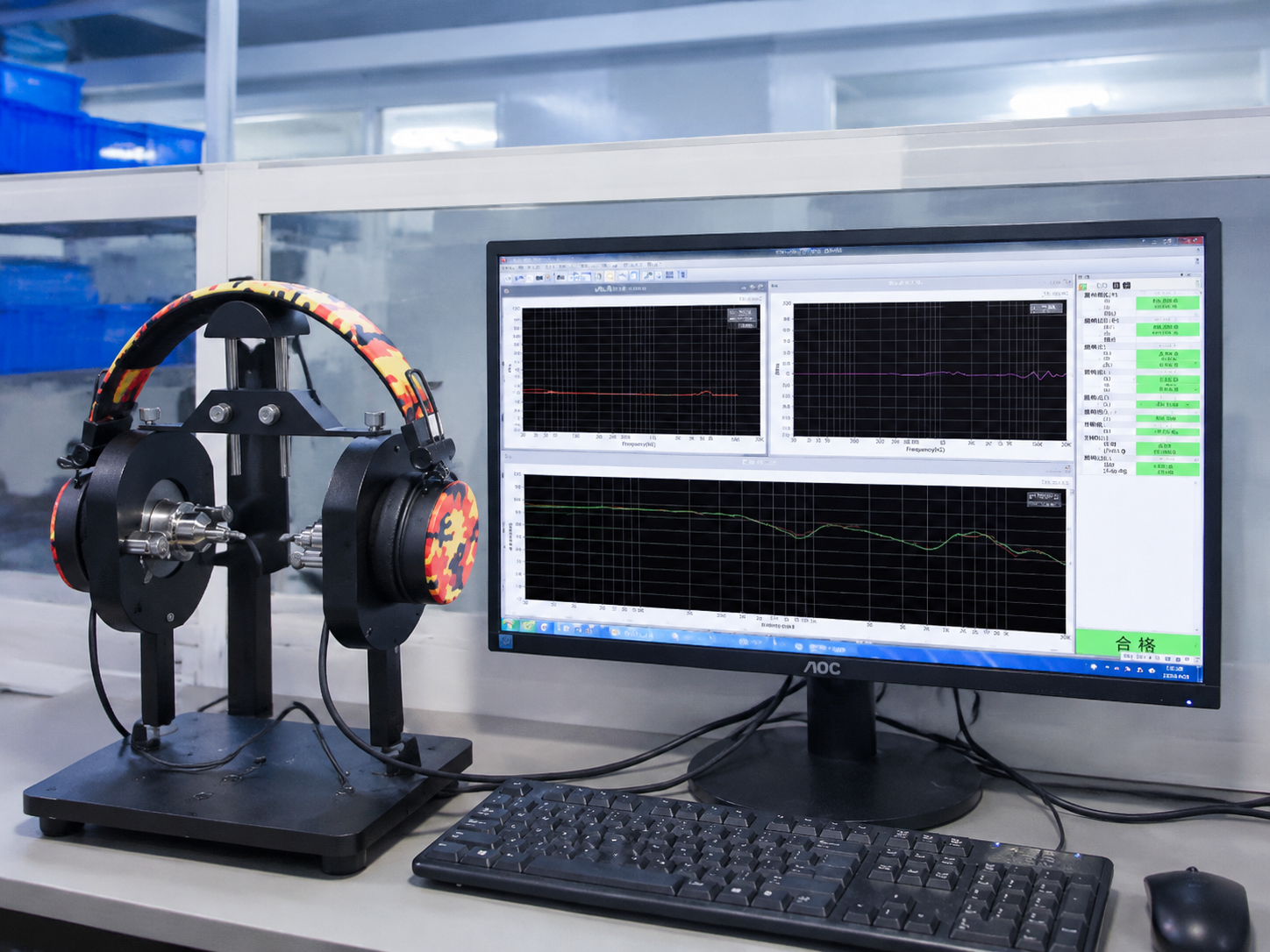
Testing should cover functional, acoustic, charging, wireless, reliability and packaging risks appropriate to the project. Certification planning depends on the target market and final configuration. The HOG source lists certification support requirements, not completed certificates, so buyers should confirm scope, sample responsibility and documentation before making compliance claims.
MACH can support requirement review, platform integration, appearance execution, sample development, acoustic evaluation, reliability testing, packaging coordination and final inspection. MOQ and lead time remain project dependent because artwork, configuration, tooling, package and approval scope affect the production plan.

Buyer Checklist: What Brands Should Prepare Before Developing a Tri-Mode Gaming Headset
A useful RFQ package defines target users, exact devices, mode-by-platform functions, customization, accessories, compliance scope, quantities and approval timing.
Provide a prioritized platform list rather than asking for universal compatibility. For every target, state the preferred connection, required audio and microphone functions, expected controls, accessory needs and acceptable limitations.
Add the commercial brief: target channel, price position, launch markets, forecast quantity, packaging language and certification requirements. Then supply logo files, authorized artwork, color references and any material or firmware direction that affects the product.
Finally, define the validation process. Identify who approves appearance, engineering, firmware and packaging samples; which devices will be tested; and which documents form the production release. This preparation reduces quotation assumptions and makes later changes easier to control.
- Target users, channels and product position
- Exact PC, console, mobile and portable target devices
- Preferred connection and required functions for every target
- Dongle, cable, microphone and adapter package
- Artwork, logo, color, material and lighting direction
- Pairing name, prompts, controls and firmware requirements
- Target markets and certification support scope
- Forecast quantity, launch date and sample approval owners
- Packaging files, languages and claim hierarchy
- Golden sample, test matrix and change-control requirements

Conclusion
The best tri-mode platform is the one whose connection routes, target devices and user expectations are defined clearly enough to engineer, test, package and support.
HOG shows how 2.4GHz wireless, Bluetooth 5.4 and 3.5mm wired audio can coexist in a collaborative headset platform. Its value for buyers is not only the presence of three modes, but the ability to assign those modes to specific PC, console and portable scenarios.
Before starting an OEM/ODM project, create a platform-mode decision map and connect it to the hardware configuration, accessories, firmware, testing and claims. MACH industry can evaluate your target platforms, customization brief and production requirements for a multi-mode gaming headset program.
Frequently Asked Questions
What is a tri-mode gaming headset?
A tri-mode gaming headset provides three connection routes: dedicated 2.4GHz wireless, Bluetooth and 3.5mm wired audio. Functions and compatibility can differ by route.
Why do gaming brands choose multiple headset connection options?
Multiple modes let one platform address different PC, console, mobile and portable scenarios. Brands still need to define the correct route and supported functions for each target device.
Is 2.4GHz wireless always better than Bluetooth for gaming?
No. Dedicated 2.4GHz is often selected for a controlled gaming route, while Bluetooth can be more convenient for compatible mobile and portable devices. The right choice depends on product positioning and verified performance.
What 2.4GHz latency is confirmed for the HOG gaming headset?
The published HOG specification lists approximately 20ms latency for its dedicated 2.4GHz configuration. This value should not be applied to Bluetooth or other headset platforms.
Which HOG connection works with Xbox?
The HOG manual lists 3.5mm audio and microphone support for Xbox. It does not list HOG dongle or Bluetooth support for Xbox.
Does Bluetooth provide the same functions on every gaming device?
No. Bluetooth profiles and host behavior vary. HOG's manual lists Bluetooth microphone support on PC/Mac and Android/iOS, but not on Switch/Switch 2, and it does not list Bluetooth support for PS5/PS4 or Xbox.
Why is a 3.5mm connection useful in a tri-mode headset?
It provides an analog audio and microphone route for compatible devices and can serve systems that do not support the product's wireless routes. Buyers should confirm jack format, adapters and control limitations.
What should OEM buyers test on a multi-platform gaming headset?
Test audio, microphone, controls, indicators, switching, reconnect, charging and accessories for every approved device-and-mode combination using production-representative hardware and firmware.
What HOG customization options can MACH evaluate?
The HOG source confirms project-specific artwork, Pantone colors, silicone logo parts, stitching, leather direction, dongle appearance, braided cables, Bluetooth pairing name, voice prompts and packaging coordination.
What should a brand prepare before requesting a tri-mode headset OEM quote?
Prepare target devices, preferred connection routes, required functions, artwork, CMF direction, accessories, packaging scope, target markets, certification needs, forecast quantity and sample approval plan.
Related Resources
Need OEM/ODM gaming audio solutions?
Contact MACH Industry to discuss your gaming headset, gaming earbuds, or private-label audio project.
Contact MACH Industry