Home > Resources > OEM Knowledge
How Audio Brands Can Combine PC Gaming and Daily ANC Listening in One Headphone Platform
A B2B product-planning guide to using Bluetooth, 2.4GHz and hybrid ANC in one multi-use headphone platform while controlling SKU, channel and validation complexity.
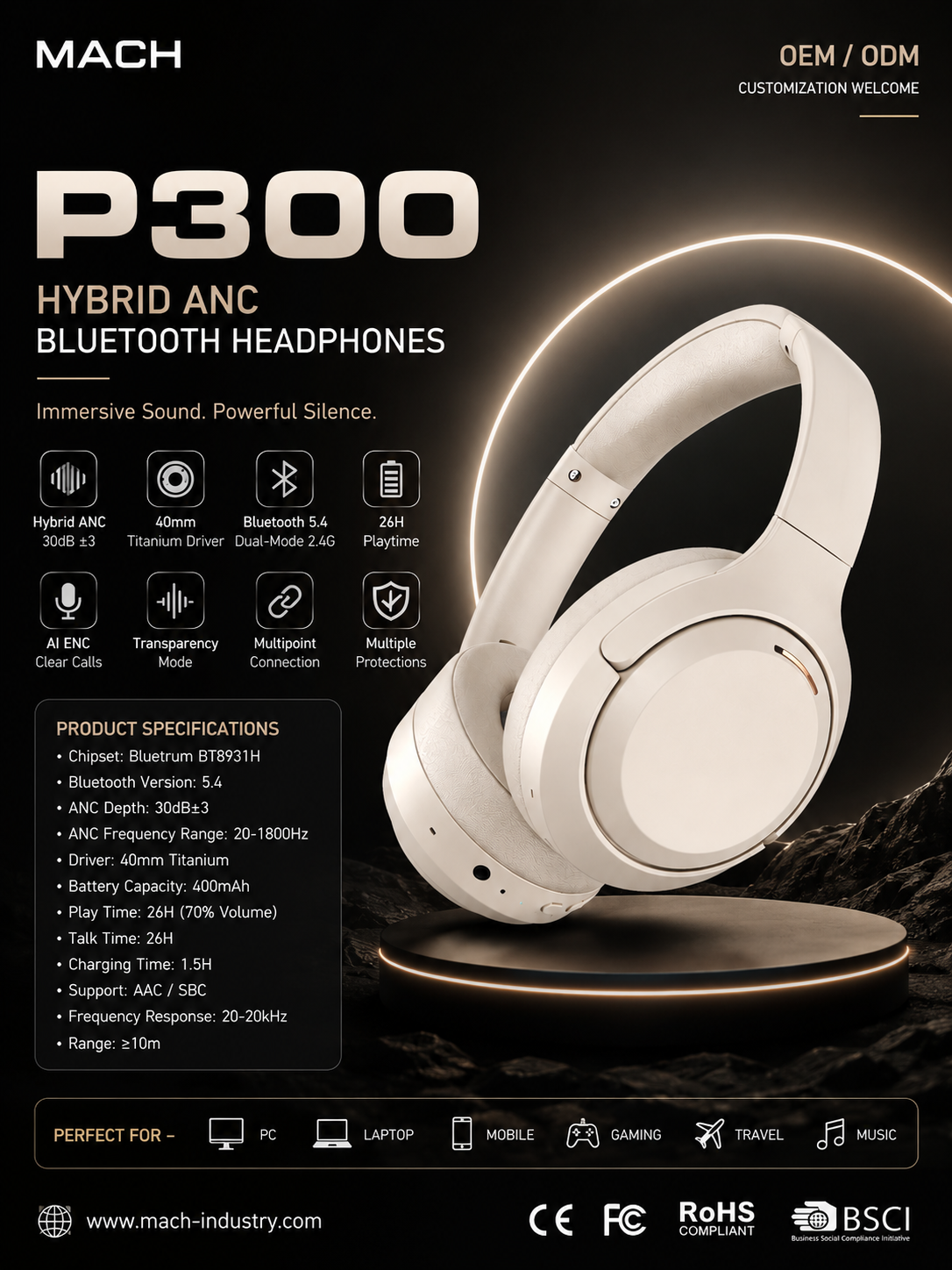
A dual-mode hybrid ANC headphone platform can cover PC gaming, mobile listening, commuting, office calls and daily music when Bluetooth, dedicated 2.4GHz wireless, ANC, voice functions and wired backup each have a clearly defined role. The platform should be planned around use cases and channels rather than a long feature list.
For private-label brands, the main opportunity is reducing unnecessary product-line duplication. One validated hardware foundation can support several commercial positions through controlled color, packaging, accessories and messaging. The main risk is creating vague compatibility and inconsistent SKU claims.
P300 provides a documented OEM/ODM reference for this planning problem. This guide uses confirmed P300 facts while keeping general product-strategy advice separate from product specifications.
The Market and Buyer Problem
Audio brands often separate gaming headsets and lifestyle ANC headphones into different SKUs, but that structure can duplicate inventory, packaging, compliance planning and marketing work.
A gaming-oriented product may prioritize a dedicated PC wireless link and communication, while a lifestyle headphone may prioritize Bluetooth, mobile use, commuting and ANC. Running separate platforms can create clearer positioning, but it also increases the number of samples, accessories, cartons, manuals, forecasts and spare parts a brand must manage.
A multi-use platform offers another route. Bluetooth can support mobile and daily wireless scenarios; dedicated 2.4GHz can support compatible PC and gaming use; hybrid ANC and transparency can address travel, office and public environments; wired audio can provide a backup route. The buyer can then decide which commercial story belongs to each channel.
Consolidation is not automatically the right answer. If gaming and lifestyle customers need fundamentally different structures, microphones, acoustics or price points, separate products may remain more effective. The sourcing task is to decide which requirements can share one foundation without weakening the user promise.
What Is a Hybrid ANC Dual-Mode Headphone Platform?
It is an over-ear headphone foundation combining two wireless routes, typically Bluetooth and dedicated 2.4GHz, with feedforward and feedback active noise cancellation for multiple usage scenarios.
Bluetooth is commonly assigned to phones, tablets, laptops, music and calling. Dedicated 2.4GHz uses a matching transmitter for an intended PC or gaming connection. These modes should be treated as separate product journeys with defined pairing, switching, audio, microphone, control and compatibility behavior.
Hybrid ANC combines a feedforward path that senses environmental sound and a feedback path that monitors residual sound inside the ear cup. Final performance depends on microphone location, cushions, seal, ear-cup acoustics, driver integration, firmware and user fit. Transparency mode provides a separate awareness state when users need to hear surroundings.
A multi-use product therefore joins connection, acoustic, voice, comfort, battery and channel decisions. A Bluetooth version number or ANC specification cannot determine whether the complete product fits a brand's gaming, commuting or office strategy.
Bluetooth and 2.4GHz Serve Different Buyer Needs
Bluetooth favors convenient daily device connection, while dedicated 2.4GHz gives brands a controlled transmitter-based path for compatible PC and gaming use.
The table describes product-planning direction rather than universal performance. Exact latency, range, audio, microphone and compatibility results depend on the final hardware, firmware, transmitter and host. P300 does not publish a numeric latency value, so buyers should validate responsiveness during sampling.
The RFQ should identify target devices before defining claims. A brand may place Bluetooth at the center of mobile and office packaging, while a PC-focused bundle emphasizes its included 2.4GHz transmitter. Both can share a platform only when the final SKU and instructions match the approved functions.
| Planning area | Bluetooth | Dedicated 2.4GHz |
|---|---|---|
| Typical device | Phone, tablet or Bluetooth-equipped computer | Compatible PC or intended gaming host through transmitter |
| Primary use case | Daily music, mobile use, office and calls | Dedicated PC or gaming-oriented wireless use |
| Buyer value | Familiar connection without a dedicated receiver | Controlled headset-to-transmitter product path |
| SKU consideration | Pairing, multipoint, profiles and naming | Dongle type, pairing, host matrix and replacement |
| Validation | Media, calls, reconnection and target devices | Audio, voice, responsiveness and target hosts |
Why Hybrid ANC Matters Beyond Travel Headphones
Hybrid ANC expands a headphone platform beyond travel by supporting focused listening and adaptable awareness across commuting, office, music and entertainment scenarios.
Commuting and travel are familiar ANC positions, but an office user may also want reduced environmental noise during focused work. Transparency mode can help when conversation or announcements need to remain audible. Daily music users may value the choice between isolation and awareness depending on location.
For gaming and entertainment, ANC can support the product's environmental-noise-management story, but it should not be claimed to improve microphone quality or game sound automatically. Voice communication is a separate path; P300 identifies AI algorithm ENC for communication.
ANC also affects commercial planning. It may support a more feature-rich retail tier, but it adds microphone, acoustic, firmware, power and sample-validation requirements. Packaging should describe the available modes accurately rather than presenting noise cancellation as total silence.
The product's cushions, seal and comfort matter to both ANC and long-session use. A cosmetic or material change can alter fit and acoustic behavior, so channel-specific CMF should preserve the approved performance foundation.
One Platform, Multiple Use Cases
P300-type platforms can address gaming, mobile listening, commuting, office, calling, retail and private-label programs when each scenario is tied to an approved mode and product claim.
PC gaming can use the dedicated 2.4GHz route with the matching transmitter and validated host. Mobile listening and Bluetooth calls can use Bluetooth 5.4. Travel and commuting can combine Bluetooth listening with hybrid ANC or transparency according to the user's environment.
Office positioning can include Bluetooth connection, calls, multipoint and online-meeting scenarios, while wired audio gives a backup option for compatible sources. The brand should confirm which microphone path and controls operate in every claimed mode.
Consumer-electronics retail and e-commerce channels can use different merchandising priorities without changing the underlying facts. A gaming bundle may lead with 2.4GHz and accessories; a lifestyle bundle may lead with ANC, Bluetooth and CMF. Manuals and compatibility statements should remain configuration specific.
| Use case | Primary platform element | Buyer confirmation |
|---|---|---|
| PC gaming | Dedicated 2.4GHz transmitter | Hosts, audio, voice and responsiveness |
| Mobile listening | Bluetooth 5.4 | Devices, profiles, codecs and controls |
| Commuting and travel | Hybrid ANC and transparency | Fit, seal, modes and stated runtime condition |
| Office and calls | Bluetooth, multipoint and AI ENC | Voice quality, switching and target apps or devices |
| Wired backup | Audio cable | Connector, source and wireless transition |
How Dual-Mode Headphones Can Reduce SKU Complexity
A dual-mode platform can reduce SKU complexity by keeping the validated electronics, acoustics and core user experience consistent while varying only controlled commercial elements by channel.
The first benefit is shared engineering. One approved Bluetooth, 2.4GHz, ANC, voice and acoustic foundation can reduce the number of unrelated platforms a product team must understand. Core firmware, transmitter behavior, driver direction, cushions and controls can remain common when every SKU requires the same functions.
The second benefit is supply planning. Shared structural parts, electronics and accessories can simplify forecasting compared with separate gaming and lifestyle products. This benefit depends on disciplined item numbers and bills of material. A color, package or dongle change still creates a controlled SKU that must be forecast and inspected correctly.
Brands can create channel differentiation through approved logo, color and CMF direction, packaging, manuals and accessories. A PC bundle may include and feature the 2.4GHz transmitter prominently. A lifestyle retail version may use a different color and lead with Bluetooth, hybrid ANC and transparency. Both versions must disclose the same underlying functions accurately.
Some elements should remain stable. Connection behavior, button mapping, ANC modes, core acoustics, microphone routes, battery conditions and compatibility evidence should not drift casually between channel variants. Changing these items can turn a simple commercial SKU into a new engineering configuration that needs additional validation.
A platform strategy also needs a claim hierarchy. The brand should choose one primary audience for each package instead of giving every feature equal prominence. A gaming-oriented listing can explain dedicated 2.4GHz and PC use; a commuting listing can explain ANC and transparency; an office listing can explain Bluetooth calling and multipoint. The facts remain consistent while the buying context changes.
SKU reduction has limits. Combining every optional function can increase cost, firmware states, accessories, support burden and positioning ambiguity. The buyer should compare the operational savings from a shared platform against the commercial value of a simpler single-purpose product.
Before launch, create a SKU matrix listing color, logo, firmware, pairing name, transmitter, cables, package, labels, manuals, market and claims. This document connects product strategy with quotation, sample approval, production inspection and inventory control.
| SKU layer | Keep common where possible | Differentiate under control |
|---|---|---|
| Engineering | Core electronics, acoustics, modes and controls | Only approved firmware or optional configurations |
| Appearance | Structure and performance-critical interfaces | Logo, color, CMF and approved cushion material |
| Accessories | Validated transmitter and cable specification | Bundle contents by channel |
| Marketing | Confirmed functions and compatibility | Use-case emphasis and package hierarchy |
| Operations | Quality plan and traceability | SKU, barcode, carton and market labels |
OEM/ODM Customization Considerations
P300 private-label work can evaluate branding, CMF, cushions, packaging, manuals, accessories, pairing name and voice prompts while deeper changes remain project dependent.
Confirmed customization directions include custom logo, product color and CMF, ear-cushion material review, packaging, user manuals and accessories. Buyers should provide vector artwork, color references, material direction, channel requirements and cosmetic acceptance standards.
Bluetooth pairing-name and voice-prompt customization are also listed. These changes should be released with the correct firmware version and checked alongside controls, connection states and instructions. Firmware, ANC, transparency, AI ENC and transmitter adjustments require scope review rather than automatic acceptance.
Optional detachable Type-C microphone and 6D head tracking are additional project configurations, not standard functions for every SKU. The article does not claim app customization, completed certification or unrestricted tooling support.
MOQ and lead time are project based. They depend on final configuration, customization and accessories and should be confirmed after RFQ and sample-scope review.

Buyer Evaluation Checklist
A useful P300 RFQ defines target users, mode priorities, channel SKU plan, customization, sample tests, markets and commercial assumptions before quotation.
| Decision area | Buyer input | Required output |
|---|---|---|
| Target user | Gaming, commuting, office, music or blended audience | Primary product promise |
| Connection priority | Bluetooth, 2.4GHz and wired scenarios | Device and mode matrix |
| ANC and voice | ANC, transparency, calls and meeting requirements | Sample acceptance plan |
| Channel variants | Colors, packages, accessories and claims | Controlled SKU matrix |
| Private label | Logo, CMF, cushions, pairing name and prompts | Customization scope |
| Commercial plan | Market, forecast, timing and compliance needs | Project-based MOQ and lead-time review |
- Define the primary user and secondary use cases.
- List every target PC, mobile device and connection mode.
- Set gaming versus daily-use priorities.
- Define hybrid ANC, transparency and voice expectations.
- Confirm cushion, comfort, color and CMF direction.
- Create package, accessory, manual and barcode requirements.
- Separate common platform functions from channel variations.
- Prepare sample tests for Bluetooth, 2.4GHz, wired, ANC and calls.
- Identify target-market certification coordination needs.
- Treat MOQ and lead time as subject to final configuration and customization.
When Is This Product Strategy Not Suitable?
A multi-use hybrid ANC platform is not ideal when the brand needs a narrowly optimized product, a minimum-cost feature set or a fundamentally different mechanical design.
A professional competitive-gaming product may require a different microphone, controls, weight, software, compatibility or performance priority. A dedicated platform can communicate that purpose more clearly than a crossover lifestyle model.
A basic Bluetooth music product may not need a transmitter, hybrid ANC or the related firmware and accessory complexity. Removing unused systems can support a simpler brief and price position. Likewise, a target channel that does not value ANC may not recover the added product-development effort.
Brands needing a completely different structure or mold should treat the work as deeper development rather than a simple private-label variant. The same applies when market requirements, certification scope or channel rules demand a configuration outside the approved platform.
A single platform is also unsuitable when one package tries to speak equally to every audience. If gaming, commuting and office priorities cannot be ranked, separate products or clearer channel SKUs may produce better customer understanding.
P300 as an OEM/ODM Reference Platform
P300 is a confirmed hybrid ANC over-ear platform with Bluetooth 5.4, dedicated 2.4GHz, wired audio and private-label customization directions for multi-use audio programs.
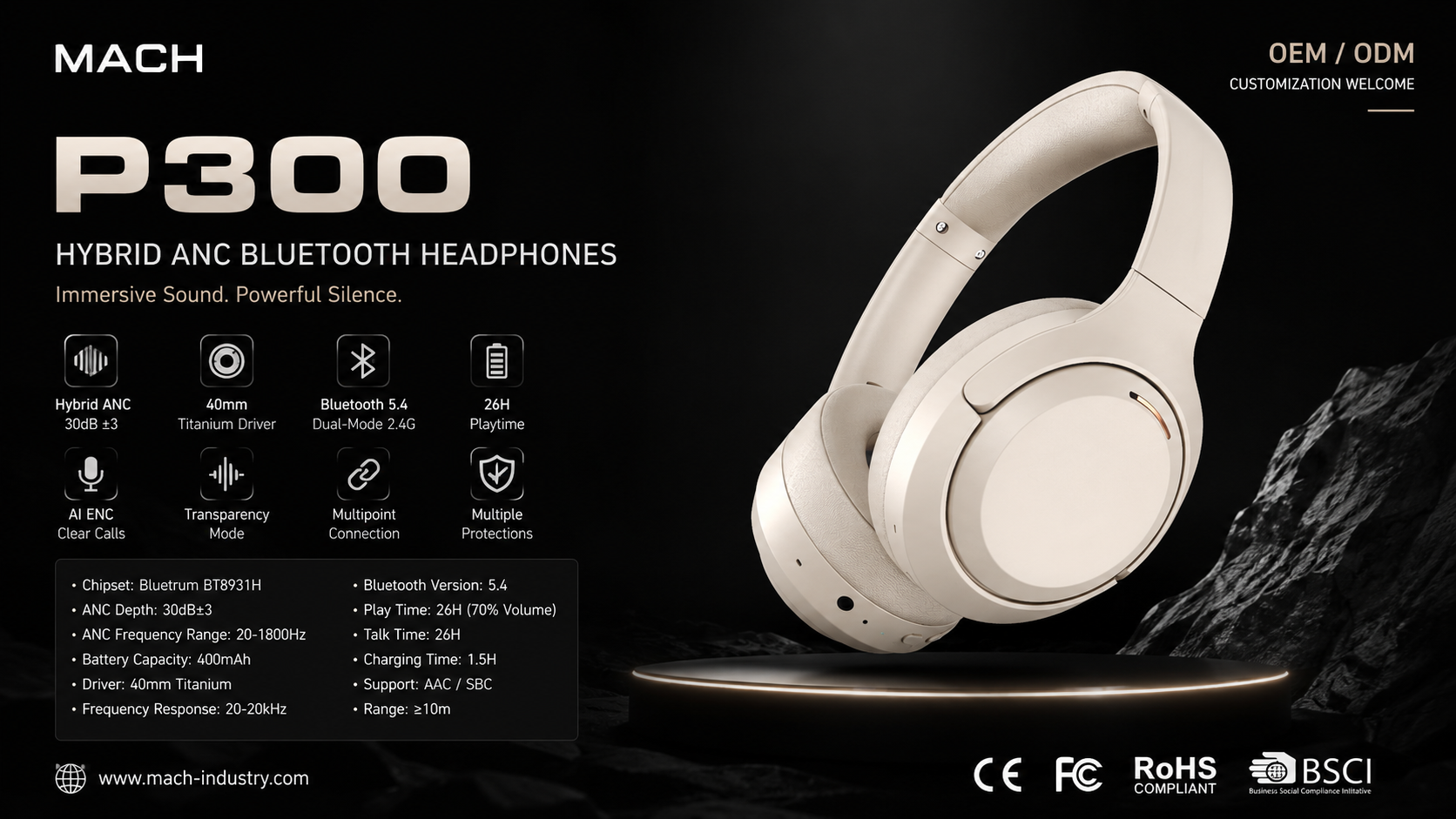
The published P300 platform uses the Bluetrum BT8931H chipset, Bluetooth 5.4, 2.4GHz wireless, wired audio, multipoint and iOS battery display. Bluetooth profiles include HSP, HFP, A2DP and AVRCP, with SBC and AAC formats. No numeric latency is published.
P300 confirms feedforward plus feedback hybrid ANC, transparency mode and AI algorithm ENC. Its published ANC specification is 30dB plus or minus 3dB over a 20Hz-1800Hz effective range. These are product specifications, not independent test results from this article.
The acoustic platform uses a 40mm titanium-diaphragm driver with 32-ohm impedance, 115dB sensitivity and a listed 20Hz-20kHz response. The battery is 400mAh, with approximately 1.5-hour charging and published approximately 26-hour call and music conditions, the latter at 70 percent volume.
Standard platform facts, customizable commercial elements and optional engineering items should remain separate in quotations and packaging. MOQ is subject to final configuration, customization and accessories; lead time is project based after RFQ review. Buyers can review the P300 product page before discussing a channel and SKU plan.

Conclusion
A multi-use headphone platform can reduce product-line complexity when Bluetooth, 2.4GHz, hybrid ANC and channel variants are controlled through one clear SKU and validation strategy.
P300 provides a documented foundation for gaming, mobile, commuting, office, calling, retail and private-label directions. Its value is not that every brand should launch every feature, but that buyers can select a coherent use-case hierarchy from a confirmed platform.
MACH industry can review target users, mode priorities, channel variants, branding, accessories, sample validation and market requirements. A structured RFQ helps determine whether one platform should support several SKUs or whether a more focused product is appropriate.
Frequently Asked Questions
What is a hybrid ANC dual-mode headphone platform?
It is an over-ear platform combining feedforward and feedback ANC with two wireless routes, such as Bluetooth and dedicated 2.4GHz. P300 also confirms wired audio support.
Why combine Bluetooth and 2.4GHz in one headphone?
Bluetooth supports mobile and everyday wireless use, while a dedicated 2.4GHz transmitter can support compatible PC and gaming scenarios. The buyer should define and validate each mode separately.
Can one dual-mode headphone serve gaming and travel users?
It can when dedicated 2.4GHz, Bluetooth, hybrid ANC, comfort, voice and packaging meet both use cases. Each channel should still have a clear primary product promise.
How can a shared headphone platform reduce SKU complexity?
Brands can keep core electronics, acoustics, firmware and quality controls common while varying approved color, branding, package, accessories and use-case messaging by channel.
What can be customized for a private-label P300 project?
MACH can evaluate logo, color and CMF, ear-cushion material, packaging, manuals, accessories, Bluetooth pairing name and voice prompts according to project scope.
How should buyers evaluate hybrid ANC samples?
Compare ANC off, ANC on and transparency with the final cushions, fit, housing and firmware. Review sound, comfort, stability and unit consistency under defined conditions.
Does P300 publish a 2.4GHz latency number?
No numeric latency value is published in the P300 product data. Buyers should agree on a test method and validate the final transmitter, headset and target-host configuration.
What determines MOQ for a P300 private-label project?
MOQ is subject to final product configuration, customization level and accessory requirements. It should be confirmed after RFQ review rather than treated as one fixed quantity.
What determines P300 project lead time?
Lead time is project based after RFQ and sample-scope review. Branding, firmware, optional functions, packaging, accessories and market requirements can affect the schedule.
What should an audio brand include in a P300 RFQ?
Include target users and devices, gaming and daily-use priorities, ANC and voice needs, SKU plan, logo and CMF, package, accessories, market, forecast and launch timing.
Related Resources
Need OEM/ODM gaming audio solutions?
Contact MACH Industry to discuss your gaming headset, gaming earbuds, or private-label audio project.
Contact MACH Industry