Home > Resources > OEM Knowledge
How to Evaluate a Private-Label Bluetooth ANC Headphone Before Sampling
A B2B guide to evaluating ANC, passive isolation, acoustics, Bluetooth, battery, comfort and OEM scope before ordering a private-label headphone sample.
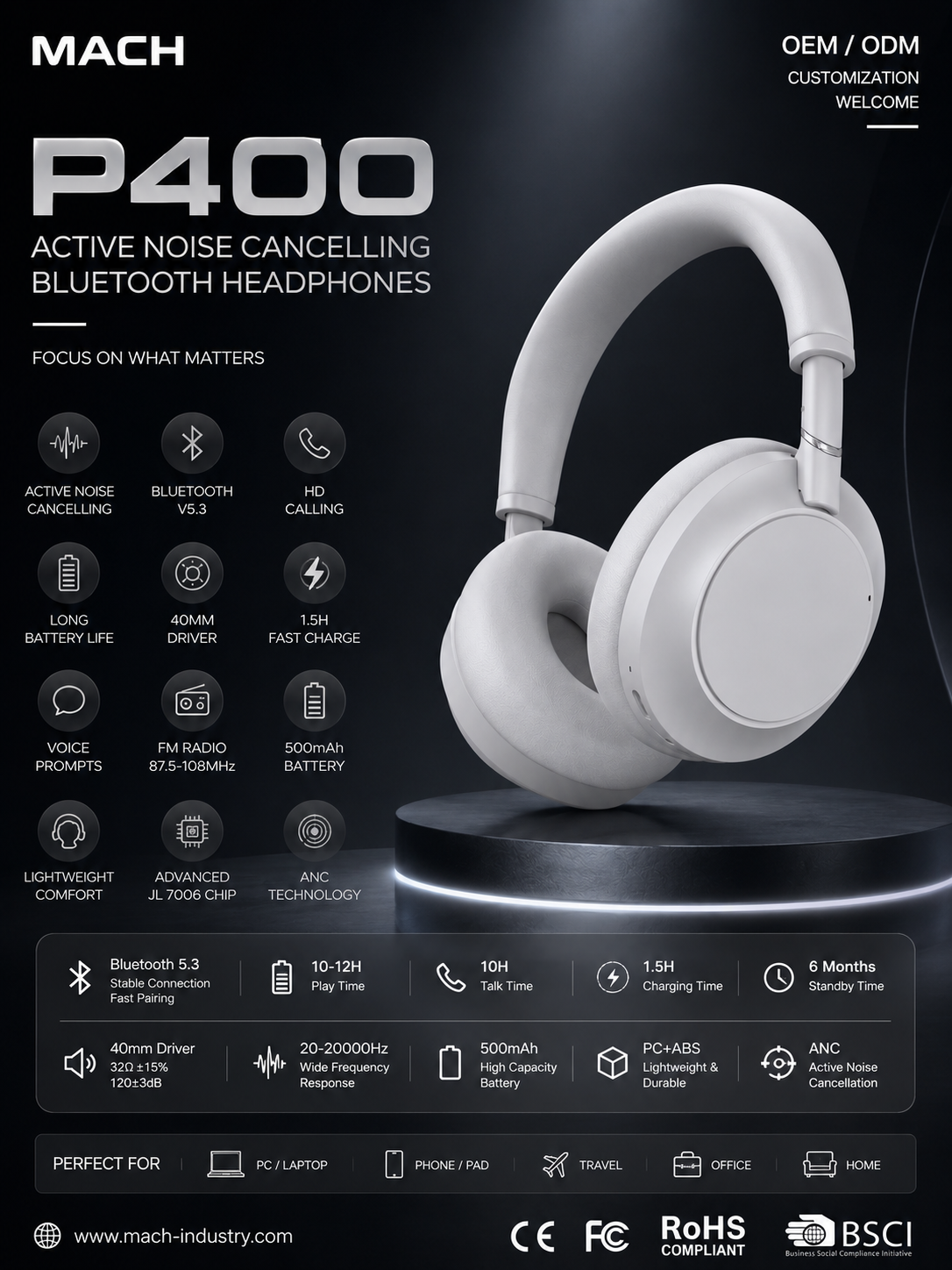
Before ordering a Bluetooth ANC headphone sample, a private-label brand should define the target user and channel, separate active noise cancellation from passive isolation, review the acoustic and Bluetooth platform, document battery-test conditions, assess comfort and materials, and freeze the required branding, packaging and compliance scope. A specification sheet is the starting point, not the approval decision.
The sample brief should turn each feature into a testable question. Buyers need to know what is standard, what is optional, which claims depend on the final configuration and how the approved sample will be controlled in production. ANC performance, fit, tuning, calls, prompts, runtime and cosmetics must be judged together because a strong result in one area does not compensate for an unclear overall product position.
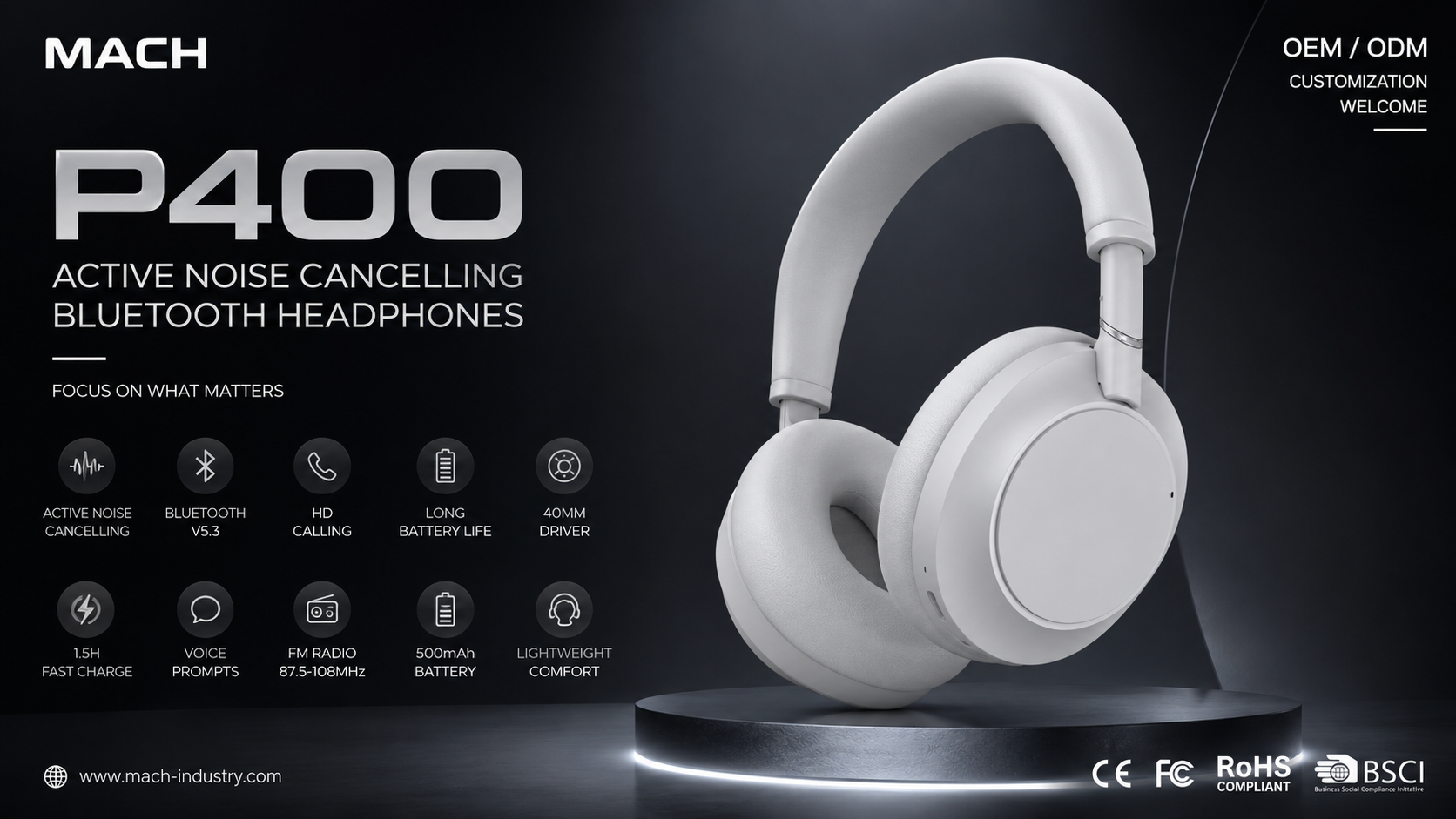
MACH P400 provides a practical reference: a Bluetooth 5.3 over-ear ANC platform using the JL7006 chipset, a 40mm driver and a 500mAh battery. This guide uses only its confirmed public data to explain the sourcing process rather than repeating the product page.
Quick Answer for Private-Label Buyers
Approve an ANC headphone platform only after the target use case, ANC and passive isolation, sound, Bluetooth behavior, calls, runtime, comfort, customization, compliance and retail package have separate acceptance criteria.
- Define the target market, channel, user and leading listening scenario.
- Test ANC and passive isolation as related but different parts of the experience.
- Evaluate tuning and consistency instead of judging sound from driver diameter alone.
- Confirm pairing, reconnection, calling, controls, prompts and device naming.
- Document the conditions behind music, call, charging and standby claims.
- Freeze logo, CMF, cushions, packaging, accessories and certification requirements before sample approval.
Why an ANC Headphone Specification Sheet Is Not Enough
Bluetooth version, driver size, battery capacity and an ANC label describe a platform, but they do not prove the final product experience or production consistency.
A buyer can compare specification sheets to create a shortlist, but the final decision depends on how the platform behaves as a complete product. Ear-cup geometry and cushions influence passive isolation. Fit changes perceived bass and comfort. ANC behavior can interact with acoustic tuning, while firmware and control logic shape daily use.
Battery capacity alone does not establish runtime under every condition. Bluetooth version alone does not prove stable behavior with every phone or laptop. A 40mm driver does not define tonal balance, distortion or unit-to-unit consistency. Each published item needs an associated sample test and acceptance note.
Buyers should also separate standard functions from options under discussion. Packaging and marketplace copy must not include an adjustable feature, certification or performance claim until the final configuration and evidence are approved.
Define the Target Market Before Selecting the Platform
The correct ANC platform depends on where it will be sold, who will use it and which daily problem the product is expected to solve.
Travel and commuting programs may prioritize comfort, passive sealing, useful reduction of selected low-frequency background noise and understandable controls. Office and online-call positioning requires buyers to review pairing, call operation, microphone behavior, prompts and long-session comfort.
Daily music and lifestyle retail need a coherent sound and appearance brief. E-commerce brands also need product claims that can be explained through images, comparison tables and concise setup content without promising that ANC removes every sound.
P400 is positioned for daily music, travel, commuting, office use, online calls and private-label consumer-audio programs. That does not mean one configuration automatically fits every channel. A buyer should choose the primary use case and define secondary scenarios before deciding which functions lead the package.
| Target scenario | Primary evaluation focus | Claim discipline |
|---|---|---|
| Travel and commuting | ANC, passive seal, comfort and runtime | Do not claim elimination of all outside sound |
| Office and online calls | Pairing, calls, prompts and long-session fit | Do not imply an unconfirmed microphone system |
| Daily music | Tuning, consistency, controls and cosmetics | Do not infer sound quality from driver size alone |
| Retail and e-commerce | Clear standard features, package and support content | Keep optional functions out of standard claims |
Evaluate ANC and Passive Noise Isolation Separately
Passive isolation comes from the physical fit and ear-cushion seal, while ANC uses an electronic system to reduce selected environmental noise, especially some lower-frequency components.
Passive isolation changes with head shape, cushion compression, wearing position and the seal around glasses or hair. Buyers should listen with ANC off first and record fit, leakage, comfort and the amount of outside sound reduced by the physical structure.
ANC should then be evaluated in representative, controlled sound environments and compared with the same sample in its off state. The test should consider whether unwanted tonal changes, pressure sensation, hiss or other artifacts appear and whether the result matches the intended travel, commuting or office use case.
ANC cannot remove every external voice, sudden sound or high-frequency event. P400 confirms Active Noise Cancellation but does not publish a specific reduction depth, microphone quantity or ANC architecture. This article therefore makes no numerical attenuation claim and does not describe P400 as hybrid ANC.
A useful approval report records the sample version, cushion and fit, ANC state, background-noise source, listener position, program material and observed result. This gives the OEM team a reproducible target instead of a general comment such as stronger noise cancelling.
| Evaluation area | Passive isolation | Active Noise Cancellation | Buyer check |
|---|---|---|---|
| Primary mechanism | Physical ear-cup and cushion seal | Electronic noise-control system | Test off and on states separately |
| Main variables | Fit, cushion, glasses and wearing position | Tuning, firmware, structure and environment | Use representative users and conditions |
| Expected result | Broad physical reduction dependent on seal | Reduction of selected environmental noise | Avoid all-noise or unsupported depth claims |
| Approval evidence | Fit and isolation notes | Defined ANC comparison procedure | Record sample version and configuration |
Check the Acoustic Platform, Not Only Driver Diameter
Driver diameter is one input; final sound depends on the driver, enclosure, cushions, seal, tuning and production consistency working together.
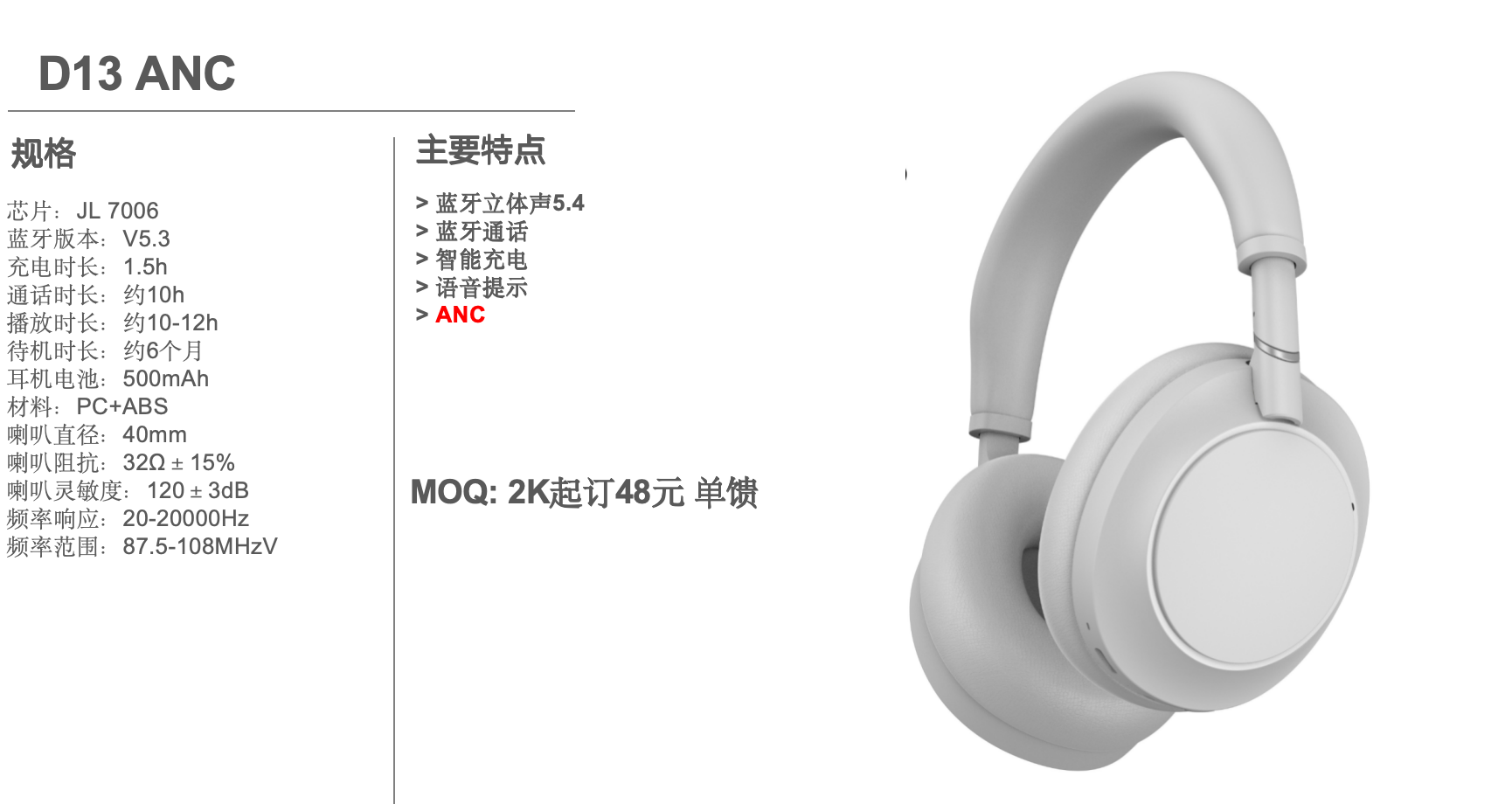
The confirmed P400 data lists a 40mm driver, 32 ohm plus or minus 15 percent impedance, 120 plus or minus 3dB sensitivity and a 20Hz-20kHz frequency response. These values are useful for comparison and engineering discussion, but they do not by themselves establish tonal balance or perceived quality.
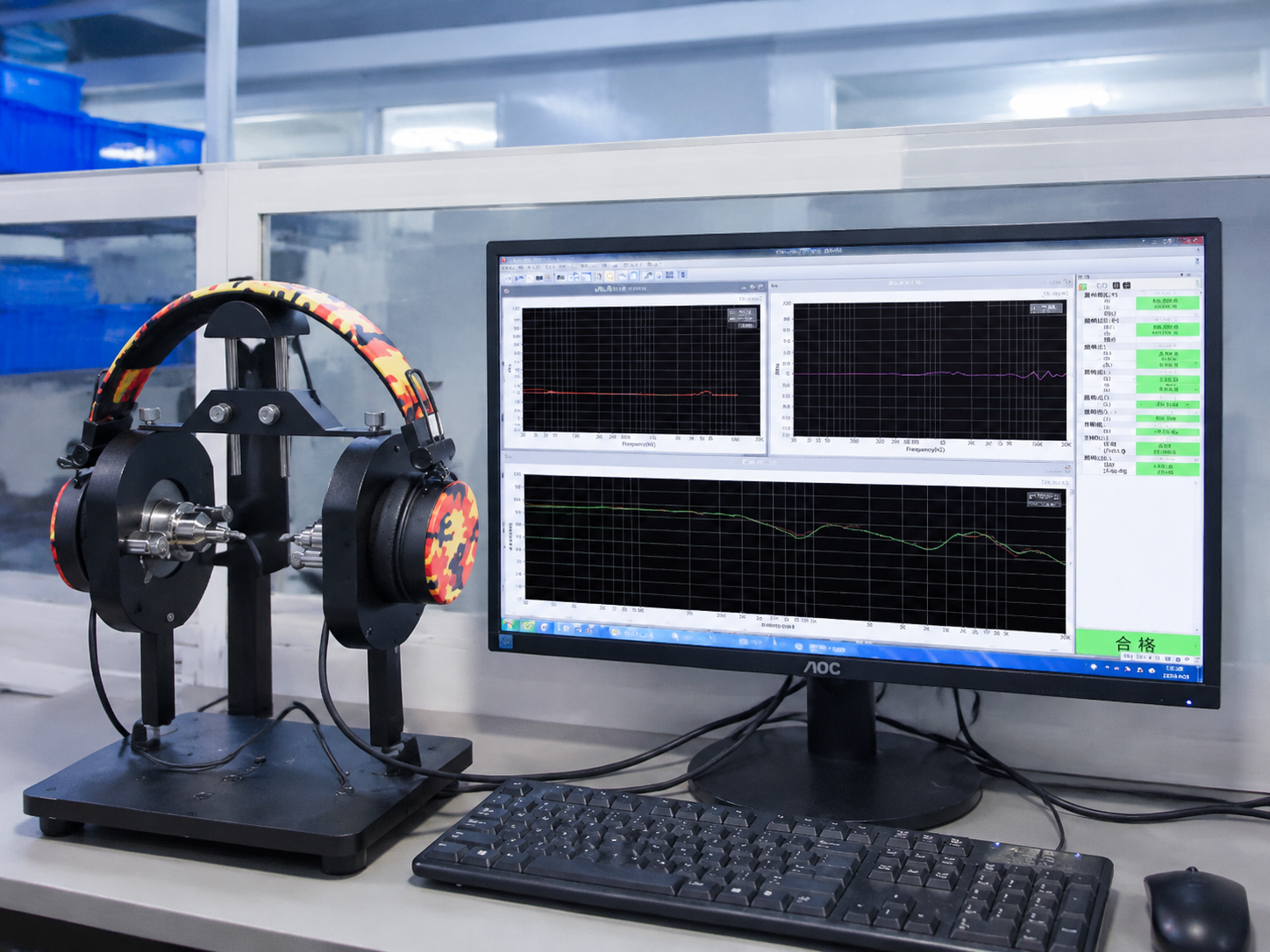
Sample evaluation should cover speech and music clarity, bass control, midrange balance, treble behavior, left-right consistency, distortion at useful levels and unwanted mechanical noise. Buyers should compare ANC on and off because the active system may affect the listening result.
Ear-cup volume, vents, driver mounting, cushion seal and wearing position can change the response. A revised cushion, surface treatment or assembly detail may therefore require acoustic rechecking even when the nominal driver specification remains unchanged.
Approval should use production-representative samples and agreed reference tracks or measurements. A single listening session on one early sample is not enough to define mass-production acceptance.
Review Bluetooth Functions and User Experience
A Bluetooth ANC sample should be reviewed as a complete interaction flow: pairing, reconnection, playback, calls, controls, prompts, charging and ANC state.
P400 confirms Bluetooth 5.3 on the JL7006 platform, Bluetooth stereo playback, Bluetooth calling and voice prompts. Buyers should test representative phones, tablets and laptops used by the target audience and record pairing, reconnection, audio recovery after calls and button behavior.
Bluetooth device name and voice prompts can be discussed for private-label projects. The brand should provide the exact device name, prompt list, languages, voice style requirements and fallback wording before firmware confirmation.
The public P400 data does not confirm multipoint, app control, specific codecs, spatial audio or exact microphone quantity. Those functions must not appear in the article, package or RFQ baseline unless separately evaluated and confirmed. Connection stability should be tested in the intended use context without inventing a fixed range claim.
Battery Specifications Must Be Verified Through Use Cases
Battery claims are meaningful only when the mode, volume, source, call activity, ANC state, sample configuration and test method are documented.
The current P400 specification lists a 500mAh battery, approximately 10-12 hours of music playback, approximately 10 hours of call time, approximately 1.5 hours charging and approximately six months standby. These figures provide a starting reference for buyer evaluation.
Before publishing retail claims, buyers should confirm whether music runtime was measured with ANC on or off, the approximate volume level, Bluetooth conditions and the final battery configuration. Call time and music time should remain separate because their power profiles differ.
Sample variation and component changes can affect results. A brand should define the validation method, sample count and acceptable tolerance with the supplier. If battery configuration is discussed as an OEM change, runtime, charging, weight, structure, compliance and package information may need another review.
The product data does not confirm fast charging. The approximately 1.5-hour charging figure should not be marketed as a fast-charge feature without additional approved evidence.
Materials and Wearing Comfort Affect Product Acceptance
For over-ear headphones, comfort and material decisions affect perceived quality, long-session use and the consistency of passive isolation.
P400 uses a PC and ABS material direction and an over-ear form. Buyers should assess headband pressure, ear-cushion contact, clamp balance, adjustment range, heat buildup, surface feel and stability during normal movement. The public data does not list product weight, so no weight claim should be created.
Cushion material is part of the OEM discussion and should be evaluated with the acoustic and ANC result. A change that feels softer may also alter the seal or wearing position. CMF and surface-finish samples should be inspected under relevant lighting for color, texture, logo contrast and cosmetic consistency.
Mechanical review can cover repeated adjustment, hinge or slider behavior where present on the sample, cushion attachment, controls and charging-port access. Test criteria should reflect the final construction rather than assumed features such as folding or touch control.
What Can Be Customized in a Private-Label ANC Headphone Project?
P400 projects can discuss branding, color and CMF, cushion direction, packaging, documentation, accessories and selected firmware or configuration items, subject to engineering and sample approval.
Confirmed customization discussions include logo placement, product color, surface finish, ear-cushion material, retail box, insert tray, user manual, warranty card, labels and accessory planning. Buyers should provide artwork, color references, package language and channel requirements in the initial brief.
Bluetooth device name, voice prompts, firmware adjustment, battery configuration and ANC tuning can be evaluated. Evaluation is not a promise that every requested change is feasible without cost, tooling, schedule or compliance impact. The final scope must be confirmed through engineering review and samples.
Certification support is available according to the target market and final product configuration. Support planning does not mean every certificate has already been issued for the final private-label version. MOQ and lead time also depend on branding, packaging, accessories, configuration and the approved project plan.
P400 as a Practical Evaluation Example
P400 is a practical reference for brands seeking a conventional Bluetooth ANC over-ear platform for lifestyle and private-label retail rather than a 2.4GHz gaming or hybrid-wireless project.
Its confirmed baseline includes Bluetooth 5.3, the JL7006 chipset, Active Noise Cancellation, Bluetooth calls, voice prompts, a 40mm driver, 500mAh battery and PC plus ABS construction. Published use cases include daily music, travel, commuting, office use and online calls.
The platform gives buyers clear areas to evaluate before sampling: ANC versus passive seal, acoustic tuning, Bluetooth workflow, runtime conditions, comfort, CMF and retail preparation. It does not confirm transparency mode, hybrid ANC, ENC, multipoint, premium codecs, spatial audio, app control or a numerical ANC depth.
Brands can use the P400 product page to review the current platform and then submit a project brief covering market, functions, customization, packaging, accessories and compliance. The sample should represent the intended configuration closely enough for meaningful approval.
Private-Label ANC Headphone Sample Evaluation Checklist
A useful sample checklist links every commercial claim to a repeatable product, packaging or documentation check.
| Evaluation area | What the buyer should check | Why it matters | P400 reference |
|---|---|---|---|
| ANC | On/off comparison in defined environments | Prevents vague or unsupported claims | ANC confirmed; depth not published |
| Passive isolation | Seal, cushions, fit and glasses variation | Affects isolation, bass and comfort | Over-ear platform; cushion discussion supported |
| Acoustics | Tuning, clarity, balance, distortion and consistency | Driver size alone does not approve sound | 40mm, 32 ohm, 120dB, 20Hz-20kHz listed |
| Bluetooth and calls | Pairing, reconnection, controls, calls and prompts | Defines daily user experience | Bluetooth 5.3, calls and prompts confirmed |
| Battery | Music, calls, ANC state, level and charging | Keeps retail claims reproducible | 500mAh and published time references |
| Comfort and materials | Pressure, cushions, heat, adjustment and finish | Affects long-session acceptance | Over-ear PC plus ABS platform |
| Branding and package | Logo, CMF, copy, labels, manual and accessories | Converts the platform into a retail SKU | Customization discussion supported |
| Compliance | Destination-market plan for final configuration | Avoids assuming platform support equals certification | Project-based coordination available |

Questions to Ask an ANC Headphone Manufacturer Before RFQ
An RFQ should establish the standard configuration, optional scope, validation responsibility and evidence required for the destination market.
- Which published specifications and functions are standard in the quoted version?
- Which requested changes need firmware work, component changes or engineering validation?
- How should ANC and passive isolation be evaluated on samples?
- What acoustic and battery test conditions support the intended retail claims?
- Which logo, color, CMF, cushion and package options can be sampled?
- How are Bluetooth names, voice prompts, manuals and accessory sets confirmed?
- Which compliance documents or tests apply to the target market and final configuration?
- What project information determines MOQ, sample scope, price and lead time?
Common Sourcing Mistakes
The most common errors come from approving labels and headline specifications before validating the full configuration and user experience.
- Treating the ANC label as proof of a specific reduction level.
- Confusing electronic ANC with passive isolation from fit and cushions.
- Judging sound quality from 40mm driver diameter alone.
- Comparing battery capacity without reviewing runtime conditions.
- Skipping comfort checks across representative users and longer sessions.
- Promoting optional firmware or configuration work as standard functionality.
- Assuming certification support means the final SKU is already certified.
- Approving the product before branding, packaging, manuals and accessories are frozen.

Conclusion
A private-label ANC headphone should move to sampling only when its market position, test plan, customization scope and retail claims are specific enough to approve objectively.
P400 offers a confirmed Bluetooth 5.3 ANC starting platform with JL7006, a 40mm driver, Bluetooth calls, voice prompts, 500mAh battery and lifestyle-audio positioning. Those facts create a shortlist candidate; sample evidence determines whether it fits the brand.
MACH industry can review the product brief, logo, CMF, cushions, package, user interface, battery or ANC evaluation scope, accessories and certification plan. Buyers should use the RFQ and sample stages to convert every intended claim into a controlled final specification.
Frequently Asked Questions
What should a brand check before ordering an ANC headphone sample?
Confirm the target user and channel, standard and optional functions, ANC and passive-isolation test plan, acoustic requirements, Bluetooth workflow, battery conditions, comfort, customization, packaging and compliance scope.
Is ANC the same as passive noise isolation?
No. Passive isolation comes from physical fit, ear cups and cushions. ANC uses an electronic system to reduce selected environmental noise. Neither should be described as removing every outside sound.
Is a 40mm driver enough to judge headphone sound quality?
No. Driver diameter is only one specification. Enclosure design, cushion seal, tuning, distortion, left-right consistency and production variation also affect the final sound.
How should buyers compare ANC headphone battery specifications?
Compare the battery capacity together with music and call test conditions, ANC state, volume, charging method, sample configuration and acceptable production tolerance.
What battery information is confirmed for P400?
P400 lists a 500mAh battery, approximately 10-12 hours of music playback, approximately 10 hours of calls, approximately 1.5 hours charging and approximately six months standby. Final claims should match the approved configuration and test method.
Can the P400 logo, color and packaging be customized?
MACH can discuss logo placement, color and CMF, ear-cushion direction, retail packaging, manuals, labels and accessories according to engineering review and sample approval.
Can Bluetooth device names and voice prompts be customized?
Yes, Bluetooth device naming and voice-prompt requirements can be evaluated. The buyer should provide exact names, languages and prompt content for firmware review.
Can ANC tuning or battery configuration be adjusted?
ANC tuning, firmware and battery configuration can be discussed, but feasibility and the effect on testing, compliance, cost and schedule depend on engineering evaluation and final samples.
Does certification support mean the P400 is already certified for every market?
No. Certification support is available according to the target market and final product configuration. Applicable documents and tests must be confirmed for the final private-label SKU.
What affects the MOQ of a private-label P400 project?
MOQ depends on the selected configuration, logo, color and CMF, packaging, accessories, firmware requirements and compliance scope. MACH confirms MOQ after reviewing the project brief.
Related Resources
Need OEM/ODM gaming audio solutions?
Contact MACH Industry to discuss your gaming headset, gaming earbuds, or private-label audio project.
Contact MACH Industry