Home > Resources > Gaming Headset Guide
How Should Brands Evaluate Gaming Headset Headband Durability?
A B2B buyer guide to evaluating reinforced headset headbands, clamp consistency, adjustment, materials, reliability tests, sample approval, and production control for private-label gaming headset programs.
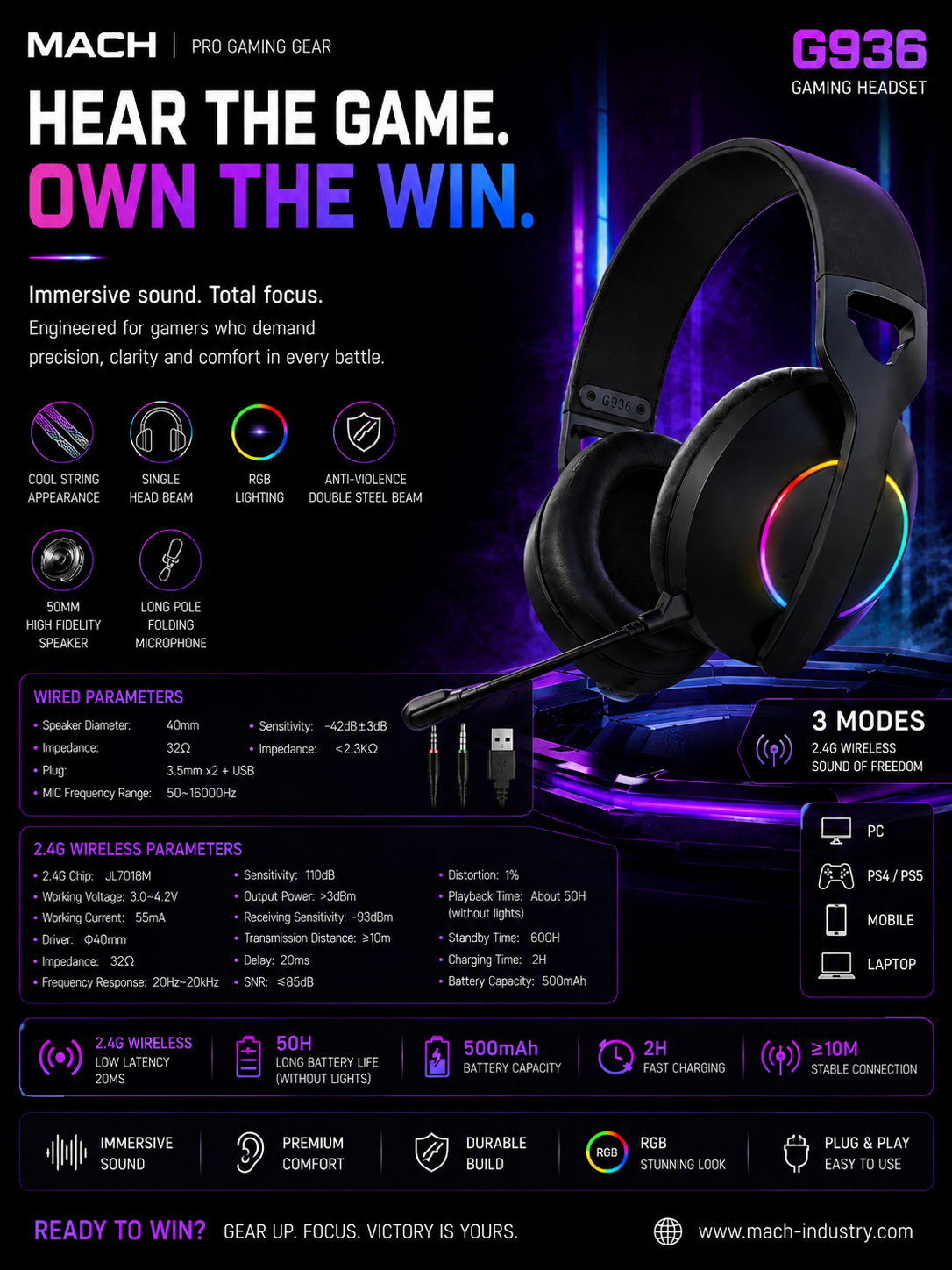
Gaming brands should evaluate headband durability before OEM production because the headband is the main structural link between the ear cups, adjustment system, wearing force, and repeated user handling. A useful approval plan reviews material and reinforcement, extension and return, torsion, clamp consistency, adjustment retention, joints, cosmetic wear, cable or electronic integration, packaging stress, and variation across production-representative samples.
This issue deserves separate attention from wireless performance. A headset can meet its 2.4GHz, Bluetooth, audio, microphone, RGB, and battery targets but still create returns if the headband loosens, cracks, twists permanently, produces inconsistent clamp, exposes sharp gaps, or changes fit after repeated use. Procurement teams therefore need measurable structural requirements rather than a general statement that a headset is reinforced.
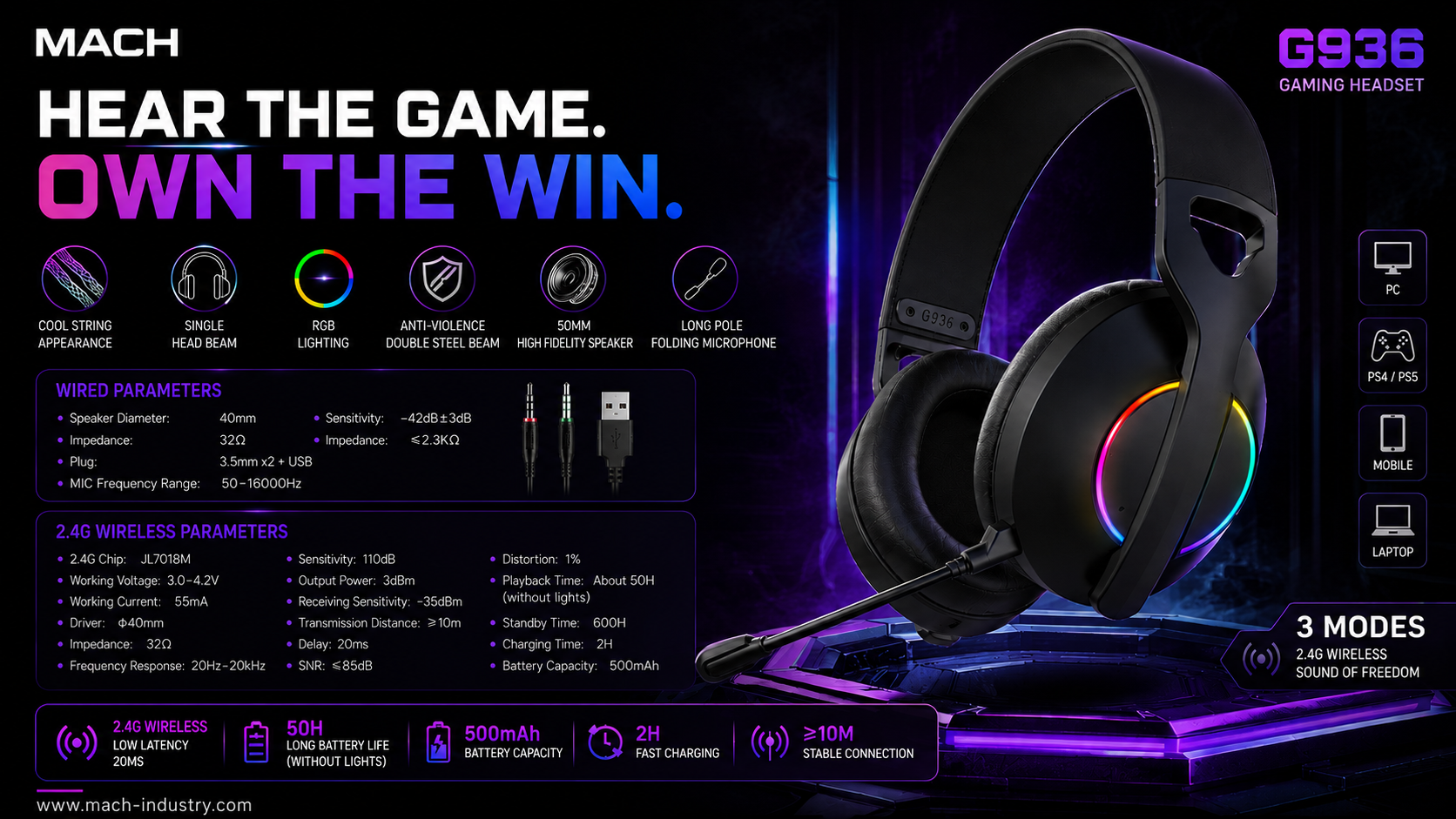
MACH G936 Black provides a documented product reference. It is a black RGB tri-mode wireless gaming headset with a reinforced double-steel headband structure, JL7018M-based 2.4GHz wireless, Bluetooth, 3.5mm audio, a confirmed 40mm driver, folding microphone with ENC support, RGB lighting, and a 500mAh battery. This article uses those confirmed facts to explain a broader OEM buyer decision without duplicating the product page.
Core Search Intent Answer: What Should Brands Check in a Gaming Headset Headband?
Brands should approve a gaming headset headband through defined structural, fit, adjustment, cosmetic, packaging, and production-consistency checks rather than relying on material names or a single hand-built sample.
Begin with the intended user and use pattern. Define the target head-size range, expected adjustment, session length, glasses use, movement, storage, transport, and sales channel. These conditions influence the required balance between clamp, retention, flexibility, cushion seal, weight distribution, and structural strength.
Next, identify the complete load path. The buyer should understand which headband parts provide spring force, which parts guide extension, where the ear cups attach, how fasteners and joints transfer load, and which decorative covers hide structural elements. A double-steel reinforcement can support a strong product direction, but finished durability also depends on geometry, heat treatment or material condition, plastic interfaces, fasteners, tolerances, and assembly.
Approval should include repeated extension and return, left-right adjustment, torsion, outward spreading, normal drop or handling scenarios defined by the project, surface-rub checks, and inspection for permanent deformation, cracks, looseness, abnormal noise, exposed edges, or functional change. Test quantities and cycles should follow the project's risk and agreed standard; unsupported numbers should not be invented for marketing.
Fit must be checked before and after structural testing. Record clamp, ear-cup position, adjustment retention, symmetry, seal, crown pressure, and user feedback across representative head sizes. A structure can remain unbroken yet still fail the product requirement if clamp or alignment changes enough to affect comfort, acoustics, or microphone position.
Finally, compare multiple production-representative samples. A golden sample shows the intended result, but buyers also need tolerances and acceptance limits for spring force, extension length, left-right symmetry, gaps, step differences, screw condition, cosmetic surfaces, noise, and return behavior. This turns durability from a subjective impression into a controllable manufacturing requirement.
| Evaluation area | Weak approval method | Buyer-ready method |
|---|---|---|
| Material | Steel headband stated | Confirmed structure, material specification, interfaces, BOM, and approved sample |
| Durability | One sample bent by hand | Defined extension, torsion, handling, inspection, and post-test fit criteria |
| Comfort | Feels comfortable briefly | Representative head sizes, timed wear, clamp, balance, seal, and post-test comparison |
| Production | Matches appearance sample | Tolerances, force and symmetry limits, assembly controls, traceability, and change control |
Product Case Reference: G936 Black
G936 Black is a reinforced RGB tri-mode wireless gaming headset platform for private-label gaming audio, retail, distribution, and e-commerce programs.
Its connection set includes dedicated 2.4GHz wireless, Bluetooth, and 3.5mm audio. The 2.4GHz route uses the JL7018M solution and is specified at 20ms latency with a transmission distance of at least 10m. Bluetooth provides a separate wireless path for compatible devices, while the 3.5mm connection provides a wired audio option.
The acoustic platform uses a confirmed 40mm driver with 32-ohm impedance, 110dB sensitivity, and a listed 20Hz-20kHz frequency response. The folding microphone is specified at -42dB plus or minus 3dB sensitivity, below 2.3k ohms impedance, and 50-16000Hz frequency range. ENC microphone support is selected in the product data.
A 500mAh battery is specified for approximately 50 hours of playback with RGB lighting off, approximately 600 hours standby, and approximately two hours charging. These references should be confirmed under documented mode, volume, lighting, microphone, temperature, battery, and endpoint conditions before market claims are finalized.
The black housing, circular RGB ear-cup lighting, folding microphone, and double-steel headband structure establish the product's visual and structural identity. MACH can evaluate product design and color, logo and private-label branding, retail packaging, industrial and mechanical development, audio tuning, sampling, and mass-production coordination according to the final project scope.
| G936 system area | Confirmed reference | Buyer validation |
|---|---|---|
| Structure | Reinforced double-steel headband | Fit, clamp, adjustment, torsion, extension, cosmetics, tolerance, and assembly consistency |
| Connections | 2.4GHz, Bluetooth, and 3.5mm audio | Host and mode matrix, latency method, range conditions, controls, and microphone route |
| Audio and voice | 40mm driver and folding microphone with ENC support | Tuning, channel match, speech quality, positioning, movement, and production variation |
| Power and lighting | 500mAh battery and RGB | Runtime conditions, charging, indicator behavior, lighting consistency, and aging |
Technical Analysis: Headband Structure, Fit, and Product Integration
Headband engineering affects structural life, clamp force, acoustic seal, microphone position, wireless integration, appearance, packaging, and production repeatability.
Structural reinforcement is only one part of the system. The metal elements must work with plastic covers, adjustment rails, yokes or ear-cup joints, fasteners, padding, and decorative surfaces. Buyers should inspect transitions where stiffness changes because local stress, gaps, rubbing, noise, or assembly variation can appear at interfaces even when the reinforcing material itself remains intact.
Clamp force connects mechanics to comfort and acoustics. Too little retention may allow movement or an inconsistent ear-cushion seal. Excessive clamp can increase jaw or temple pressure. The correct target depends on head-size range, cushion geometry, product weight, ear-cup movement, and acoustic tuning. Record the approved feel and measurable production limits instead of asking the factory for a headset that is simply strong.
Adjustment behavior also needs limits. The extension should move predictably, retain the selected position, remain reasonably symmetrical, and avoid exposing edges or creating loose movement. Folding or rotating parts, where present in the approved design, should be checked for interference with the microphone, ear cups, RGB housings, controls, and cable paths.
Wireless electronics make structural review more cross-functional. Mechanical changes can alter internal space, component position, antenna conditions, cable routing, and assembly sequence. The G936 source confirms the finished wireless modes and reinforced structure but does not publish internal antenna or cable details. Any structural customization should therefore trigger engineering review rather than assuming electronics remain unaffected.
Packaging can load the headband for long periods during storage and transport. The tray should support the headset without permanently spreading or compressing it, protect the RGB ear cups and microphone, secure the cable and accessories, and avoid cosmetic rubbing. Packaging approval should use final materials and production-representative headset samples.
Why Reinforced Double-Steel Headbands Require Production-Level Validation
Double-steel reinforcement can support durability and a defined clamp structure, but the brand must validate the assembled headset, manufacturing variation, and user-facing result rather than treating two steel elements as a complete durability claim.
The phrase double-steel headband describes a structural choice, not a finished performance rating. Steel geometry, thickness, condition, forming, spacing, connection points, plastic interfaces, and assembly all influence stiffness and return behavior. Two samples with the same material description can feel different when tolerances or assembly loads vary.
Procurement teams should begin with an approved structural specification and golden sample. Record the headset's adjustment range, left-right symmetry, clamp target, return after spreading, ear-cup position, visible gaps, joint movement, surface quality, and any acceptable sound during adjustment. These references give quality teams something more precise than visual similarity.
Reliability testing should represent how the headset will be handled. Depending on the agreed project plan, evaluation can include repeated headband spreading, extension adjustment, torsion, ear-cup movement, folding-microphone movement, cable connection, button use, charging, and defined handling or packaging tests. Inspect during and after testing for cracks, whitening, looseness, permanent set, sharp edges, abnormal noise, changed clamp, uneven extension, cosmetic wear, and loss of wireless, audio, microphone, RGB, or charging function.
Post-test fit is essential because structural deformation may be subtle. Compare the tested sample with the golden sample on defined fixtures or representative users. Check ear-cup alignment, cushion contact, crown position, retention during movement, microphone location, and left-right balance. An unbroken frame is not sufficient if the headset no longer sits or seals as approved.
Production variation deserves its own controls. Incoming metal and plastic parts, forming, molding, fasteners, screw torque, adhesive where applicable, assembly fixtures, cable placement, and cosmetic handling can affect the finished headband. The inspection plan should define sampling, critical dimensions or force checks, functional checks, appearance criteria, and response to out-of-limit results.
Customization can expand risk. Changing color or logo may be relatively contained, while modifying headband geometry, padding, covers, adjustment parts, ear-cup attachment, structural material, or tooling can affect clamp, balance, strength, acoustics, antenna conditions, packaging, and test scope. Brands should separate cosmetic requests from mechanical redesign in the RFQ.
Change control protects the approved result. A supplier substitution, material adjustment, tooling repair, fastener change, or assembly-process update should be evaluated against the parts and functions it can affect. Relevant samples should be compared with the approved standard before the change reaches mass production.
For private-label buyers, the practical lesson is that reinforced construction becomes commercially useful only when it is measurable and repeatable. The claim should follow evidence from the final configuration, while the factory documents how materials, assembly, inspection, testing, traceability, and engineering changes preserve that configuration.
| Validation layer | Buyer question | Approval evidence |
|---|---|---|
| Design | Does the structure support the intended fit and handling? | Drawings or specification, golden sample, interfaces, adjustment, clamp, and appearance |
| Reliability | Does repeated use change structure or function? | Agreed tests plus pre- and post-test mechanical, fit, cosmetic, and functional results |
| Manufacturing | Can production repeat the approved result? | BOM, tolerances, fixtures, incoming controls, assembly limits, inspection, and traceability |
| Change control | Will a material or process change alter performance? | Risk review, comparison samples, revalidation scope, approval record, and version control |

Buyer Decision Guide Before OEM Production
Buyers should approve the target user, structural requirements, complete tri-mode feature matrix, customization, validation, compliance plan, packaging, and manufacturing controls before releasing production.
Start with product positioning. Define target users, session duration, price level, sales channel, required visual identity, connection modes, supported devices, and expected product life. This helps the supplier balance headband structure, comfort, audio, electronics, battery, RGB, packaging, and cost against a clear use case.
Create a feature-and-host matrix. For G936, separate the JL7018M-based 2.4GHz route, Bluetooth, and 3.5mm audio. Record the supported host, required receiver or cable, audio, microphone, controls, RGB, charging state, latency method, range condition, and limitations for each route. Do not transfer the 20ms 2.4GHz specification to Bluetooth or analog operation.
Define structural approval in the same document as electronics and acoustics. Include head-size coverage, clamp and comfort target, adjustment, symmetry, headband and joint checks, reliability plan, packaging load, cosmetics, and post-test acceptance. Then add driver tuning, microphone speech, battery conditions, RGB behavior, and production tolerances.
Certification support should be planned for the target market and final configuration. The G936 source states that support can be coordinated but does not claim completed G936 Black certificates. Buyers should confirm applicable radio, EMC, battery, materials, labeling, documentation, and testing requirements with qualified parties.
Before mass production, approve the golden sample, BOM, firmware, mechanical versions, colors, logo, packaging, manuals, accessories, test reports, inspection plan, traceability, corrective-action process, and engineering-change rules. Production samples should be compared with both functional limits and the approved physical standard.
- Define target users, head-size range, session length, sales channel, price position, quantity, and schedule.
- Set headband structure, clamp, adjustment, symmetry, fit, comfort, cosmetic, and durability requirements.
- List every target host and the required 2.4GHz, Bluetooth, or 3.5mm behavior and accessories.
- Agree on latency and range methods for 2.4GHz; evaluate Bluetooth and wired operation separately.
- Define 40mm acoustic tuning, channel match, useful output, microphone voice, ENC, and production limits.
- State battery-runtime conditions, charging, indicators, RGB behavior, lighting-off claim, and aging checks.
- Separate logo, color, CMF, and packaging work from structural, tooling, RF, electrical, or acoustic changes.
- Approve packaging support, accessory placement, surface protection, instructions, labels, and transport checks.
- Confirm market-specific compliance, documentation, testing, and certification responsibilities.
- Freeze the golden sample, BOM, firmware, mechanical revisions, QC limits, traceability, and change control.
OEM/ODM Opportunity
MACH can evaluate G936 Black branding, product color and design, retail packaging, industrial and mechanical development, audio tuning, sampling, testing coordination, and mass-production support.
A useful project brief should state the target market, required hosts and modes, structural and comfort targets, product positioning, logo, color, RGB presentation, packaging, accessories, quantity, timing, validation, and compliance needs. Mark each item as mandatory, preferred, or optional so engineering trade-offs are visible.
Logo and color customization should define method, location, artwork, color master, finish, durability, and cosmetic acceptance. Packaging should protect the reinforced headband, RGB ear cups, folding microphone, cable, and accessories without holding the headset in a stressed position.
Industrial or mechanical development can affect headband force, adjustment, ear-cup position, acoustic seal, internal space, wireless conditions, tooling, reliability, and packaging. Audio tuning can affect the product target independently of the 40mm driver size. These changes require project-specific feasibility, samples, and validation.
MACH can coordinate product and specification review, sample and functional evaluation, wireless, audio and microphone testing, packaging and branding preparation, reliability and aging-test coordination, final inspection, and mass-production planning for the approved scope.
Conclusion
A durable gaming headset is not defined by a reinforced-material label alone; it is defined by an approved structure, stable fit, verified functions, measurable production limits, and controlled changes.
G936 Black provides a useful reference because it combines a double-steel headband structure with 2.4GHz, Bluetooth, 3.5mm audio, a 40mm driver, folding ENC microphone support, RGB, and a 500mAh battery. The platform's suitability depends on the buyer's user profile, device matrix, structural target, customization, validation, packaging, compliance, and production controls.
When procurement, engineering, quality, packaging, marketing, and support teams agree on those requirements before production, the brand can make clearer claims and reduce ambiguity between the golden sample and the finished shipment.
Discuss your gaming headset project with MACH. Share your target users, structural and comfort requirements, connection modes, branding, packaging, quantity, and target market.
Contact MACH IndustryFrequently Asked Questions
How should brands test gaming headset headband durability?
Define extension, spreading, torsion, adjustment, handling, cosmetic, and packaging tests for the intended product. Compare pre- and post-test structure, clamp, fit, symmetry, adjustment, noise, surfaces, and all electrical functions.
Does a double-steel headband guarantee a durable gaming headset?
No. Finished durability also depends on steel geometry and condition, plastic interfaces, joints, fasteners, adjustment parts, tolerances, assembly, packaging, and quality control. The assembled production configuration must be validated.
Why does headband clamp consistency matter?
Clamp affects retention, pressure, ear-cushion seal, acoustic response, movement, and perceived comfort. Buyers should define an approved target and production limits across representative head sizes and samples.
What connection modes does G936 Black support?
The confirmed G936 Black configuration supports JL7018M-based 2.4GHz wireless, Bluetooth, and 3.5mm wired audio. Host compatibility and mode-specific functions should be confirmed during sampling.
What is the specified 2.4GHz latency of G936 Black?
The product source lists 20ms latency for the dedicated 2.4GHz route. Buyers should agree on the host, firmware, measurement method, RF conditions, and acceptance criteria before using the value in claims.
Can MACH customize the G936 headset color and branding?
MACH can evaluate product design and color, logo and private-label branding, retail packaging, industrial and mechanical development, audio tuning, sampling, and production support according to the project scope.
How does OEM gaming headset sampling work?
Sampling normally follows a written brief covering configuration, mechanics, fit, connections, audio, microphone, battery, RGB, branding, packaging, test criteria, and compliance. The final approved sample should be linked to the BOM and acceptance limits.
What MOQ applies to a private-label G936 project?
MOQ is project based and depends on product configuration, branding, mechanical work, color, packaging, accessories, and order planning. Buyers should provide the intended scope for evaluation.
Which certifications are required for a tri-mode wireless gaming headset?
Requirements depend on the target market and final radio, EMC, battery, materials, labels, accessories, and documentation. MACH can coordinate support, but completed G936 Black certifications are not claimed without product-specific documents.
What should buyers approve before mass production?
Approve the golden sample, structural and comfort limits, BOM, firmware, connection matrix, acoustics, microphone, battery, RGB, colors, logo, accessories, packaging, compliance plan, inspection criteria, traceability, and change control.
Related Resources
Need OEM/ODM gaming audio solutions?
Contact MACH Industry to discuss your gaming headset, gaming earbuds, or private-label audio project.
Contact MACH Industry