Home > Resources > OEM Knowledge
How Gaming Brands Develop Low-Latency Wireless Gaming Earbuds Platforms
A B2B development guide to selecting, customizing and validating a low-latency wireless gaming earbuds platform without turning unverified targets into product claims.
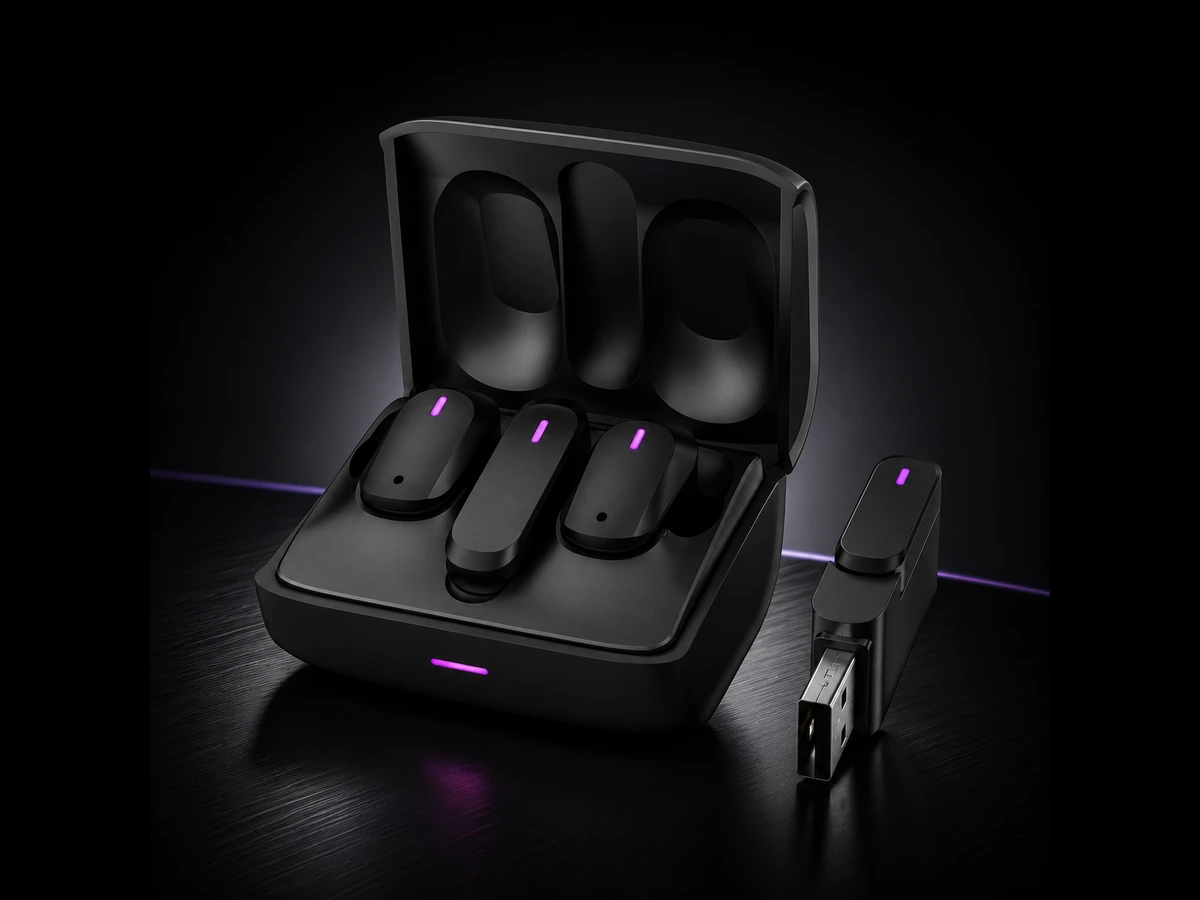
Modern gaming brands need more than a finished product. They need flexible wireless audio platforms that allow customization, reliable performance and faster product development.
The practical route is to begin with a documented OEM or ODM platform, define the target gaming scenario, and validate latency, connection behavior, voice communication, power, acoustics and packaging as one controlled product configuration. A platform can shorten development by providing an engineering starting point, but it does not remove the buyer's responsibility to set measurable requirements and approve evidence.
MACH GE7 illustrates this approach. Its public specification confirms an ATS3031 chipset, 2.4G wireless plus Bluetooth 5.3, ENC voice communication, a 500mAh charging case and customization for industrial design, logo, packaging, firmware and color. No numerical latency, runtime, driver, compatibility or certification claim is published, so those items remain project-specific validation points in this guide.
Why Gaming Brands Need a Custom Gaming Earbuds Platform
A custom gaming earbuds platform gives a brand a validated engineering starting point while preserving room for market-specific design, firmware, packaging and positioning.
Wireless gaming earbuds combine several tightly connected systems in a small enclosure. The radio architecture, antennas, batteries, charging case, microphones, acoustic parts, controls and firmware all affect the user experience. A change that looks cosmetic can influence fit, antenna clearance, sealing, power consumption or assembly yield. Buyers therefore need a platform decision before they need a long feature list.
A mature platform can reduce duplicated engineering work because core functions already have a defined architecture. The buyer can focus resources on the parts that create commercial distinction: industrial design, color, branding, packaging, control logic and market claims. This is especially relevant for private-label brands that need a credible product without funding every subsystem from a blank sheet.
Platform selection also improves cost control. Instead of estimating an undefined concept, the supplier can evaluate customization against an existing bill-of-material direction and development scope. Tooling, firmware, acoustic work, packaging, certification planning and testing can then be separated into visible work packages. The final quotation still depends on the approved configuration, quantity and schedule.
Speed should not be confused with skipping validation. A reusable platform lowers avoidable risk only when the selected hardware, firmware, industrial design and accessories are tested together. Brands should treat the reference platform as a controlled starting point, then release their own product through samples, verification and a golden sample.
| Buyer objective | Platform contribution | Buyer decision still required |
|---|---|---|
| Faster development | Existing wireless and charging architecture | Target schedule, customization depth and approval stages |
| Product differentiation | Defined base for industrial design and firmware work | Brand identity, controls, color, packaging and claims |
| Risk control | Known engineering starting point | Project-specific validation and change control |
| Cost visibility | Clearer base configuration | Tooling, testing, certification and order requirements |
GE7 Gaming Earbuds Platform Overview
GE7 is a concept gaming earbuds platform built around ATS3031, 2.4G wireless and Bluetooth 5.3, ENC communication and a 500mAh charging case.
GE7 is positioned for gaming brands, OEM/ODM concept projects, private-label gaming earbuds and Amazon gaming audio sellers. Its dual wireless architecture creates two distinct routes that can be developed around different user scenarios. The exact target devices, receiver format, mode behavior and compatibility claims must be established in the project specification.
The ATS3031 chipset is confirmed as the platform basis. A chipset name is useful for engineering identification, but it is not a complete performance specification. Antenna implementation, firmware, earbud mechanics, receiver design, host devices and test conditions still determine the released product behavior.
ENC clear voice communication is included in the published platform information. Buyers should define the intended communication scenario, such as game chat or calls, and approve a repeatable test method. ENC does not by itself establish microphone count, sensitivity, noise conditions or identical behavior in both wireless modes.
The charging case capacity is listed as 500mAh. The public data does not state earbud battery capacity, playback time, charging time, cycle assumptions or test conditions. Those values should be confirmed with the final hardware and firmware before they appear on packaging or online listings.
Confirmed customization areas are industrial design, logo, packaging, firmware and color. This range supports meaningful brand differentiation, but every change needs an engineering review. MOQ requires contact and lead time is project dependent.
How OEM Gaming Earbuds Platforms Reduce Product Development Risk
An OEM gaming earbuds platform reduces risk by converting an open-ended product idea into a controlled base configuration with defined customization, validation and production gates.
Brands do not always benefit from developing every circuit, enclosure and software behavior from zero. Full custom development can be appropriate when the product requires a genuinely new architecture or protected industrial design, but it also creates more interfaces to manage. Radio performance, charging, microphones, acoustics, mechanical fit and firmware must mature at the same time. A platform approach narrows the initial uncertainty.
The first benefit is hardware traceability. A platform gives the project team a named chipset, connection architecture and charging direction from which to build the product requirement document. For GE7, the confirmed base includes ATS3031, 2.4G wireless, Bluetooth 5.3, ENC and a 500mAh charging case. The buyer can identify what is fixed, what is configurable and what requires new engineering before design work begins.
The second benefit is faster customization. Industrial design, logo, color and packaging can be developed around known internal constraints. Firmware customization can be scoped against an existing software baseline instead of an undefined feature wish list. Faster does not mean automatic: new housing geometry may affect antennas, fit or assembly, while firmware changes can affect mode switching, prompts, controls and power behavior. Each change needs an owner and an approval test.
The third benefit is lower engineering risk through staged decisions. The supplier and buyer can freeze the connection architecture before approving industrial design, freeze major mechanical interfaces before cosmetic tooling, and freeze firmware before compliance and production verification. This order prevents late branding or packaging decisions from hiding an unresolved technical dependency.
A platform also improves production readiness. The development team can define critical-to-quality checks for pairing, audio, voice, charging, controls, indicators and appearance. A golden sample can connect the final earbud, case, receiver, firmware, color, logo and package. Production inspection then compares against a released reference rather than a marketing rendering.
Commercial risk is reduced when claims follow evidence. Low latency should be treated as a measurable target with a named mode, host, test method and acceptance limit. Bluetooth 5.3 should not inherit a 2.4G result, and a 2.4G label should not imply support for every console. Similarly, 500mAh case capacity does not establish total playback time without the rest of the power system and test conditions.
The platform approach lets brands invest differentiation where customers can recognize it. GE7 supports industrial design, logo, packaging, firmware and color work. A brand might prioritize a distinctive case, clear controls, a coherent color system or market-specific packaging while retaining the platform architecture. Requests for tuning or accessories should be reviewed because they are not listed as confirmed GE7 customization fields.
Finally, platform development creates a clearer change-control process. Any update to housing, antenna area, receiver, battery, firmware, microphone or charging components should identify affected tests. That discipline protects the approved product after sampling and helps the buyer evaluate whether a later substitution is cosmetic, functional or claim-sensitive.
| Risk area | Uncontrolled development | Platform-based control |
|---|---|---|
| Requirements | Feature list without system priorities | Base configuration plus documented customization |
| Engineering | Multiple new subsystems mature together | Known architecture with project-specific verification |
| Claims | Marketing language written before tests | Mode-specific claims released from evidence |
| Production | Visual sample used as the only reference | Golden sample, firmware revision and QC plan |
| Changes | Substitutions evaluated informally | Impact review and selective revalidation |
Technical Deep Dive: What Makes a Low-Latency Gaming Earbuds Platform?
A low-latency gaming earbuds platform is not defined by one chip or label; it requires a complete, measured path from the host through the wireless link and firmware to the final acoustic output.
Latency is the elapsed time between a source event and the audible result. In a wireless earbud system, delay can be introduced by the host, audio processing, encoding, transmission, buffering, decoding and synchronization. The product team should therefore specify end-to-end behavior for a named connection route and device rather than asking only for a chipset figure.
GE7 provides 2.4G wireless and Bluetooth 5.3. These modes should be evaluated separately. A dedicated 2.4G route commonly uses a receiver and can be developed for gaming-focused behavior, while Bluetooth supports compatible devices without a dedicated receiver. The public GE7 data does not provide a latency number, receiver connector or compatibility list, so no numerical or platform claim should be inferred.
The buyer should define an acceptance method before samples arrive. The test must state the host, software or signal source, active mode, firmware, measurement equipment, sample count and pass limit. Perceived checks can help product evaluation, but a repeatable technical method is needed for a published numerical claim.
Connection stability matters alongside delay. Test pairing, reconnect, interference, range under defined conditions, mode switching and recovery from charging or sleep states. A fast link that reconnects unpredictably may create more support cost than a carefully specified product with clear mode behavior.
Voice communication forms another path. GE7 confirms ENC, but the released product still needs target scenarios for speaking distance, background noise, host devices and wireless mode. The team should test intelligibility and stability rather than assuming the ENC label guarantees the same result in every environment.
Power and heat can change system decisions. The 500mAh charging case is one confirmed element, but the public specification does not publish earbud batteries, runtime or charging behavior. Brands should validate runtime by mode, standby, charging cycles and any firmware setting that changes radio or processing behavior.
A professional specification links every performance statement to a revision-controlled sample. If industrial design or firmware changes after approval, affected latency, connection, voice, charging and acoustic tests return to validation. This is what turns a low-latency objective into a production-ready platform instead of an unsupported label.
- Define target devices and the role of 2.4G and Bluetooth 5.3.
- Specify a latency test method and pass criterion for each claimed mode.
- Confirm receiver format, pairing, reconnect and mode switching.
- Define ENC voice scenarios and microphone acceptance criteria.
- Validate runtime and charging with final hardware and firmware.
- Tie results to earbud, case, receiver and firmware revisions.
- Repeat affected tests after industrial-design or firmware changes.
OEM vs ODM Gaming Earbuds Development
OEM and ODM describe different starting points: OEM follows a buyer-defined product specification, while ODM adapts a supplier platform and engineering base to the brand's market requirements.
The labels are often used loosely, so the project contract should define ownership and deliverables instead of relying on terminology. A mostly private-label program can use an existing configuration with branding and packaging. A deeper ODM project can adapt industrial design, color, firmware and other feasible areas. A full OEM project may bring more buyer-controlled specifications and engineering input.
GE7 is explicitly positioned as a concept earbuds platform with OEM/ODM design support. That makes it suitable for a platform discussion, but not every requested change is automatically included. Buyers should separate confirmed customization from new engineering and ask how tooling, firmware, tests, certification planning and intellectual property will be handled.
The best route depends on differentiation, budget, schedule and technical ownership. A brand does not gain value by selecting the most custom label; it gains value by choosing the development scope that supports its product strategy with manageable risk.
| Decision area | OEM-led project | ODM platform project |
|---|---|---|
| Starting point | Buyer specification or design direction | Supplier platform and engineering base |
| Customization | Potentially broader, subject to feasibility | Focused on supported platform options |
| Development work | More buyer-defined engineering and validation | Adaptation and validation around an existing base |
| Investment | Potentially higher for new tooling and engineering | Often more controlled when the base is retained |
| Schedule | Depends on novelty and approval cycles | Can be shorter when customization stays within the platform |
Key Considerations Before Developing Gaming Earbuds
Buyers should define the user, target devices, connection roles, measurable performance, customization and market requirements before requesting a gaming earbuds quotation.
Start with the target platform and user journey. List the devices, connection selected for each device, receiver or adapter requirements, game-chat expectations, portable use and charging routine. A broad phrase such as multi-platform is not precise enough for engineering or packaging.
Define wireless performance as testable requirements. For 2.4G and Bluetooth, identify pairing, reconnect, range, interference, latency and mode-switching expectations. Separate must-have requirements from preferences so the supplier can evaluate tradeoffs.
Audio and voice need reference scenarios. The public GE7 information does not publish a driver or tuning specification, so buyers should provide target sound direction and reference material for project evaluation. ENC requirements should identify voice use, environment and host devices.
Industrial design should account for fit, controls, charging contacts, antenna areas, assembly and case storage. Brand teams should provide logo artwork, color references, packaging language and target-market requirements early enough for engineering review.
Certification planning belongs in the initial brief even though no certification is published for GE7. The required program depends on the final product, radio configuration and destination market. Buyers should not treat a platform component or earlier report as automatic approval for a customized finished product.
- Target users, channels and price position
- Named devices and connection mode for each
- Latency, stability and voice acceptance methods
- Industrial design, logo, color and firmware scope
- Charging case, accessories and package contents
- Destination markets and certification plan
- Forecast quantity, sample stages and launch schedule
- Golden sample, production QC and change-control requirements
Gaming Earbuds Development Process
A controlled gaming earbuds project moves from concept and platform selection through design, engineering, prototypes, testing and a documented mass-production release.
Concept definition establishes the customer, channels, target devices, required modes, differentiation and commercial constraints. Platform selection then compares those requirements with confirmed GE7 capabilities and identifies gaps that require engineering review.
Design converts the brief into industrial-design, color, logo, packaging and user-interface directions. Engineering evaluates mechanics, antennas, charging, firmware, ENC and manufacturability. The team should freeze high-risk interfaces before cosmetic approvals become expensive to change.
Prototype stages answer different questions. Early samples verify architecture and fit; later samples should represent the branded product, released firmware and complete accessories. Testing covers connection behavior, latency where claimed, audio, voice, charging, reliability, cosmetics, packaging and destination-market requirements.
Mass production begins only after the product specification, bill-of-material revision, firmware, artwork, test plan and golden sample agree. Incoming inspection, assembly checks, functional testing and outgoing inspection should match the released configuration. Changes after approval need impact review.
| Stage | Primary output |
|---|---|
| Concept | Buyer brief and target-user definition |
| Platform selection | GE7 fit-gap and customization scope |
| Design | Industrial design, brand and packaging direction |
| Engineering | Controlled hardware, firmware and test specification |
| Prototype | Evidence for staged buyer approval |
| Testing | Performance, reliability and market evidence |
| Mass production | Golden-sample-based quality control |
Who Should Consider a Gaming Earbuds Platform?
A gaming earbuds platform suits brands that need a differentiated wireless product but want to build from a defined technical base rather than commission every subsystem from zero.
Established gaming brands can use a platform to extend from headsets into compact audio while maintaining their own industrial design and brand language. New gaming accessory brands can use the development structure to control technical risk and focus on a precise customer segment.
Amazon and marketplace sellers may benefit when they are prepared to create accurate connection, voice, charging and compatibility content rather than relying on generic feature icons. Distributors can use the platform approach to adapt packaging, color and positioning for a defined region while planning the correct market requirements.
Private-label buyers should choose GE7 only after its confirmed ATS3031, 2.4G plus Bluetooth 5.3, ENC and 500mAh charging-case direction fit the product brief. A platform is not the right choice when the project requires an incompatible architecture or unsupported feature with no engineering budget.
The common requirement is disciplined product management. The buyer must own the market brief, approve measurable criteria and keep claims aligned with the final sample. The supplier must explain feasibility, validation, manufacturing and change control.
Conclusion
Gaming brands can develop low-latency wireless earbuds efficiently by selecting a suitable platform, defining measurable mode-specific requirements and controlling customization through validation and production release.
GE7 offers a confirmed platform reference with ATS3031, 2.4G wireless, Bluetooth 5.3, ENC communication, a 500mAh charging case and industrial-design, logo, packaging, firmware and color customization. Those facts create a useful starting point; numerical latency, compatibility, runtime, acoustics and certification still require project-specific evidence.
MACH industry can review your target users, devices, wireless modes, design direction, firmware scope, packaging and market plan. A clear brief allows both parties to determine whether GE7 is a suitable ODM base or whether the project requires a different OEM development route.
Frequently Asked Questions
What is a gaming earbuds platform?
A gaming earbuds platform is a defined technical base covering wireless architecture, charging, voice, firmware and mechanical constraints that brands can evaluate and customize for an OEM or ODM product.
What is confirmed for the MACH GE7 platform?
GE7 confirms an ATS3031 chipset, 2.4G wireless plus Bluetooth 5.3, ENC clear voice communication, a 500mAh charging case and customization for industrial design, logo, packaging, firmware and color.
What latency does GE7 provide?
The public GE7 specification does not publish a numerical latency. Buyers should define the target mode, host, test method and acceptance limit, then validate the released project configuration.
Why choose ODM gaming earbuds instead of developing from zero?
An ODM platform can provide an established engineering starting point, making customization, cost scoping and production planning more controlled. The final branded configuration still requires project-specific tests and approvals.
How can brands customize GE7 gaming earbuds?
Published GE7 customization includes industrial design, logo, packaging, firmware and color. Feasibility, tooling, cost, schedule and validation are determined during project review.
Does Bluetooth 5.3 guarantee low-latency gaming performance?
No. A Bluetooth version alone does not establish end-to-end latency. Host behavior, profiles, buffering, firmware and the final hardware configuration affect results.
Does GE7 support every PC, console and mobile device?
The public GE7 information does not publish a compatibility list. Every target device should be tested with the intended 2.4G receiver or Bluetooth mode before compatibility claims are released.
What does ENC mean for gaming earbuds?
ENC describes an environmental-noise-reduction direction for voice communication. Microphone configuration, speaking distance, background noise, host devices and acceptance criteria still need project-specific definition.
What should buyers prepare before starting a gaming earbuds project?
Prepare target users, devices, connection roles, performance criteria, industrial-design direction, logo, color, firmware needs, packaging, destination markets, quantity and launch schedule.
How does a gaming earbuds project move to mass production?
The project progresses through concept definition, platform selection, design, engineering, prototypes, testing and release of a golden sample, firmware, artwork and quality-control plan before mass production.
Related Resources
Need OEM/ODM gaming audio solutions?
Contact MACH Industry to discuss your gaming headset, gaming earbuds, or private-label audio project.
Contact MACH Industry