Home > Resources > OEM Knowledge
Dual-Mode Wireless Gaming Earbuds: A Complete OEM Development Guide for Gaming Brands
A B2B guide to choosing between dual-mode and tri-mode gaming earbuds, with A8-based guidance on wireless architecture, power validation and OEM development.
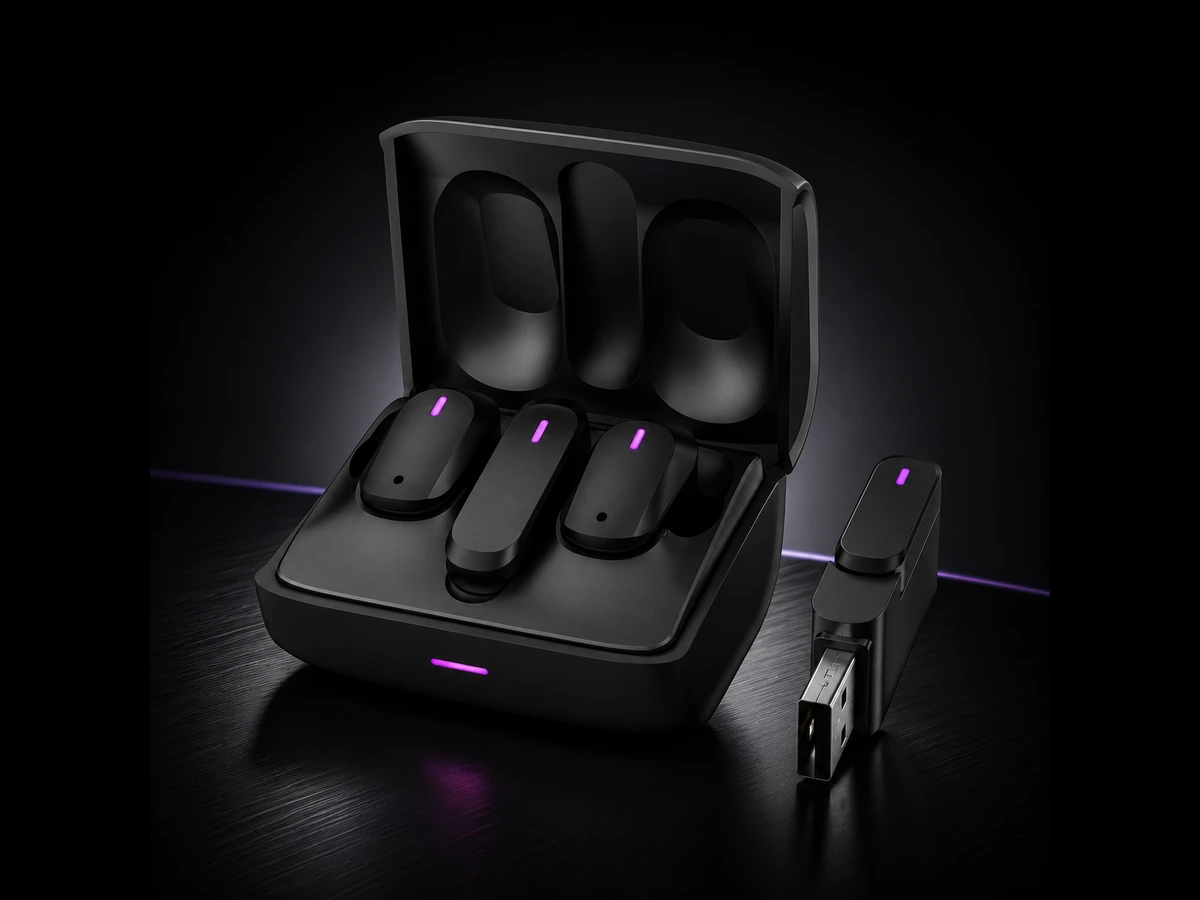
Gaming brands should choose a dual-mode wireless earbud platform when they need a dedicated 2.4GHz route for gaming and Bluetooth for everyday mobile use without the added hardware and validation burden of a third connection mode.
The decision depends on target users, devices, product position, mode-specific performance, battery expectations, receiver handling, customization and market requirements. Dual mode is not automatically simpler in every detail, and tri mode is not automatically better. The right architecture is the smallest one that fully supports the intended customer journey.
MACH A8 provides a confirmed dual-mode reference with 2.4G and Bluetooth 6.0, an AB5712C earbud and dongle platform, a 10mm driver, 200mAh battery, 45g lightweight open-ear form, 7–8 hours published Bluetooth play time and 17 hours dongle-mode play time. This guide uses those facts for buyer education rather than repeating the A8 product page.
Why Gaming Brands Are Moving Toward Dual-Mode Wireless Earbuds
Dual-mode earbuds let brands separate a gaming-focused 2.4GHz route from a Bluetooth route for compatible mobile and everyday use.
Gaming audio users increasingly move between a desk, phone, tablet and portable setup. A single connection may not provide the preferred behavior in every scenario. Dedicated 2.4GHz can create a controlled receiver path for approved gaming hosts, while Bluetooth can support familiar wireless use where a dongle is inconvenient.
This separation can make the product story clearer. The brand can position one mode for gaming and the other for daily mobile use, provided the functions and supported devices are validated independently. Users need to understand which mode to select, which accessory is required and whether microphone, controls or other behavior changes.
Open-ear products can also serve users who prefer a lighter, less isolating form. A8 is published as a 45g lightweight open-ear design with a 10mm driver. Fit, retention, sound leakage and ambient awareness still need representative user evaluation because the public page does not provide universal comfort or acoustic-isolation claims.
Dual-mode development is most valuable when the target user genuinely needs both routes. Adding a dongle to a Bluetooth product without a clear gaming purpose increases package, support and replacement complexity. Buyers should define the primary and secondary scenario before selecting the platform.
| User scenario | Likely route | Buyer validation |
|---|---|---|
| Dedicated gaming setup | 2.4GHz dongle | Host support, controls, audio, latency and receiver behavior |
| Mobile and everyday audio | Bluetooth | Pairing, reconnect, calls, controls and operating time |
| Portable gaming | Depends on approved host and connector | Dongle fit, adapter needs and Bluetooth behavior |
| Sports or open-ear use | Usually Bluetooth on compatible devices | Fit, retention, awareness and control access |
A8 Dual-Mode Wireless Earbuds Platform Overview
A8 is a lightweight open-ear dual-mode platform combining 2.4G wireless and Bluetooth 6.0 with an AB5712C earbud and dongle solution.
The confirmed architecture lists AB5712C for the earbuds and AB5712C for the dongle. The two connection routes are 2.4G and Bluetooth 6.0. The public source does not publish numerical latency or a device compatibility table, so these areas require project-specific validation.
A8 uses a 10mm speaker driver and a 200mAh battery. Published play time is 7–8 hours in Bluetooth mode and 17 hours in dongle mode. The source does not state volume, test signal, distance, microphone state or other measurement conditions, which should be confirmed before the values are used in buyer-facing claims.
The product is described as a 45g lightweight open-ear form. Its application direction includes gaming audio brands, wireless earbud brands, Amazon sellers and sports audio brands. This range supports a market-selection discussion rather than one narrow gaming claim.
Confirmed OEM/ODM options are logo, packaging, color and firmware. MOQ requires contact and lead time is project dependent. The public A8 data does not confirm microphone specifications, charging-case capacity or behavior, charging time, completed certifications or named platform compatibility.
Dual Mode vs Tri Mode Gaming Earbuds: Choosing the Right Wireless Platform for Different Markets
Choose dual mode when 2.4GHz gaming and Bluetooth daily use cover the target market; choose tri mode only when a verified third connection solves a real device or channel requirement.
Dual mode describes two distinct connection routes. In the A8 platform, those routes are 2.4G through a dongle and Bluetooth 6.0. The dedicated wireless route can be assigned to approved gaming scenarios, while Bluetooth can serve compatible phones and everyday use. The architecture is commercially useful because each mode has a clear purpose.
Tri mode adds a third connection option. In gaming audio, that third route is often wired audio, but 'tri mode' is not a universal technical standard. Buyers must verify what the three modes actually are, whether the third route carries audio, which devices support it and what controls or microphone functions remain available. A charging cable does not automatically mean wired-audio support.
Cost should be considered as a system question. Dual mode already includes receiver hardware, firmware, accessories, package space and additional testing. Tri mode may add connectors, cables, switching logic, mechanical space and more validation. The exact cost depends on the selected architecture and customization, so a brand should compare complete released configurations rather than count modes.
Product positioning is equally important. Dual mode can fit gaming brands that want a focused low-latency route and convenient Bluetooth without presenting a complex compatibility story. It can also suit Amazon and sports-audio brands when the open-ear form and two wireless routes match their customers. Tri mode may be more appropriate for a broader multi-platform offer where a real wired fallback is commercially necessary.
Target users determine whether the third mode creates value. Mobile-first buyers may prioritize Bluetooth and compact use. PC or compatible portable gamers may value the 2.4GHz dongle. Console-focused users may need a third route only if the approved console path cannot be served by the existing receiver or Bluetooth. Compatibility must be tested, not inferred from the number of modes.
Development complexity rises with every route. Engineers must control switching, prompts, reconnect behavior, accessories, power states and firmware. Quality teams need a device-by-mode matrix. Packaging and customer support must explain how each route works. A third mode that few customers use can add cost and support burden without improving conversion.
Market demand should therefore be validated before architecture selection. Review search behavior, channel expectations, competitor packages, return reasons and target-device ownership. A brand should choose dual mode when two routes fully support the intended user journey and protect a clear price position. Choose tri mode when the third route has a named target device, measurable function and strong commercial reason.
The practical rule is simple: more modes are valuable only when each mode solves a verified problem. A focused dual-mode platform can be the more professional decision because its hardware, claims and user instructions are easier to align around the intended market.
| Buyer factor | Dual mode | Tri mode |
|---|---|---|
| Connection scope | Two defined routes, such as 2.4GHz + Bluetooth | Three verified routes; exact definition must be confirmed |
| Positioning | Focused gaming plus everyday wireless use | Broader compatibility story when the third route is useful |
| Development | Receiver, mode switching and dual-route validation | Additional hardware, controls, accessories and tests |
| Cost | Controlled around two released routes | Potentially higher integration and package cost |
| Best fit | Brands whose target journey is covered by two modes | Brands with a verified device or channel need for mode three |
Key Technical Factors Buyers Should Evaluate Before Developing Gaming Earbuds
Buyers should evaluate the complete mode architecture, target-device behavior, acoustics, power, fit, firmware and accessories rather than compare isolated headline specifications.
Wireless evaluation should separate 2.4G and Bluetooth 6.0. Create a device-by-mode table for pairing, audio, controls, reconnect and any microphone function once the project specification confirms it. A8 does not publish console compatibility or a latency result, so those claims require testing.
The 10mm driver is a component specification, not an acoustic quality score. Buyers should define reference tuning, use scenarios and fit conditions, then review production-representative samples. Open-ear placement can influence perceived bass, leakage and consistency across users.
Battery evaluation should use the 200mAh A8 configuration and clearly stated mode conditions. The published 7–8-hour Bluetooth and 17-hour dongle values should be tied to a test method before packaging release. A higher hour figure in one mode does not explain why the difference occurs.
Microphone requirements must be treated as unconfirmed until the selected A8 specification supplies them. Buyers should define calls, game chat, wind or background noise scenarios and target devices instead of assuming a microphone solution.
A charging case is not described in the public A8 data. If the project requires one, confirm whether it is included, its battery capacity, charging interface, earbud recharge cycles, indicators and package content. Do not infer case functionality from the word earbuds.
- Define target devices for each connection mode.
- Confirm dongle connector and adapter requirements.
- Validate acoustic tuning with final open-ear fit.
- Document battery test conditions by mode.
- Confirm microphone and charging-case scope.
- Control firmware, receiver and earbud revisions.
- Verify claims on the final branded configuration.
Why Battery and Power Management Matter in Wireless Gaming Earbuds
Battery claims must be validated separately for Bluetooth and dongle modes because wireless architecture, firmware and user behavior can produce different operating-time results.
A8 confirms a 200mAh battery and publishes 7–8 hours in Bluetooth mode versus 17 hours in dongle mode. These figures are useful platform indicators, but the source does not publish their test conditions. Product managers should not invent an explanation for the difference.
A valid comparison identifies volume, audio content, distance, active controls, standby behavior, firmware, battery age and environmental conditions. Both modes should be tested on the final sample using the same documented method where possible.
Power management also shapes user experience. Auto-off behavior, reconnect time, low-battery prompts, charging interruption and mode memory can influence perceived reliability. These details should be defined in firmware requirements and verified with the released configuration.
If a charging case is part of the project, its role needs a separate power budget. Earbud capacity, case capacity, conversion losses, recharge cycles and indicator logic should be measured. A8's public data does not confirm a case, so no case-related performance claim belongs in the article or package without project documentation.
Packaging should connect every runtime number to the correct mode and test condition. A single blended battery claim can mislead users when Bluetooth and dongle results differ substantially.
| Power question | Bluetooth mode | Dongle mode |
|---|---|---|
| Published A8 play time | 7–8 hours | 17 hours |
| Test record | Volume, device, firmware and audio condition | Same plus dongle hardware and host |
| User behavior | Pairing, reconnect and mobile use | Receiver connection, mode entry and recovery |
| Claim wording | Identify Bluetooth result | Identify dongle-mode result |
OEM Development Process for Gaming Earbuds Brands
A dual-mode earbud project moves from market definition and platform selection through engineering validation, samples, testing and controlled mass production.
Concept definition establishes target users, devices, price position and the purpose of each connection mode. Platform selection then confirms whether A8's 2.4G plus Bluetooth 6.0 architecture, open-ear form and published power profile fit the brief.
Industrial design and customization align logo, color and packaging with the physical product. Engineering validation confirms receiver, firmware, mode switching, acoustics, power and any project-specific microphone or charging requirements.
Prototype rounds should separate appearance and functional risks when needed. Testing uses representative devices and documented conditions. A golden sample then records the approved earbuds, dongle, firmware, appearance and package before mass production.
Production control should verify mode function, audio, controls, receiver pairing, cosmetic references and package content. Changes to chipset, receiver, battery, firmware or materials return affected requirements to validation.
- Concept and target-market brief
- Dual-mode platform selection
- Industrial design and customization review
- Engineering and compatibility validation
- Appearance and functional prototypes
- Mode-specific power and user testing
- Golden sample and production release
- Mass-production inspection and change control
How Brands Customize Wireless Gaming Earbuds
A8 confirms logo, packaging, color and firmware customization, with final execution controlled through project review and approved samples.
Logo work should define position, dimensions, contrast and application process on the available product surfaces. Color customization needs named references and physical approval because material and finish affect the final appearance.
Packaging should explain the dual-mode value, included receiver, supported use cases and separate play-time figures without adding unverified compatibility or charging-case claims. Artwork, labels and accessories must match the released configuration.
Firmware customization can affect mode behavior, prompts, controls or power management when technically supported. Every firmware change needs a revision tied to samples, instructions and test records.
Accessories beyond the confirmed product and dongle require project confirmation. The public data does not promise a charging case, microphone configuration or adapter set. MACH can evaluate the requested scope, while MOQ and lead time remain project dependent.
Gaming Earbuds Buyer Checklist
A useful RFQ defines target users, connection routes, devices, power expectations, acoustic and microphone requirements, customization, compliance and production approval.
- Primary gaming and everyday-use scenarios
- Exact devices for 2.4G and Bluetooth 6.0
- Dual-mode or tri-mode business requirement
- Dongle connector, branding, storage and adapter needs
- 10mm driver tuning and open-ear fit references
- 200mAh battery test conditions by mode
- Microphone and charging-case requirements
- Logo, color, packaging and firmware scope
- Target-market certification and labeling plan
- MOQ, forecast, schedule and approval owners
- Golden sample, test plan and change control
Conclusion
Dual-mode earbuds are the right OEM choice when dedicated gaming wireless and Bluetooth daily use cover the target market more efficiently than a third connection route.
A8 combines 2.4G and Bluetooth 6.0 with an AB5712C earbud and dongle platform, 10mm driver, 200mAh battery, lightweight open-ear form and mode-specific published play times. These confirmed features create a useful platform for gaming, wireless and sports-audio brand evaluation.
MACH industry can review your target devices, mode architecture, power requirements, customization and launch markets. A disciplined platform decision helps turn dual-mode capability into a clear, testable and supportable product.
Frequently Asked Questions
What are dual-mode gaming earbuds?
Dual-mode gaming earbuds provide two connection routes. A8 uses 2.4G through a dongle and Bluetooth 6.0 for compatible wireless use.
What is the difference between dual-mode and tri-mode gaming earbuds?
Dual mode has two defined routes. Tri mode adds a third verified route, often wired audio in gaming products, but the exact modes and functions must be confirmed for each platform.
When should a brand choose dual-mode earbuds?
Choose dual mode when a dedicated gaming route and Bluetooth daily use fully cover the target users, devices and price position without needing a third connection.
Is tri mode always better than dual mode?
No. Tri mode can add hardware, accessories, cost, testing and support complexity. It is valuable only when the third route solves a verified market or device requirement.
What battery and play-time specifications are confirmed for A8?
A8 confirms a 200mAh battery, 7–8 hours published Bluetooth play time and 17 hours published dongle-mode play time. Project test conditions should be confirmed before claim release.
What driver and form does A8 use?
The published source confirms a 10mm speaker driver and a 45g lightweight open-ear form.
Does A8 include a charging case or microphone?
The public A8 data does not confirm charging-case or microphone specifications. Buyers should define and verify those requirements during project evaluation.
Can A8 wireless earbuds be customized?
Yes. The confirmed customization scope includes logo, packaging, color and firmware, subject to project review and sample approval.
Which devices are compatible with A8?
The public source does not publish a device compatibility table. Buyers should validate audio, controls, receiver or adapter requirements and any microphone behavior on each target device.
What should buyers prepare for an A8 OEM quote?
Prepare target users and devices, mode requirements, dongle and adapter needs, acoustic and power expectations, customization, packaging, target markets, quantity and schedule.
Related Resources
Need OEM/ODM gaming audio solutions?
Contact MACH Industry to discuss your gaming headset, gaming earbuds, or private-label audio project.
Contact MACH Industry