Home > Resources > Gaming Headset Guide
How Should Brands Use Replaceable Decorative Parts in Co-Branded Gaming Headsets?
A sourcing and engineering guide to using replaceable decorative ear-cup components across co-branded headset editions while controlling fit, durability, acoustics, SKU identity and packaging.
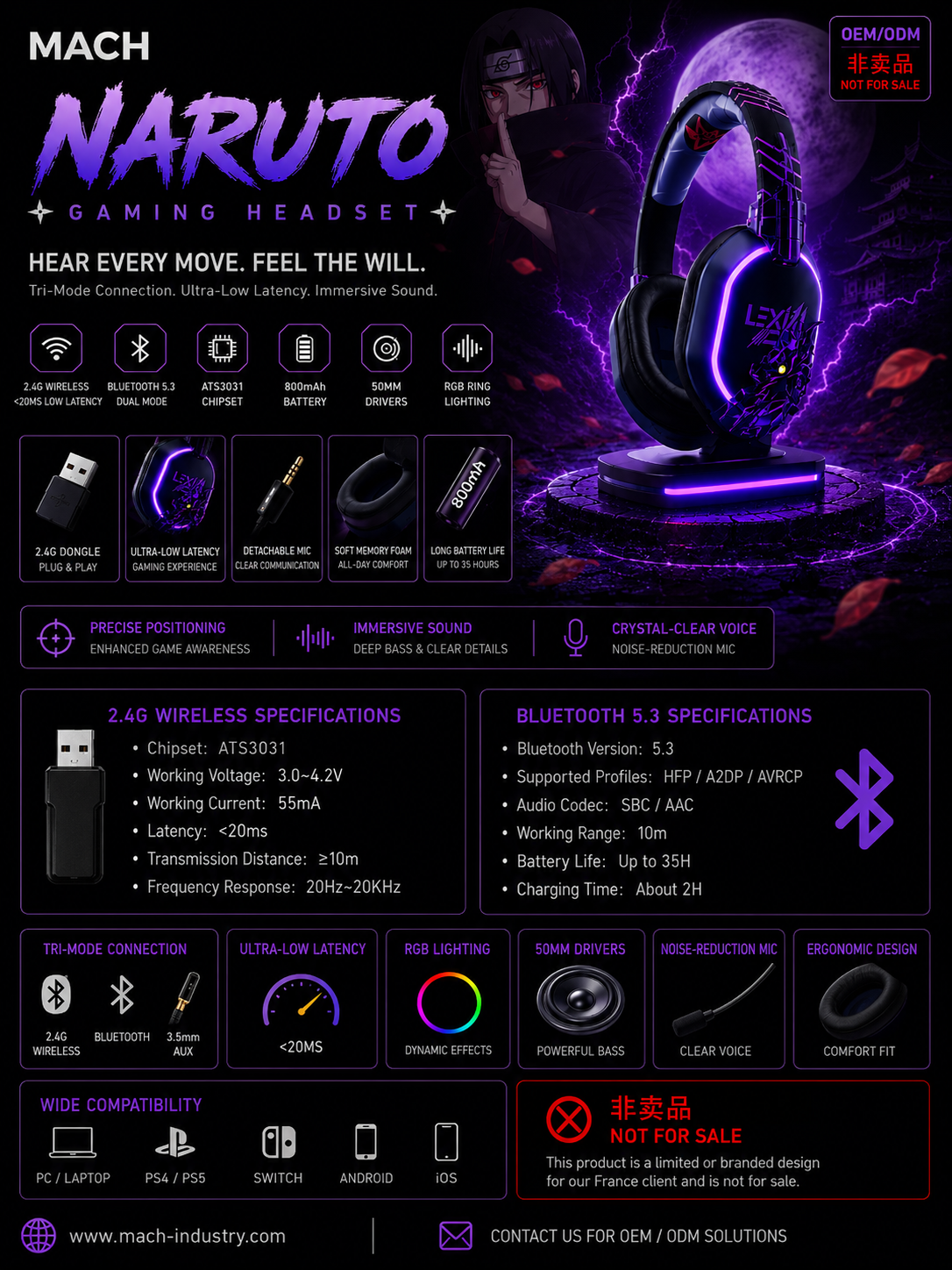
Brands should use replaceable decorative headset parts only after defining who replaces them, how they attach, which product functions they must avoid, and how every visual edition will be controlled in production. A modular decoration can help one headset platform support different co-branded identities, but it also introduces tolerance, retention, wear, acoustic, SKU, packaging and approval requirements.
This is a practical procurement question for gaming brands, IP collaboration teams, distributors and private-label buyers. A decorative ear-cup element may appear simple in a render, yet the final part must remain aligned, secure and visually consistent after assembly and handling. If the part is intended for user replacement, the safety, instructions and cycle requirements are different from a component exchanged only during factory assembly.
The SASUKA co-branded wireless gaming headset provides a relevant product reference. Its confirmed direction combines Bluetooth wireless audio, 3.5mm wired support, RGB lighting, a 50mm driver, an omnidirectional microphone and replaceable decorative-component development. This article uses those verified details to explain a modular co-branded product strategy without copying the product page or the separate SASUKE case study.
Product Overview: SASUKA as a Collaborative Headset Platform
SASUKA is a collaborative Bluetooth and 3.5mm gaming headset platform designed to demonstrate custom visual identity, RGB lighting and replaceable decorative-component possibilities.
The confirmed connection architecture is Bluetooth wireless plus 3.5mm wired audio. No 2.4GHz mode, wireless latency figure, Bluetooth version, battery capacity or chipset is published for this product, so those details should not be inferred in a sourcing brief or marketplace listing.
Its acoustic component is the YX50G-182 50mm driver, specified at 32 ohms plus or minus 15 percent, 118 plus or minus 3dB SPL at 1kHz and an effective bandwidth from F0 to 20kHz. Rated input power is 20mW and maximum input power is 25mW.
The microphone is a confirmed 6050SCR omnidirectional component with -42 plus or minus 2dB sensitivity, 2.2-kilohm impedance and 58dB signal-to-noise ratio. The product direction also includes microphone mute, volume controls and RGB lighting.
For collaborative development, the platform can be evaluated for custom artwork, logo application, product color and CMF, ear-cup decorative components, RGB direction, packaging, manuals and Bluetooth naming or firmware requirements subject to engineering review. It is presented as an OEM/ODM capability showcase rather than a standard retail offer.
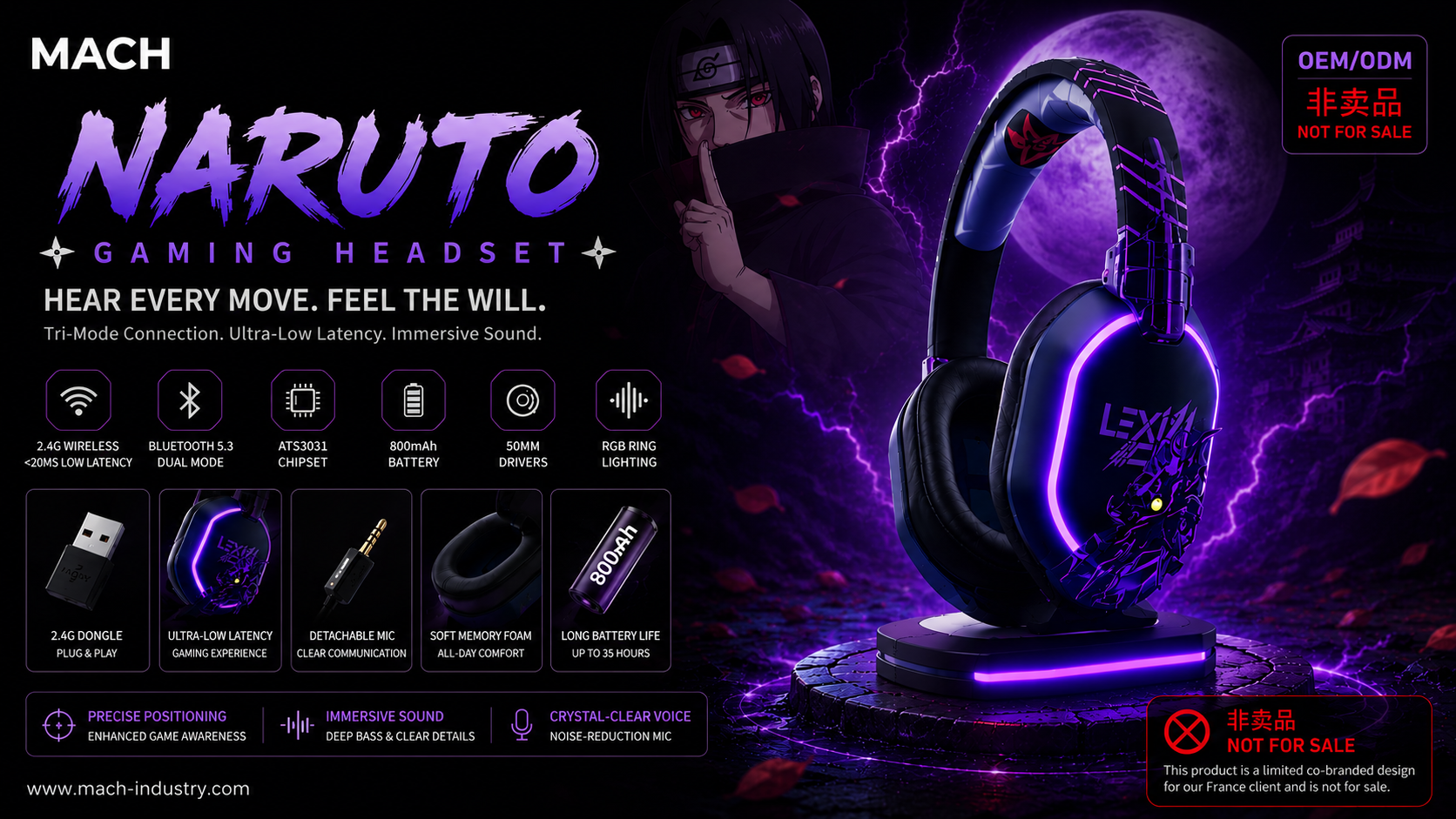
The Buyer Problem: Visual Variety Without Product Confusion
The buyer challenge is to create meaningful visual editions on one technical platform without allowing decorative variations to cause fit problems, mixed SKUs, incorrect artwork or inconsistent quality.
Co-branded programs often need more visual differentiation than a logo print. A brand may want multiple characters, campaign editions, regional artwork or channel-specific sets. Repeating full headset development for each visual direction can create unnecessary coordination, while treating every idea as a simple sticker can weaken the intended product identity.
A replaceable decorative zone offers a middle path. The base headset keeps its confirmed electronics, acoustics, controls and primary structure, while a defined component carries part of the visual story. This can make edition planning more structured, but only if the interface and ownership rules are established before artwork is finalized.
The term replaceable needs clarification. It may mean the factory can fit different decorative components to create separate finished SKUs. It may mean service personnel can replace a damaged piece. It may also mean the end user can exchange parts. SASUKA confirms a replaceable decorative direction but does not publish the intended replacement party or mechanism. Buyers must define that scope during engineering review.
Commercial control matters as much as mechanics. Each artwork edition needs a product code, approved asset, package, manual, label and component count. Warehouses and assembly lines must distinguish visually similar parts. After-sales teams need to know whether replacement pieces are interchangeable, separately supplied or restricted by collaboration rights.
| Replacement model | Typical purpose | Buyer controls |
|---|---|---|
| Factory-configured | Create different finished visual SKUs on one platform | BOM, artwork revision, line-side identification and package matching |
| Service-replaceable | Repair or restore a finished product | Spare-part identity, tools, instructions and warranty policy |
| User-replaceable | Allow customers to exchange visual parts | Tool-free safety, cycle life, misuse protection, instructions and separate packaging |
One Headset Platform, Multiple Visual Editions: Evaluating Replaceable Decorative Components
A replaceable decoration strategy works when the base headset, decorative interface, artwork system, SKU structure and approval workflow are designed together.
First, freeze the base platform boundary. Identify which housing, acoustic volume, driver, microphone, controls, RGB elements, ports and structural joints remain common. The decorative component should have a defined keep-out zone around sound openings, buttons, hinges, cushions, antennas where applicable, compliance labels and assembly screws. This prevents artwork ambition from silently changing core product behavior.
Second, select the replacement model before designing the part. A factory-configured component can use assembly methods unsuitable for users. A user-changeable part needs intuitive orientation, controlled removal force, repeated-cycle durability and protection against incorrect installation. A service replacement may accept tools but requires documented procedures and spare availability. The commercial promise must match the engineered mechanism.
Third, establish the artwork template from the real part geometry. Curved surfaces, draft, edge radii, clips and texture affect visible proportions. Each visual edition should use a controlled print or decoration file linked to the component drawing. Important artwork should remain inside a safe area so normal part and process variation does not cut through logos, faces or copyright text.
Fourth, define CMF by edition. Color targets depend on substrate, base resin, coating, ink, gloss and texture. RGB lighting can alter perceived color near the ear cup. Buyers should approve production-representative samples under agreed lighting instead of relying only on screen renders. A master limit sample and objective color data can support different inspection decisions.
Fifth, build the SKU and rights matrix. For each edition, list the approved artwork owner, permitted market, effective dates, decorative-part code, headset color, RGB direction, packaging, manual, labels and carton. The matrix should prevent an approved component from being packed with the wrong regional or campaign materials.
Sixth, plan logistics. Decorative parts need protection from scratches, warping and mixed artwork during inbound transport, line feeding and final packing. If the product includes more than one decorative set, package cavities and accessory counts must stop pieces from rubbing or being omitted. Barcode or visual identification should work at component and finished-goods levels.
Seventh, define change control. A new visual edition may not require new electronics, but it still needs artwork, CMF, fit, package and quality approval. A change to the interface, material or attachment method can affect every edition and therefore deserves a broader engineering review.
The result is a controlled product family rather than a collection of unrelated decorations. Buyers gain a repeatable way to evaluate new visual directions while preserving the confirmed headset platform and keeping approval responsibilities visible.
| Decision layer | Required definition | Approval evidence |
|---|---|---|
| Base platform | Common structure, audio, microphone, controls and lighting boundary | Released specification and golden sample |
| Decorative interface | Attachment, orientation, clearances, removal method and replacement owner | Drawing, fit samples and cycle or retention review |
| Visual edition | Artwork, safe area, CMF, copyright and permitted use | Approved physical sample and asset record |
| Commercial SKU | Part code, package, manual, labels, market and effective period | SKU matrix and packaging approval |
| Production control | Incoming identification, line feeding, inspection and traceability | QC plan, limit sample and lot records |

Technical Deep Dive: Attachment, Tolerance and Acoustic Boundaries
Decorative headset parts need a stable attachment interface and tolerance plan that preserves structure, acoustics, controls, radio behavior and user comfort.
The attachment concept determines most downstream testing. Snap features, magnets, screws, slides or other methods each create different requirements for retention, rattle, gap, repeated use and assembly error. SASUKA does not publish a mechanism, so buyers should evaluate options with the supplier rather than assume a user-swappable magnetic design.
Tolerance stack-up affects perceived quality. The decorative part, ear-cup shell and attachment features all vary. Their combined dimensions determine gap, flushness, alignment and removal force. A design that looks perfect in one prototype may bind or loosen at production extremes. Drawings should define datums, critical dimensions and cosmetic limits that inspection can apply.
Acoustic boundaries must remain protected. The confirmed 50mm driver and ear-cup system rely on enclosure geometry, vents, cushion seal and controlled openings. A decorative part should not cover a vent, create an unintended leak, vibrate against the shell or alter the cushion interface. Acoustic checks should compare representative finished editions if material, mass or coverage changes.
RGB adds an optical boundary. Decoration near lighting needs a controlled relationship with light windows, diffusion and opacity. Different colors or coatings can make the same RGB behavior appear inconsistent. The buyer should decide whether the edition changes only a graphic or also changes the intended lighting presentation.
Reliability testing should follow the replacement model. Factory-installed parts need assembly retention, handling, vibration and environmental review. Service parts add removal and refit checks. User-changeable parts require repeated cycles, foreseeable misuse, small-part and pinch considerations, and instructions. Test scope should be agreed for the final design rather than copied from another product.
Quality control connects the engineering decisions to production. Incoming inspection verifies material, artwork and part identity; assembly checks fit and orientation; final inspection uses gap, alignment, surface and function criteria. Traceability should connect the finished SKU to the correct decorative component and artwork revision.
- Define who is allowed to replace the decorative part.
- Select and validate the attachment method for that replacement model.
- Set dimensional datums, gap, flushness and retention criteria.
- Protect vents, controls, hinges, cushions and labels with keep-out zones.
- Review acoustic and RGB behavior on production-representative editions.
- Match reliability testing to factory, service or user replacement.
- Trace every finished SKU to the correct decorative-part revision.

OEM/ODM Development Considerations
A modular co-branded headset program should move through ownership review, platform definition, interface engineering, edition approval, testing and controlled production release.
Buyers should provide artwork ownership or authorization where applicable, visual guidelines, target markets, product positioning, connection requirements, packaging concept, quantity expectations and the intended replacement model. MACH can evaluate those requirements against the SASUKA Bluetooth and 3.5mm platform direction.
Industrial design establishes the decorative zone and interface. CMF development translates artwork and color into production materials and processes. Engineering samples confirm fit, controls, RGB, acoustics and microphone operation. Packaging samples verify protection, edition identity and included parts.
No SASUKA-specific completed certificates are claimed. Certification support is evaluated according to the target market and final configuration. Any Bluetooth naming or firmware requirement is also subject to engineering review.
Before mass production, the parties should approve the base specification, decorative-part drawing, artwork revision, CMF limit sample, SKU matrix, package files, inspection plan and complete golden sample. Changes to the interface, material, artwork or package return to the appropriate approval stage.

Who Is This Product Direction Suitable For?
The SASUKA direction is suitable for B2B buyers who need a Bluetooth-and-wired headset platform with stronger visual-edition potential than basic logo private labeling.
Gaming and gaming-accessory brands can use the direction to evaluate a recognizable headset family built around custom ear-cup decoration, CMF and RGB. IP collaboration companies can explore controlled visual editions after confirming artwork rights and approval requirements.
Private-label teams and Amazon sellers may use the concept when their differentiation strategy depends on a visible product identity rather than only listing copy. Console-accessory brands should confirm the actual 3.5mm and Bluetooth behavior required for their target devices because the product source does not publish broad platform compatibility claims.
Importers and distributors may evaluate separate regional, retail or campaign SKUs, provided artwork permissions, package language and component identification are controlled. The product is less suitable when a buyer needs a confirmed 2.4GHz low-latency route, published battery specification or an off-the-shelf retail item, because those are not established by the SASUKA source.
| Buyer type | Potential use | Key preparation |
|---|---|---|
| Gaming brand | Visual product family or campaign edition | Platform brief, design language and launch roadmap |
| IP collaboration team | Authorized character or brand editions | Rights, assets, approval owners and usage limits |
| Private-label seller | Differentiated Bluetooth-and-wired offer | Channel claims, package plan and quality standard |
| Importer or distributor | Regional or channel-specific SKUs | Market documents, SKU matrix and forecast |
Buyer Checklist
Before requesting a modular co-branded headset quotation, buyers should prepare the visual, technical, commercial and approval requirements that define each edition.
- Confirm artwork rights and approval responsibilities.
- Define target buyers, channels, markets and edition roadmap.
- Confirm Bluetooth and 3.5mm connection requirements without adding unverified modes.
- Decide whether decoration is factory-, service- or user-replaceable.
- Provide artwork, logo, CMF and RGB direction for each edition.
- Define decorative-part attachment, safe areas and cosmetic acceptance.
- Specify package contents, spare parts and replacement policy.
- Create unique part codes and finished SKUs for every artwork edition.
- Plan acoustic, microphone, RGB, reliability and packaging validation.
- Identify certification support needed for the final market configuration.
- Approve physical samples, drawings, artwork and QC references.
- Define change control for future editions and component revisions.
Conclusion
Replaceable decorative components can turn one headset platform into a controlled co-branded product family, but only when the interface, artwork, SKU and quality systems are designed together.
SASUKA provides a confirmed reference with Bluetooth and 3.5mm audio, a 50mm driver, an omnidirectional microphone, RGB and collaborative visual development. Its replaceable decorative direction creates a specific sourcing question that goes beyond conventional logo application.
Buyers should define who replaces the part, protect acoustic and functional boundaries, validate production tolerances, and connect every visual edition to its approved artwork, package and inspection evidence. This turns modular decoration from a styling idea into a repeatable product-development method.
Brands can contact MACH industry with their authorized assets, technical brief, replacement objective, target markets and edition plan for an OEM/ODM project evaluation.
Frequently Asked Questions
What is a replaceable decorative component on a gaming headset?
It is a defined visual part that can be exchanged at the factory, by service personnel or by the user, depending on the engineered attachment and approved replacement model.
Does SASUKA confirm user-swappable ear-cup decorations?
No. The product confirms a replaceable decorative-component direction but does not publish who replaces it or the attachment method. Those details require engineering review.
Which wireless connection does the SASUKA headset support?
The confirmed wireless route is Bluetooth. The product also supports 3.5mm wired audio. No 2.4GHz mode is published for SASUKA.
What driver does the SASUKA platform use?
The formal specification identifies a YX50G-182 50mm driver with 32Ω ±15% impedance and 118 ±3dB SPL sensitivity at 1kHz.
Can one headset platform support several co-branded editions?
Potentially yes, if the common platform and decorative interface are controlled and each edition has approved artwork, CMF, part codes, packaging, SKU identity and inspection references.
What must be tested for a user-replaceable decorative part?
Testing should address orientation, removal and installation force, cycle life, misuse, retention, small-part or pinch considerations, acoustics, RGB interaction and instructions.
Can decorative ear-cup parts affect gaming headset sound?
They can if they cover vents, change enclosure leakage, vibrate against the shell or alter the cushion interface. The decorative zone should protect acoustic boundaries and be validated on representative samples.
What customization can MACH evaluate for a SASUKA-style project?
MACH can evaluate authorized artwork, logos, product color and CMF, ear-cup decorative components, RGB direction, packaging, manuals and engineering-reviewed Bluetooth naming or firmware requirements.
What should buyers prepare before requesting a quotation?
Prepare artwork authorization, edition plan, target markets, Bluetooth and wired requirements, replacement model, CMF direction, packaging, quantities, certification needs and approval contacts.
Are completed SASUKA certifications already available?
No SASUKA-specific certification files are claimed. Certification support is evaluated according to the target market and final product configuration.
Related Resources
Need OEM/ODM gaming audio solutions?
Contact MACH Industry to discuss your gaming headset, gaming earbuds, or private-label audio project.
Contact MACH Industry