Home > Resources > OEM Knowledge
How to Control Multi-Color Gaming Headset Packaging Across Markets
A procurement guide to controlling color SKUs, retail boxes, barcodes, SSCC labels, destination warnings and master-carton pack-out for private-label gaming headset programs.
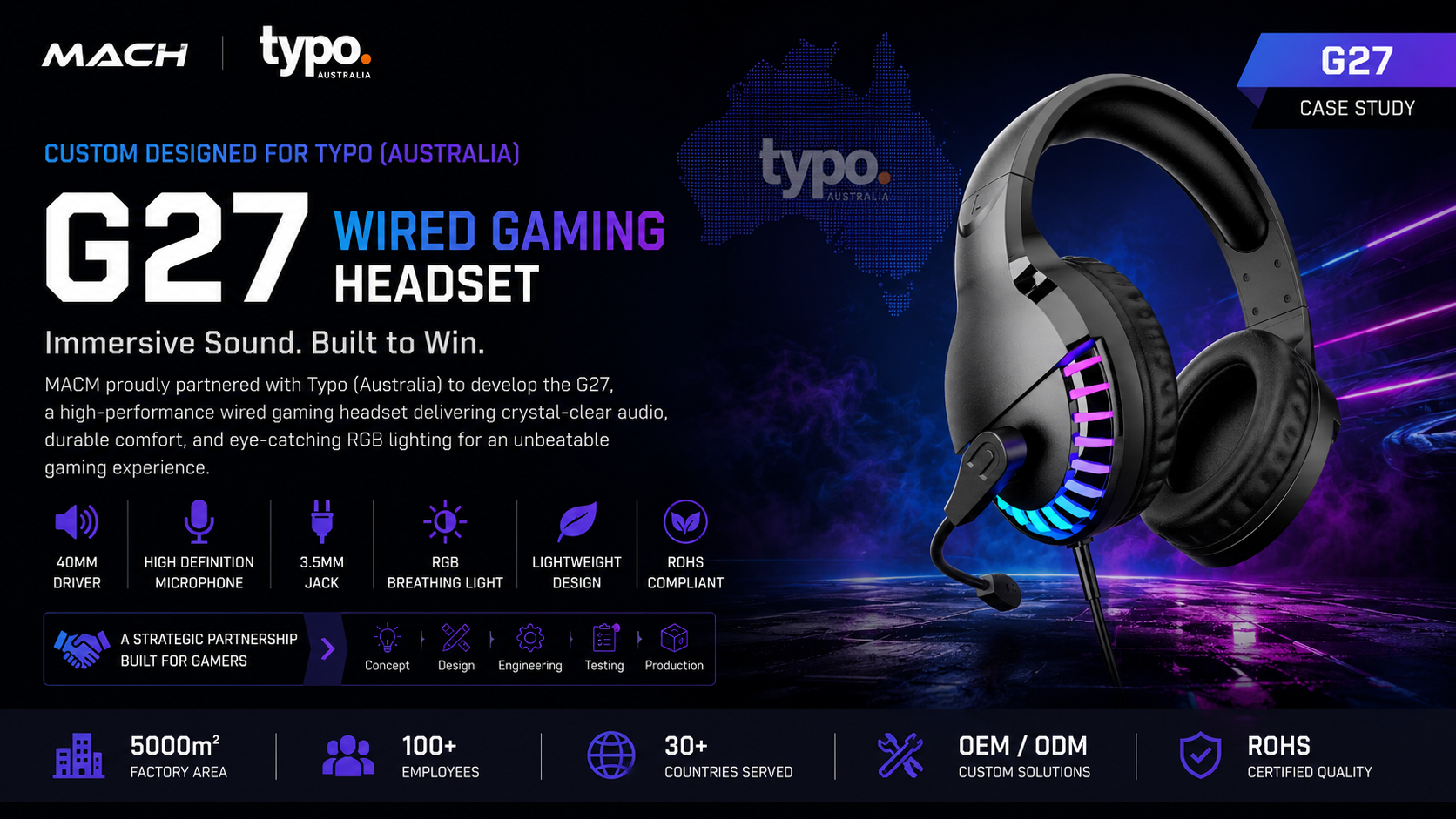
Importers should control a multi-color gaming headset program with one SKU-to-packaging-to-destination matrix. Each sellable color needs an approved product identity, retail box, barcode, manual, label set, accessories, carton mark and shipping rule. The matrix should also identify which files are shared and which change by market. Without that control, a factory can manufacture the correct headset but apply the wrong box, barcode or destination label.
The G27 Australia OEM project is a practical reference. It included black, dusty lilac and denim blue versions, separate retail packaging, manuals, PP bags, tissue protection, barcode and SSCC requirements, destination-specific warnings and a defined master-carton pack. MACH industry coordinated the packaging and label files with trial production, QC and shipment preparation.
This article uses the G27 Australia OEM project as a practical reference. Product specifications and customization scope depend on the selected platform and final buyer requirements.
Key Takeaways for Importers and Distributors
A multi-color private-label program is controlled successfully when every physical product, printed file, logistics label and destination rule can be traced to one approved SKU record.
- Give every sellable color a unique, stable SKU identity before artwork approval.
- Map the product color, box, barcode, manual, labels and carton requirements in one control matrix.
- Separate shared files from color-specific and destination-specific files.
- Use revision numbers and named approvers for artwork, labels and pack-out instructions.
- Validate the complete retail pack and master carton during trial production.
- Reconcile unit quantities, color mix and logistics labels before shipment release.
Why Packaging Control Becomes Harder With Every SKU
Adding a color does more than add a cosmetic option; it can multiply product codes, artwork, barcodes, images, labels, inventory records and packing decisions.
A private-label gaming headset may share one core platform across several colors, but retailers and logistics systems usually treat those colors as different sellable items. A black product in a dusty lilac box is not a minor cosmetic error. It creates incorrect inventory, customer returns, channel disputes and unreliable sales data.
The complexity increases when one importer serves several destinations. A shared headset platform may require different warnings, importer details, language files, barcode assignments or carton instructions. The buyer needs to state these rules. A supplier should not guess whether one label is universal or market-specific.
The G27 project makes this problem concrete because the confirmed scope included three color versions and destination-specific packaging and labeling requirements. The lesson is broader than G27: product, retail and logistics identities must remain synchronized from artwork release to shipment.
G27 Australia OEM Project Context
G27 was an OEM wired RGB gaming headset program for an Australian importer and distributor, prepared for Australia and other export-market requirements.
The source case confirms black, dusty lilac and denim blue product versions with corresponding retail packaging. It also confirms logo customization, manuals, PP bags, tissue-paper protection, barcode and carton label placement, SSCC labels and warning stickers for selected destination shipments.
The project included industrial-design, structure and PCB support, tooling follow-up, color and logo execution, packaging-file coordination, trial production, QC and mass-production preparation. CE and RoHS test support was included in the scope, but compliance support should not be interpreted as automatic certification of every future configuration.
The confirmed master-carton reference was 52 x 41 x 46 cm with 20 units arranged 5 x 2 x 2. Those figures describe the published G27 project. Another headset, package structure or accessory set requires its own carton engineering and validation.
The source does not publish a connection interface, driver diameter, microphone measurements, material grade, product weight, MOQ, price or delivery time. This article therefore focuses on the packaging and logistics facts that are actually confirmed.

Building a SKU-to-Packaging-to-Destination Control Matrix
The control matrix should give every SKU one row that links its physical color, printed files, machine-readable codes, pack-out and destination instructions.
Begin with the commercial SKU list. Assign one stable identifier to each sellable combination of product color, package language and destination where those differences affect inventory. For the G27 reference, black, dusty lilac and denim blue are distinct physical variants. If a color uses more than one destination package, the buyer may need another level of item or packaging identity.
Add product-level references. Each row should identify the approved color standard or sample, logo artwork and position, visible accessories and any externally distinguishable feature. The matrix should not rely on informal names alone. A term such as blue can be interpreted differently; the approved G27 description is denim blue, supported by a physical or file reference.
Connect the retail packaging. Record the color-box artwork number and revision, product image, color name, feature panel, manual language, insert, PP bag, tissue protection and accessory layout. The G27 case confirms separate boxes and protection materials, but the exact dielines and files belong to the project record rather than this public guide.
Connect the retail identity. Barcode data should be supplied or approved by the brand or responsible channel owner and mapped to the exact SKU. The human-readable product name and color should agree with the encoded identity. A scan check should be part of artwork proofing and final pack-out.
Connect destination rules. Record market, importer or responsible-party text where required, language, warning label, compliance marks supported by the final evidence and any channel-specific placement. The G27 project used warning stickers for selected shipments, illustrating why one universal label assumption can be risky.
Connect the shipping unit. Define master-carton artwork, quantity, arrangement, color mix policy, carton barcode or SSCC, destination mark and protection requirements. For G27, the published reference is 20 units in a 5 x 2 x 2 arrangement within a 52 x 41 x 46 cm master carton. A mixed-color carton, if requested in another project, would need a separate reconciliation rule.
Finally, add governance columns: file owner, revision, approval date, approver, sample status and change note. When artwork changes, the matrix should show which SKUs and cartons require reapproval. A folder containing several final files is not a control system if nobody knows which final version applies.
During trial production, use the matrix as a physical audit tool. Select each color and destination combination, scan the barcode, verify the product and box color, inspect labels and accessories, then build at least the agreed representative carton pack. Record discrepancies before mass packaging starts.
| Matrix field | Question it answers | Evidence to approve | Error it prevents |
|---|---|---|---|
| SKU and color | Which physical variant is this? | Approved color sample and item code | Wrong-color product or inventory identity |
| Retail artwork | Which box and manual belong to it? | Revision-controlled print files and pack-out sample | Correct product in the wrong box |
| Barcode | Which sellable item does the code identify? | Brand-approved data and scan result | Inventory and retailer receiving mismatch |
| Destination labels | Which market rules apply? | Approved text, placement and destination map | Wrong warnings or market information |
| Master carton | How is the shipment unit identified and packed? | Carton specification, SSCC rule and packing sample | Quantity, routing and warehouse errors |

How to Separate Shared Files From SKU-Specific Files
A packaging file should be shared only when its content is accurate for every SKU and destination that will use it.
Shared files can reduce duplication, but a shared designation must be intentional. A manual may be common if operation, accessories, languages and model references are identical. A warranty card may be common if the responsible party and terms apply across destinations. The buyer should record that decision rather than let the printer reuse files by convenience.
Color-specific files include product images, color names, swatches and barcodes where each color is a separate retail item. G27 used three named color versions and separate color boxes, making the connection between physical product and retail artwork explicit.
Destination-specific files can include language, warnings, importer information, compliance statements and logistics labels. If one sticker adapts a shared box for a market, control its text, revision, placement and applicable SKU set with the same rigor as the main artwork.

Barcode, SSCC and Destination Label Governance
Machine-readable and destination labels require controlled data ownership because the supplier cannot safely infer a brand's retail or logistics identity.
A retail barcode identifies a sellable item, while an SSCC identifies a logistics unit. They serve different levels of the supply chain. The buyer or authorized channel partner should provide or approve the data, and the supplier should verify print quality, placement and the relationship to the packed contents.
For every code, record the source, file revision, human-readable text, size, quiet zone and required scan check according to the buyer's system. This guide does not prescribe a barcode standard because the G27 case only confirms barcode and SSCC requirements, not the owner's implementation rules.
Destination labels need an application map. A selected-market warning should not appear on every shipment by default. Packing instructions should connect purchase order, destination, SKU, carton and label revision, with a final check before release.

Master Carton and Pack-Out Control
The master-carton specification controls protection, quantity, warehouse identity and shipping execution as one approved logistics unit.
The G27 case confirms a 52 x 41 x 46 cm master carton containing 20 units in a 5 x 2 x 2 arrangement. That reference gives the importer a defined quantity and packing geometry for the approved project.
Before production, buyers should review the final retail-box dimensions, orientation, internal protection, carton material requirement, unit count and arrangement. A change to the retail box, manual, accessory or protective material can affect carton fit and should trigger a packing review.
Carton marks and SSCC data must correspond to the actual contents. Where colors ship separately, the carton should identify the correct SKU and quantity. Where a buyer requests mixed colors, the mix ratio and reconciliation method need an explicit instruction and inspection record.
Compliance Information and Market-Specific Claims
Compliance marks and statements belong on packaging only when they apply to the final product configuration and destination and are supported by the appropriate project evidence.
The G27 project included CE and RoHS test support for its multi-market program. That fact shows compliance coordination was part of development, not that every possible G27 color, package or future private-label version automatically carries the same status.
Product changes, materials, electronics, labels or target markets may affect the compliance plan. Buyers should identify applicable requirements early, then make sure the exact model and configuration references agree across reports, declarations, manuals, labels and packaging.
Packaging should avoid broad certified language when the project only confirms coordination or testing support. MACH industry can discuss documentation and test planning according to the target market and final approved product.
Common Packaging Development Risks
Most packaging errors come from identity, revision or handoff failures rather than from graphic design alone.
These are general sourcing risks, not claims that each problem occurred in the G27 project. The G27 case instead demonstrates that color boxes, labels, warnings, carton control and QC were treated as explicit project requirements.
| Risk | General cause | Buyer control |
|---|---|---|
| Wrong color in box | Product and artwork identities are not linked | SKU matrix, color staging and pack-out verification |
| Wrong barcode | Code files are copied or renamed without ownership | Approved barcode register and scan check |
| Wrong destination warning | One label is treated as universal | Destination map and purchase-order packing instruction |
| Outdated artwork | Several files are called final | Revision control, approver and release date |
| Incorrect carton quantity | Retail or accessory change is not reflected | Final carton sample and quantity reconciliation |
| Unsupported compliance claim | Packaging is printed before evidence is aligned | Compliance review for the final model and market |
Buyer Checklist Before RFQ and Artwork Release
A packaging-ready RFQ should define the sellable SKU structure, destination rules, file ownership and approval process before printing begins.
- List every product color, sellable SKU and destination package combination.
- Provide approved color names, physical references and product images.
- Define whether retail boxes and manuals are shared or SKU-specific.
- Provide logo artwork, placement and color requirements.
- Assign retail barcodes to the correct product and color identity.
- Define SSCC ownership, data exchange, placement and validation requirements.
- Map destination warnings, languages and responsible-party information.
- Confirm the accessory list, PP bag, tissue or other protection and pack-out sequence.
- Approve the retail-box dieline, artwork revision and complete pack-out sample.
- Define master-carton dimensions, quantity, arrangement and color-mix policy.
- Confirm carton marks, logistics labels and shipment-destination instructions.
- Align compliance marks and claims with final product evidence.
- Name the file owner and approver for every packaging layer.
- Validate each SKU and representative destination during trial production.

How MACH Supports Packaging Execution
MACH industry can coordinate product identity, color execution, packaging files, labels, trial production, QC and shipment packing for an approved OEM headset program.
The G27 case confirms support for three product colors, separate retail packaging, manuals, barcode and carton labels, SSCC labels, selected-market warnings, protective materials and master-carton control. MACH also coordinated tooling, trial production, QC and compliance-test support.
For a new project, the buyer remains responsible for supplying or approving brand artwork, commercial codes and market-specific information. MACH can review manufacturability, organize file and pack-out confirmation and coordinate production according to the final RFQ.
Commercial terms, MOQ, testing, packaging structure and schedule depend on the selected platform, number of variants, destination requirements and approved scope.
Conclusion
Multi-color gaming headset packaging is reliable when every physical variant, retail identity, logistics label and destination rule is linked in one controlled matrix.
The G27 Australia OEM project shows the practical value of this approach through three named colors, separate packaging, barcode and SSCC requirements, destination warnings and a defined 20-unit master-carton pack.
Importers can use the matrix and checklist in this guide to prepare a clearer RFQ, reduce artwork ambiguity and make trial-production approval more meaningful. Brands planning a similar private-label headset program can review the G27 case and contact MACH industry for an OEM/ODM packaging and production evaluation.
Share your color plan, SKU list, target markets, packaging files, barcode and label requirements, carton plan and compliance needs for an OEM/ODM evaluation.
Contact MACH IndustryFrequently Asked Questions
What is a multi-color gaming headset packaging control matrix?
It is a document that maps each sellable color SKU to its product color, retail box, artwork revision, barcode, manual, labels, accessories, carton mark and destination requirements.
Why does each gaming headset color need separate SKU control?
Different colors may require different product codes, images, barcodes, boxes and carton labels. Separate control prevents a correct headset from being packed into the wrong retail or shipping identity.
Should every color use a different retail box?
It depends on the brand's packaging strategy. The G27 project used separate color boxes for black, dusty lilac and denim blue. Other projects may use shared packaging with controlled color identification if approved.
What is an SSCC label in an OEM packaging project?
An SSCC identifies a logistics unit in a supply-chain system. Buyers should provide the required data format, ownership, placement and validation rules for their channel rather than asking the factory to infer them.
How should destination-specific warning labels be controlled?
Link each warning label to a destination, SKU, approved file revision and placement instruction. The packing order should prevent the label from being applied to shipments for the wrong market.
What should buyers verify in a master-carton specification?
Verify carton dimensions, unit quantity, packing arrangement, product protection, carton marks, barcodes or SSCC labels, gross and net weight requirements where applicable, and destination instructions.
Can CE and RoHS requirements be handled through packaging alone?
No. Packaging labels and documents must correspond to the final product and applicable evidence. Certification and test coordination depends on the target market and approved product configuration.
How can importers reduce mixed-color packing errors?
Use unique SKU identities, approved color references, separate staging, barcode checks, pack-out samples, carton reconciliation and final inspection records for every color and destination.
What MOQ applies to a multi-color private-label headset project?
MOQ depends on the platform, number of colors, branding, packaging, accessories and production plan. It should be confirmed in a project-specific quotation.
What files should a buyer send before packaging development starts?
Send the SKU list, color references, logos, box artwork, manuals, barcode data, labels, destination rules, carton marks, accessory list, compliance requirements and approval contacts.
Related Resources
Need OEM/ODM gaming audio solutions?
Contact MACH Industry to discuss your gaming headset, gaming earbuds, or private-label audio project.
Contact MACH Industry