Home > Resources > OEM Knowledge
How to Position Headphones With Speaker Mode for Travel and Outdoor Retail
A B2B planning guide to evaluating N900-style headphones with speaker mode, FM and TF card playback for travel, outdoor leisure and private-label retail.
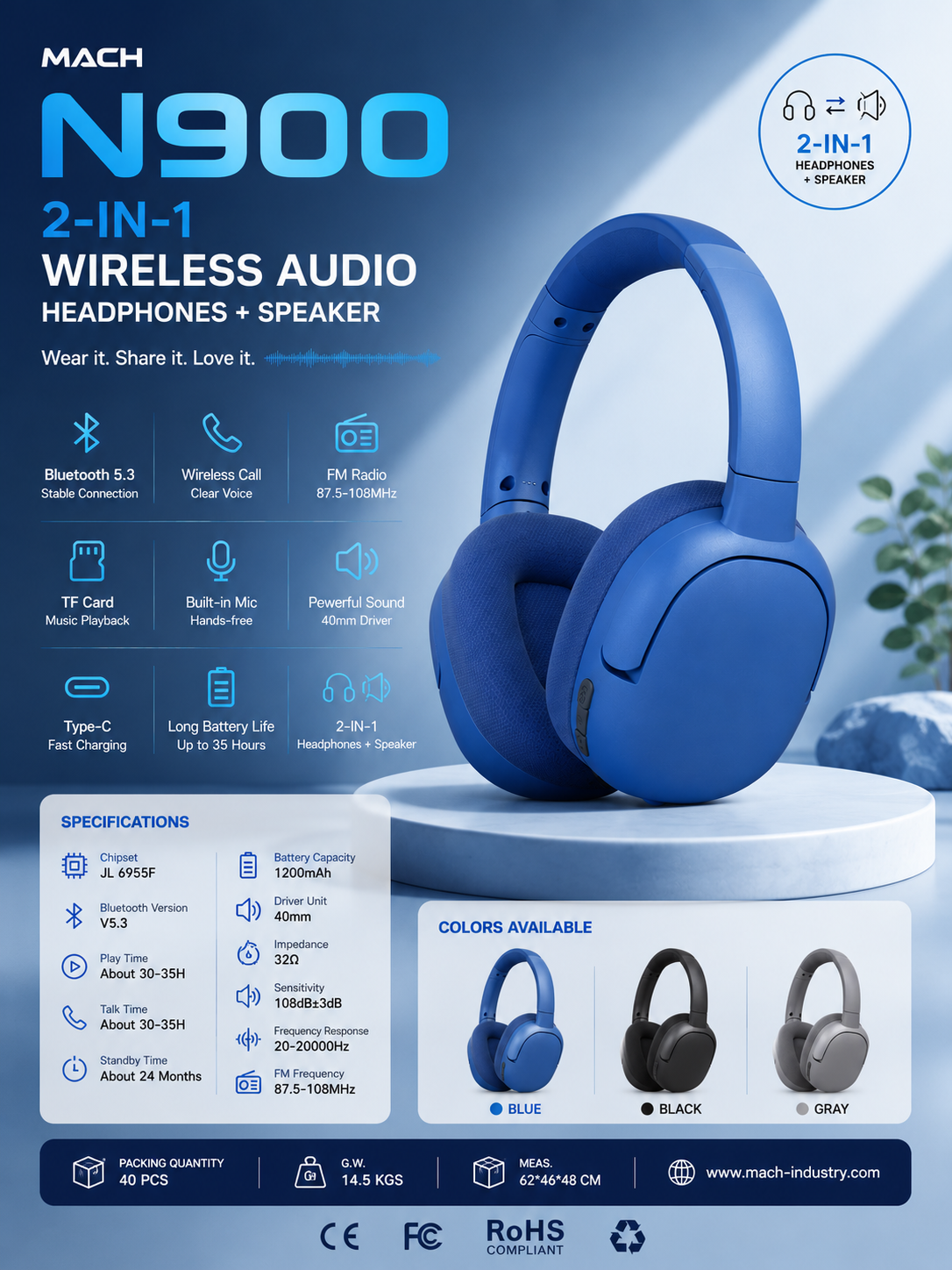
A Bluetooth headphones-and-speaker 2-in-1 product can fit travel and outdoor retail when the brand can define a credible journey from private listening to nearby shared playback. It is not simply a standard headphone with more feature icons. The buyer must connect each mode, source and control to a real use case, then prove that story through samples, packaging and instructions.
For travel-oriented and leisure channels, headphone mode supports personal listening while speaker mode creates a shared-use option at a destination. FM radio and TF card playback can add value where users want audio without continuous mobile data or a constant phone connection. These benefits are market dependent, so the correct decision is based on channel needs rather than maximum feature count.
The MACH N900 is a confirmed Bluetooth 5.3 platform built around the JL6955F chipset, headphone and external-speaker modes, FM radio, TF card playback and Bluetooth calling. Its published 1200mAh battery and approximately 30-35 hours of music or call time provide a useful case for explaining how brands should plan this product type without duplicating the N900 product page.
Key Takeaways for Product Planners
For travel and outdoor retail, a 2-in-1 audio platform works best when the private-to-shared listening journey is clear, offline features match the market and every claim is validated on the final sample.
- Choose one primary channel and one leading use case before selecting feature priorities.
- Define where personal headphone listening ends and nearby speaker playback begins.
- Treat FM and TF card playback as market-specific benefits, not universal requirements.
- Verify published battery claims under conditions relevant to the intended mode and source.
- Make the package and manual explain switching, source selection and charging clearly.
- Confirm branding, CMF, accessories, compliance and MOQ through a project-specific RFQ.
What Is a Headphones-and-Speaker 2-in-1 Product?
It is an over-ear Bluetooth audio platform that supports private headphone listening and external speaker playback within one product.
In headphone mode, audio is intended for the wearer. In speaker mode, the product provides open playback for nearby listeners. The value is a change in listening context: a traveler can listen privately while moving and use shared playback later at home, at accommodation or during casual leisure time.
This format differs from an ordinary Bluetooth headphone because the buyer must plan two user messages, two listening expectations and a mode-selection journey. The N900 data confirms both modes, but buyers should verify the exact switching behavior during sample review rather than assume a mechanical or software method.
The platform is best understood as multifunction consumer audio. It should not be positioned as professional gaming equipment, studio monitoring or an ANC travel product because those capabilities are not confirmed for N900. Accurate definition helps distributors and end users understand what the product is designed to do.
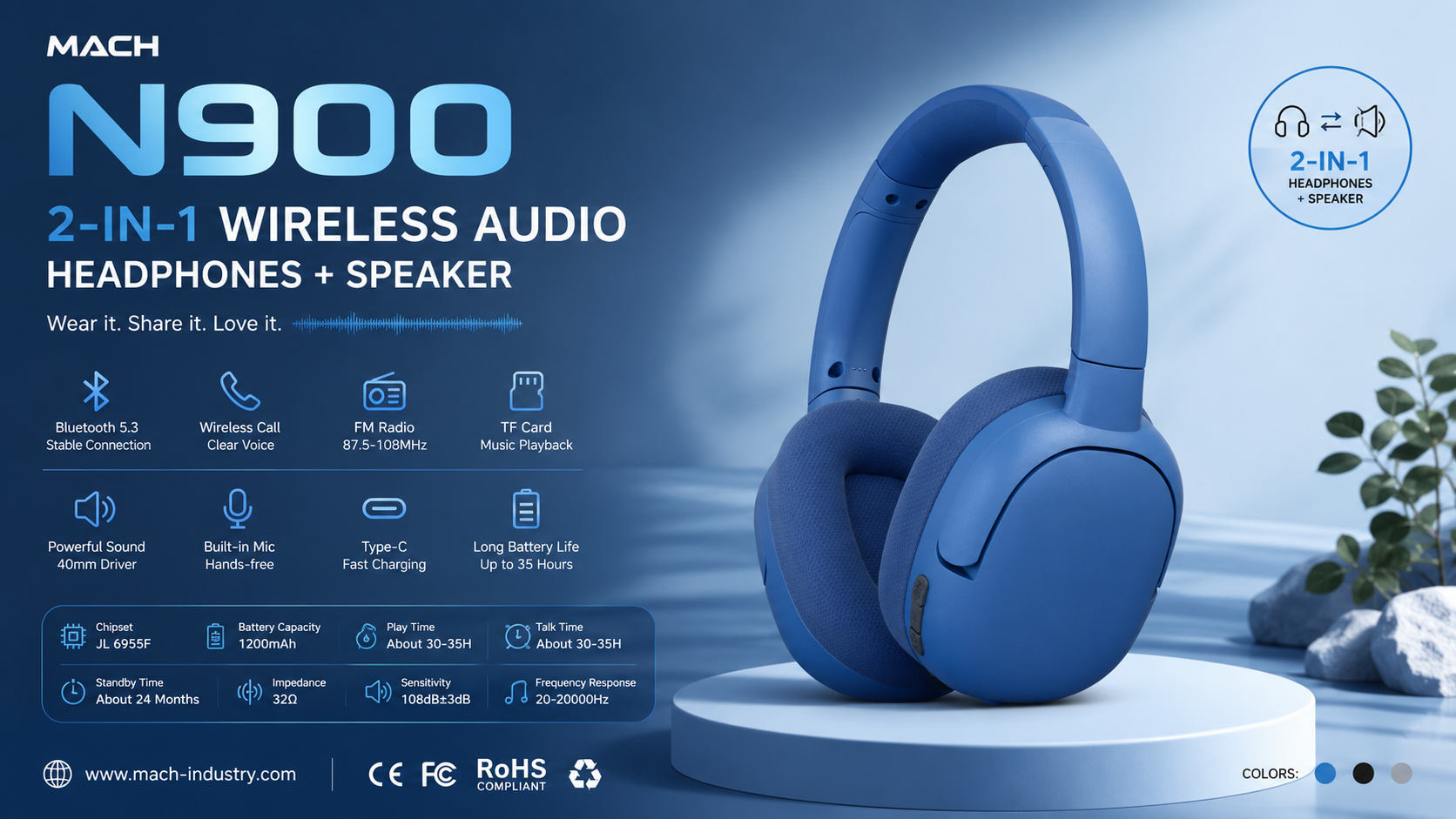
Why Travel and Outdoor Retail Need a Clear Use-Case Story
Travel and outdoor channels reward versatility only when customers can understand when, where and why each function is useful.
A coherent travel story begins with personal listening in transit and moves to shared playback at the destination. Home and outdoor-leisure scenarios can extend that story, but the product should not imply the output or environmental protection of a dedicated outdoor speaker unless separately confirmed.
Retail buyers should decide whether convenience, offline playback or the private-to-shared transition is the main proposition. Trying to lead simultaneously with Bluetooth, FM, TF card, calls, long usage and speaker mode can make the package difficult to scan. One primary message and a structured set of supporting functions usually create clearer merchandising.
For e-commerce, images should demonstrate the two modes and label confirmed sources. For physical retail, the package front should communicate the 2-in-1 concept quickly, while the side or back panel can explain FM, TF card, Bluetooth calling and charging. Manuals and listing copy must use the same terminology.
Outdoor leisure should be described conservatively. N900 supports shared speaker playback as a use scenario, but the available data does not confirm waterproofing, dust protection or a dedicated rugged design. Buyers should avoid adding such implications through lifestyle images or copy.
N900 Product Platform Overview
N900 is a Bluetooth 5.3 over-ear headphones-and-speaker 2-in-1 platform intended for private-label consumer-audio programs.
The confirmed platform uses the JL6955F chipset and provides Bluetooth stereo playback, Bluetooth calling with a built-in microphone, external speaker playback, FM radio from 87.5-108MHz, TF card playback and Type-C USB charging.
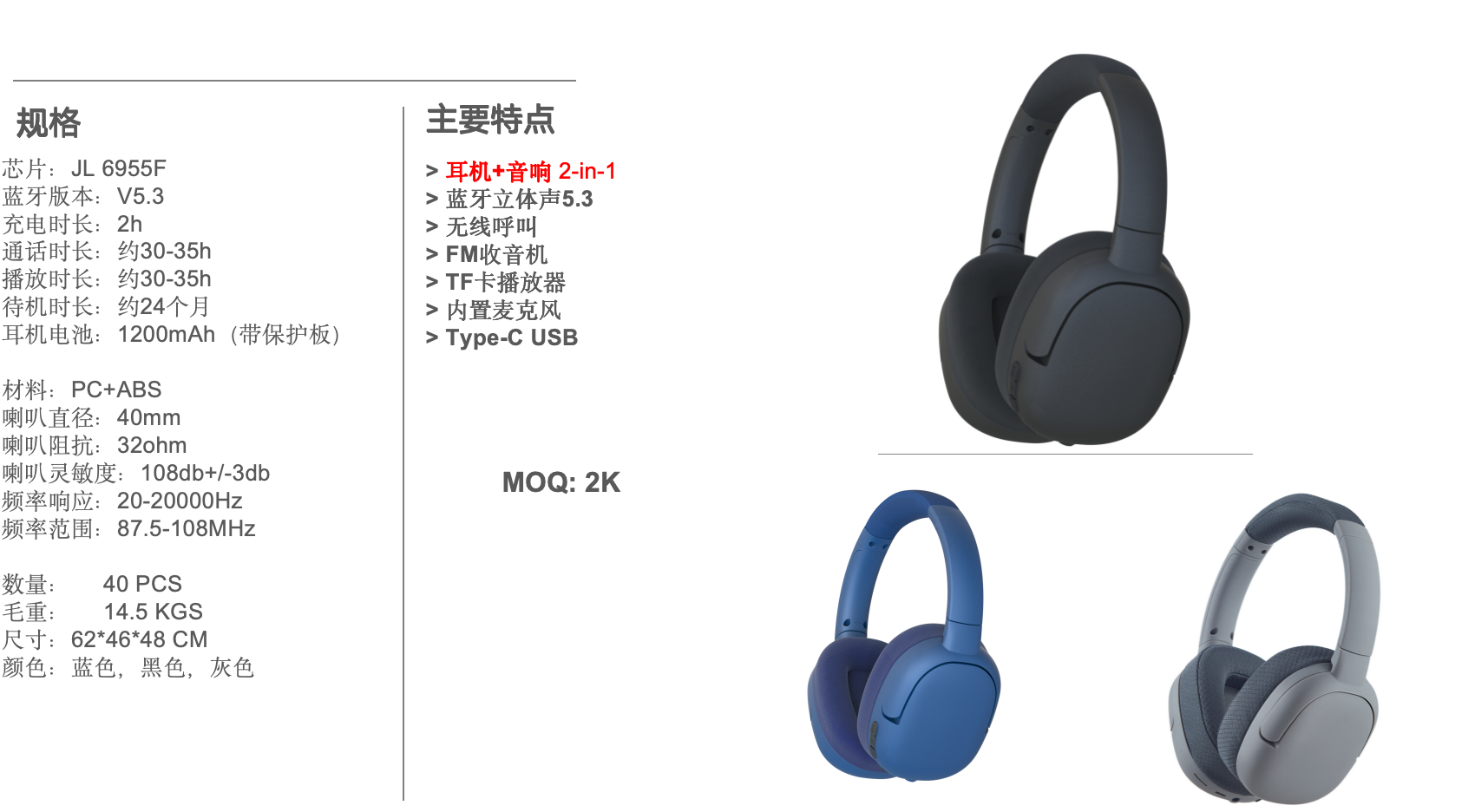
Published hardware information includes a 40mm driver, 32-ohm impedance, 108dB plus or minus 3dB sensitivity, 20Hz-20kHz frequency response, PC and ABS construction, and a 1200mAh battery with a protection board. The specification lists approximately two hours charging time, approximately 30-35 hours music playback, approximately 30-35 hours call time and approximately 24 months standby time.
These are product-platform specifications, not a substitute for sample validation. Runtime can depend on volume, listening mode, source, calls and test method. The product data does not confirm a 3.5mm input, ANC, RGB, 2.4GHz gaming wireless, waterproofing or app control, so this guide does not attribute those functions to N900.
Available colors are listed as black, blue and gray. OEM/ODM discussions can cover logo, color and CMF direction, ear-cushion material, packaging, manuals, accessories, Bluetooth name, voice prompts and selected configuration questions subject to engineering review.
Headphone Mode vs Speaker Mode Across the User Journey
The two modes should be mapped to different stages of the customer journey rather than presented as interchangeable outputs.
| Planning area | Headphone mode | Speaker mode | Buyer decision |
|---|---|---|---|
| Typical moment | Private listening during travel or personal time | Nearby shared playback at home or leisure destination | Define the leading journey on the package |
| User expectation | Comfort, personal clarity and left-right consistency | Clear open playback for the intended nearby setting | Approve each mode separately |
| Social context | Individual use | Small-group or shared use | Avoid implying a dedicated large speaker |
| Runtime claim | Depends on level, source and usage | Depends on level, source and usage | Document the test condition behind retail copy |
| Support content | Wearing, pairing and calls | Switching, placement and volume | Use consistent terms across listing and manual |
Commercial Value of Bluetooth, FM and TF Card Playback
Bluetooth, FM and TF card playback serve different source habits, so their value depends on the target market and channel rather than the number of functions alone.
Bluetooth 5.3 supports the main wireless music and calling experience. Buyers should test pairing, reconnection, device naming, call controls, button mapping and voice prompts with representative phones and tablets. The Bluetooth version is confirmed, but this article makes no unsupported range or latency claim.
FM radio can matter in markets where local radio remains part of daily or travel listening. N900 confirms 87.5-108MHz, but reception depends on location and operating conditions. Sampling should cover tuning, station navigation, instructions and realistic reception in the intended market.
TF card playback can support offline music without continuous mobile data or a connected phone. That may be useful for travel, leisure or users with stored audio libraries. Card capacity, supported file formats, folder behavior and control sequence are not specified in the public data and should be confirmed if they affect the retail promise.
Bluetooth calling adds everyday utility through the built-in microphone. It should be presented as daily communication rather than a professional broadcast or gaming-microphone claim. Buyers should include call connection, microphone behavior and return-to-playback logic in sample testing.
The commercial decision is not whether every function is technically available. It is whether each active function deserves package space, manual content, quality-control steps and customer-support attention in the destination channel.
How to Evaluate a Headphones-Speaker 2-in-1 Platform Before Private-Label Sampling
Before ordering samples, the buyer should turn the channel concept into a written configuration, validation matrix and retail-content brief.
Start with positioning. Define the target country, channel, expected price direction, primary customer and leading use case. A travel-accessory buyer may prioritize personal comfort, battery information and compact communication. An outdoor-leisure program may place more emphasis on shared playback and offline sources. These are planning priorities, not claims that one sample automatically satisfies every scenario.
Next, freeze the required function set. Confirm whether FM and TF card playback are essential, secondary or unnecessary for the market. State Bluetooth naming and voice-prompt languages, required call behavior, charging accessories and any desired function configuration. Features that are only under discussion must not appear as standard features in packaging before engineering confirmation.
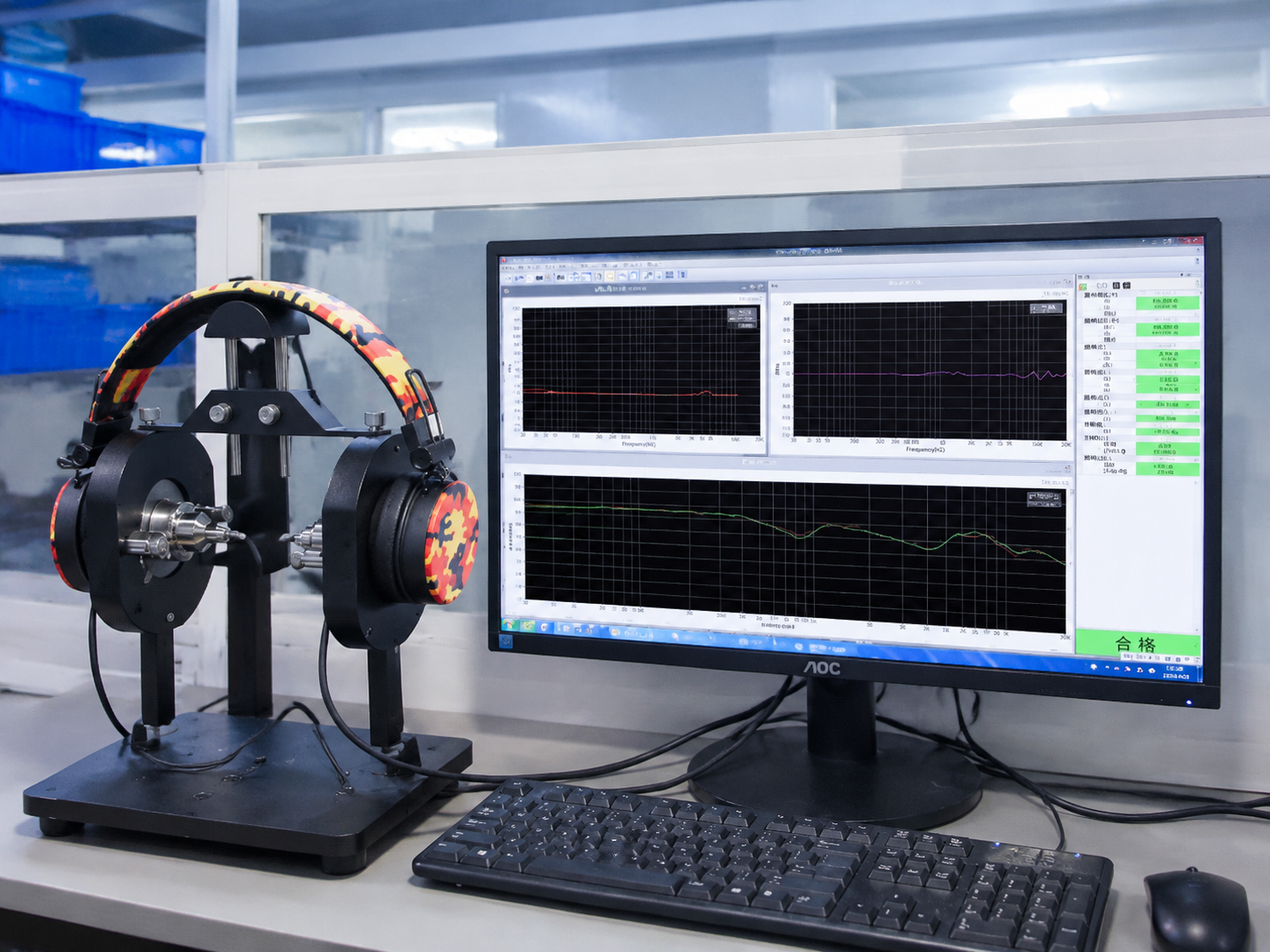
Create separate acceptance criteria for headphone and speaker modes. For headphone use, review comfort, fit, tonal balance, speech clarity, channel consistency and useful listening levels. For speaker use, review nearby clarity, unwanted vibration, housing resonance, orientation and mode transition. Do not use one listening approval for both outputs.
Battery information requires a defined test context. N900 publishes a 1200mAh battery, approximately 30-35 hours of music or call time, approximately two hours charging and approximately 24 months standby. Before using these figures in retail claims, confirm the applicable sample configuration and understand the conditions behind the approved values, especially if mode, volume or source changes.
Convert the retail story into packaging requirements before sampling. Provide logo files, color and CMF references, required package languages, barcode and regulatory fields, accessory list and manual structure. The 2-in-1 message should appear consistently in the product name, diagrams, source icons and operating instructions.
Finally, build a decision gate. A sample should not advance because its feature list looks complete. It should advance only when the intended customer journey, key functions, controls, two playback modes, cosmetics, packaging direction and unresolved compliance questions have documented owners and acceptance notes.
- Target market, channel, price direction and buyer persona
- Leading travel, home or outdoor-leisure use case
- Required headphone, speaker, Bluetooth, FM, TF and call functions
- Headphone-mode and speaker-mode acceptance criteria
- Runtime and charging claim validation conditions
- Button map, prompts, Bluetooth name and mode terminology
- Logo, available color or project CMF direction and cushion review
- Packaging language, manual, labels and accessory set
- Certification plan for the final market and configuration
- Forecast quantity, MOQ review and project-based schedule
Retail Positioning and Channel Fit
N900 is most relevant to channels that can explain multifunction consumer audio and value both personal and shared listening.
Consumer-electronics retail and distributor portfolios can use the platform to add a visibly differentiated product beside conventional Bluetooth headphones. E-commerce can demonstrate the transition between modes through a short sequence of accurate product images and concise benefit copy.
Travel accessories and gift-oriented audio programs may value the combination of private listening, shared playback and offline sources. Outdoor leisure can be a use context for casual shared audio, but waterproof, rugged or high-output claims should not be added because they are not confirmed.
The platform may be a poor fit for a minimalist product line, a professional gaming brief or a category strategy centered on ANC. A brand should choose N900 because its channel can explain and support the multifunction journey, not simply because it has more functions than a basic headphone.
| Stronger fit | Potentially weaker fit |
|---|---|
| Multifunction consumer-electronics retail | Minimalist single-function headphone range |
| Travel, home and casual leisure positioning | Professional esports or studio-monitoring brief |
| Markets that value FM or offline TF playback | Channels focused only on ANC features |
| Private-label programs able to explain two modes | Listings unable to support mode education |
OEM/ODM Customization Considerations
N900 private-label discussions can cover branding, color and CMF, cushions, packaging, documentation, accessories and selected interface details within the confirmed platform scope.
MACH industry can review logo placement, black, blue or gray starting colors, project CMF direction, surface finish and ear-cushion material. Final appearance and comfort should be approved on representative samples rather than from color references alone.
Packaging can be adapted for language, barcode, channel requirements, user manual, warranty material and accessory presentation. Bluetooth device name and voice-prompt customization can also be discussed. Any change to switching behavior, battery, FM or TF configuration remains subject to engineering evaluation.
Certification coordination should follow the target market and final configuration. It is support planning, not a claim that every certification has already been issued for this exact private-label version. MOQ depends on configuration, branding, packaging and accessories, while lead time is confirmed after RFQ and sample-scope review.
Common Product-Planning Mistakes
Most avoidable risk comes from unclear positioning, unverified options and incomplete instructions rather than from the number of confirmed functions.
- Promoting every function equally instead of choosing a leading retail message.
- Failing to define separate headphone and speaker use scenarios.
- Assuming travel or outdoor use implies waterproofing or rugged construction.
- Publishing battery figures without documenting the relevant operating conditions.
- Skipping FM reception and TF card workflow checks for the destination market.
- Approving Bluetooth playback without testing calls, controls and mode transitions.
- Showing optional or proposed functions as standard before engineering confirmation.
- Leaving the 2-in-1 operating logic unclear in packaging and manuals.

What Buyers Should Confirm Before Requesting an N900 Sample
A useful N900 sample request gives the supplier enough commercial, functional and packaging context to configure and evaluate the correct version.
This brief allows quotation, MOQ and schedule discussions to reflect the real project rather than a generic product request. It also creates a consistent basis for sample comments and production approval.
- Target country, sales channel and intended customer
- Primary private-listening and shared-playback scenarios
- Required Bluetooth, FM, TF card and calling functions
- Logo artwork, color and CMF direction
- Ear-cushion material or comfort priorities
- Bluetooth name and voice-prompt requirements
- Package language, manual, labels and accessories
- Runtime and sample-test expectations
- Certification requirements for the final configuration
- Forecast quantity and requested project timing

Conclusion
N900 is worth evaluating when a brand has a clear travel, home or outdoor-leisure channel for both private listening and nearby shared playback.
Its confirmed Bluetooth 5.3 and JL6955F platform, FM radio, TF card playback, Bluetooth calling, 40mm driver and 1200mAh battery give product planners a defined foundation. The commercial opportunity comes from connecting those facts to a coherent journey, not from treating feature count as the positioning strategy.
MACH industry can review the target channel, function priorities, logo, color and CMF, cushion direction, package, manual, accessories and sample plan. A structured brief helps buyers decide whether N900 belongs in the range before committing to private-label production.
Frequently Asked Questions
What is a headphones-and-speaker 2-in-1 product?
It is an over-ear Bluetooth audio platform that supports private headphone listening and external speaker playback. N900 combines these two modes in one consumer-audio product.
Who should consider headphones with speaker mode for travel retail?
Brands serving travel, home, casual outdoor, gift or multifunction consumer-electronics channels can evaluate the format when both private and nearby shared listening are relevant to their customers.
Does N900 support Bluetooth 5.3 and wireless calling?
Yes. N900 uses the JL6955F platform with Bluetooth 5.3, Bluetooth stereo playback, a built-in microphone and wireless calling.
Does N900 support FM radio?
Yes. The confirmed N900 specification includes FM radio from 87.5-108MHz. Reception and tuning behavior should be checked in the intended market during sampling.
Can N900 play music from a TF card?
Yes. TF card offline playback is confirmed. Buyers should verify required card capacity, file formats, navigation and control behavior because those details are not specified publicly.
What battery information is published for N900?
N900 lists a 1200mAh battery with protection board, approximately 30-35 hours of music or call time, approximately two hours charging and approximately 24 months standby. Final retail claims should match the approved sample and test conditions.
Can brands customize the N900 logo, colors and packaging?
MACH can discuss logo placement, color and CMF direction, ear-cushion material, retail packaging, manuals and accessories according to the project scope and sample approval.
Can the Bluetooth name and voice prompts be customized?
Bluetooth device naming and voice-prompt customization can be reviewed for N900 private-label projects. Language, prompt list and engineering feasibility should be confirmed before sampling.
What should buyers provide before requesting an N900 sample?
Provide the target market and channel, use cases, required functions, branding and CMF, package and manual languages, accessories, compliance needs, forecast quantity and project timing.
What is the MOQ for a private-label N900 project?
MOQ depends on the selected product configuration, branding, packaging and accessory requirements. MACH confirms the applicable MOQ after reviewing the project brief.
Related Resources
Need OEM/ODM gaming audio solutions?
Contact MACH Industry to discuss your gaming headset, gaming earbuds, or private-label audio project.
Contact MACH Industry