Home > Resources > OEM Knowledge
How to Evaluate a Headphones-and-Speaker 2-in-1 Product for Private-Label Retail
A B2B buyer guide to evaluating headphone mode, speaker mode, Bluetooth, FM, TF card, wired audio, packaging and OEM scope for 2-in-1 retail products.
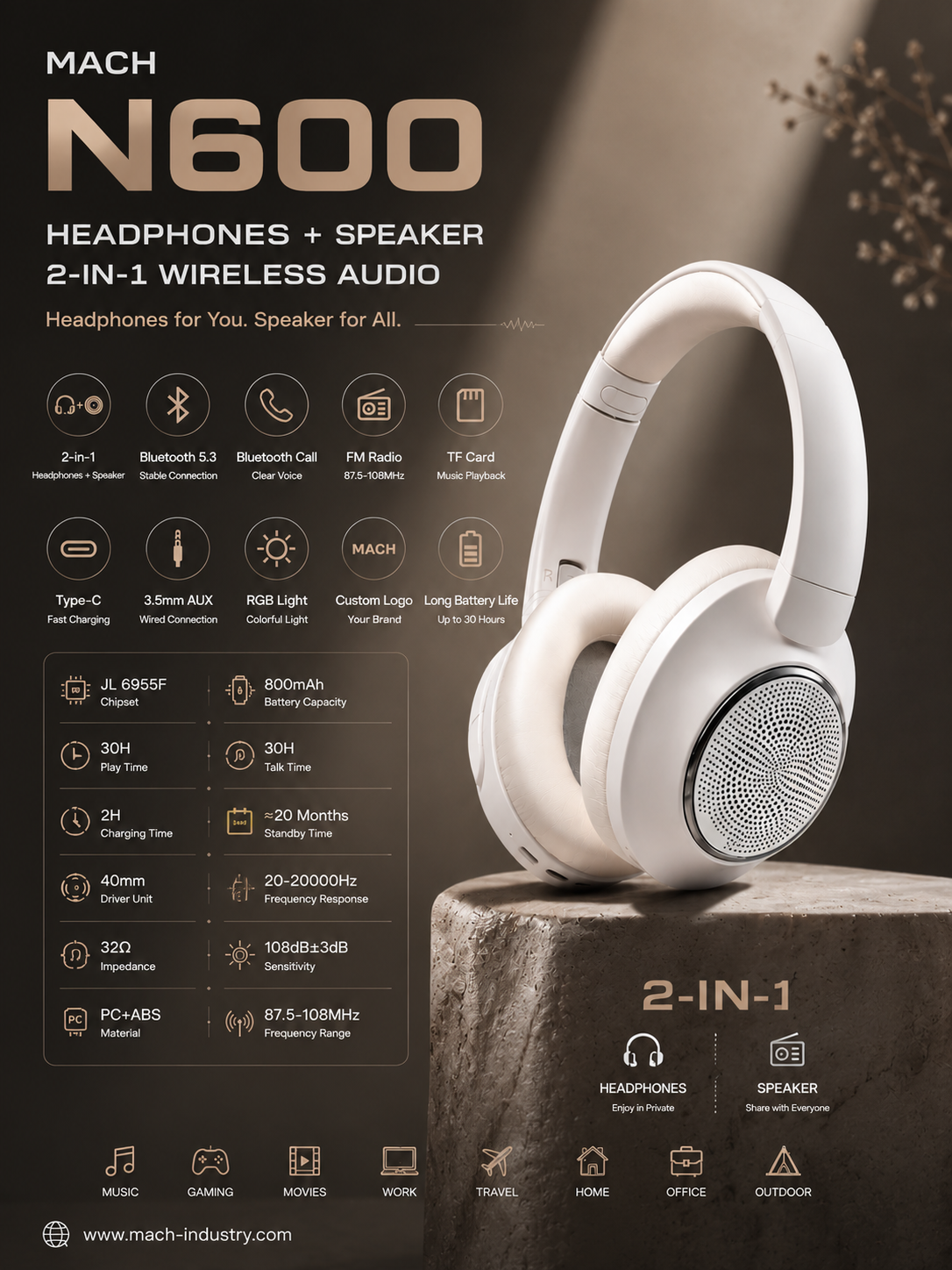
A headphones-and-speaker 2-in-1 product combines private over-ear listening with external shared playback in one consumer-audio platform. Brands consider this format when they need a retail product that is more differentiated than a standard Bluetooth headphone and can serve personal, home, travel or leisure scenarios.
Buyers should evaluate it as two listening systems supported by one control, battery, wireless and packaging architecture. Headphone sound, speaker sound, switching, Bluetooth, FM, TF card, wired input, calls and user instructions each need separate confirmation. More functions create value only when the target market understands and uses them.
MACH N600 is a confirmed Bluetooth 5.3 example using the JL6955F platform. This guide uses its published facts to explain the procurement decision without repeating the product page.
Key Takeaways for Private-Label Buyers
A 2-in-1 audio product succeeds when private and shared listening are both useful, separately validated and easy to explain at retail.
- Define the main customer and whether headphone or speaker use leads the product story.
- Approve headphone and external-speaker acoustics with separate criteria.
- Confirm Bluetooth, FM, TF card, 3.5mm and calling functions individually.
- Evaluate mode switching, controls, prompts and battery indication as one user journey.
- Make package graphics, accessories and manuals explain every included mode clearly.
- Use project-specific samples, MOQ, compliance and lead-time planning.
What Is a Headphones-and-Speaker 2-in-1 Product?
It is an over-ear audio product designed for private headphone listening and external speaker playback, with both experiences integrated into one platform.
Headphone mode directs personal audio to the wearer. Speaker mode supports open playback for nearby listeners. The product format can reduce the need to carry separate personal headphones and a casual speaker, but it should not be evaluated as a normal headphone with one extra feature icon.
The two modes serve different listening distances, acoustic loads and social contexts. Private listening may be suitable for travel, study or individual music use. External playback may suit home, casual outdoor or shared leisure scenarios. The exact switching mechanism should be confirmed on the N600 sample because the published data confirms the two modes but does not define every mechanical or software detail.
N600 also combines several source options. Bluetooth supports wireless playback and calling, FM provides radio reception, TF card supports local offline media, and 3.5mm input provides wired audio. These functions position the product as multifunction consumer audio rather than a single-purpose headset.
Why This Product Format Can Create a Distinct Retail Position
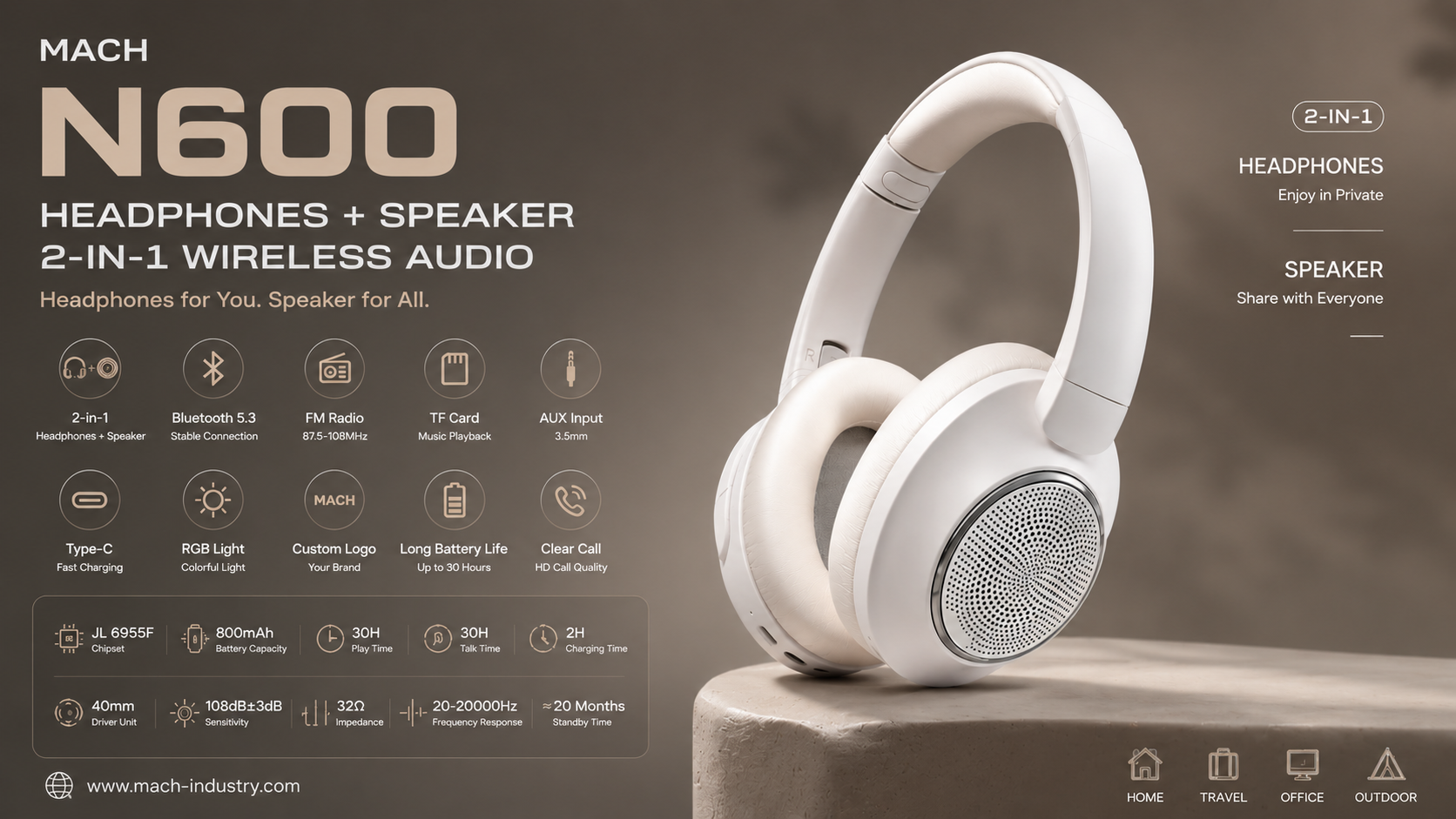
A headphones-speaker combination can give retail brands a visible demonstration story and a practical switch between personal and shared audio use.
In a store or e-commerce listing, the 2-in-1 format is easier to differentiate from a row of standard Bluetooth headphones. Product imagery and packaging can show two listening contexts without relying on unsupported performance claims.
Gift, promotional and lifestyle channels may value a product with several understandable uses. A recipient can use it for private music, casual shared playback, FM, offline TF card content or wired audio. The commercial value is versatility, not evidence of higher sales or a universal fit for every market.
The product can also support home and travel positioning. A user may listen privately during transit and use external playback later in a room or leisure setting. Packaging should avoid implying that the open speaker replaces a dedicated large speaker or that one acoustic standard applies to both modes.
For e-commerce, the listing should explain mode selection, source options, included accessories and intended scenarios near the top of the page. Too many isolated icons can make a differentiated product look confusing instead of useful.
Key Functions Buyers Should Evaluate
N600 buyers should connect every confirmed feature to a target user, operating step, package claim and sample test rather than treating the specification list as the product strategy.
The core N600 direction is headphones plus speaker 2-in-1. Buyers should test both modes, the switch between them, volume behavior and the way controls or prompts communicate the active state.
Bluetooth 5.3 and the JL6955F chipset support the wireless platform direction. Pairing, reconnection, playback, Bluetooth calling, button mapping, name and prompt behavior should be reviewed on intended phones, tablets or computers.
FM radio is confirmed for 87.5-108MHz. Reception, tuning controls, station navigation and any antenna-related operating instruction should be evaluated in the target market. This article does not claim reception quality for every location.
TF card playback supports offline audio without continuous phone connection. Buyers should confirm supported card capacity, file formats, folder behavior and controls if these details matter because they are not published in the current product data.
The 3.5mm input adds a wired-source option. Validate audio behavior, controls and mode transition with the included or specified cable. Bluetooth calling, Type-C charging and battery indication should be checked as separate user journeys.
Headphone Mode vs Speaker Mode
Headphone and speaker modes share the product platform but require different usage, acoustic and retail expectations.
| Evaluation area | Headphone mode | Speaker mode | Buyer check |
|---|---|---|---|
| Primary use | Private personal listening | Shared nearby playback | Confirm the target scenario for each mode |
| Acoustic expectation | Ear-coupled left/right listening | Open-air sound projection | Test both modes separately |
| Battery impact | Configuration and level dependent | Configuration and level dependent | Measure with defined sample conditions |
| Volume expectation | Safe and useful ear-level output | Useful open-air output for intended distance | Do not use one acceptance target |
| Retail message | Personal audio and calls | Social or shared audio | Keep positioning and instructions clear |
Why a 2-in-1 Audio Product Must Be Evaluated as Two Acoustic Systems
Near-ear headphone playback and open-air speaker playback have different acoustic targets, so approving one mode does not approve the other.
Headphone mode places the transducers close to the ears and depends on ear-cup geometry, cushions, fit, seal, left-right matching and the user's listening level. Buyers should evaluate tonal balance, speech and music clarity, channel consistency, distortion at useful levels, leakage and comfort. A loud result is not automatically a good result.
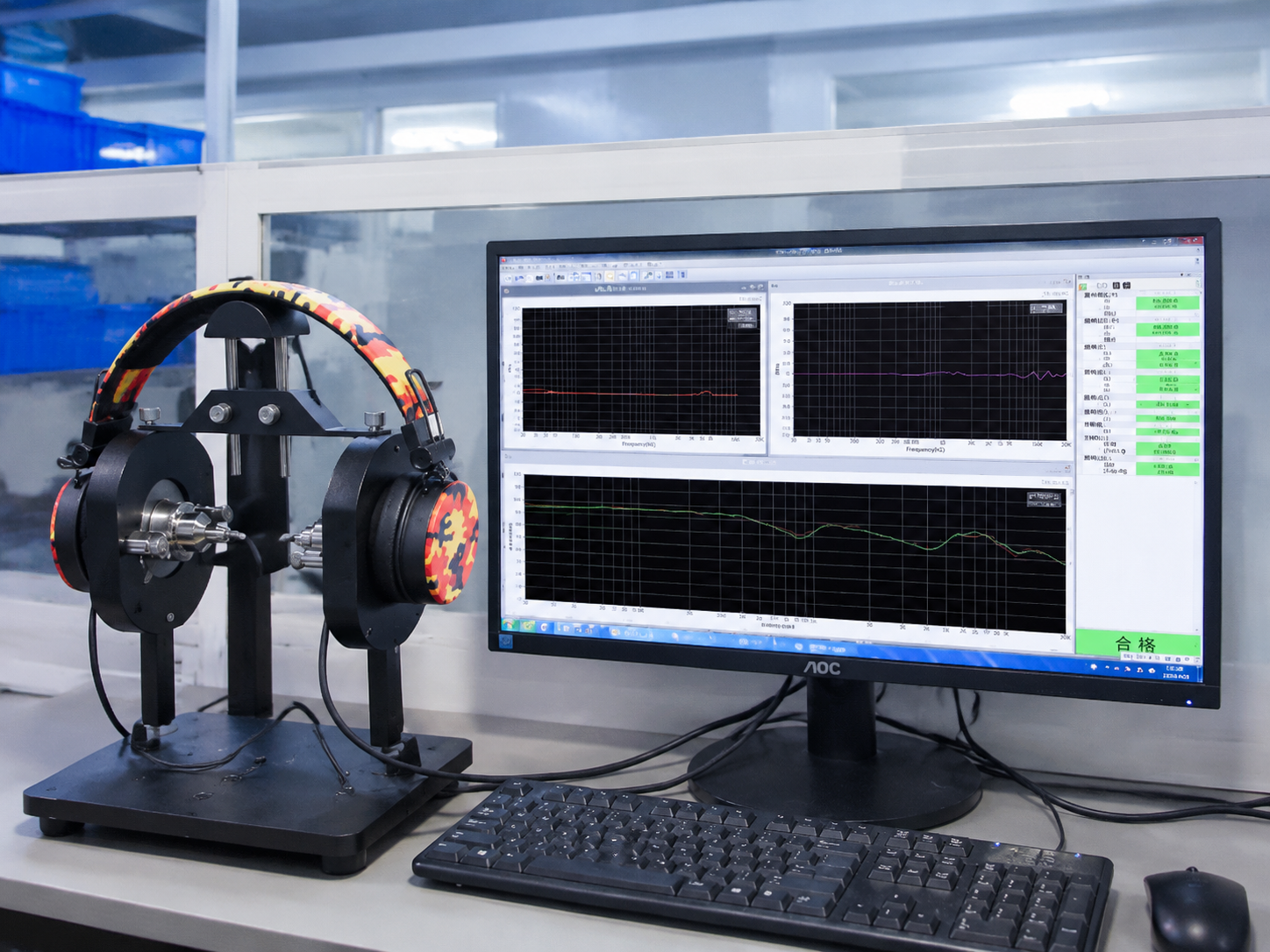
Speaker mode radiates into an open environment. Distance, orientation, surface placement and nearby boundaries can change what the listener hears. Sample review should consider clarity, tonal balance, distortion, rattling, housing resonance and useful output at the intended nearby listening distance.
The same housing must support both jobs. Mechanical parts, cavities, vents, driver mounting and materials may behave differently when sound is directed toward the ear or into the room. A cosmetic or structural change can affect one mode more than the other, so final CMF and assembly samples should be used for approval.
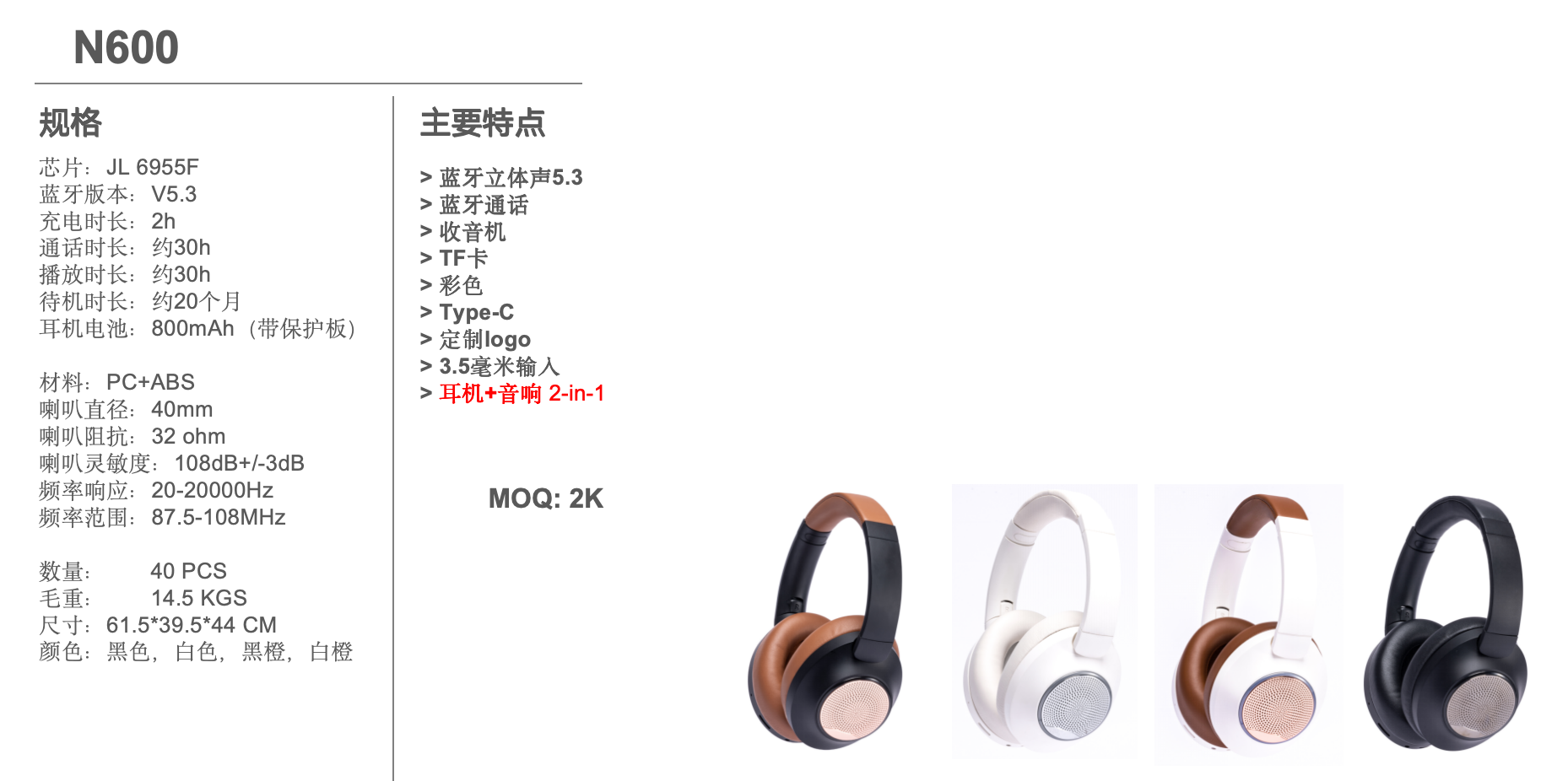
Frequency-response figures do not replace mode-specific listening and measurement. N600 publishes a 40mm driver, 32-ohm impedance, 108dB plus or minus 3dB sensitivity and a 20Hz-20kHz response as platform specifications. These values do not prove the final headphone or speaker tuning in this article.
A practical sample plan uses separate test tracks, levels, listener position and acceptance notes for each mode. Headphone checks should include left-right balance and wearing consistency. Speaker checks should include open-air clarity and unwanted mechanical noise. Mode switching should not create unexpected output or confusing volume changes.
Battery testing should also distinguish the modes. N600 publishes approximately 30 hours of music playback and an 800mAh battery, but the article does not assume identical runtime for every level, source or speaker-use pattern. Buyers should state the mode and operating condition behind any final retail claim.
Production control should preserve both approved experiences. Functional inspection can confirm mode selection and output, while acoustic sampling and cosmetic checks follow agreed limits. A brand should not approve mass production after listening only through the ear cups or only through the external speakers.
| Acoustic layer | Headphone approval | Speaker approval |
|---|---|---|
| Listening geometry | Worn position and cushion seal | Open-air distance and orientation |
| Consistency | Left-right and fit variation | Housing, resonance and assembly variation |
| Useful output | Ear-level comfort and clarity | Nearby projection without excessive distortion |
| Validation result | Approved personal-listening target | Approved shared-playback target |
Is More Functionality Always Better?
More functions are valuable only when they match the target market, remain easy to operate and can be explained clearly in packaging and support content.
Bluetooth may be the main source for smartphone users, while FM or TF card can matter more in channels that value standalone playback. A wired input can support older or non-Bluetooth sources. Speaker mode creates a visible difference from normal headphones, but it also adds another operating state to explain.
The buyer should decide which functions lead the product story and which remain secondary. Every active source or mode affects buttons, prompts, indicators, manuals, customer questions and sample testing. A product with many functions but unclear controls can create avoidable support cost.
Packaging should use a simple hierarchy: define the 2-in-1 format, show private and shared use, then explain Bluetooth, FM, TF and wired sources. The user manual should identify mode order, button behavior, charging, calls and source-specific limitations.
If a target channel does not value FM or TF playback, the buyer can discuss configuration scope rather than automatically promoting every feature. Any change remains subject to engineering and project evaluation.
Retail and Channel Positioning
N600-type products fit channels that value visible multifunctionality, private-to-shared listening and several playback sources more than narrow specialist positioning.
Consumer-electronics retail can demonstrate the two listening modes and source options. Gift and promotional channels can use the multifunction story when the package remains easy to understand. E-commerce listings can show mode and source diagrams that answer setup questions before purchase.
Travel, home, leisure and casual outdoor scenarios align with N600's published applications. Bluetooth calling, FM and TF card playback may also suit markets where users value several independent audio sources.
The platform should not be described as a professional esports headset, studio monitor or ANC travel headphone because those functions are not confirmed for N600. Accurate positioning gives the product more credibility than broad claims.
OEM/ODM Customization Checklist
A private-label N600 project can evaluate branding, approved colors and CMF, cushions, packaging, manuals, accessories, Bluetooth naming and prompts according to the final scope.
Confirmed starting colors include black, white, black-orange and white-orange. Buyers should provide logo artwork, preferred color direction, finish references, cushion material requirements and cosmetic acceptance standards.
Packaging work should define the product image, 2-in-1 explanation, source modes, market language, barcode, included 3.5mm cable or other approved accessories and carton labels. Manuals and voice prompts should use consistent terminology.
Certification coordination can be discussed according to destination market and final configuration. This is not a claim that every certificate is already completed. MOQ remains subject to customization and project configuration, and lead time is project based after RFQ review.
- Target country, channel, price position and main user
- Primary headphone, speaker and playback scenarios
- Required Bluetooth, FM, TF card and wired functions
- Logo location, color and CMF direction
- Ear-cushion material and comfort direction
- Retail package and manual languages
- 3.5mm cable and accessory set
- Bluetooth name and voice-prompt requirements
- Certification target and sample-validation plan
- Forecast quantity and project-based schedule
Sample Evaluation Checklist
Sample approval should cover every playback source, both acoustic modes, the complete control flow and the final package rather than only Bluetooth headphone playback.
- Pair and reconnect Bluetooth on representative devices.
- Review headphone playback, left-right balance and comfort.
- Review external speaker playback, clarity and housing resonance.
- Switch between headphone and speaker modes repeatedly.
- Tune and operate FM within the confirmed 87.5-108MHz range.
- Test the required TF card and audio-file workflow.
- Test 3.5mm input with the final cable and source.
- Check Bluetooth calling and microphone behavior.
- Review buttons, prompts, charging and battery indication.
- Inspect logo, colors, cushions and cosmetic quality.
- Verify packaging, manuals, labels and accessory count.
- Record sample version and unresolved issues before production.

When Is a 2-in-1 Product the Right Choice?
A 2-in-1 platform is appropriate for brands that can clearly sell both personal and shared audio use and whose customers value several playback methods.
It can fit a differentiated multifunction product line, private-to-shared listening proposition, FM and TF-focused market, gift program or lifestyle retail channel. The product is strongest when at least two of these uses matter to the intended buyer.
It may be unsuitable for a minimalist Bluetooth range, a professional competitive-gaming brief, an ANC-focused travel product or a channel that cannot explain multiple modes. A simpler or more specialized platform may serve those priorities better.
The decision should consider retail message, expected support questions, accessory needs, target price, sample validation and compliance scope. Feature count alone should not decide the platform.
| Good fit | Possible poor fit |
|---|---|
| Multifunction consumer-audio retail | Minimalist single-source headphone |
| Private and shared listening proposition | Professional esports-only requirement |
| FM, TF card or wired-backup demand | ANC-only travel strategy |
| Gift, lifestyle or promotional channel | Channel unable to explain multiple modes |
Why Work With an OEM/ODM Manufacturer?
An OEM/ODM partner can help convert a multifunction concept into a controlled configuration, sample plan, package and production specification.
MACH industry can review product configuration, branding, color and CMF, cushions, packaging, manuals, accessories and sample requirements for N600 private-label projects. Function or configuration changes remain subject to engineering evaluation.
Production support can coordinate incoming materials, assembly, acoustic checks, reliability review, final inspection and shipment preparation according to the approved project. No fixed performance result, certification or delivery promise is added by this article.
A complete RFQ should state the target market, required modes, primary retail story, branding, package, accessories, forecast and timing. This gives engineering and sourcing teams a common basis for quotation and sampling.

Conclusion
A headphones-and-speaker 2-in-1 product is a strong private-label option when both listening modes have real customer value and every source, control and retail claim is validated clearly.
N600 provides a confirmed foundation with Bluetooth 5.3, JL6955F, private headphone and shared speaker playback, FM, TF card, 3.5mm input, Bluetooth calling, Type-C charging, a 40mm driver and 800mAh battery.
MACH industry can review your target channel, mode priorities, branding, package, accessories and sample plan. A disciplined two-system evaluation helps the brand launch a differentiated product without allowing multifunctionality to become confusion.
Frequently Asked Questions
What is a headphones-and-speaker 2-in-1 product?
It is an over-ear audio platform that supports private headphone listening and external speaker playback. N600 combines both modes with Bluetooth and other confirmed source options.
Can N600 be used for both private listening and shared playback?
Yes. Headphones plus speaker 2-in-1 is the confirmed N600 product direction. Buyers should verify switching, volume and acoustic behavior on the final sample.
Why should headphone and speaker modes be evaluated separately?
Headphone mode is near-ear and depends on fit, seal and left-right consistency, while speaker mode radiates into open air and requires separate checks for clarity, distortion and housing resonance.
What should buyers test in N600 speaker mode?
Review useful nearby output, clarity, tonal balance, distortion, rattling, resonance, orientation, controls, battery conditions and the transition from headphone mode.
Does N600 support FM radio and TF card playback?
Yes. N600 confirms FM radio from 87.5-108MHz and TF card offline playback. Required card capacity and file formats should be confirmed if they matter to the project.
Does N600 support 3.5mm wired audio and Bluetooth calling?
Yes. The published N600 data confirms 3.5mm wired input and Bluetooth calling in addition to Bluetooth 5.3 wireless playback.
Can the N600 logo, color and packaging be customized?
MACH can evaluate logo, color and CMF, cushion material, retail packaging, manuals, accessories, Bluetooth name and voice prompts according to project scope.
How is MOQ determined for a private-label N600 project?
MOQ is subject to customization requirements and project configuration. Branding, colors, packaging, accessories, function scope and forecast should be reviewed before confirmation.
What certification support can be discussed for N600?
MACH can coordinate certification support according to the destination market and final configuration. Support availability does not mean every certificate is already completed.
What information is needed for an N600 OEM quotation?
Provide target market and channel, required playback modes, branding and colors, package and manual languages, accessories, compliance needs, expected volume and schedule.
Related Resources
Need OEM/ODM gaming audio solutions?
Contact MACH Industry to discuss your gaming headset, gaming earbuds, or private-label audio project.
Contact MACH Industry