Home > Resources > Gaming Headset Guide
How to Choose a Wireless Gaming Headset Solution for Your Brand
A buyer-focused OEM guide to evaluating 2.4GHz, Bluetooth, 7.1 audio, 50mm drivers, ENC microphones, RF engineering, customization, and production readiness.
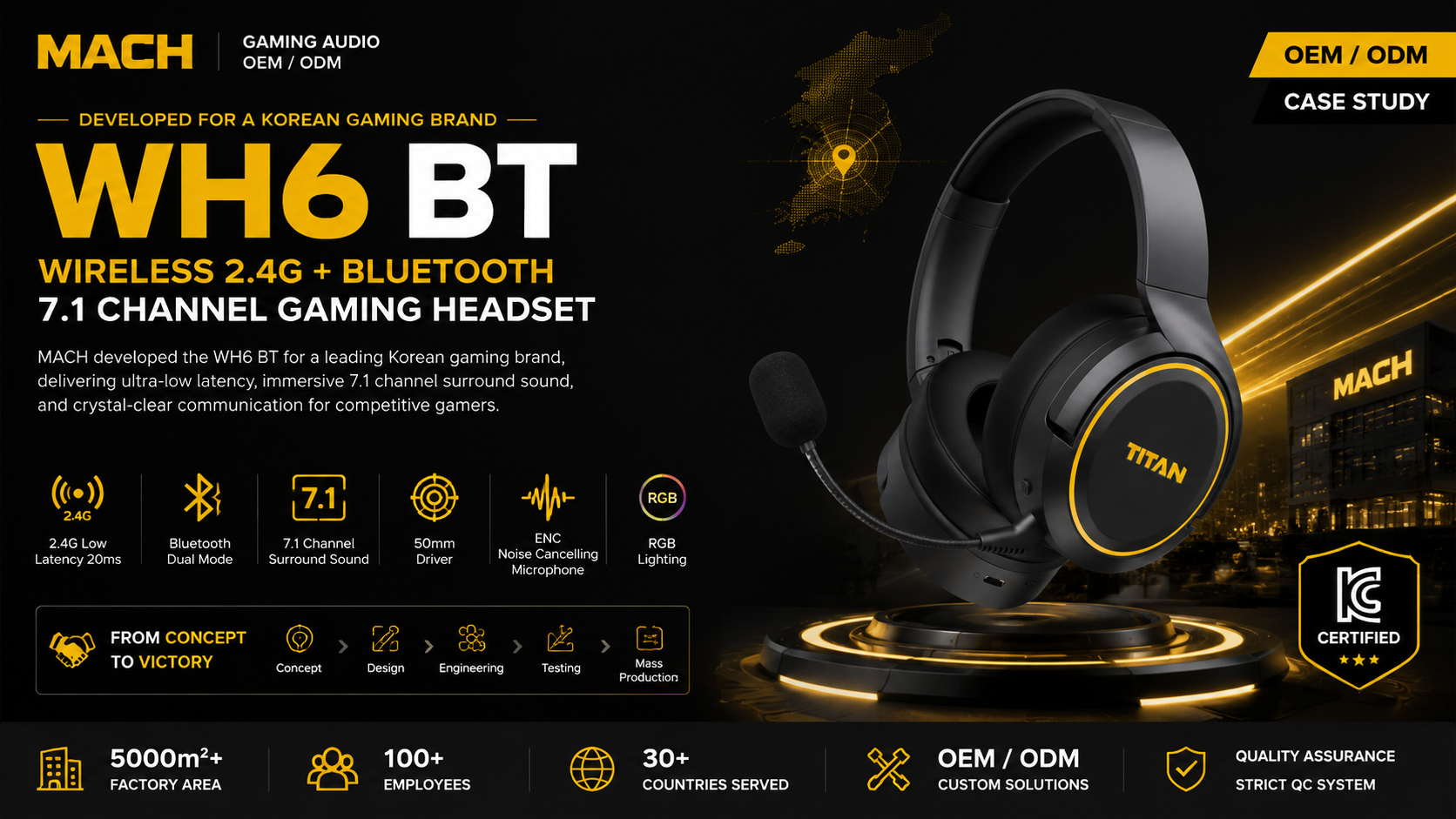
A successful wireless gaming headset requires more than adding a radio module to an existing design. Gaming brands need to balance connection latency, audio performance, microphone quality, device compatibility, firmware behavior, comfort, customization, compliance, and manufacturing capability. A platform that looks complete on a feature list can still create risk if its RF architecture, mechanical layout, user controls, documentation, and production process are not reviewed as one system.
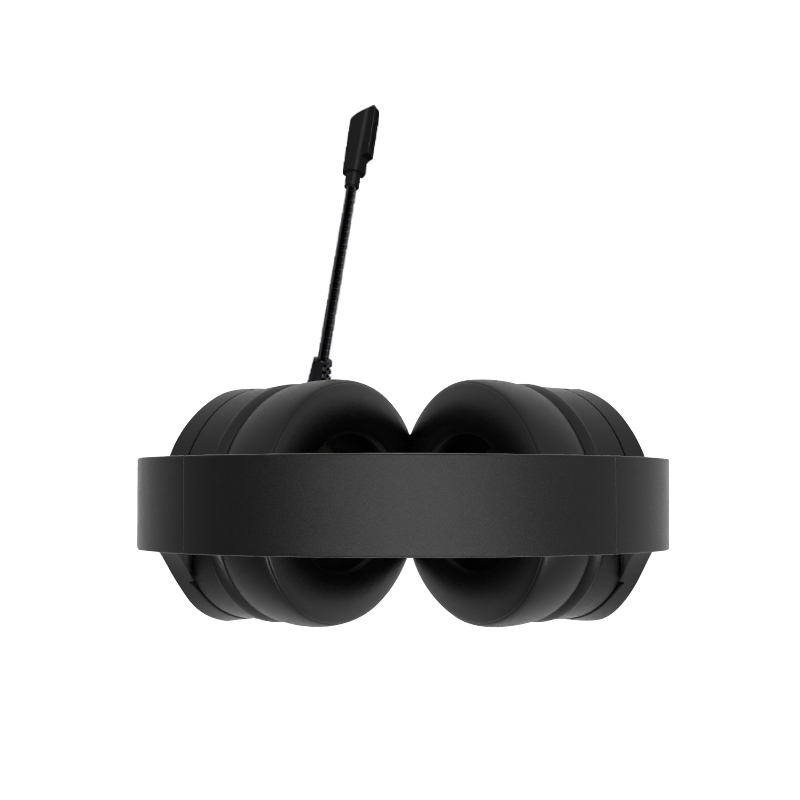
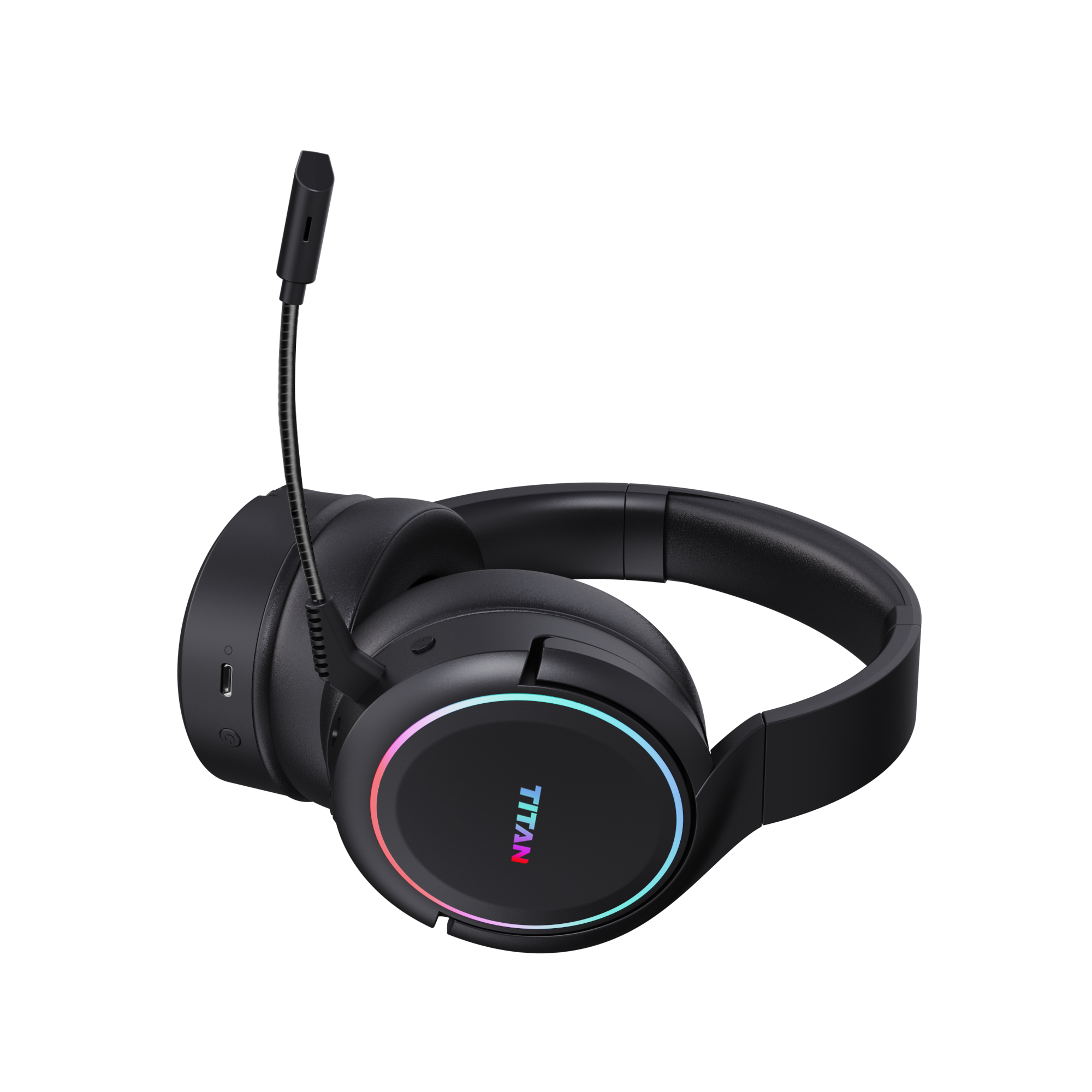
This guide uses the WH6 BT Korea OEM project as a practical example. The platform supports 2.4GHz wireless and Bluetooth, 7.1-channel surround-sound positioning, a 50mm speaker driver, an ENC noise-cancelling microphone, and a low-latency gaming application designed around a 20ms target. The Korea project also included KC certification and private-label logo and packaging work. The purpose here is not to repeat the case study, but to explain how a buyer can evaluate a wireless gaming headset OEM or ODM solution before committing to development.
What Should Gaming Brands Consider Before Developing a Wireless Headset?
Define the target user, gaming scenarios, connection modes, device list, price position, customization depth, destination markets, and acceptance criteria before selecting a headset platform.
Target users determine which tradeoffs matter. A PC-focused player may value a dedicated USB transmitter, responsive microphone return, and clear game cues. A console user needs verified compatibility with the intended platform and interface. A customer who also uses the headset for phones, music, or calls may expect Bluetooth. Trying to serve every scenario without prioritization can add controls, accessories, firmware states, documentation, and support complexity without creating equal customer value.
Commercial positioning should be defined as a complete retail proposition rather than a factory price alone. The headset, transmitter, charging cable, detachable microphone, packaging, manuals, compliance preparation, inspection, and logistics all influence the program. Brands should identify required features and optional features separately so the wireless gaming headset manufacturer can propose a platform that fits the intended channel.
Customization can range from logo, color, CMF, packaging, and firmware voice prompts to new mechanics, PCB revisions, acoustic targets, accessories, and tooling. A mature gaming headset ODM platform is often appropriate when the core architecture meets the brief. Deeper OEM work is justified when the brand's differentiation depends on changes that cannot be achieved through controlled platform customization.
2.4GHz vs Bluetooth: Choosing the Right Wireless Connection
2.4GHz normally serves dedicated PC or console gaming through a matched USB transmitter, while Bluetooth adds convenient direct pairing for compatible mobile and general-audio devices. Neither connection is universally better for every user scenario.
Bluetooth provides broad consumer familiarity and is useful when direct connection to phones, tablets, laptops, or other compatible devices is part of the product plan. Actual latency and two-way audio behavior depend on the Bluetooth implementation, codec and profile support, host device, operating system, and firmware. It should be evaluated against the intended use case rather than described only by a Bluetooth version number.
A proprietary 2.4GHz gaming connection typically uses a dedicated USB transmitter. Because the transmitter and headset are developed as a matched system, engineers can prioritize audio transport, microphone communication, pairing behavior, and gaming-mode operation. The brand still needs a verified compatibility list because USB interfaces, consoles, adapters, and software environments do not all behave identically.
A dual-wireless product such as WH6 BT can cover both dedicated gaming and everyday wireless use. The additional flexibility also requires clear mode switching, reconnection logic, indicator behavior, voice prompts, accessory labeling, and user instructions. Buyers should test the complete interaction flow, not only whether each radio can connect in isolation.
| Evaluation point | 2.4GHz wireless | Bluetooth |
|---|---|---|
| Latency focus | Designed for a dedicated low-latency gaming application with matched transmitter and headset | Performance varies with codec, profile, host device, and operating system |
| Compatibility | Requires a compatible USB transmitter and verification on target PC or console platforms | Direct pairing with a broad range of compatible consumer devices |
| Typical gaming usage | Competitive or PC/console scenarios where responsive audio and microphone communication are priorities | Casual gaming and situations where a direct Bluetooth connection is preferred |
| Mobile usage | Possible with a compatible transmitter and interface, but not universally supported | Convenient for phones, tablets, music, calls, and general audio |
| Development complexity | RF link, dongle behavior, USB compatibility, antenna performance, firmware synchronization | Profiles, codecs, pairing, reconnection, multipoint requirements, and host variation |
WH6 BT Korea OEM Project Overview
WH6 BT was selected for a Korean gaming brand project requiring 2.4GHz and Bluetooth modes, 7.1-channel audio positioning, a 50mm driver, ENC microphone support, KC certification, and private-label execution.
The WH6 BT platform was designed to combine a dedicated gaming connection with Bluetooth convenience. Its 2.4GHz mode supports low-latency gaming applications through a transmitter, while Bluetooth provides an additional connection route for compatible general-audio devices. The project specification referenced a 20ms low-latency application; this should be treated as a platform design target, not as a universal result across every host, mode, firmware version, and test condition.
The audio system combines a 50mm speaker driver with 7.1-channel surround-sound positioning intended for gaming content. The ENC microphone is designed to support clearer multiplayer communication by reducing selected environmental noise in the microphone signal. Final performance depends on acoustic tuning, microphone placement, processing, fit, firmware, and the actual user environment.
For the Korea OEM program, MACH supported industrial design coordination, mechanical development, PCB and firmware work, acoustic tuning, testing support, logo customization, packaging customization, KC compliance preparation, and mass-production coordination. The confirmed scope demonstrates how a private-label gaming headset project connects engineering, compliance, branding, and production rather than treating them as separate tasks.
Planning a wireless gaming headset project?
Share your target users, countries, device list, connection priorities, feature requirements, and customization scope for a platform review.
Discuss your requirements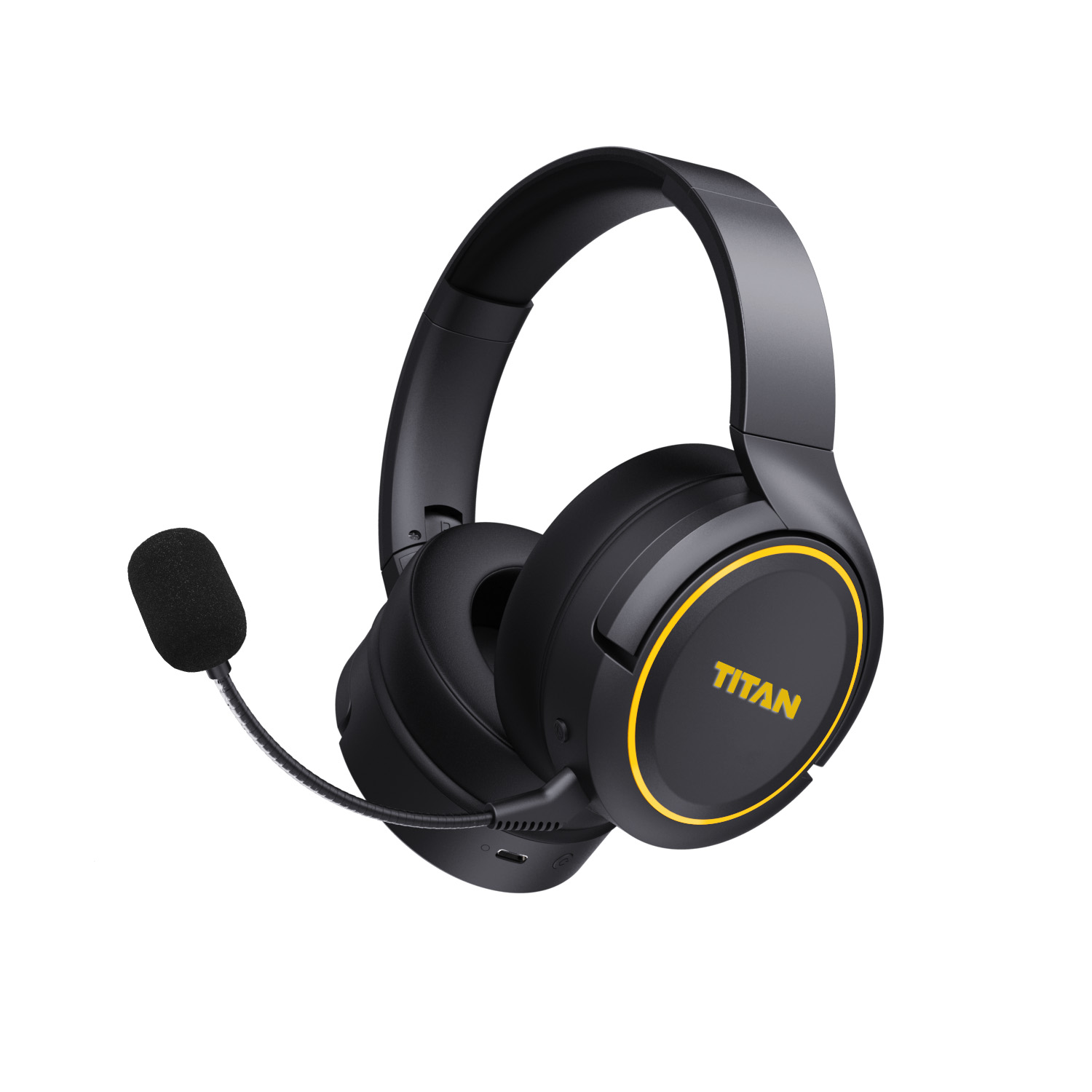
Technical Deep Dive: How 2.4GHz Wireless Technology Improves Gaming Headset Performance
A dedicated 2.4GHz system can prioritize responsive game audio and two-way communication, but performance depends on RF design, antenna integration, interference control, firmware, power management, and host compatibility.
Gaming audio carries time-sensitive information: footsteps, directional movement, weapon actions, environmental cues, and team communication. A delay between the screen and the headset can weaken the player's sense of control. A dedicated 2.4GHz link gives the development team a matched transmitter and receiver architecture that can be designed around gaming traffic. Bluetooth remains valuable for convenience, mobile devices, and general audio, so the right solution may be 2.4GHz, Bluetooth, or both depending on the intended customer journey.
RF design starts with chipset and circuit decisions but must be validated in the assembled product. Antenna placement is affected by the battery, driver magnets, PCB ground, metal headband parts, cables, RGB components, enclosure walls, and the user's head. A mechanical or CMF change can alter antenna surroundings after an early sample appears functional. Industrial design, mechanics, PCB layout, and RF review therefore need to progress together.
Signal stability must be evaluated in realistic environments. A gaming desk may contain Wi-Fi routers, wireless mice, keyboards, phones, USB hubs, and other 2.4GHz devices. Interference control involves channel strategy, reconnection behavior, packet handling, transmitter placement, and test conditions. A statement such as '2.4GHz always performs better' is not technically responsible because a poorly integrated 2.4GHz system can still be unstable.
Firmware manages pairing, mode selection, USB communication, microphone transport, mute behavior, indicators, prompts, sleep states, charging, and reconnection. The transmitter and headset must use controlled firmware versions, and changes should be traced between prototype, pilot, and mass-production stages. Otherwise, an approved sample and a production batch can behave differently even when the hardware appears unchanged.
Power management is part of wireless performance. The engineering team needs defined behavior for idle states, charging protection, low-power warnings, RGB operation, microphone use, and mode switching. Because battery duration changes with volume, radio mode, lighting, battery specification, and firmware, this guide does not claim an unconfirmed WH6 BT runtime.
A mature OEM or ODM platform can reduce RF development risk because its fundamental architecture has already moved beyond a blank-sheet concept. It can also reduce compatibility and production risk by providing an established component layout, firmware foundation, assembly method, and test baseline. Custom changes still require validation, especially when they affect the antenna area, PCB, battery, structure, transmitter, or firmware state logic.
Why 50mm Drivers Are Widely Used in Gaming Headset Development
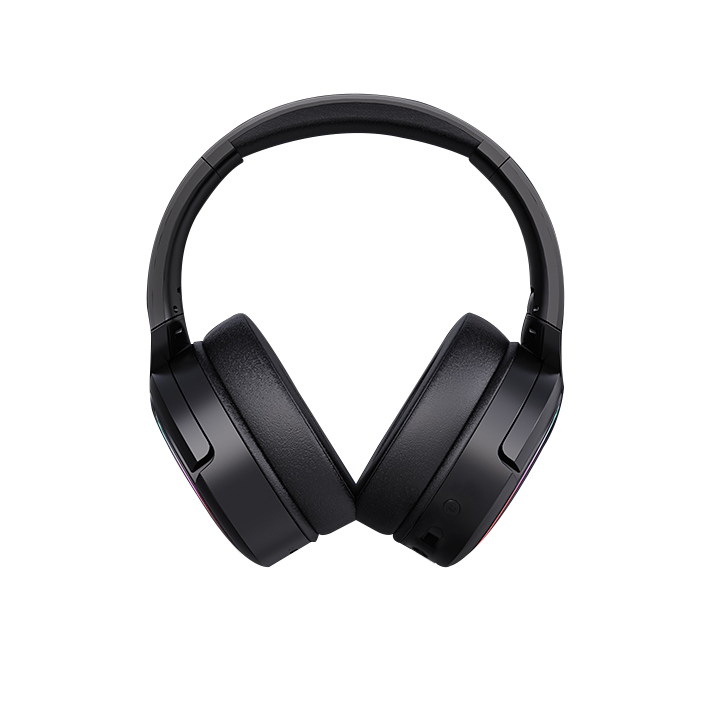
A 50mm driver offers a practical foundation for over-ear gaming audio, but driver diameter alone does not determine sound quality, positional performance, or product tier.
The 50mm format is familiar in gaming-headset development and fits many over-ear mechanical architectures. It can support the desired output and bass response when paired with a suitable enclosure, but nominal diameter is only one variable. Diaphragm material, motor strength, impedance, sensitivity, distortion, matching, and manufacturing consistency all influence the result.
The acoustic chamber controls the driver's interaction with air volume, vents, damping materials, grille openings, and leakage paths. Ear-pad material, geometry, compression, and seal affect bass, perceived space, comfort, and variation between users. The headband clamping force and driver-to-ear distance also shape the experience. A 50mm driver should therefore be assessed in the finished mechanical structure.
Acoustic tuning should reflect the brand's target user and content. Positional cues, speech intelligibility, impact, listening fatigue, music playback, and maximum usable volume may carry different priorities. Measurements and controlled listening can help assess the assembled headset. The correct conclusion is not that 50mm is always superior to 40mm, but that the complete acoustic system must meet the intended product target.
The Role of ENC Microphones in Modern Gaming Headsets
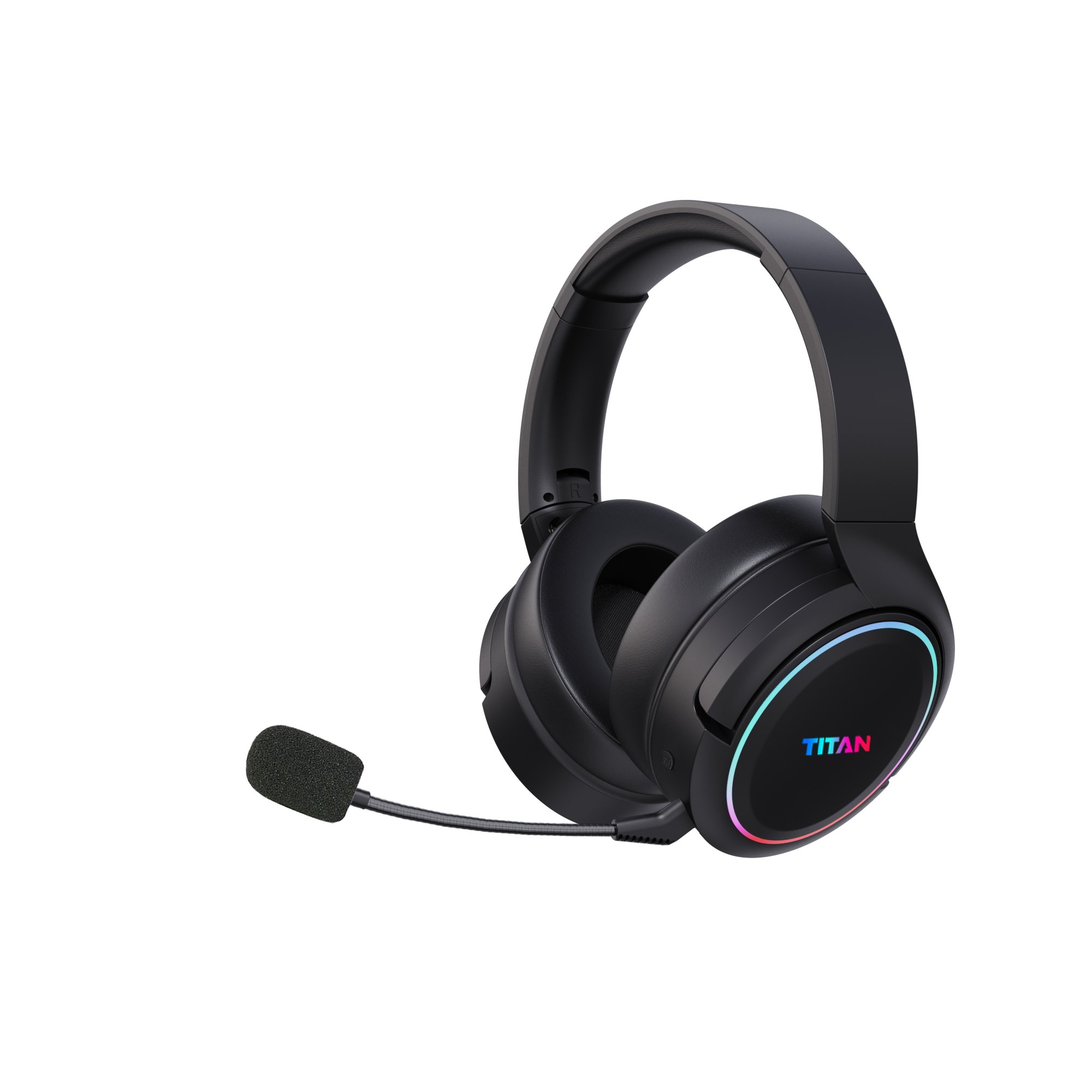
ENC processing is designed to improve transmitted voice clarity by reducing selected background noise, but its effectiveness depends on microphone hardware, placement, processing, boom geometry, firmware, and the noise environment.
Multiplayer communication places different demands on a microphone than music playback places on a speaker. Team members need intelligible speech with stable level and limited distraction from keyboards, fans, nearby conversations, or room noise. ENC can process the microphone signal to reduce parts of the environmental background before the voice is transmitted.
ENC is not the same as active noise cancellation for the listener. ANC primarily targets unwanted sound reaching the user's ears, while ENC in this context targets the outgoing communication signal. Buyers should ensure that packaging and product descriptions use these terms accurately so users do not expect a listening feature from a microphone-processing function.
Evaluation should include different speakers, boom positions, speech levels, keyboard activity, and representative background conditions. Over-aggressive processing may make speech sound gated or unnatural. The goal is not maximum noise suppression at any cost, but reliable intelligibility for the intended gaming environment.
OEM Development Process for Wireless Gaming Headsets
A controlled project moves from requirements and platform selection through multidisciplinary engineering, prototypes, validation, compliance preparation, pilot production, and mass production.
Requirement analysis should record target markets, users, sales channels, devices, connection modes, feature priorities, customization, packaging, compliance needs, and commercial constraints. MACH can then review whether WH6 BT or another custom wireless gaming headset platform fits the brief and identify requests that require firmware, mechanical, acoustic, PCB, accessory, or tooling work.
Industrial design and engineering review should connect product appearance with antenna location, internal space, driver chamber, microphone geometry, controls, battery, PCB, and assembly. Prototype rounds need named objectives and issue tracking. Buyers should approve both physical samples and controlled specifications, including firmware versions and accessory definitions.
Testing support may cover functional operation, pairing, mode switching, reconnection, target-device compatibility, RF stability, acoustic and microphone evaluation, charging, controls, indicators, mechanical reliability, packaging, and labels. Certification requirements depend on the final configuration and destination markets. Pilot production confirms assembly and inspection criteria before mass production proceeds.
- Requirement analysis
- ODM or OEM platform selection
- Industrial design coordination
- Mechanical, RF, PCB, firmware, and acoustic review
- Prototype and issue tracking
- Functional and compatibility testing
- Certification preparation
- Pilot and mass-production control
OEM Buyer Checklist Before Developing a Wireless Gaming Headset
A structured RFQ lets the supplier evaluate platform fit, expose open risks, and separate confirmed requirements from optional features before quotation and sampling.
Buyers do not need to complete all engineering decisions before contacting a supplier, but they should describe their product strategy clearly. Target-market and channel information gives context to the feature list. A device matrix is more useful than a general request for 'universal compatibility,' and a defined test condition is more useful than an unsupported battery or latency headline.
Reference products can communicate design direction when the buyer identifies what should be learned from them: fit, controls, sound balance, microphone position, materials, or price positioning. Compliance planning should list every intended country and channel. Packaging planning should include brand files, languages, barcodes, importer information, accessories, labels, and logistics requirements.
- Target market and retail channel
- 2.4GHz connection requirement
- Bluetooth requirement and use cases
- PC compatibility list
- Console and adapter compatibility list
- Driver size and acoustic positioning
- Microphone and ENC expectations
- 7.1 audio and software requirements
- RGB and power-management behavior
- Firmware, controls, prompts, and indicators
- Logo, CMF, accessories, and packaging
- Destination-market certification scope
Reducing Risk When Selecting an OEM or ODM Platform
Choose a supplier that can explain system tradeoffs, define what is already validated, identify what customization changes, and control specifications from sample approval through production.
An ODM gaming headset platform can reduce development work when its core wireless, mechanical, and acoustic architecture already fits the product brief. Logo, CMF, packaging, prompts, and selected configuration changes may create meaningful differentiation without restarting every engineering activity. Buyers should still ask which aspects are established and which require fresh validation after customization.
A deeper OEM route is appropriate when the brand requires distinctive industrial design, structure, PCB, controls, acoustics, firmware, or accessories. This path can create stronger differentiation but also expands tooling, sampling, testing, certification, and production-control responsibilities. The choice should reflect the commercial value of the difference, not the assumption that more custom engineering is always better.
Supplier evaluation should cover industrial design, mechanical development, PCB and firmware coordination, RF review, acoustic tuning, testing support, packaging, quality control, and mass production. Documentation matters: specification versions, firmware records, sample issue lists, approved CMF standards, packaging files, and inspection criteria help keep the production result aligned with the approved product.
Need a customized 2.4GHz + Bluetooth gaming headset platform?
Send MACH your target countries, intended devices, connection modes, acoustic and microphone priorities, customization requirements, and launch plan for an OEM/ODM discussion.
Contact MACH
Conclusion
The right wireless gaming headset solution is the platform that fits the brand's users, devices, differentiation plan, compliance markets, and ability to validate and manufacture the complete system.
The WH6 BT Korea OEM project illustrates why wireless headset development is a system decision. 2.4GHz and Bluetooth serve different connection needs; 7.1 audio, a 50mm driver, and ENC microphone support must be evaluated within the complete acoustic and communication design; KC compliance, packaging, firmware, and production control must remain aligned with the final configuration.
Brands can reduce risk by preparing a clear RFQ, choosing the correct OEM or ODM depth, validating real device scenarios, controlling changes, and working with a gaming audio OEM manufacturer that can connect engineering decisions to production. MACH supports this process from platform review and industrial design through mechanics, PCB, firmware, acoustic tuning, testing support, packaging, and mass production.
Frequently Asked Questions
What is the difference between a Bluetooth and 2.4GHz gaming headset?
Bluetooth is convenient for direct pairing with compatible mobile and consumer devices. A 2.4GHz gaming headset normally uses a dedicated USB transmitter and a matched wireless link designed around gaming audio and microphone communication. Actual performance depends on the complete implementation and host device.
Why do gaming brands choose 2.4GHz wireless?
Brands often choose 2.4GHz for PC and console scenarios that prioritize a dedicated low-latency gaming connection, controlled transmitter behavior, and two-way microphone communication. Compatibility still needs verification on the intended devices.
Can MACH customize wireless gaming headsets?
Yes. MACH supports project-dependent customization including industrial design, mechanics, logo, CMF, packaging, firmware prompts and controls, acoustic tuning, accessories, and selected PCB or configuration work. Feasibility and validation scope depend on the requested changes.
What can be customized on an OEM gaming headset?
Customization can include logo process, colors, surface finishes, structure, controls, ear pads, microphone, firmware behavior, voice prompts, accessories, manuals, labels, and retail packaging. The available scope depends on the selected platform and project requirements.
Is a 50mm driver better for gaming?
Not automatically. Driver diameter is one design variable. Driver construction, acoustic chamber, damping, ear-pad seal, impedance, sensitivity, tuning, fit, and manufacturing consistency all affect the final user experience.
What is ENC microphone technology in a gaming headset?
ENC microphone processing is designed to reduce selected background noise in the outgoing communication signal so speech can remain clearer. It is different from ANC, which targets unwanted sound heard by the listener.
What certifications are needed for wireless gaming headsets?
Certification requirements depend on the final wireless and battery configuration, intended countries, sales channels, labels, and packaging. The WH6 BT Korea project included KC certification, but other markets may require a different compliance scope.
How does wireless gaming headset OEM development work?
The process normally includes requirement analysis, platform selection, industrial and mechanical design review, RF and electronics review, firmware and acoustic work, prototypes, testing, certification preparation, pilot production, inspection, and mass production.
Should gaming brands choose OEM or ODM development?
ODM is suitable when a mature platform meets the core brief with controlled customization. Deeper OEM development is appropriate when the brand needs distinctive mechanics, electronics, firmware, acoustics, or accessories and can support broader validation.
How can brands reduce wireless headset development risks?
Prepare a clear device and market brief, select the appropriate platform, review RF and mechanical integration together, control firmware and specification versions, test representative scenarios, plan compliance early, and verify pilot production before volume manufacturing.
Related Resources
Need OEM/ODM gaming audio solutions?
Contact MACH Industry to discuss your gaming headset, gaming earbuds, or private-label audio project.
Contact MACH Industry