Home > Resources > Gaming Headset Guide
How Brands Evaluate a 53mm Driver Wired Gaming Headset for OEM Development
A B2B guide to evaluating 53mm drivers, sensitivity, impedance, cushions, microphones, cables and source interfaces before private-label wired headset production.
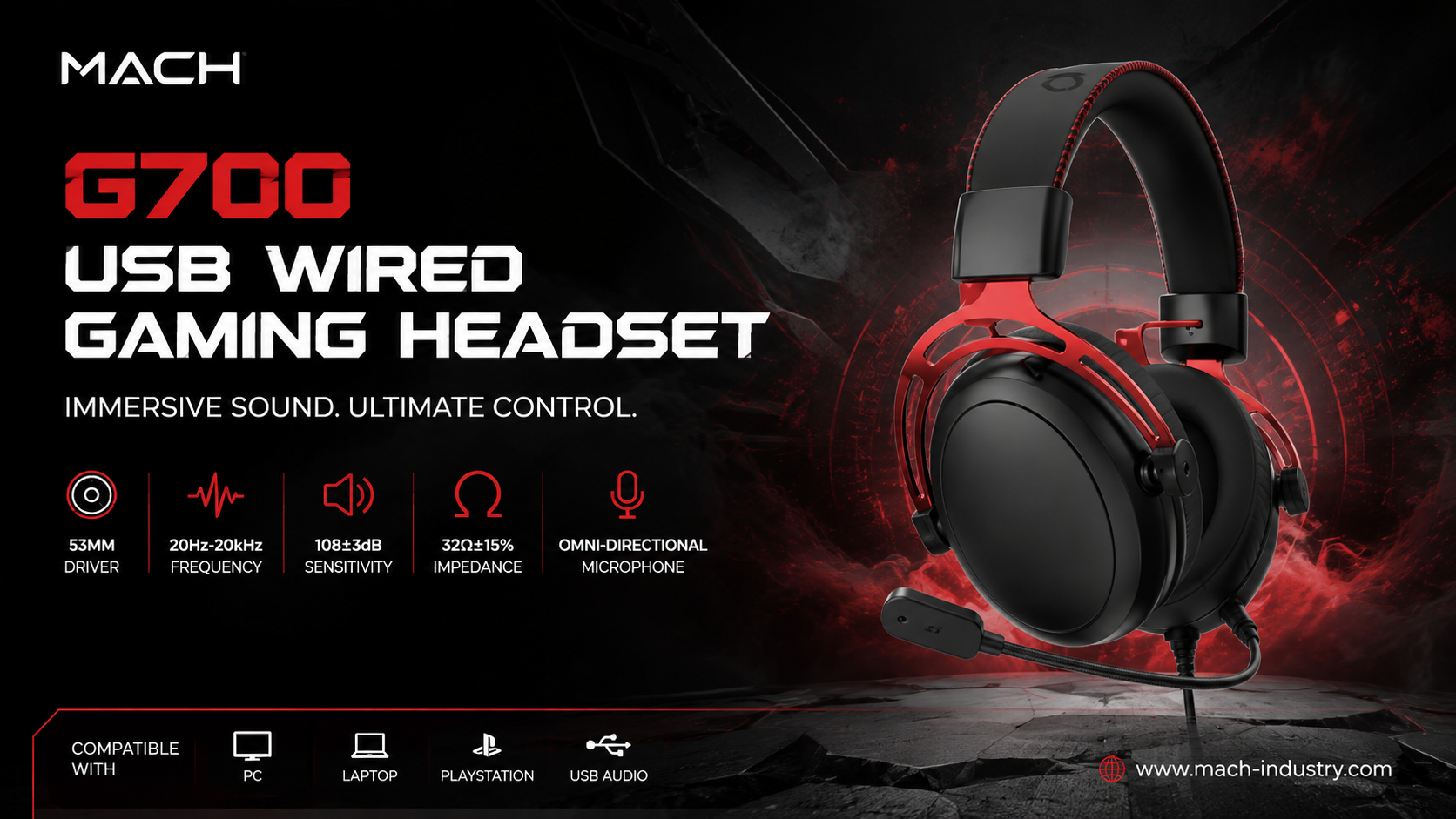
Gaming brands should evaluate a 53mm wired headset as a complete acoustic and mechanical system, not assume that a larger driver automatically produces better gaming audio. Driver size matters only when the enclosure, ear cushions, electrical load, source interface, microphone, cable and production tolerances support the intended result.
A buyer therefore needs a repeatable evaluation framework: define target users and devices, confirm the USB and 3.5mm routes, review the published electrical specifications, approve sound and voice references, and test the final branded structure. This turns a component number into a product decision.
MACH G700 provides a practical reference. Its public data confirms USB audio cable support, a 3.5mm interface, a 53mm driver, 20Hz-20KHz response, 108dB plus or minus 3dB sensitivity, 32-ohm plus or minus 15% impedance, an omnidirectional microphone, a 2m plus or minus 10% cable and stitched ear cushions. It is positioned for PC, laptop, PlayStation, Amazon, retail and private-label wired headset projects.
Market Background: Why Wired Headset Platforms Still Need Differentiation
Wired gaming headsets remain relevant for brands that need direct connectivity and no battery management, but differentiation must come from a controlled system rather than an oversized feature list.
Gaming buyers compare driver size, connection, microphone, comfort, cable and visual design within a crowded category. A brand may select wired architecture to avoid charging and pairing, yet still needs a clear reason for the product to exist. That reason can be acoustic positioning, fit, durable construction, device focus or a coherent private-label package.
USB audio and 3.5mm serve different implementation paths. G700 confirms both USB audio cable support and a 3.5mm headset interface. Buyers should map the intended route to each target device and verify audio, microphone and controls. A product listing should not treat connector labels as universal compatibility without a released device test.
Driver size is a visible marketing specification, but it is also an engineering input. A 53mm driver affects available enclosure space, acoustic volume, weight distribution and mechanical design. It does not establish bass quality, spatial accuracy or loudness by itself.
Retail readiness adds another layer. Cable length, cushions, microphone behavior, package contents, user instructions and compliance documentation influence support costs. Brands need a platform whose engineering definition can be translated into accurate packaging and repeatable production checks.
| Market requirement | Buyer question | Evidence to request |
|---|---|---|
| Audio differentiation | What sound direction fits the product tier? | Reference tracks, final-sample listening and measurable checks |
| Device strategy | Which route serves PC, laptop or PlayStation? | Device-by-connector function matrix |
| Comfort | Does the driver and enclosure fit the target user? | Production-representative fit and cushion samples |
| Retail reliability | Can cable, microphone and package survive normal handling? | Released durability and packaging plan |
G700 Product Development Overview
G700 is a USB + 3.5mm wired gaming headset platform built around a 53mm driver, omnidirectional microphone, 2m cable and stitched ear-cushion direction.
The speaker is specified at 53mm, 20Hz-20KHz frequency response, 32 ohms plus or minus 15% impedance and 108dB plus or minus 3dB sensitivity. These values describe the published platform; final performance still depends on the source, enclosure, cushions, fit and approved production limits.
The microphone is an omnidirectional 6.0 by 2.7mm unit with -42dB plus or minus 3dB sensitivity. Omnidirectional describes pickup direction, not automatic voice quality. Boom geometry, mouth distance, acoustic openings, host input and environmental conditions need final-sample testing.
The cable is listed at 2m plus or minus 10%, with USB audio support and a 3.5mm headset interface. Buyers should confirm the final cable and connector arrangement, any adapters and function by device before packaging is released.
Regular stitched ear cushions are confirmed, and cushion material and stitching direction are customizable. Cushions influence fit, sealing, perceived bass, heat and appearance, so a material change should trigger comfort and acoustic review.
G700 has a published MOQ of 2,000 pieces and sample lead time of 7-15 days. Mass-production lead time is project dependent. Confirmed applications include PC and laptop product lines, PlayStation audio projects, Amazon listings, private-label programs and retail channels.
Does a 53mm Driver Create a Better Wired Gaming Headset?
A 53mm driver can support a brand's acoustic and product-positioning goals, but it is not inherently better than a smaller driver; the complete implementation determines the result.
Driver diameter describes one physical characteristic. A larger diaphragm can influence design possibilities, but it does not independently determine frequency balance, distortion, transient behavior, positional cues or maximum usable output. Magnet system, voice coil, diaphragm material, damping, enclosure and tuning all matter. Buyers should reject any supplier claim that converts diameter directly into guaranteed sound quality.
The published G700 figures provide useful starting points. A 20Hz-20KHz response states the nominal range, but not how evenly the headset behaves across that range or under which test conditions. The 108dB plus or minus 3dB sensitivity indicates output behavior under the manufacturer's reference method, but the method and source level must be understood before comparing it with another model.
Impedance affects the electrical relationship with the source. G700 is listed at 32 ohms plus or minus 15%, a common direction for consumer gaming devices, yet source voltage, output impedance and USB implementation still influence level and behavior. A PC USB audio path, laptop analog output and controller jack should be evaluated separately.
Mechanical integration is equally important. A 53mm driver needs an ear cup and baffle that preserve its mounting, acoustic volume and venting. The cushion must create the intended relationship with the ear. If a private-label project changes cushion thickness, foam, covering or stitching, perceived bass, seal and comfort may change even when the driver remains identical.
The buyer should create an acoustic approval matrix. Include reference tracks and game scenarios, output-level matching, left-right consistency, bass control, dialogue clarity, high-frequency balance and spatial cues. Listening panels should use the final ear cushions, enclosure, cable and connection route. Measured checks should be tied to the same sample revision.
Product positioning matters because the right sound is not universal. A retail brand may want an energetic presentation, while a PC accessory bundle may prioritize speech clarity and broad compatibility. The 53mm specification can support the product story, but the story should follow an approved listening target rather than replace it.
Production control turns the approved sound into a repeatable product. Driver incoming limits, polarity, channel matching, enclosure assembly, cushion installation and functional testing should reference a golden sample. Changes to drivers, damping, cushions or plastics require impact review and selective acoustic revalidation.
The practical conclusion is simple: choose the G700 53mm platform when its electrical, mechanical and acoustic direction fits the intended product. Do not choose it solely because 53 is numerically larger than 50 or 40.
| Buyer assumption | Engineering reality | Required decision |
|---|---|---|
| Larger driver always means better bass | Bass depends on driver, enclosure, seal and tuning | Approve final-system bass balance |
| 20Hz-20KHz proves flat response | Published range does not show response shape | Review measurements and listening references |
| 108dB means identical loudness on every device | Source and measurement method affect comparison | Test named USB and 3.5mm hosts |
| The same driver guarantees the same result | Cushions, housing and assembly affect sound | Control final materials and production revisions |
Technical Deep Dive: Matching Driver, Source, Cushion and Cable
G700 engineering should align its 53mm driver with the electrical source, acoustic enclosure, stitched cushions, microphone and 2m cable as one released configuration.
The source path comes first. USB audio uses a digital interface and controller in the released cable or headset system, while the 3.5mm route uses a compatible host's analog audio interface. Buyers should validate gain, noise, microphone routing and controls on the intended PC, laptop, PlayStation or other approved host.
The 32-ohm plus or minus 15% driver specification should be considered with source output. The 108dB plus or minus 3dB sensitivity is useful for platform evaluation, but comparisons need consistent methods. Product teams should define a safe, practical listening range rather than chase maximum loudness.
Ear-cup volume, baffle openings and damping influence the 53mm driver's response. Mechanical changes for appearance should identify acoustic-sensitive zones. A new decorative grille, vent or internal feature may require retesting.
Stitched cushions affect seal, distance from the ear and comfort. Material and stitching customization are confirmed for G700, so sample approval should cover appearance, softness, heat, compression recovery and sound. Cushion substitutions after approval require an impact check.
The omnidirectional microphone needs controlled placement and host validation. Its -42dB plus or minus 3dB sensitivity is not a full communication result. Boom position, mouth distance, electrical input and background conditions should be defined.
The 2m plus or minus 10% cable influences reach, resistance, handling and packaging. Cable and connector customization should specify jacket, plugs, branch points, strain relief, controller if present, continuity, pull and flex requirements. Packaging should avoid bends or compression that undermine the approved cable.
Production testing should connect all these systems. Audio playback, channel balance, microphone, connector continuity and mechanical assembly need released criteria. Cosmetic and package checks should confirm the correct cushions, cable, labels and accessories.
- Name each target device and its USB or 3.5mm route.
- Approve audio on the final driver, enclosure and cushion configuration.
- Use consistent methods for sensitivity and source comparisons.
- Validate microphone position and voice scenarios.
- Define cable, connector, flex and strain-relief requirements.
- Control cushion material, stitching and compression references.
- Tie production checks to the golden sample and released BOM.
OEM/ODM Buyer Guide for G700 Customization
G700 supports private-label changes to branding, CMF, cable, connectors, microphone structure, cushions and packaging, subject to engineering review and sample approval.
Logo branding is available on headset housing, while color and CMF can align G700 with a broader gaming accessory family. Buyers should supply vector artwork, named color standards, finish references and physical appearance limits.
Cable and connector configuration can be adapted to the device and package strategy. The RFQ should define USB audio route, 3.5mm format, cable length, jacket, adapters and package arrangement. Functional changes need host-specific verification.
Microphone structure customization is supported. The buyer should describe boom form, placement, packing and replacement expectations. A structural change does not guarantee a different voice result without acoustic and electrical validation.
Ear-cushion material and stitching direction are confirmed options. This is a meaningful differentiation area because it affects appearance, fit and acoustic sealing. Approve cushions with the final headset rather than as isolated material swatches.
Retail box design, manuals, barcode labels, private-label packaging and compliance-documentation support are listed capabilities. Documentation support does not imply that every G700 configuration already holds every destination-market certification.
| Customization area | Buyer input | Approval focus |
|---|---|---|
| Logo and CMF | Artwork, color and finish references | Placement, contrast and cosmetic limits |
| Cable and connectors | Hosts, plugs, length, adapters and jacket | Function, durability and packaging |
| Microphone structure | Boom, position and pack-out direction | Retention, contact and voice result |
| Ear cushions | Material, foam and stitching direction | Fit, seal, comfort, sound and appearance |
| Packaging | Artwork, language, labels and accessories | Accuracy, protection and destination-market needs |
Who Should Choose This Platform?
G700 suits brands that need a 53mm wired headset with defined USB audio and 3.5mm routes, customizable cushions and a documented private-label path.
Gaming brands can use G700 when a 53mm acoustic platform fits their intended sound and mechanical positioning. Private-label companies can build differentiation through CMF, cable, microphone structure, cushions and packaging without beginning every subsystem from zero.
Amazon sellers and retailers may value the published specifications and clear wired architecture, provided listings explain verified device and connector behavior. Distributors can adapt packaging and accessories for a destination market after project review.
New gaming accessory brands should choose the platform only after testing the final system against target users and devices. G700 is not automatically the right solution when the program requires a different form, wireless architecture or unsupported feature.
The common fit is a buyer who can provide a structured brief, approve samples and maintain change control through mass production.
Buyer Checklist Before Sampling
A useful G700 RFQ connects market positioning with device routes, acoustic targets, microphone, cable, cushions, customization and commercial requirements.
Define the target user, channel, price position and reason for selecting a 53mm platform. List PC, laptop, PlayStation and any other intended devices with the required USB or 3.5mm behavior.
Provide listening references and describe bass, dialogue, spatial and volume priorities. Add microphone scenarios, cable requirements and comfort expectations. Mark each customization request as required, preferred or optional.
Supply logo, color, CMF, cushion, stitching and packaging references. Identify destination markets and documentation needs. State sample quantity, forecast, launch date and decision owners.
- Target customer, channel and product tier
- Reason for choosing a 53mm driver platform
- Device-by-connection function matrix
- Audio and microphone approval references
- Cable, connector and accessory requirements
- Cushion material, stitching and comfort direction
- Logo, CMF, packaging and documentation scope
- 2,000-piece MOQ, sample plan and launch schedule
Conclusion
A 53mm driver becomes valuable when its electrical, acoustic, mechanical and production implementation supports a brand's verified headset strategy.
G700 offers a confirmed foundation with USB audio and 3.5mm routes, a 53mm driver, published sensitivity and impedance, an omnidirectional microphone, a 2m cable and stitched cushions. These specifications should be evaluated together rather than used as isolated marketing claims.
MACH industry can review your target devices, acoustic direction, microphone scenarios, cable and connector plan, cushion customization, branding, packaging and destination markets. A structured brief makes it possible to determine whether G700 fits the intended OEM/ODM program.
Frequently Asked Questions
Is a 53mm gaming headset driver better than a 50mm or 40mm driver?
Not automatically. Driver construction, enclosure, cushions, fit, source and tuning determine the final result. Diameter should be evaluated as part of the complete headset system.
What G700 speaker specifications are confirmed?
G700 confirms a 53mm driver, 20Hz-20KHz response, 32-ohm plus or minus 15% impedance and 108dB plus or minus 3dB sensitivity.
Does G700 support both USB audio and 3.5mm?
Yes. Published data lists USB audio cable support and a 3.5mm headset interface. Buyers should verify the final cable arrangement and function on each target device.
Which devices are listed for G700?
The published product data lists PC, laptop, PlayStation and USB audio platforms. Final compatibility and function should be validated by device and connection route.
What microphone does G700 use?
G700 uses an omnidirectional 6.0 x 2.7mm microphone with -42dB plus or minus 3dB sensitivity. Final voice quality depends on structure, placement, host and test conditions.
Can brands customize G700 ear cushions?
Yes. Ear-cushion material and stitching direction are confirmed customization areas. Changes should be approved for fit, comfort, acoustic seal and appearance.
What private-label customization is available for G700?
Published options include housing logo, color and CMF, cable and connectors, microphone structure, ear-cushion material and stitching, retail box, manuals, barcode labels, packaging and compliance-documentation support.
What is the G700 MOQ and sample lead time?
The published MOQ is 2,000 pieces, and sample lead time is 7-15 days. Mass-production timing is project dependent.
Does G700 have published certifications?
No specific finished-product certification is published in the G700 data. Compliance-documentation support is available, while required testing depends on the customized product and destination market.
What should a buyer prepare for a G700 OEM quotation?
Prepare target users and devices, USB and 3.5mm routes, acoustic and microphone requirements, cable and cushion direction, branding, packaging, markets, quantity and schedule.
Related Resources
Need OEM/ODM gaming audio solutions?
Contact MACH Industry to discuss your gaming headset, gaming earbuds, or private-label audio project.
Contact MACH Industry