Home > Resources > Gaming Headset Guide
How Should Brands Evaluate a Wireless Gaming Headset Charging Dock?
A technical buyer guide to evaluating charging alignment, headset stability, RGB presentation, USB hub functions, packaging, validation, and production control for a wireless gaming headset and dock OEM bundle.
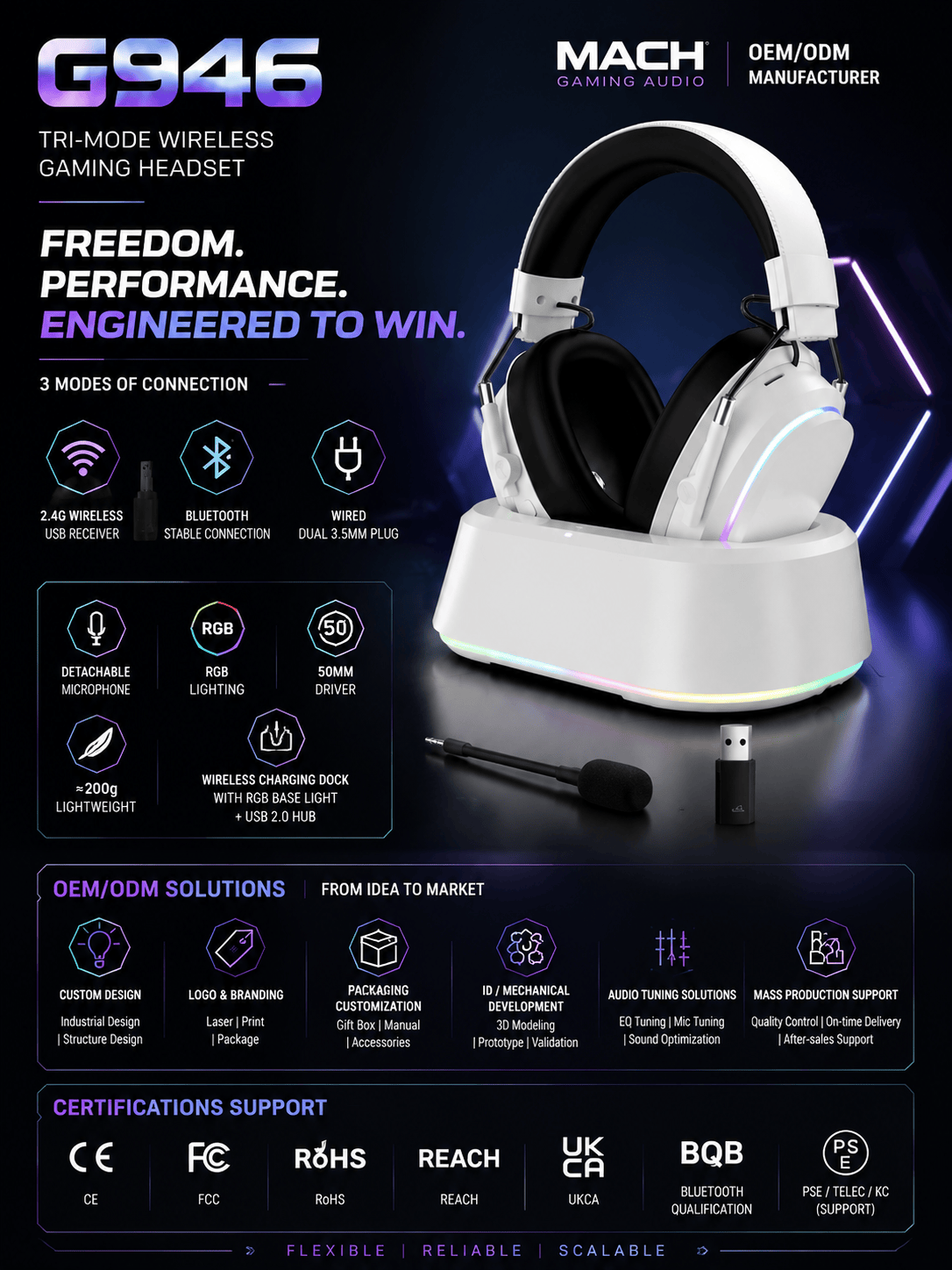
Gaming brands should evaluate a wireless gaming headset charging dock as part of a complete headset-and-dock system, not as a display stand added near the end of development. The sourcing specification should define how the headset is positioned and charged, how the dock is powered, which USB hub functions are included, how RGB behaves, how the headset and dock are protected in packaging, and how charging, cosmetics, accessories, and pairing are controlled during production.
This matters because a dock changes both the user experience and the OEM project scope. It can create a more complete desktop product, provide a consistent storage position, add visible RGB presentation, and support charging between sessions. It can also introduce alignment, stability, cable, power, packaging, tolerance, and after-sales questions that do not exist in a headset-only product.
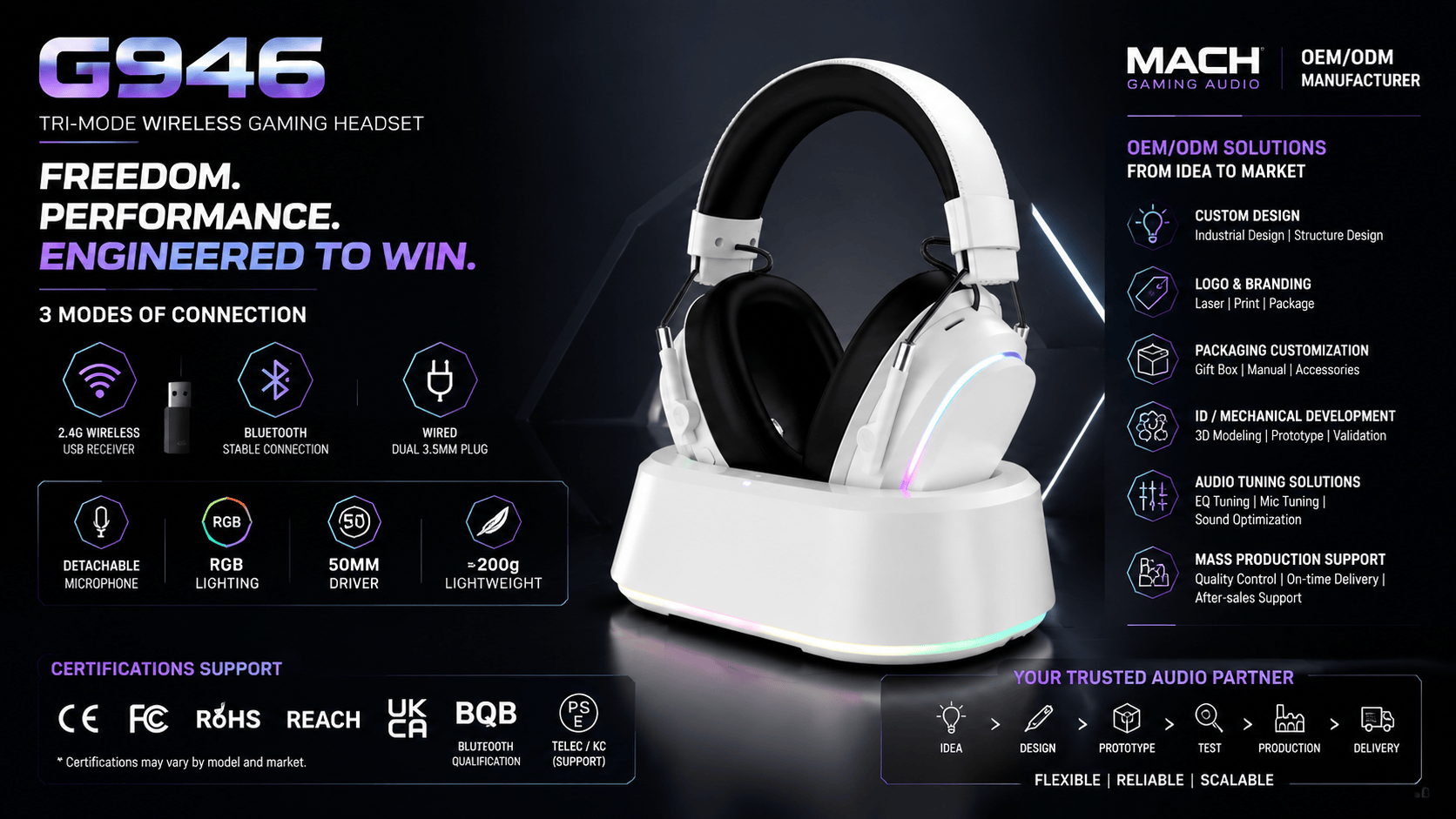
G946 WH with charge base is used as a documented reference. The confirmed platform combines a white tri-mode headset with 2.4GHz wireless through an included USB receiver, Bluetooth, dual 3.5mm wired plugs, a 50mm driver, detachable microphone with ENC support, RGB, a 2000mAh battery, and an RGB wireless charging dock with an integrated USB 2.0 hub. This guide explains how OEM buyers can evaluate that type of bundle without turning the article into a product-page summary.
Understanding the Product Development Challenge
A headset-and-dock bundle must work as one mechanical, electrical, cosmetic, packaging, and support system while preserving the headset's approved wireless, audio, microphone, battery, and wired functions.
A conventional wireless-headset RFQ usually focuses on connectivity, latency, audio, microphone, battery, fit, industrial design, accessories, packaging, and compliance. Adding a charging dock creates a second product interface. The headset must rest in a repeatable position, remain stable on a desk, initiate charging as intended, and be easy to remove without damaging visible surfaces.
The dock also becomes part of the retail proposition. Its dimensions, lighting, cable exit, controls, USB hub, branding, and relationship to the headset affect shelf imagery, desk footprint, unboxing, setup, and customer support. A purchasing team should therefore define whether the dock is essential to the SKU or an optional bundle before artwork, tray design, manuals, and certification planning are finalized.
Cross-functional ownership is important. Industrial design may approve the silhouette, while electrical engineering reviews charging and hub behavior, mechanical engineering reviews stability and tolerance, quality defines inspection, packaging protects both items, and marketing describes only tested functions. A written system specification prevents each team from approving a different version of the product.
The buyer should also separate confirmed product facts from project-dependent claims. G946 supplies wireless charging through the dock, RGB base lighting, and a USB 2.0 hub. The source does not provide charging-power values, dock dimensions, port count, or a claim that every USB host is supported. Those details should be confirmed for the final sample rather than inferred.
| Development area | Headset-only project | Headset-and-dock bundle |
|---|---|---|
| Mechanical approval | Fit, adjustment, controls, microphone, and structure | Adds dock footprint, headset placement, stability, removal, and tolerance |
| Electrical approval | Wireless, audio, battery, charging cable, and controls | Adds dock power, wireless charging behavior, RGB base, and USB 2.0 hub |
| Packaging | Headset, receiver, cable, microphone, and documentation | Adds dock protection, cable routing, tray retention, weight, and setup instructions |
| After-sales | Headset, receiver, cable, microphone, and battery questions | Adds dock compatibility, charging alignment, hub, lighting, and replacement boundaries |
G946 Product Platform Overview
G946 WH with charge base is a white tri-mode wireless gaming headset and RGB charging-dock bundle developed for private-label gaming audio programs.
The headset provides three confirmed connection paths: dedicated 2.4GHz wireless through an included USB receiver, Bluetooth, and dual 3.5mm wired plugs. The 2.4GHz route is specified at 20ms latency and a transmission distance of 10m. Bluetooth provides an additional wireless path for compatible devices, while the dual 3.5mm plugs provide separate wired audio and microphone connections for matching ports.
The acoustic platform uses a 50mm driver specified at 32 ohms, 110dB sensitivity, and a listed 20Hz-20kHz frequency response. The microphone is detachable and has ENC support selected in the product data. The headset is listed at approximately 200g and uses a 2000mAh battery.
Published battery references are approximately 150 hours of playback with lighting off, approximately 1200 hours standby, and approximately three to four hours charging. These values should be attached to documented test conditions in an OEM project because mode, volume, lighting, microphone use, battery state, temperature, and test endpoint can affect the result.
The charging dock provides wireless headset charging, RGB edge lighting, and an integrated USB 2.0 hub. This combination positions the product as a coordinated desktop bundle rather than a headset with an unrelated stand. Confirmed OEM/ODM evaluation areas include headset and dock appearance, logo and private-label branding, RGB and CMF presentation, packaging and accessories, industrial design and mechanical development, audio and microphone tuning, receiver configuration, sampling, and mass-production coordination.
| Platform element | Confirmed G946 reference | Buyer approval focus |
|---|---|---|
| Headset connections | 2.4GHz USB receiver, Bluetooth, dual 3.5mm plugs | Mode-specific hosts, features, controls, microphone route, and accessories |
| Dock | Wireless charging, RGB base light, USB 2.0 hub | Placement, charging, power, hub operation, lighting, and cable management |
| Audio and microphone | 50mm driver and detachable microphone with ENC support | Tuning, voice quality, connector durability, routing, and consistency |
| Battery | 2000mAh; approximately 150 hours without lighting | Runtime conditions, dock charging behavior, indicators, aging, and production cells |
Key Design and Engineering Considerations
Buyers should review the dock interface, wireless modes, audio, microphone, battery, lighting, USB hub, packaging, and production tolerances as connected parts of one approved system.
Start with the user sequence. Document how the headset is placed on the dock, how the user knows charging has started, how it is removed, where the receiver and microphone are stored, which cables are connected, and what the RGB indicators mean. A clear sequence helps engineering define tests and helps packaging and support teams prepare accurate instructions.
Wireless charging depends on repeatable placement. The buyer should evaluate how much position variation is acceptable, whether the headset remains stable after light desk movement, whether cushions, headband surfaces, or controls contact the dock, and whether cosmetic wear appears after repeated placement. Final pass criteria must be based on the approved mechanical and electrical design rather than assumptions about charging technology.
The integrated USB 2.0 hub requires its own functional matrix. Confirm the final port arrangement, intended host connection, supported functions, cable and power requirements, device recognition, and behavior when the headset is charging. A hub label describes the interface class but does not prove compatibility with every host, peripheral, power condition, or usage sequence.
RGB should be reviewed as both a visual and electrical feature. Define lighting zones, color behavior, brightness, diffusion, control, memory state, startup and shutdown behavior, and cosmetic tolerance. The headset and dock should appear coordinated in final CMF samples. Runtime claims for the headset must state whether headset lighting is on or off.
The three headset connection routes need separate approval. The 20ms value belongs to the specified 2.4GHz route and should not be transferred to Bluetooth or analog marketing. Dual 3.5mm requires compatible audio and microphone ports. The buyer should create a tested device-and-mode matrix covering audio, microphone, controls, charging state, receiver, adapters, and any limitations.
Audio and microphone approval remains necessary even when the dock is the main differentiator. Driver diameter and basic specifications do not prove tuning or unit consistency. Evaluate useful-level response, distortion, channel match, seal variation, and production samples. For the detachable ENC microphone, review voice clarity, connector fit, insertion cycles, positioning, mute behavior, transport in wireless and wired modes, and replacement handling.
Why Charging Dock Design Matters in Premium Wireless Gaming Headset Development
A charging dock can strengthen product positioning only when charging reliability, mechanical placement, desktop usability, lighting, hub behavior, packaging, and service planning are engineered as one repeatable experience.
The dock changes the headset from a wearable device into a desktop system. That can give a gaming brand a stronger product story and a more visible place in a user's setup, but it also makes the interaction between two physical products part of the quality promise. The headset should sit predictably, appear intentional from common viewing angles, and remain secure during ordinary desk use.
Mechanical alignment is the first procurement issue. Wireless charging still requires an approved relationship between the charging areas in the headset and dock. Housing tolerances, headband adjustment, cushion compression, product weight distribution, dock angle, surface friction, and assembly variation can affect placement. Buyers should test minimum and maximum tolerance samples, not only a hand-selected appearance sample.
Charging feedback is the second issue. Users need a clear way to recognize correct placement and charging status. The final project should define which headset or dock indicator communicates charging, full charge, standby, or an unsuccessful placement. Indicator behavior must match the manual and should be checked across normal setup sequences. The source confirms wireless charging and RGB lighting but does not publish a specific indicator logic, so this remains a final-sample requirement.
Desktop integration adds power and cable decisions. The RGB base and USB 2.0 hub need a defined connection and intended operating scenario. Buyers should evaluate cable exit direction, desk footprint, nearby-port access, stability, hub recognition, device connection and removal, lighting behavior, and any limitations under the final power arrangement. These details influence both industrial design and customer support.
Durability testing should reflect repeated daily use. A project may include placement and removal cycles, surface-rub checks, cable strain, connector use, dock stability, lighting operation, charging repetition, hub insertion cycles, and visual inspection. Test quantities and limits should be agreed according to project risk; no unsupported cycle count should be added to marketing.
Packaging needs to protect the system without confusing setup. The tray should prevent movement of the headset and dock, protect visible white and RGB surfaces, secure the receiver, detachable microphone and cables, and make each accessory easy to identify. A quick-start guide can reduce returns by showing dock power, headset placement, USB receiver use, wired plugs, Bluetooth pairing, microphone installation, and charging indications.
After-sales planning is the final design layer. Brands should decide whether the headset and dock have separate identifiers, whether replacement docks or cables are supported, how compatibility between revisions is managed, and which troubleshooting steps customer service can request. A beautiful dock that cannot be identified, replaced, or diagnosed creates avoidable support cost.
For OEM buyers, the conclusion is practical: charging-dock value comes from system control, not from adding a stand-shaped accessory. The approved golden sample, BOM, mechanical drawings, charging behavior, RGB standard, USB hub function, accessories, packaging, instructions, inspection plan, and engineering-change process should describe one complete retail SKU.
| Dock decision | Insufficient brief | Buyer-ready requirement |
|---|---|---|
| Placement | Headset charges on the stand | Approved placement range, stability, contact points, feedback, and tolerance samples |
| RGB | RGB dock included | Zones, behavior, brightness, diffusion, controls, memory state, and cosmetic standard |
| USB hub | USB 2.0 hub | Final ports, host connection, intended functions, cable and power conditions, and test matrix |
| Packaging | Gift box required | Tray retention, surface protection, accessory map, cable routing, setup guide, and transport test |
| Production | Check charging | Locked BOM, golden sample, charging and hub tests, RGB inspection, traceability, and change control |

OEM/ODM Customization Opportunities
G946 can be evaluated for coordinated headset-and-dock appearance, branding, RGB and CMF, packaging, accessories, industrial and mechanical development, audio and microphone tuning, receiver configuration, and production support.
Branding should be planned across the headset, dock, receiver, packaging, manual, labels, and accessories. Define logo location, method, dimensions, colors, durability, artwork ownership, and acceptance limits. White housings and illuminated surfaces should be approved under consistent viewing conditions because material, texture, gloss, print, and light diffusion can change perceived color.
CMF and RGB decisions should create one product family. The buyer can evaluate the relationship between headset lighting and dock lighting, but any requested behavior must be confirmed in the engineering scope. Appearance changes that affect materials, charging alignment, antenna conditions, structural parts, thermal behavior, or tooling require more than cosmetic approval.
Packaging customization should start early because the dock increases tray volume, product weight, exposed surfaces, cable routing, and accessory count. Confirm the gift box, protective materials, receiver, detachable microphone, cables, manuals, labels, and setup sequence with production-representative samples.
MACH can evaluate industrial and mechanical development, audio and microphone tuning, receiver and accessory configuration, sampling, quality inspection, and mass-production coordination according to the final project. Certification support depends on the target market and approved configuration; completed G946 charging-dock certificates should not be claimed without product-specific documents.
How Brands Evaluate a Wireless Gaming Headset Platform
A brand should evaluate commercial fit, confirmed functions, host compatibility, user experience, customization depth, validation evidence, compliance scope, and production control before selecting a headset-and-dock platform.
Commercial fit comes first. Define the target buyer, price position, sales channel, desktop use case, packaging size, accessory expectation, and whether the charging dock is mandatory for every SKU. A retail gift-box program and an e-commerce bundle may have different protection, imagery, instructions, and logistics priorities.
Next, build a function matrix from confirmed facts. For G946, that matrix can include 2.4GHz through the USB receiver, Bluetooth, dual 3.5mm plugs, charging dock, RGB, USB 2.0 hub, 50mm driver, detachable ENC microphone support, and the 2000mAh battery reference. Each row should identify supported hosts, accessories, test method, limitations, and claim wording.
Sample approval should cover more than appearance. Review wearing fit, structure, controls, acoustic response, microphone, connection modes, latency method, range conditions, battery test, charging placement, dock stability, RGB, USB hub, cables, packaging, and instructions. Production-representative samples should be compared with the golden sample and agreed limits.
Finally, review manufacturing controls. The approved BOM, firmware, headset and dock mechanical versions, colors, charging function, receiver, microphone, cables, packaging, inspection criteria, traceability, corrective action, and engineering-change process should be frozen before mass production.
Buyer Checklist Before Developing a Gaming Headset
The RFQ should define the target market and the complete headset, receiver, dock, accessory, packaging, testing, compliance, and production system.
Use this checklist before requesting samples. Mark requirements as mandatory, preferred, or optional so the supplier can assess trade-offs without guessing.
- Define target buyers, markets, sales channels, price position, desktop use case, quantity, and schedule.
- List every required host, connection mode, port, receiver, wired plug, adapter, and mode-specific function.
- Specify 2.4GHz latency and range test conditions; document Bluetooth and wired behavior separately.
- Define headset and dock placement, stability, charging feedback, cable routing, desk footprint, and removal experience.
- Confirm the USB 2.0 hub's final ports, host connection, intended functions, power conditions, and test matrix.
- Set audio tuning, channel match, useful output, microphone voice, connector durability, ENC, and production limits.
- State battery-runtime conditions, charging time, charging behavior, RGB state, indicators, aging, and traceability.
- Approve logo, white CMF, lighting, materials, cosmetic limits, receiver, microphone, cables, and accessories.
- Develop packaging retention, surface protection, accessory placement, quick-start instructions, and transport checks.
- Identify market-specific radio, EMC, battery, materials, labeling, documentation, and testing requirements.
- Freeze the golden sample, BOM, firmware, mechanical versions, packaging, QC plan, traceability, and change control.
Conclusion
The right charging-dock gaming headset platform is the one that turns charging, storage, RGB, hub functions, headset performance, packaging, and production into one controlled and understandable retail product.
G946 WH with charge base provides a real reference for that product direction: tri-mode connectivity, a 2.4GHz USB receiver, 50mm driver, detachable microphone with ENC support, 2000mAh battery, RGB, and a wireless charging dock with USB 2.0 hub. Final suitability depends on the buyer's host matrix, desktop scenario, branding, packaging, validation, compliance, and quality requirements.
Brands should involve product, engineering, quality, packaging, marketing, and support teams before sample approval. A dock can support differentiated positioning, but only a complete system specification makes the experience repeatable from the approved sample to mass production.
Discuss your gaming headset project with MACH. Share your target market, headset and dock requirements, connection modes, branding, packaging, quantity, and compliance scope.
Contact MACH IndustryFrequently Asked Questions
What should brands evaluate in a wireless gaming headset charging dock?
Evaluate headset placement, charging reliability and feedback, dock stability, power and cables, RGB behavior, USB hub functions, surface wear, packaging protection, instructions, production tolerances, and replacement support.
Why add a charging dock to a private-label gaming headset?
A dock can provide a defined storage and charging position, create a coordinated desktop presentation, and support a differentiated retail bundle. It also adds mechanical, electrical, packaging, quality, and after-sales requirements.
Does the G946 charging dock include RGB lighting?
Yes. The confirmed G946 WH charging dock has RGB edge lighting. Final color behavior, brightness, controls, memory state, and cosmetic limits should be approved for the project configuration.
Does the G946 charging dock include a USB hub?
Yes. The confirmed dock includes a USB 2.0 hub. Buyers should validate the final ports, host connection, intended functions, cables, power conditions, device recognition, and limitations.
Which connection modes does the G946 headset support?
The confirmed modes are dedicated 2.4GHz wireless through an included USB receiver, Bluetooth, and dual 3.5mm wired plugs for compatible audio and microphone ports.
How should charging alignment be tested?
Agree on an acceptable placement range and test normal use, tolerance samples, desk movement, repeated placement and removal, charging feedback, surface contact, and production-representative headset and dock assemblies.
How should a headset and charging dock be packaged?
The tray should retain both products, protect visible surfaces, secure the receiver, microphone and cables, prevent movement, and make setup clear. Instructions should cover dock power, placement, charging feedback, connections, and accessories.
Can MACH customize the G946 headset and charging dock?
MACH can evaluate coordinated appearance, logo and private-label branding, RGB and CMF presentation, packaging, accessories, industrial and mechanical development, audio and microphone tuning, receiver configuration, sampling, and production support.
What should buyers approve before mass production?
Approve the golden sample, headset and dock versions, BOM, firmware, charging behavior, hub operation, RGB standard, acoustics, microphone, receiver, accessories, packaging, manuals, labels, QC limits, and change-control process.
Which certifications are needed for a wireless gaming headset and dock?
Requirements depend on the target market and final radio, electrical, battery, materials, labeling, accessories, and documentation. Certification support should be planned for the approved configuration; completed certificates should not be claimed without product-specific documents.
Related Resources
Need OEM/ODM gaming audio solutions?
Contact MACH Industry to discuss your gaming headset, gaming earbuds, or private-label audio project.
Contact MACH Industry