Home > Resources > Gaming Headset Guide
How to Choose a Professional Wired Gaming Headset Platform for OEM Brands
A B2B guide to evaluating USB and 3.5mm audio roles, virtual 7.1, microphone, cable, structure and OEM controls before wired gaming headset production.
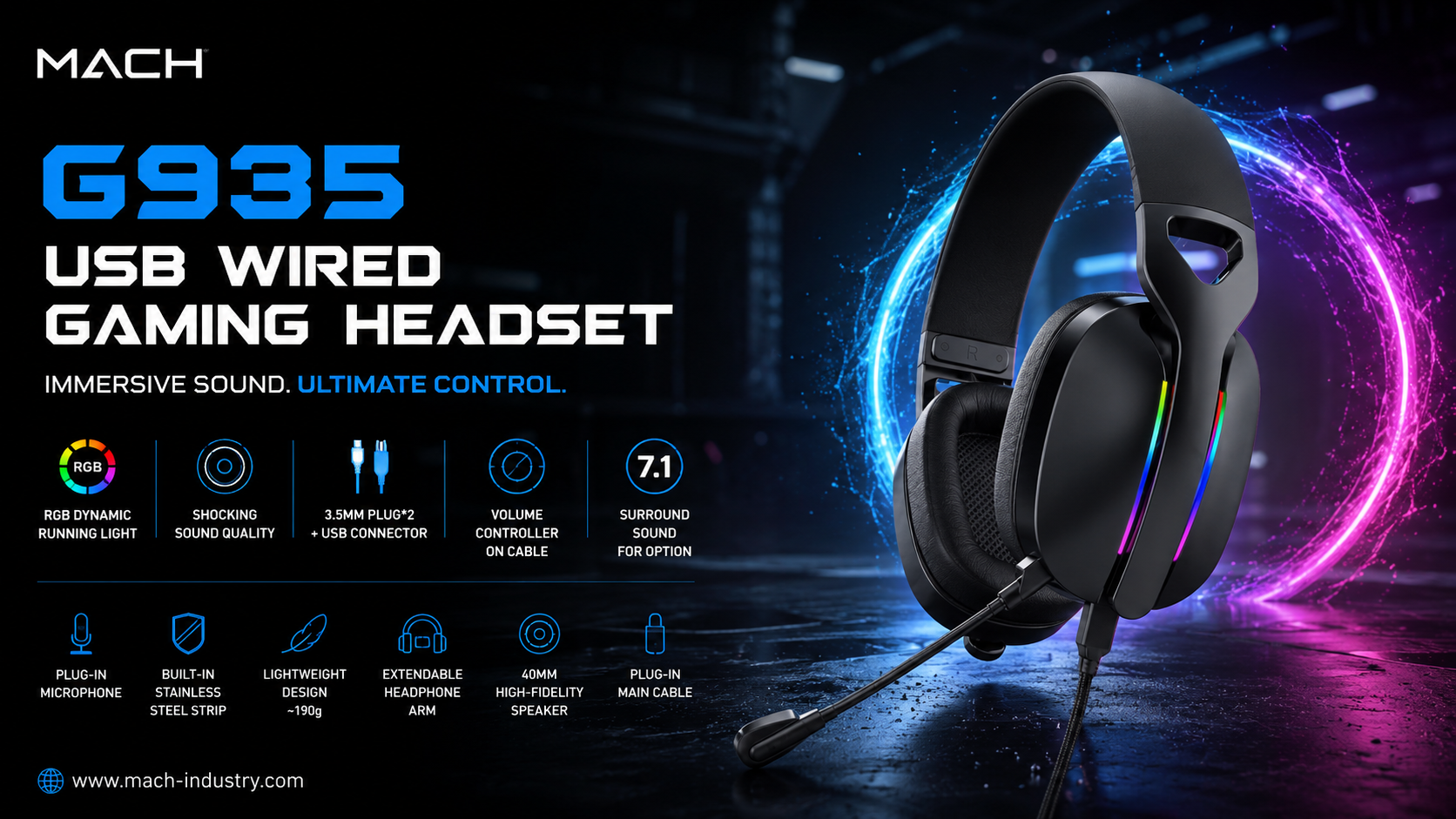
Professional gaming brands need more than a headset supplier. They need a manufacturing partner that understands audio performance, USB connectivity, customization and production reliability.
The right wired gaming headset platform should match the brand's target devices, connection logic, acoustic goals, microphone use, mechanical requirements and retail position. Buyers should define what 3.5mm and USB each do, whether virtual 7.1 is included, and how every claim will be validated before packaging is approved.
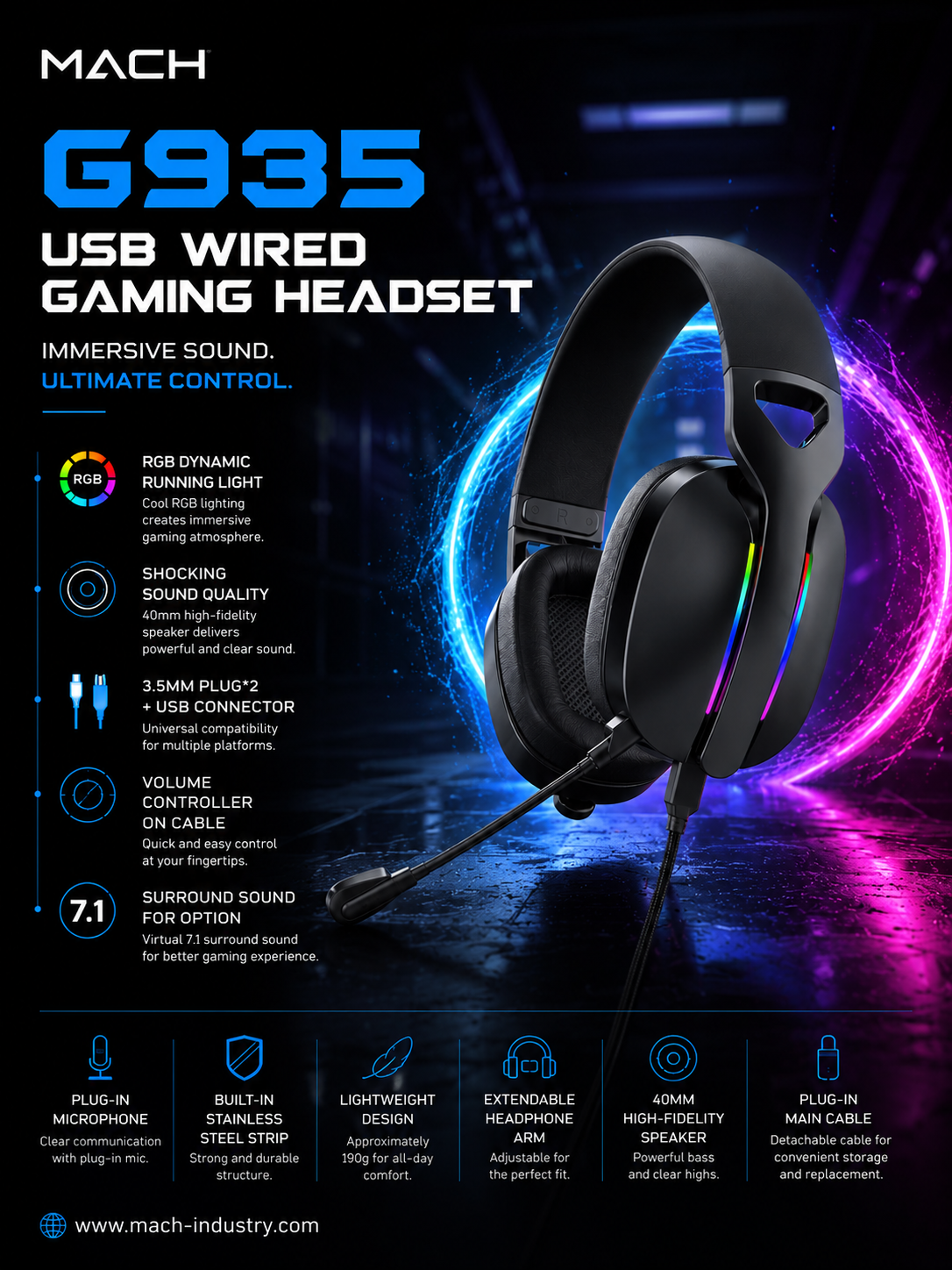
MACH G935 is a useful reference platform. Published data confirms 3.5mm + USB connectivity, a 40mm speaker, 20Hz-20KHz speaker response, a plug-in microphone, inline volume control, RGB running light, an approximately 190g structure, a stainless-steel strip, an extendable arm and a virtual 7.1 option. Because the exact role of each connector can depend on the released configuration, this guide separates confirmed platform features from project-specific implementation.
Why Wired Gaming Headsets Are Still Important for Gaming Brands
Wired gaming headsets remain commercially relevant because they provide a direct audio path, avoid battery management and can serve clearly defined PC, console and retail use cases.
A wired platform removes charging, battery aging and wireless pairing from the core user journey. That can simplify instructions and support for a brand whose customers value plug-in operation. It does not guarantee perfect performance: connector choice, host behavior, cable construction, acoustic tuning and microphone implementation still require engineering control.
USB and 3.5mm can support different product strategies. A 3.5mm route can use the host's analog interface, while a USB audio configuration can place digital audio processing within the headset system. Some dual-connector products use USB only for lighting or another powered function. Buyers must confirm the selected G935 configuration instead of assuming both connectors always carry audio.
Wired products also give brands a practical entry-to-mid-range option. G935 is positioned for USB wired headset brands, RGB product lines, PC gaming bundles, Amazon sellers, private-label programs and retail channels. The approximately 190g design direction, inline control and plug-in microphone can support a straightforward user proposition when the final package and connection instructions are clear.
For competitive gaming, consistency matters more than a generic technology label. A brand should validate audio, microphone, controls and virtual surround behavior on named devices. Wired architecture reduces some variables, but the product still needs a released cable, connector, controller and acoustic configuration.
| Buyer objective | Why wired can fit | What still requires validation |
|---|---|---|
| Simple user setup | No pairing or battery charging | Connector roles, adapters and host behavior |
| PC gaming features | USB audio and virtual surround can be configured | Controller, software and device-specific function |
| Broad analog use | 3.5mm can use compatible host audio interfaces | Combined jack, split connectors and microphone support |
| Retail value | Stable feature set and visible RGB direction | Claims, packaging, durability and quality limits |
G935 Wired Gaming Headset Platform Overview
G935 is a lightweight USB wired RGB gaming headset platform with 3.5mm + USB connectivity, a 40mm speaker, plug-in microphone, inline control and optional virtual 7.1.
The published speaker specification is a 40mm high-fidelity unit with 20Hz-20KHz frequency response and 32-ohm impedance. These numbers describe the component direction, not the complete listening result. Enclosure volume, ear cushions, fit, leakage, tuning and the host or USB processing path influence the finished product.
The plug-in microphone is specified at 50Hz-16000Hz response, -45dB plus or minus 3dB sensitivity and impedance at or below 2.3K ohms. A detachable structure can simplify packing and replacement, while the final connector retention, microphone position and voice result require sample approval.
The cable carries an inline volume controller, and the main cable is described as plug-in. The product also includes RGB dynamic running light. Cable and connector configuration, RGB direction, microphone structure and packaging bundle are confirmed customization areas.
Mechanically, G935 uses a built-in stainless-steel strip, extendable headphone arm and an approximately 190g minimalist structure. Weight alone does not establish comfort; clamp force, adjustment range, cushion geometry and user fit should be evaluated with production-representative samples.
MOQ is published at 2,000 pieces. Sample lead time is 7-15 days, while mass-production timing is project dependent. Confirmed market directions include North America, Europe, Amazon sellers, PC gaming accessory brands and retail gaming brands.
What Should Brands Consider Before Developing a USB Wired Gaming Headset?
Before development, brands should define a connector-function matrix, acoustic and microphone targets, cable architecture, virtual surround scope, customization and production acceptance criteria.
Begin with the audio architecture. Identify each target host and decide whether audio will pass through 3.5mm analog, USB digital audio or both. For USB, specify the controller function, channel format, microphone path, inline controls, lighting power, software dependency and virtual 7.1 behavior. For 3.5mm, define whether the product uses a combined headset plug, separate audio and microphone connectors, or an included adapter.
The connector-function matrix should name the cable or adapter required for every host. Test playback, microphone input, volume control, mute behavior, RGB power and surround function separately. A USB connector on a gaming headset may provide digital audio, lighting power or more than one role; packaging should describe only the released configuration.
Audio requirements should combine measurable specifications with listening scenarios. G935 confirms a 40mm speaker, 20Hz-20KHz response and 32-ohm impedance, but buyers still need a target sound direction and final-sample evaluation. Virtual 7.1 is an option, not a universal improvement. The brand should define the supported USB route, controls, software or hardware dependency and intended gaming scenario.
Microphone design includes more than frequency response. The plug-in structure needs insertion retention, electrical contact stability, positioning range and packaging protection. Voice approval should use named hosts, speaking distance, background conditions and comparison criteria. A detachable microphone can improve serviceability only if connectors and replacement policy are controlled.
Cable design affects both user experience and warranty exposure. Define length, jacket, strain relief, plug geometry, branch points, controller location, flex tests and packaging method. G935 confirms cable and connector customization, but the final configuration must be feasible for assembly and target devices.
Product customization should be divided into cosmetic and functional changes. Logo, color and CMF can shape brand identity; RGB direction, cable, connector and microphone changes can affect hardware, firmware or tests. Retail box, manuals, barcode labels and compliance documents must match the final product rather than the reference platform.
Manufacturing feasibility should be reviewed before design freeze. The supplier needs final drawings, approved colors, cable and microphone samples, controller behavior, firmware or surround configuration, package contents and a golden sample. Every late change should identify affected cost, schedule and validation.
Finally, buyers should define quality gates. Incoming parts, speaker matching, microphone function, cable continuity, controls, RGB, mechanical adjustment and cosmetic limits all need measurable checks. A professional platform becomes production-ready only when engineering evidence and the retail claim set describe the same product.
| Definition area | Buyer decision | Release evidence |
|---|---|---|
| Connection | Role of 3.5mm and USB for each target host | Host-by-function matrix |
| Audio | Target tuning and virtual 7.1 scope | Final-sample listening and functional approval |
| Microphone | Voice scenario and detachable structure | Host tests, retention and contact checks |
| Cable | Length, jacket, plugs, controller and strain relief | Released sample and durability plan |
| Customization | Logo, color, RGB, package and labels | Golden sample, artwork and limit references |
USB Audio vs Traditional 3.5mm Gaming Headset
USB and 3.5mm are different implementation choices: USB can support a controlled digital audio path and optional processing, while 3.5mm uses the compatible host's analog audio interface.
A USB audio headset can integrate digital conversion, controls and virtual surround within the selected headset configuration. This can help a brand define a consistent PC-focused feature set, but controller choice, host support and any software dependency must be validated. The presence of USB does not by itself confirm audio, 7.1 or universal compatibility.
A 3.5mm headset relies more heavily on the host's analog output and microphone interface. It can fit devices with a compatible headset jack and may simplify use where no USB audio path is required. Plug format, adapter needs, microphone behavior and control support still vary.
G935 publishes 3.5mm + USB connectivity and a virtual 7.1 option. Buyers should decide whether the selected product is USB-audio-led with analog flexibility, analog-audio-led with USB-powered lighting, or another verified combination. That decision affects packaging, accessories, quality tests and product positioning.
| Evaluation area | USB audio configuration | 3.5mm analog configuration |
|---|---|---|
| Audio processing | Can use an integrated digital controller and optional surround processing | Uses the compatible host's analog audio path |
| Compatibility | Depends on USB implementation, host and any software | Depends on jack wiring, adapters and host analog support |
| Gaming application | Can suit PC-focused digital audio and feature control | Can suit compatible console, controller and analog-audio scenarios |
| Brand positioning | Feature-led digital platform | Direct, broadly familiar analog connection |
| Primary buyer risk | Assuming USB means every digital feature on every host | Assuming every 3.5mm jack supports audio, microphone and controls identically |
Technical Deep Dive: Engineering Considerations Behind Wired Gaming Headsets
Wired headset engineering coordinates the speaker, enclosure, microphone, cable, controller, virtual surround and mechanical structure as one released system.
Speaker selection starts with electrical and mechanical fit, but final sound depends on the complete acoustic system. The G935 40mm speaker, 32-ohm impedance and published response provide a development base. Cushion sealing, ear-cup volume, damping, fit and USB or host output should be evaluated together.
Microphone engineering links capsule specification, boom position, port geometry, connector contact and host input. The plug-in microphone should be checked for insertion force, rotation or positioning, intermittent contact and repeated use. Voice tests should use the final cable and connection route.
Cable durability involves conductor construction, jacket, plug molding, strain relief and flex concentration points. The inline controller adds interfaces that need continuity and operation checks. A plug-in main cable can support packing or service objectives, but both connection ends require retention and cycle criteria.
USB controller integration should define audio channels, sample behavior, microphone routing, controls, lighting power and any firmware or software. This guide does not infer a chipset because none is published for G935. The released controller configuration should be revision-controlled.
Virtual 7.1 is a signal-processing option that creates directional cues from a headset's two physical ear channels. Its value depends on implementation, source content and user preference. Buyers should approve mode switching, indicators, supported hosts and the difference between stereo and virtual surround without claiming it replaces a discrete multi-speaker system.
Mechanical quality connects the stainless-steel strip, extendable arm, approximately 190g structure and ear cushions. Adjustment cycling, clamp consistency, hinge or slider movement, cable pull and cosmetic limits should reflect the intended channel and warranty expectations.
- Approve acoustic performance with final cushions, enclosure and connection route.
- Test plug-in microphone contact, retention, position and voice result.
- Define cable, plug, controller and strain-relief durability requirements.
- Revision-control the released USB controller and virtual 7.1 behavior.
- Validate RGB power and effects in the final connection configuration.
- Check slider, stainless-steel strip, fit and cosmetic limits.
- Tie production tests to the golden sample and approved claims.
OEM Customization Opportunities for Wired Gaming Headsets
G935 supports brand, appearance, connection, microphone and packaging customization, with scope confirmed through engineering review and sample approval.
Logo branding can be applied to available headset-housing areas, while color and CMF customization can align the product with a wider accessory family. Buyers should provide vector artwork, color standards, finish references and physical approval expectations.
RGB lighting direction is customizable. Define the illuminated zone, effect, colors, brightness direction, power route and control behavior. The approved lighting sample should be evaluated with the final housing color and USB configuration.
Cable and connector configuration can be adapted to the intended device plan. The RFQ should state plug formats, cable length, jacket, controller, adapters and package arrangement. Any change affecting audio, microphone, lighting or controls requires functional validation.
Microphone structure and packaging bundle are listed customization areas. Buyers should specify whether the plug-in microphone is packed attached or separately, how it is protected and how replacements are handled. Functional changes beyond the confirmed structure need feasibility review.
Retail box design, manuals, barcode labels, private-label packaging and compliance-document support are confirmed capabilities. Documentation support does not mean the unmodified platform already holds every required certification; requirements depend on final configuration and destination market.
How MACH Supports Gaming Headset Product Development
MACH supports OEM/ODM wired gaming headset projects by connecting buyer requirements with platform selection, engineering review, samples, documentation and manufacturing controls.
The process begins with a product brief covering customers, channels, target devices, connection roles, audio and microphone expectations, design direction, package contents, destination markets, quantity and schedule. A fit-gap review determines which G935 elements can be retained and which requests require customization.
Engineering aligns the cable and connector plan, acoustic reference, microphone structure, RGB, virtual 7.1 option, mechanics and manufacturability. Samples are then approved against named requirements rather than a generic reference unit.
Production preparation connects the released bill of materials, drawings, firmware or controller configuration, colors, logo artwork, packaging, test plan and golden sample. Quality checks can cover connection, audio, microphone, controls, lighting, structure, appearance and package contents.
MOQ for G935 is 2,000 pieces, and samples are listed at 7-15 days. Mass-production lead time remains project dependent because customization, tooling, materials, validation and packaging can change the schedule.
| Development stage | Key output |
|---|---|
| Requirement review | Target devices, connector-function matrix and product brief |
| Engineering | Audio, microphone, cable, RGB, surround and structural definition |
| Sampling | Functional and branded approval samples |
| Production release | Golden sample, controlled revisions, artwork and QC plan |
| Mass production | Functional, cosmetic and packaging inspection |
Buyer Checklist
A complete wired gaming headset RFQ should define the product position, hosts, connector functions, acoustic and voice targets, structure, customization, compliance needs and commercial plan.
Start with the customer and channel. State whether the product is for a PC bundle, private-label retail line, Amazon listing or broader gaming accessory family. Define the target price and features that genuinely influence purchase.
Attach a host matrix showing 3.5mm and USB roles, required adapters, audio, microphone, controls, RGB and virtual 7.1. Add listening and voice references, mechanical expectations and cable requirements.
Provide logo, color, CMF, RGB, packaging, manuals, labels and compliance requirements. State sample quantity, order forecast, launch date and approval owners. Ask the supplier to identify assumptions and changes that trigger retesting.
- Target users, channel and price position
- Host-by-connector function matrix
- Audio, microphone and virtual 7.1 requirements
- Cable, controller, plug and adapter specification
- Weight, fit, adjustment and durability expectations
- Logo, color, RGB and package direction
- Destination markets and compliance plan
- MOQ, samples, schedule and golden-sample approval
Conclusion
The best wired gaming headset platform is the one whose connection roles, audio, microphone, cable, structure and OEM scope match the brand's verified market requirements.
G935 provides a documented starting point with 3.5mm + USB connectivity, a 40mm speaker, plug-in microphone, inline control, RGB running light, approximately 190g structure and optional virtual 7.1. Its buyer value comes from turning those features into a precise released configuration rather than relying on broad connector labels.
MACH industry can review your target devices, USB and 3.5mm function matrix, audio direction, microphone needs, cable plan, RGB, branding, packaging and destination markets. A clear RFQ allows engineering and production to evaluate the right G935 OEM/ODM scope.
Frequently Asked Questions
What is a professional wired gaming headset OEM solution?
It is a controlled headset platform whose audio, microphone, cable, connectors, structure, branding, packaging and production tests are configured for a brand's target devices and market.
What specifications are confirmed for MACH G935?
G935 confirms 3.5mm + USB connectivity, a 40mm speaker, plug-in microphone, inline volume control, RGB running light, stainless-steel strip, extendable arm, approximately 190g weight and a virtual 7.1 option.
Does USB on a gaming headset always carry audio?
No. USB can carry digital audio, lighting power, controls or a combination depending on the configuration. Buyers should confirm every connector function before approving claims.
Is USB audio better than a 3.5mm gaming headset?
Neither is universally better. USB can support controlled digital processing and optional surround, while 3.5mm can suit compatible analog hosts. The right choice depends on target devices and product positioning.
What does virtual 7.1 mean in a wired gaming headset?
Virtual 7.1 uses signal processing to create directional cues through the headset's two ear channels. Buyers should confirm implementation, controls, supported hosts and the stereo-versus-surround user experience.
Can G935 be customized for private-label brands?
Yes. Published options include housing logo, RGB direction, color and CMF, cable and connectors, microphone structure and bundle, retail box, manuals, barcode labels, packaging and compliance-document support.
What is the MOQ and sample lead time for G935?
The published MOQ is 2,000 pieces, and sample lead time is 7-15 days. Mass-production timing is project dependent.
What should brands test in a wired gaming headset cable?
Brands should define continuity, flex, pull, plug retention, strain relief, controller operation, branch points and packaging conditions for the final cable configuration.
Can MACH support gaming headset certification documentation?
G935 lists private-label packaging and compliance-documentation support. Required testing and certification depend on the customized product and destination market; no universal certification is implied.
What should a buyer prepare for a G935 OEM quotation?
Prepare target users and devices, USB and 3.5mm roles, audio and microphone requirements, cable plan, virtual 7.1 scope, RGB, branding, packaging, markets, quantity and schedule.
Related Resources
Need OEM/ODM gaming audio solutions?
Contact MACH Industry to discuss your gaming headset, gaming earbuds, or private-label audio project.
Contact MACH Industry