Home > Resources > OEM Knowledge
How to Develop a Differentiated Tri-Mode Wireless Gaming Headset on a Mature ODM Platform
A sourcing and engineering guide for private-label gaming brands using the X2 China ODM project to explain tri-mode wireless headset platform reuse, Bluetooth, 2.4GHz, 3.5mm AUX, 50mm drivers, RF review, CMF, wood-grain validation, compliance planning, and mass-production support.
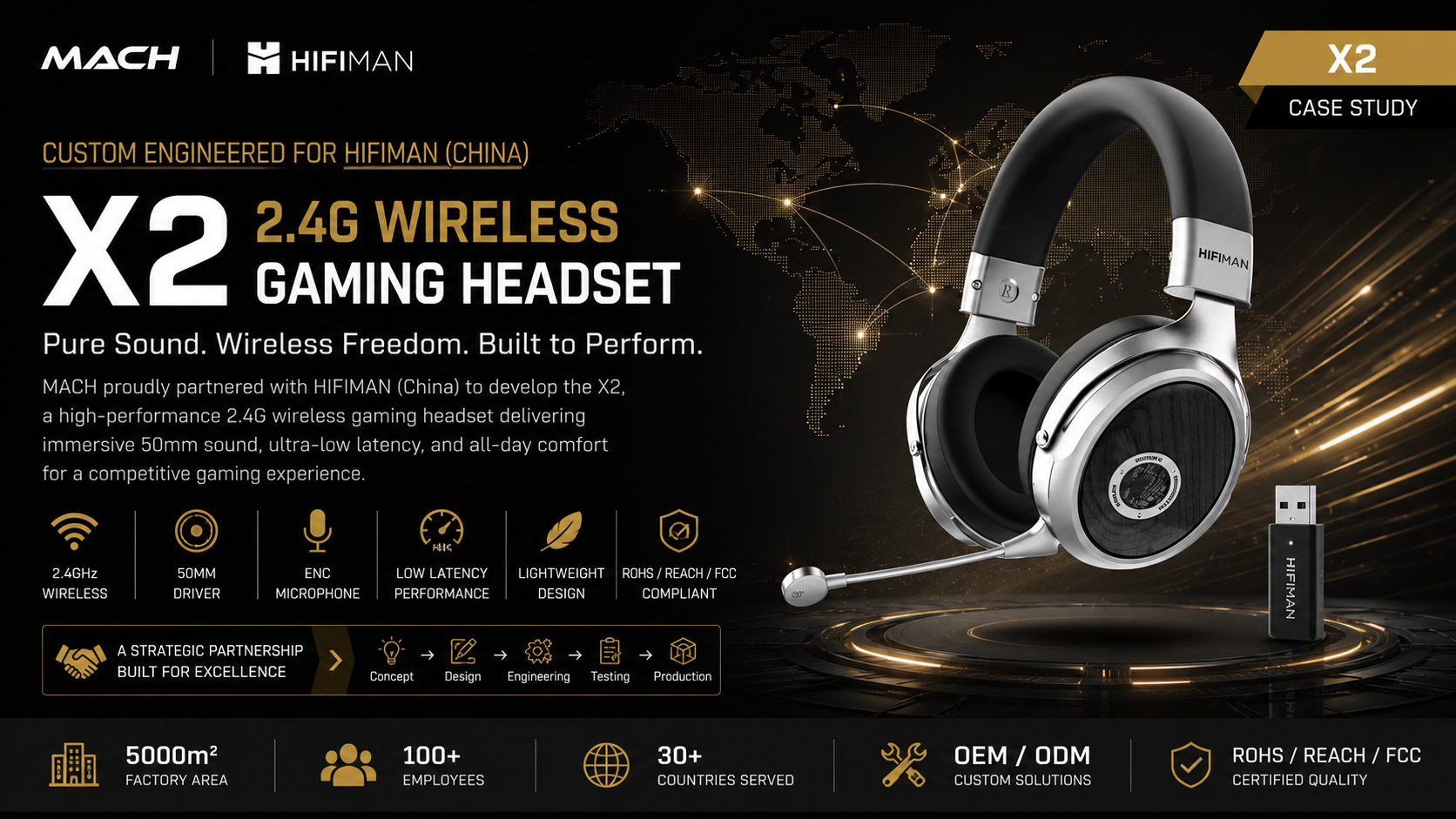
A private-label gaming brand does not always need to develop a wireless headset entirely from scratch. For many OEM and ODM buyers, a mature tri-mode wireless gaming headset platform is the practical starting point: the wireless, structural, acoustic, and production foundations already exist, while the buyer can still customize CMF, logo, packaging, accessories, microphone configuration, lighting behavior, documentation, and channel positioning.
This article uses the X2 China ODM project as an educational example. It explains how a gaming accessories brand can use a mature Bluetooth + 2.4GHz + 3.5mm platform to reduce RF, tooling, firmware, compatibility, certification, and mass-production risks while building a recognizable private-label product.
What Is a Tri-Mode Gaming Headset?
A tri-mode gaming headset combines Bluetooth, 2.4GHz wireless audio, and 3.5mm AUX so one SKU can cover wireless use, gaming, and wired fallback scenarios.
For OEM and ODM buyers, tri-mode architecture gives the brand a broader compatibility story than a single-mode headset. The X2 platform includes Bluetooth, 2.4GHz low-latency wireless audio, a USB transmitter, 3.5mm AUX input, Type-C charging, RGB lighting control, a 50mm driver, noise-reduction microphone, detachable microphone input, and firmware update support through Type-C.
The sourcing point is not only the feature list. Each mode affects packaging claims, user manuals, accessories, support scripts, and validation. A buyer should confirm how the headset switches modes, how the transmitter pairs, how the microphone behaves in each connection scenario, and which claims are safe for the target sales channels.
X2 Project Snapshot
The X2 China ODM project was positioned as an OEM plus ODM tri-mode wireless gaming headset platform for a private-label gaming audio buyer serving export markets.
The confirmed model is X2. The base platform originated from China for global private-label gaming audio channels. The buyer should be described anonymously as a private-label gaming audio buyer or gaming accessories brand. The source case references Korea, the USA, Germany, France, the UK, Japan, and other export markets, which makes compliance planning and multi-device validation important.
Confirmed specifications include 2.403-2.478GHz wireless operation, 50mm driver, 32-ohm impedance, 20Hz-20kHz speaker frequency range, microphone sensitivity of -38 +/- 3dB, omnidirectional pickup, RGB lighting control, logo customization, retail packaging customization, color/finish exploration, and wood-grain appearance review. This article uses those facts to explain a sourcing path, not to repeat the case page.
Why the Buyer Chose a Tri-Mode ODM Platform
The sourcing logic was risk reduction: reuse a mature wireless, structural, acoustic, and production foundation, then customize the brand-facing layers that matter to retail buyers.
Developing a wireless headset from zero can be justified for a flagship product, but it introduces more tooling, electronics, RF, firmware, acoustic, certification, and production variables. Many private-label brands need a credible differentiated product without taking on every engineering risk at once.
MACH industry supported the X2 project with industrial design review, structural review, PCB support, RF stability review, antenna validation, acoustic and microphone review, tooling support, logo and packaging customization, compliance document coordination, reliability and aging testing support, trial production, QC, and mass-production planning. Planning a tri-mode gaming headset for multiple target devices? Define connection modes, transmitter behavior, microphone structure, firmware needs, CMF, packaging claims, and compliance expectations before treating samples as final.

How to Differentiate a Private-Label Gaming Headset Without Developing Everything From Scratch
Platform reuse does not have to mean logo-only sourcing. A brand can reuse the engineering base while differentiating CMF, packaging, accessories, microphone configuration, lighting behavior, documentation, and user experience.
The first layer is CMF: color, material, finish, texture, trim contrast, logo placement, and surface treatment. In the X2 context, wood-grain appearance review shows how a buyer can seek a distinctive look beyond standard black gaming hardware. That type of finish should be checked for visual consistency, adhesion, abrasion resistance, color repeatability, production yield, assembly tolerance, and RF impact.
The second layer is configuration. Buyers can shape microphone structure, detachable microphone input, accessory bundle, USB transmitter presentation, Type-C cable, AUX cable, RGB behavior, user manual language, retail box layout, and warranty content. Firmware changes may be possible where the platform supports them, but they should be controlled because they can affect pairing, charging, lighting control, or compatibility.
Not every change carries the same risk. Logo, packaging, color selection, accessories, and manuals are usually lower-risk. Surface texture, coating, wood-grain finish, and lighting behavior need more validation. Antenna relocation, PCB changes, battery changes, major acoustic cavity changes, and new tooling can increase cost exposure and validation load. RF stability, antenna position, structure, DFM, assembly process, and QC criteria should be reviewed before appearance is frozen.
Comparison table: Ready Platform | Scope: existing architecture with logo, packaging, color, and accessories | Tooling: minimal unless special changes are required | Engineering risk: lower | RF validation: confirm target-use stability | Differentiation: moderate | Cost exposure: lower | Time-to-market: generally faster, without promising a fixed cycle | Recommended buyer: private-label brands needing a practical launch path.
Comparison table: Semi-Custom ODM | Scope: mature platform plus CMF, finish, microphone, lighting, firmware, packaging, or selected structural changes | Tooling: partial work may be needed | Engineering risk: medium | RF validation: deeper review | Differentiation: strong when scoped correctly | Cost exposure: medium | Time-to-market: scope-dependent | Recommended buyer: brands needing visible differentiation while controlling risk.
Comparison table: Full Custom Development | Scope: new ID, structure, electronics, acoustics, tooling, firmware, validation, and production process | Tooling: significant | Engineering risk: higher | RF validation: full path required | Differentiation: highest | Cost exposure: highest | Time-to-market: longest and project-dependent | Recommended buyer: brands with a clear flagship strategy and enough technical budget.
Not sure whether to choose a ready platform, semi-custom ODM or private tooling? Share your target markets, required modes and launch plan with MACH for an initial feasibility discussion.
Engineering Challenges in a Tri-Mode Wireless Gaming Headset
Tri-mode products create more engineering touchpoints because RF, antenna placement, firmware behavior, charging, microphone performance, audio tuning, and mechanical layout must work together.
RF stability is a primary challenge. The 2.403-2.478GHz operating range sits in a crowded wireless environment, so antenna placement, PCB layout, transmitter behavior, enclosure materials, and nearby decorative parts can affect stability. A finish that looks attractive may still need review if it changes the material stack near the antenna area.
Mode behavior is the second challenge. Bluetooth, 2.4GHz wireless, AUX input, Type-C charging, RGB lighting control, and firmware update paths must be explained and verified. These details influence manuals, packaging claims, and customer support. Trial production, reliability and aging testing support, QC criteria, carton planning, and packaging-line control then help connect sample approval to mass-production readiness.

Why a 50mm Driver Is Only One Part of the Acoustic System
A 50mm driver can support a strong gaming audio position, but driver size alone does not define sound quality, microphone clarity, or production consistency.
The X2 platform uses a 50mm speaker driver with 32-ohm impedance and a 20Hz-20kHz speaker frequency range. These are useful specification points, but acoustic performance also depends on earcup volume, cushion seal, driver placement, mesh material, enclosure rigidity, tuning direction, and production consistency.
Voice performance also depends on the whole microphone system. The noise-reduction microphone, detachable microphone input, -38 +/- 3dB sensitivity, omnidirectional pickup, boom position, and wireless transmission path all affect communication. MACH’s acoustic and microphone review helps buyers check whether the platform fits the intended channel before production planning.
CMF and Wood-Grain Finish as Brand Differentiation
CMF can turn a mature ODM platform into a recognizable private-label product, but special finishes should be validated before they become a production promise.
Color and finish exploration is often where a private-label product becomes visually ownable. Wood-grain appearance review is a useful X2 example because it shows how a buyer can create a surface language that stands out in marketplace thumbnails, retail shelves, distributor presentations, and brand campaigns.
The sourcing risk is that coating, printing, or texture changes must be checked for repeatability, alignment, wear resistance, surface defects, and assembly compatibility. The finish should not interfere with RF performance, antenna validation, structural fit, button movement, microphone connection, or Type-C access. CMF approval should therefore be connected to engineering review, not handled as a visual-only decision.
MACH’s ODM Development Workflow
A structured workflow keeps industrial design, RF, acoustics, compliance, packaging, and QC aligned from project idea to production planning.
Requirement confirmation comes first. MACH reviews target markets, connection modes, device expectations, price tier, product positioning, customization scope, packaging needs, and compliance direction. For X2, this includes Bluetooth, 2.4GHz, AUX, USB transmitter, Type-C charging, RGB control, detachable microphone, firmware update, logo, and packaging requirements.
Engineering review follows through industrial design, structure, PCB support, antenna validation, RF stability, acoustic performance, microphone behavior, tooling readiness, and finish feasibility. The final stage connects samples, reliability and aging testing support, trial production, QC standards, packaging-line coordination, compliance document coordination, warehouse planning, and mass-production scheduling.

Compliance Planning for Multiple Export Markets
Compliance should be planned around target markets and final configuration rather than assumed from a generic platform description.
The X2 support scope references KC, CE, FCC, and RoHS coordination. Because the target markets include Korea, the USA, Germany, France, the UK, Japan, and other export destinations, the buyer should map each channel’s requirements before packaging and shipment decisions are finalized.
A wireless headset with a USB transmitter, Bluetooth, Type-C charging, RGB control, microphone, and AUX input may have a different documentation path from a simple wired headset. MACH can support compliance document coordination, but buyers should not treat any document as universal proof for every importer, distributor, or marketplace.
ODM Platform vs Full Custom Development
The right route depends on how much differentiation the brand needs and how much engineering risk, tooling investment, and validation work it can support.
A ready platform suits buyers that need controlled cost, lower engineering risk, and a practical launch route. Differentiation depends on thoughtful CMF, packaging, accessories, and product story work. Semi-custom ODM adds more visible differentiation through finish, microphone option, lighting, firmware details, selected structural adjustments, and packaging, while still reusing the engineering base.
Full custom development provides the most control but also the highest exposure. New tooling, PCB, acoustic system, firmware, industrial design, and validation require more capital and coordination. It is most suitable when the brand has a clear reason to own the architecture and enough forecast confidence to support the work.

OEM/ODM Buyer Checklist
A clear buyer brief reduces quotation errors, sample revisions, and avoidable engineering changes.
Prepare target markets and device scenarios first: PC, console, mobile, Bluetooth use, USB transmitter use, AUX fallback, and channel claims. Then define product position: entry-level, mid-range, premium, esports-style, lifestyle gaming, or a special private-label bundle.
Prepare technical requirements next: connection modes, 2.4GHz expectations, microphone structure, detachable microphone needs, 50mm driver positioning, RGB behavior, Type-C charging, firmware update expectations, accessory list, logo position, color references, surface finish references, packaging direction, manual languages, carton requirements, and compliance markets.

Lessons Learned From the X2 ODM Platform
The X2 case shows that platform maturity and product differentiation can work together when the buyer customizes the right layers and validates the right engineering risks.
Tri-mode architecture should be treated as a system, not a loose feature list. Bluetooth, 2.4GHz, AUX, USB transmitter, Type-C charging, firmware update, microphone, RGB, and packaging claims must support one coherent product story.
ODM platform reuse is not a shortcut around quality work. It is a way to focus engineering review on the areas most likely to affect launch risk: RF, antenna, structure, acoustics, microphone, firmware, DFM, packaging, testing, compliance, QC, and mass-production readiness.

Conclusion and CTA
A mature tri-mode wireless gaming headset ODM platform can help private-label gaming brands launch a differentiated product while reducing unnecessary engineering exposure.
The X2 China ODM project shows how a gaming brand can use an existing tri-mode platform and still build a product that feels specific to its channel. Bluetooth, 2.4GHz wireless audio, 3.5mm AUX, USB transmitter support, Type-C charging, RGB lighting, 50mm driver positioning, detachable microphone input, CMF exploration, packaging customization, compliance coordination, reliability support, QC, and production planning all belong to the same development conversation.
Discuss Your Tri-Mode Gaming Headset ODM Project. Share your target markets, required connection modes, CMF direction, packaging plan, compliance expectations, and launch needs with MACH industry to evaluate a practical OEM or ODM route for your private-label gaming audio product.
Frequently Asked Questions
What is a tri-mode wireless gaming headset?
It supports Bluetooth, 2.4GHz wireless audio through a USB transmitter, and 3.5mm AUX wired input. Buyers should confirm device compatibility, microphone behavior, controls, charging interface, and firmware functions.
Why do private-label brands choose a mature ODM headset platform?
A mature ODM platform reduces uncertainty because structure, electronics, wireless architecture, tooling basis, and production process already exist. The buyer can focus on branding, packaging, compliance, and channel positioning.
Can a private-label wireless headset be differentiated without new tooling?
Yes. Logo, color, finish, RGB behavior, microphone option, accessory kit, manual, packaging, and bundle strategy can create differentiation. New tooling or PCB changes require deeper validation.
What is the role of 2.4GHz wireless audio in a gaming headset?
2.4GHz wireless audio is selected for gaming because it can support lower latency than typical Bluetooth audio when transmitter, firmware, antenna layout, and host behavior are validated.
Is a 50mm driver enough to guarantee good gaming sound?
No. Driver size is one part of the acoustic system. Earcup volume, cushion seal, tuning, enclosure structure, microphone placement, material consistency, and QC also matter.
What compliance documents should buyers plan for a wireless gaming headset?
The X2 context includes KC, CE, FCC, and RoHS coordination. Exact needs depend on target market, configuration, importer requirements, labels, manuals, transmitter, and sales channel.
Does ODM platform reuse mean the product is only a logo project?
No. The base architecture is reused, while the product can still be differentiated through CMF, texture, lighting, microphone configuration, packaging, accessories, manuals, and firmware details.
When should a buyer choose ready platform, semi-custom ODM, or full custom development?
Choose ready platform for speed and lower risk, semi-custom ODM for controlled differentiation, and full custom when the brand needs ownership of structure, tooling, electronics, and validation.
Can MACH support logo and retail packaging customization?
Yes. MACH industry can support logo execution, packaging, color and finish exploration, manual coordination, accessory planning, and carton information for private-label gaming audio projects.
What should buyers prepare before starting a tri-mode headset ODM project?
Prepare target markets, required modes, device expectations, feature priorities, logo files, CMF references, packaging direction, accessory list, compliance needs, forecast, and launch plan.
Related Resources
Need OEM/ODM gaming audio solutions?
Contact MACH Industry to discuss your gaming headset, gaming earbuds, or private-label audio project.
Contact MACH Industry