Home > Resources > OEM Knowledge
How to Build a Part-Level CMF Control Matrix for an IP Gaming Headset
A buyer guide to translating character artwork into controlled materials, Pantone references, textures, translucent parts, printing, painting and inspection standards for IP gaming headsets.
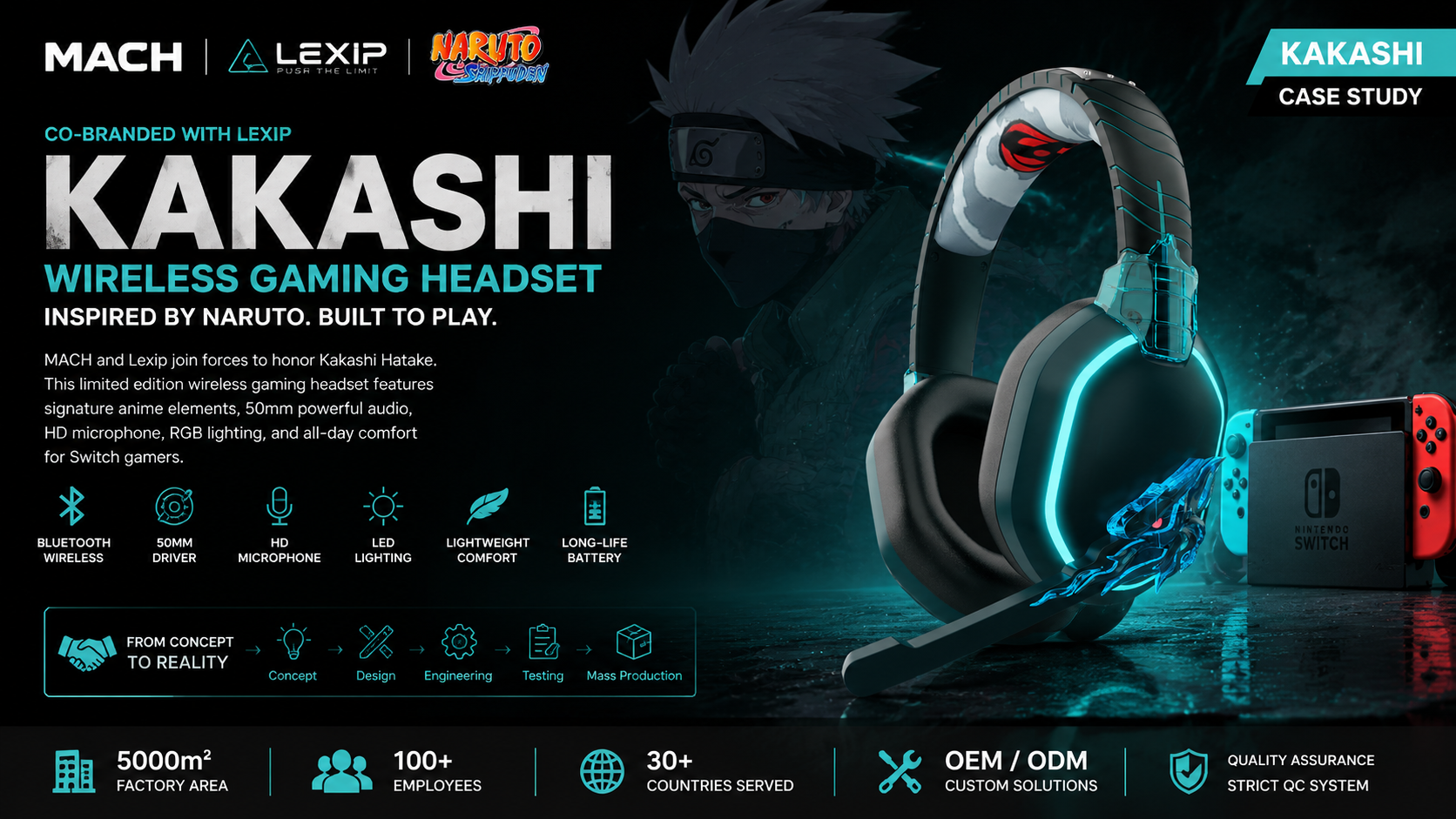
Gaming brands should convert character artwork into a part-level CMF matrix before approving an IP collaboration headset. The matrix must identify every visible component, substrate, base color, Pantone reference, texture, gloss, transparency, printing or coating process, artwork orientation, boundary, sample standard and inspection method. A mood board can communicate identity, but it cannot control mass production by itself.
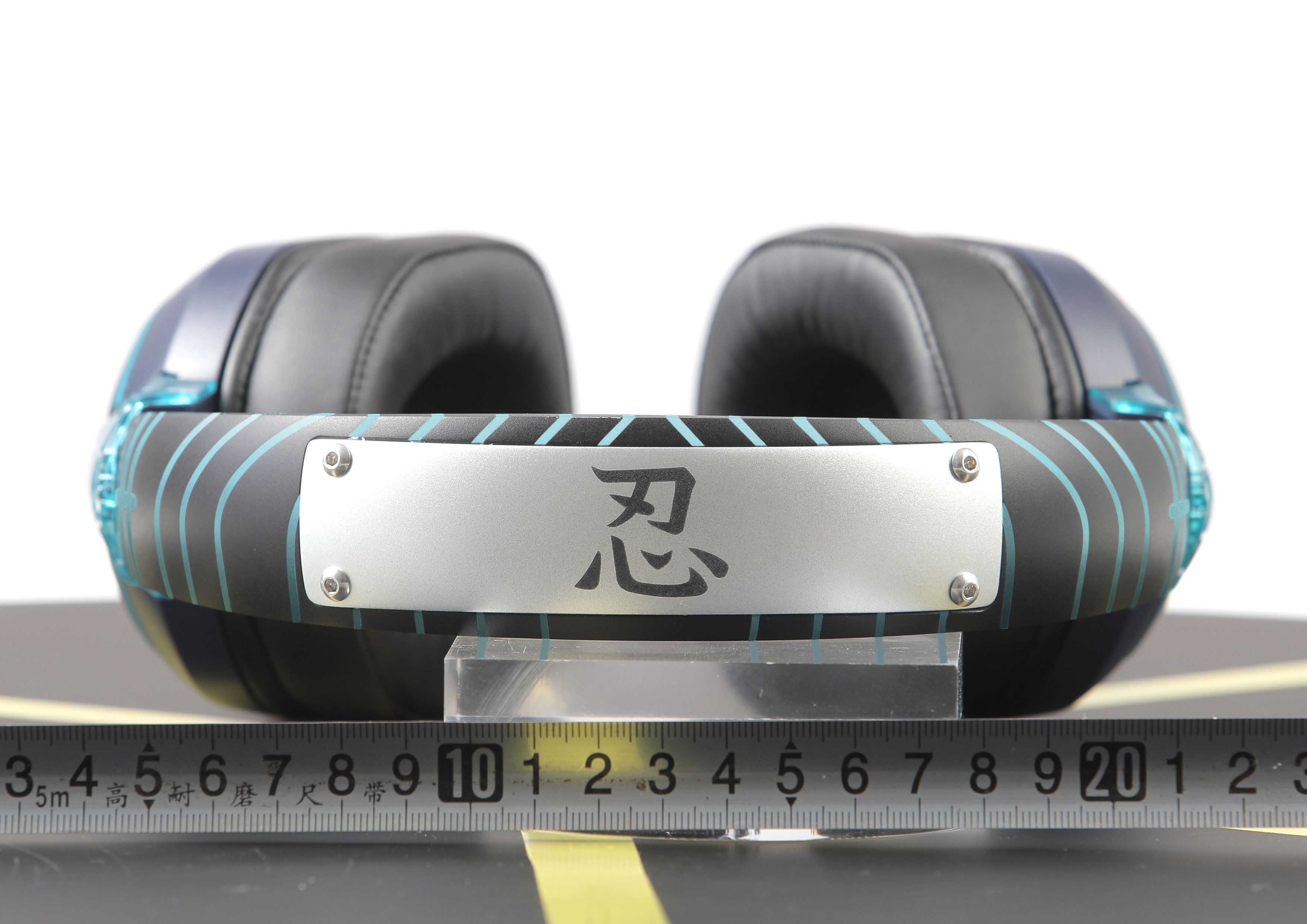
The KAKASHI France OEM project provides a detailed engineering reference. Its public files connect a character palette to PP, ABS, POM, PC, PVC, aluminum, stainless steel and PU parts, with molded color, texture, water-transfer decoration, transparent and translucent effects, matte painting, silk printing, pad printing, labels, anodizing and laser-created light details. This guide uses that evidence to answer a procurement question that is narrower than the existing KAKASHI limited-edition development article: how should a buyer freeze and inspect the visual system across many parts and processes?
What a Part-Level CMF Matrix Must Control
A production-ready CMF matrix links each component to one approved material, color reference, surface process, visual standard, tolerance and inspection method.
CMF means color, material and finish. In an IP headset, those three variables also carry character recognition. The same nominal blue can appear different when molded into PP, mixed into transparent PC, printed over paint or viewed through a light guide. The buyer must control the physical result rather than assume one digital color value will reproduce identically everywhere.
The matrix should use part names and drawing identifiers, not descriptions such as blue area or logo side. It should identify left and right orientation, texture zones, gloss transitions, artwork position, protected assembly surfaces and acceptable process variation. Physical limit samples or signed production-intent samples then support the written standard.
A clear matrix improves quotation and schedule accuracy. It reveals which colors can be molded, which need painting, which graphics require pad or silk printing, which transparent parts need toner, and where tooling texture or a secondary operation is necessary.
| Matrix field | Buyer question | Approval evidence |
|---|---|---|
| Part identity | Which exact component and side? | Drawing or BOM reference |
| Material | PP, ABS, POM, PC, PVC, metal or PU? | Released material specification |
| Color | Which reference and viewing condition? | Pantone and physical sample |
| Finish | Texture, gloss, paint, print or transparency? | Process sample and limit board |
| Inspection | How is consistency judged? | Method, lighting and defect criteria |
KAKASHI France OEM Project Overview
KAKASHI was a France-market Bluetooth gaming headset OEM project combining character-led CMF, custom structure, lighting, branding, compliance support and mass-production control.
The case card records an OEM program for a gaming brand, importer and distributor across France and other export markets. MACH support included industrial design, structure, PCB, RF, acoustic, tooling, QC and mass production. Public project data identifies Bluetooth positioning, 50mm speakers, detachable rotating microphone, USB-C charging and audio integration, LED lighting and a 1000mAh battery direction.
The engineering specification defines materials for the visual system: PP headband, POM extension arms, ABS shells and microphone covers, PC decorative and transparent parts, PVC decoration, PU cushions, stainless-steel structure, aluminum headband decoration, light boards and guides. It also documents molded color, reference texture, water-transfer decoration, transparent colored PC, matte painting, silk printing, pad printing, labeling, anodizing and laser light-ring work.
The KAKASHI palette files identify references including 2197 C, 533 C, 2165 C, Black 6 C, 3517 C and 2155 C. A process report then assigns selected references to specific components. These are project records, not universal recipes for every IP product.
| System layer | KAKASHI project direction | Control need |
|---|---|---|
| Palette | Character-linked Pantone references | Approve relationships, not isolated chips |
| Plastics | PP, ABS, POM, PC and PVC | Account for substrate and transparency |
| Decoration | Water transfer, labels, silk and pad printing | Control location, orientation and adhesion |
| Lighting | Translucent parts and laser details | Approve lit and unlit appearance |
| Structure | Shared parts and interchangeable themed components | Protect fit while changing appearance |
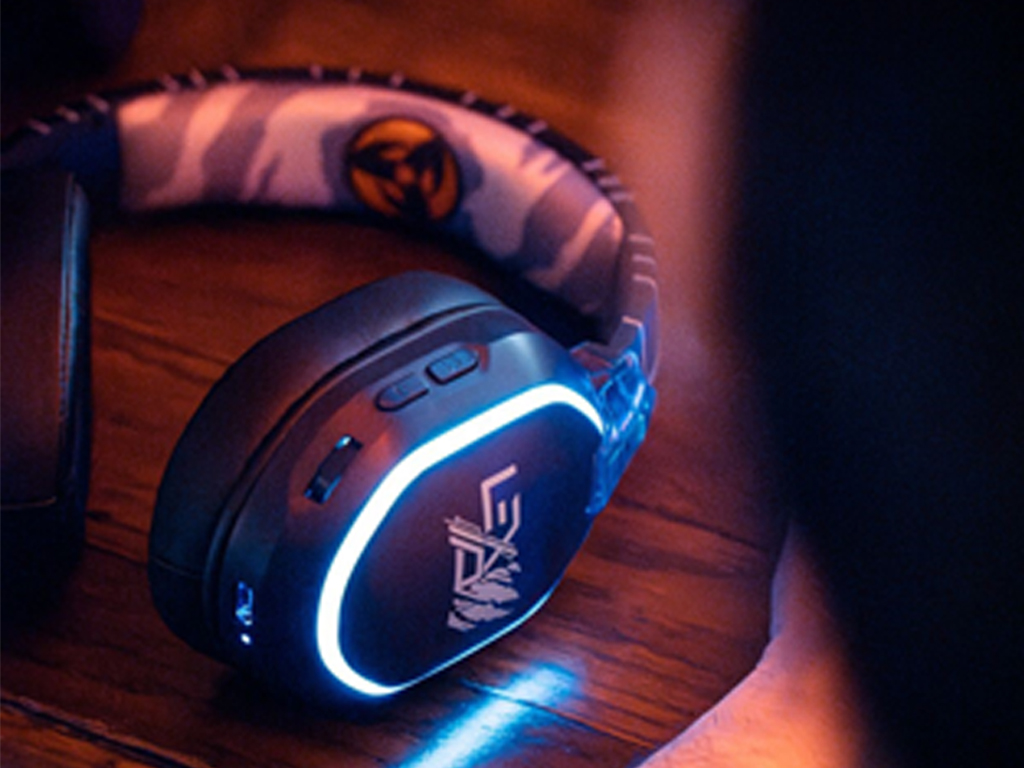
Buyer Challenge: Artwork Is Not a Production Specification
Character artwork describes visual intent; manufacturing needs process-specific instructions for real materials, geometry, tolerances and repeated production.
Flat artwork does not show how color changes on curved, textured or translucent surfaces. It may also contain relief, depth or edge effects that injection molding or printing cannot reproduce without tooling changes. The KAKASHI engineering file explicitly records questions where molding could not create the illustrated effect or where a flat printing process could match color but not concave-convex form.
Procurement managers need these feasibility gaps surfaced before final artwork approval. Otherwise, design teams may approve an image that suppliers interpret through different processes, creating quotation changes, repeated samples or inconsistent mass production.
Another challenge is family consistency. KAKASHI shared a structural platform with other themed versions while assigning different colors and decorative parts. Shared tooling improves platform efficiency, but every variant still needs a separate visual release pack and controlled interchangeability.
How MACH Connected Design With Manufacturing
MACH translated visual intent into component, material, tooling and secondary-process decisions, then connected approved samples to QC and production.
The project documentation breaks the headset into visible parts and records material, base color, texture and process directions. It distinguishes molded parts from painted, printed, labeled, anodized, translucent and laser-treated elements. This lets engineering review appearance together with assembly and tooling.
Mold planning covered the headband, extension arms, sheath covers, decorative covers, ear shells, cavity covers, buttons, microphone covers and interchangeable PVC decoration. Material and cavity planning mattered because themed parts still had to assemble on one stable headset platform.
Prototype and process samples enabled the buyer to compare digital intent with physical results. MACH could then coordinate approved CMF, structure, electronics, acoustic components, packaging, compliance documentation, OQC and mass-production follow-up as one released product.
Why Character Recognition Depends on Color Relationships Across Parts
An IP product remains recognizable when primary, secondary, accent, neutral and illuminated colors preserve their intended hierarchy across different materials and viewing states.
Buyers often ask whether a factory can match a Pantone. The harder question is whether several materials and processes still look intentional together. A molded POM arm, textured PP headband, high-gloss translucent PC cover, painted decoration and printed logo can each shift hue, saturation and brightness. Even individually acceptable parts may look wrong after assembly if their relationships drift.
Define the role of each color first. Primary character colors carry recognition; neutrals organize the silhouette; accents guide attention; illuminated areas add a second visual state. KAKASHI project files identify a coordinated family of blues, red accents and Black 6 C rather than one hero color. The matrix should state which relationship is critical, such as an accent remaining visibly distinct from its surrounding translucent part.
Approve parts in assemblies, not only as loose plaques. Adjacent materials change visual judgment, while shell curvature, texture and shadows affect perceived color. Review the headset under a defined neutral light source and viewing geometry. If retail photography or event display is important, use those environments as supplemental reviews, not replacements for controlled inspection.
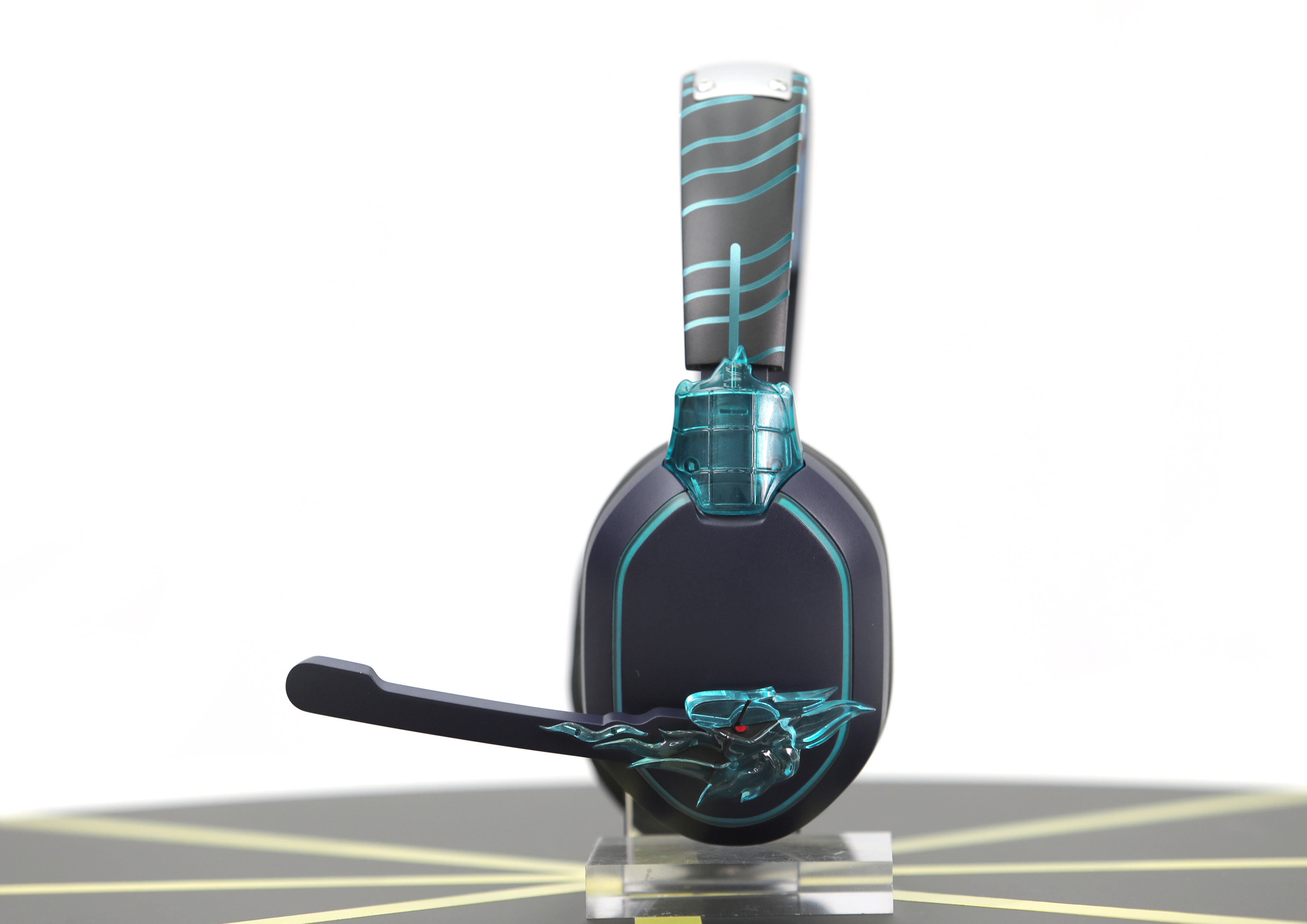
Lighting creates another hierarchy. A translucent PC or ABS light guide must be reviewed both unlit and illuminated. Toner concentration, wall thickness, surface texture, LED output and internal geometry influence brightness and color. The laser-created ring detail should remain legible without exposing unintended hotspots or process marks. A Pantone chip alone cannot approve this behavior.
Set master samples and boundary samples. The master represents the intended assembly. Limit samples show the lightest, darkest, glossiest or most visible acceptable result where numeric measurement alone is insufficient. Every sample needs a revision, date, part identity and approver. Unlabeled samples quickly become contradictory references between buyer, molding, painting, printing and QC teams.
Control variant separation. When one platform supports several characters, similar parts can be mixed during molding, decoration, assembly or packing. Use part codes, fixtures, trays, work instructions and line clearance to protect identity. Packaging artwork and accessories must use the same released variant matrix.
Finally, manage changes by relationship. Replacing resin, toner, paint, clear coat, printing ink, LED, texture or supplier may affect more than one visible part. The change review should compare the complete assembly and lit state, not approve the substituted component in isolation.
| Visual role | Typical implementation | Buyer approval question |
|---|---|---|
| Primary color | Molded or translucent major part | Does it establish character identity? |
| Neutral | Black shell, headband or structural area | Does it preserve silhouette and contrast? |
| Accent | Paint, print or small decorative component | Is it distinct without overpowering the system? |
| Graphic | Pad print, silk print, label or transfer | Are scale, side and orientation correct? |
| Illumination | Light guide and laser-treated detail | Is the lit/unlit relationship approved? |
Technical Deep Dive: Mapping Material, Color and Finish to Every Headset Component
Process selection must follow substrate, geometry, durability, optical behavior and production repeatability rather than visual preference alone.
Molded color places pigment in the resin and can support repeatable high-volume parts, but resin type, texture, thickness and lot affect appearance. KAKASHI uses molded-color directions across PP, POM and ABS components. The approved matrix should name the material grade, color reference, texture zone and sample standard.
Transparent and translucent PC need optical control. KAKASHI's decorative armor and face-cover directions combine colored PC, gloss or frosted areas, paint, logo printing and laser lighting details. Buyers should evaluate transmission, haze, internal marks, flow lines, weld lines and lit-state uniformity alongside color.
Secondary decoration solves different geometry problems. Pad printing can place graphics on curved or limited areas; silk printing suits compatible flatter zones; water-transfer decoration can cover complex forms; labels can provide fine artwork but introduce edge, alignment and adhesion considerations. The project notes that some flat processes cannot recreate a raised or recessed effect, so the buyer must approve the correct visual compromise or change structure.
Metal decoration adds another process family. The technology report identifies stamped aluminum with anodized silver or Black 6 C direction and pad-printed graphics. Metal color cannot be judged as if it were molded plastic because reflectivity and anodizing variation change perception.
Finish also protects assembly. Paint, ink or texture must not interfere with clips, sliders, microphone rotation, acoustic openings, light paths or mating surfaces. Masking boundaries and fixture contact points belong in the release specification.
QC should combine objective and visual checks: material and part identity, color measurement where applicable, master-sample comparison, gloss or transparency, artwork position, adhesion, abrasion, surface defects, left-right consistency and illuminated appearance. Test scope depends on the final process and market requirement.
OEM/ODM Approval Process From Concept to Mass Production
A controlled IP headset project moves through artwork decomposition, feasibility review, CMF specification, process samples, assembled approval, pilot production and mass-production inspection.
Concept review starts with authorized artwork, target user, retail positioning and required character cues. Design and engineering then decompose the visual into parts, materials, colors, finishes, lighting and graphics. Feasibility review identifies effects that need tooling, secondary operations or an approved alternative.
Prototype stages should separate structural validation from CMF approval while eventually bringing both together. Color plaques and process coupons help narrow direction, but the production-intent assembled headset remains the critical master because geometry, adjacency and lighting change perception.
Before pilot production, release drawings, BOM, Pantone references, process map, artwork files, inspection criteria, packaging and approved samples. The pilot checks line fixtures, variant separation, assembly effects and realistic yield. Mass production then follows controlled incoming, in-process and outgoing checks with formal change notification.
Buyer Checklist Before CMF Sampling
A useful RFQ gives the manufacturer both creative source material and manufacturing decision criteria.
- Authorized IP artwork and usage boundaries
- Character palette with Pantone or physical references
- Primary, neutral, accent, graphic and lighting hierarchy
- Target headset platform and structural-change scope
- Part-level material and process preferences
- Texture, gloss, transparency and illuminated-state expectations
- Left-right artwork orientation and logo rules
- Physical master and limit-sample ownership
- Adhesion, abrasion and appearance test expectations
- Variant coding and mix-prevention requirements
- Packaging, manuals, labels and accessory color coordination
- Target markets and required compliance planning
- Quantity, target cost, sample stages and schedule
- Change-notification and reapproval rules
Conclusion
A part-level CMF matrix turns character identity into a production system that engineering, suppliers, QC and buyers can approve consistently.
KAKASHI demonstrates why IP hardware cannot be controlled by a render and Pantone list alone. Its identity spans plastics, metal, PU, texture, translucency, paint, water-transfer decoration, printing, labels and illuminated details across an assembled headset.
The buyer should define visual hierarchy, map every part and process, approve assemblies in lit and unlit states, retain traceable samples and control changes across variants. This provides stronger sourcing value than adding decoration after the product is already frozen.
MACH industry can evaluate an authorized gaming-headset concept and coordinate industrial design, CMF engineering, structure, tooling, samples, quality and production according to the confirmed project scope.
Launch Faster With a Reliable OEM Partner.
Share your authorized artwork, target headset platform, CMF direction, markets, quantity and launch schedule with MACH industry.
Discuss Your IP Headset ProjectFrequently Asked Questions
What is a CMF control matrix for an IP gaming headset?
It links every visible part to its material, color reference, texture, gloss, transparency, decoration process, sample standard and inspection method.
Why is a Pantone list not enough for headset production?
The same reference appears differently across molded plastic, translucent PC, paint, ink, metal and textured surfaces, so assembled physical approval is still required.
How are character graphics applied to curved headset parts?
Depending on material and geometry, projects may evaluate pad printing, silk printing, water-transfer decoration, labels, paint, laser treatment or a structural solution.
Can one gaming headset platform support several IP variants?
Yes, when shared structures and variant-specific parts remain interchangeable and part codes, fixtures, line clearance, QC and packaging prevent mixing.
How should translucent RGB headset parts be approved?
Review material color, wall thickness, haze, texture, light uniformity, hotspots and the complete appearance in both lit and unlit states.
What samples should a buyer approve before mass production?
Use relevant color plaques and process samples, then approve a traceable production-intent assembled headset plus boundary samples for acceptable variation.
What can cause color drift between headset batches?
Resin, pigment, paint, ink, clear coat, texture, thickness, process settings, supplier and measurement conditions can all change appearance.
Does MACH support custom IP gaming headset tooling?
MACH can evaluate industrial design, structure, molds, decorative parts and secondary processes subject to authorized artwork, feasibility and project approval.
What compliance should IP headset buyers plan?
Requirements depend on electronics, battery, radio functions, materials, destination and final configuration; buyers should define markets before testing and labeling.
What should a brand send for an IP gaming headset RFQ?
Send authorized artwork, palette, character priorities, platform requirements, CMF direction, packaging, markets, quantity, cost direction and launch schedule.
Related Resources
Need OEM/ODM gaming audio solutions?
Contact MACH Industry to discuss your gaming headset, gaming earbuds, or private-label audio project.
Contact MACH Industry