Home > Resources > OEM Knowledge
How We Develop Custom USB-C Wired Earbuds with an Illuminated Logo
An ongoing ODM development case showing how MACH evaluates an M3 semi-in-ear USB-C wired earbud platform with Bluetrum AB136D digital audio, fixed-color illuminated logos, microphone controls, smooth TPE cable and production-intent prototype requirements.
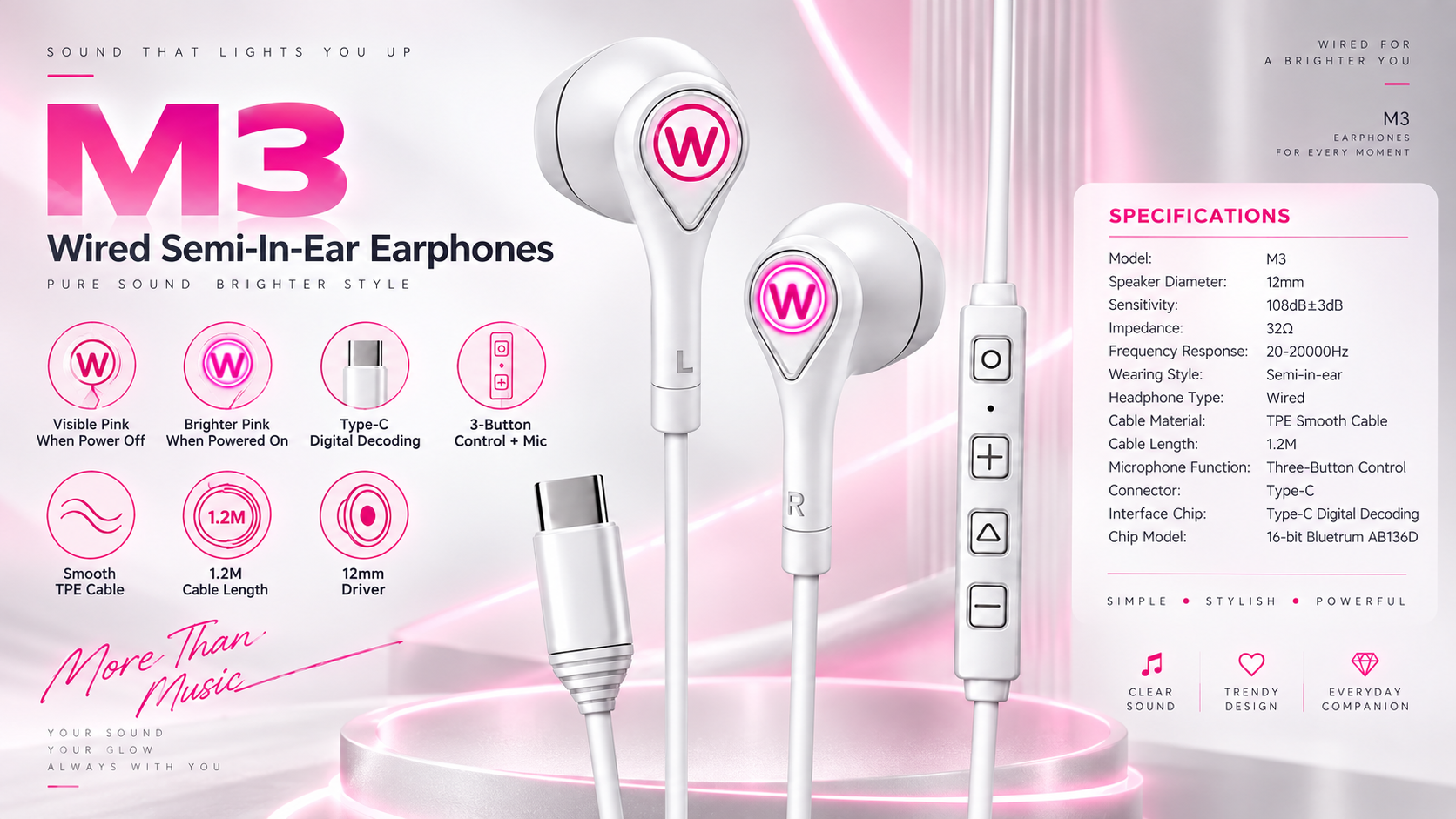
During an ongoing ODM project with a U.S.-based consumer audio brand, MACH Industry was asked to evaluate a USB-C wired semi-in-ear earbud with a distinctive illuminated logo, digital audio, microphone controls, a white smooth cable and fixed brand-color lighting. The lighting would use USB-C host power rather than an internal battery, while the logo area would remain visibly colored when unplugged and become brighter in the same color when connected.
This is not a finished launch or a mass-production result. It is a production-development case about platform selection, housing orientation, chipset consistency, functional sampling and light-leakage risk. The work illustrates what overseas buyers should verify when researching a custom USB-C wired earbuds manufacturer and moving from a visual concept toward a production-intent specification.
The Product Brief: More Than a Standard USB-C Earbud
The brief combines a clean consumer-audio form with digital USB-C audio, microphone controls and fixed-color illuminated branding; it is not a standard analog earbud or a gaming RGB concept.
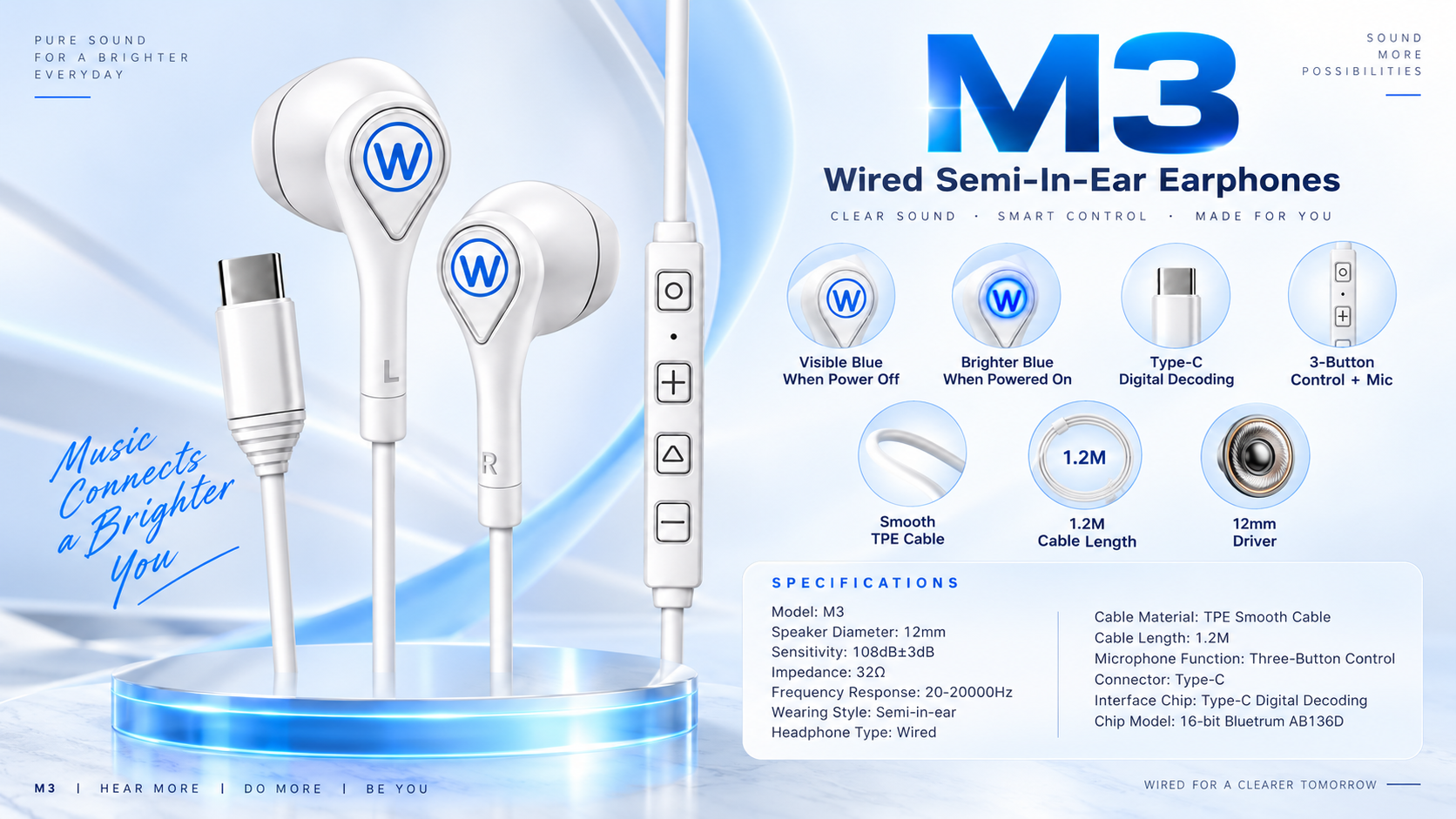
The selected M3 direction uses a white semi-in-ear housing, 12 mm speaker, 32-ohm impedance, 108 dB ±3 dB sensitivity and a 20 Hz–20 kHz frequency response. The proposed cable is a white, smooth TPE construction with a 1.2 m length. A built-in microphone and inline media controls are part of the functional direction, with a separate lighting control considered where applicable.
The USB-C connector is intended for Type-C digital decoding. For this M3 production-intent configuration, the proposed digital-audio platform uses the Bluetrum AB136D chipset. The custom visual direction adds a circular logo zone on each earbud in either a brand-specific pink or blue. Each version uses one fixed color rather than an RGB color-changing sequence.
The brief therefore connects industrial design, electronics and brand presentation. A custom Type-C earphone manufacturer must confirm that the housing, cable, digital-audio architecture, microphone, buttons and lighting work as one controlled configuration rather than as independent catalog options.
Why Semi-In-Ear Housing Matters for an Illuminated Logo
Logo visibility on semi-in-ear earbuds depends on how the earbud face sits on a real wearer, so housing orientation must be checked on people rather than judged only from product renders.
A logo can look fully visible in a front-facing image but rotate away when the earbud is worn. Ear shapes, insertion angles and left/right geometry create different viewing angles. During this ODM evaluation, on-person wearing checks were used to assess whether the illuminated surface could remain visible from the front on different wearers.
The engineering target is not a claim that the logo will face forward on every person. The practical target is to avoid a housing geometry that makes front visibility impossible. A suitable semi-in-ear platform should allow the logo area to remain visible on at least some wearers and should provide enough surface area for a readable branded treatment.
Brands developing illuminated logo earbuds should test both comfort and orientation. A housing that improves visibility but compromises fit is not a complete solution, while a comfortable housing with a hidden logo may fail the intended branding objective. Physical wearing samples help balance these factors before custom tooling is considered.
Powered-Off Color vs. Powered-On Illumination
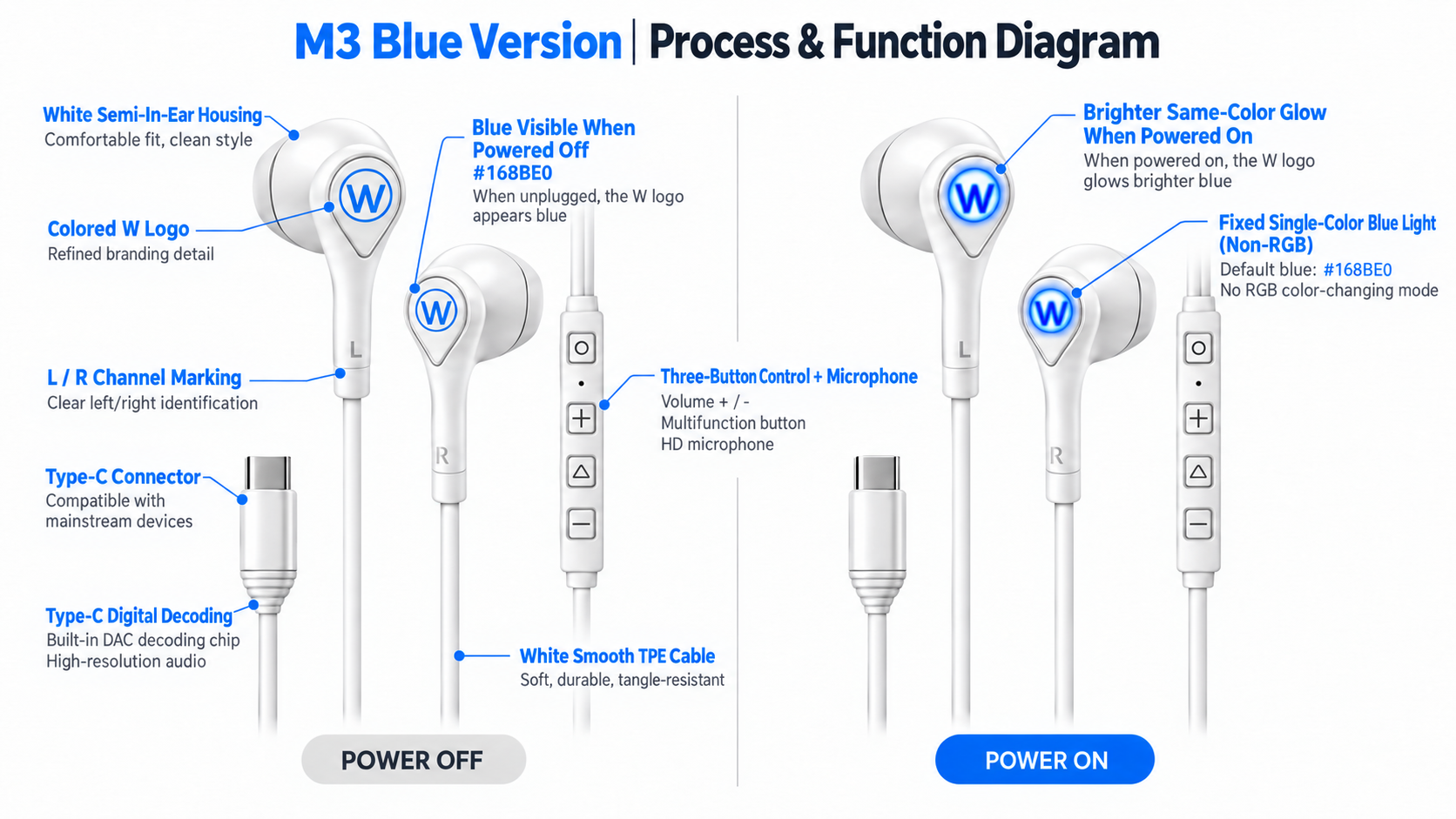
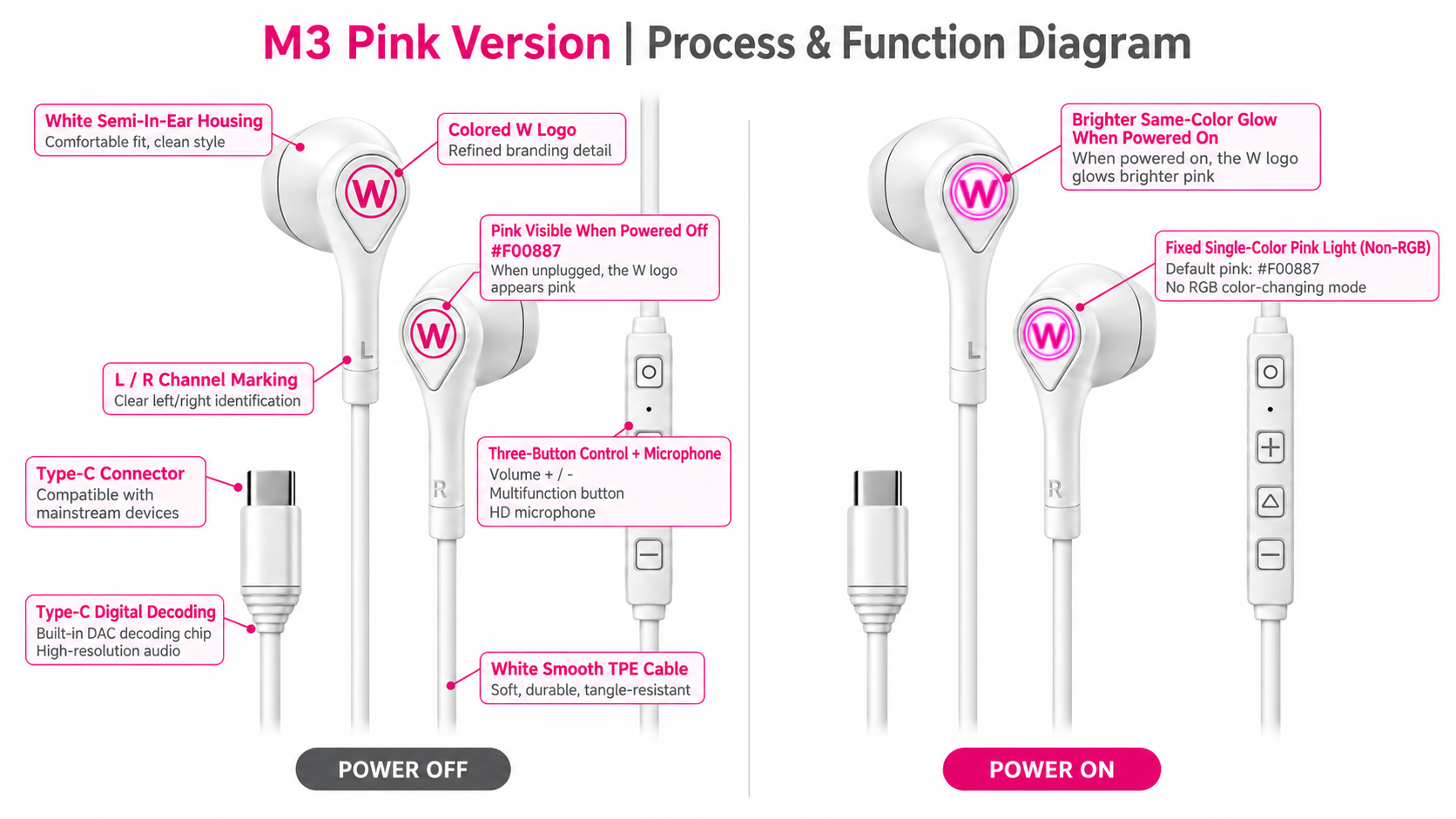
A custom logo can remain visibly colored when the earbuds are unplugged and glow more brightly in the same color when USB-C power is present, without an internal battery.
The project uses a fixed-color branding approach. In the unpowered state, the circular logo area still shows the selected pink or blue appearance. When connected to a compatible USB-C host, the same area becomes brighter in the corresponding color. The light is powered by the USB-C connection, so the lighting concept does not require a rechargeable battery inside the earbud.
This is different from gaming-style RGB. There is no color cycling in the customized pink or blue direction. The visual objective is brand consistency: the unpowered decorative color and the powered illumination should read as the same identity rather than as unrelated effects.
The final result depends on LED selection, optical behavior, material opacity, current design and the approved device configuration. Powered-off appearance and powered-on brightness must both be evaluated on physical samples. A render can communicate the intended result, but it cannot approve the production lighting behavior.
USB-C Digital Audio with Bluetrum AB136D
Bluetrum AB136D is the proposed production-intent digital-audio chipset for the M3 configuration, supporting the USB audio, microphone and control architecture that must be validated in the functional sample.
According to the available datasheet, Bluetrum AB136D is an audio player microcontroller built around a 32-bit RISC-V processor. Its documented audio resources include a stereo DAC, mono ADC, microphone amplifier input and flexible audio EQ adjustment. Supported audio sample rates include 8, 11.025, 12, 16, 22.05, 32, 44.1 and 48 kHz.
The datasheet also describes earphone microphone detection, OMTP and CTIA automatic recognition or adaptation, and support for USB data pins. It lists audio DAC signal-to-noise performance around 95 dB and audio ADC signal-to-noise performance around 90 dB. These are chipset-level datasheet references, not claims that every finished earbud automatically achieves an identical system result.
Exact identification matters. Buyers should record the manufacturer as Bluetrum and the model as AB136D. The final USB-C earbud behavior still depends on schematic design, firmware, microphone implementation, controls, cable construction, host device and production configuration. Universal USB-C compatibility, platform certification and subjective sound superiority should never be assumed from the chipset name alone.
Why Prototype Chipset Consistency Matters
A prototype using one chipset cannot reliably validate a future production configuration using another chipset; production-intent samples should use the proposed production chipset whenever possible.
The chipset influences USB enumeration, audio routing, microphone handling, inline-button behavior, EQ possibilities and device interaction. If an appearance sample or early functional sample uses a different platform, the buyer may be testing behavior that will not exist in the production-intent version.
Before authorizing samples, brands should confirm the semiconductor manufacturer, exact part number, prototype configuration and proposed production configuration. Any substitution should require written approval and a clear explanation of what must be retested. A vague reference such as “Type-C decoding chip” is not precise enough for controlled ODM development.
Chipset consistency became an important requirement in this project before production-intent samples were authorized. That requirement does not mean the design is already approved. It means the next functional prototype should represent the planned electronics closely enough to support meaningful acoustic, microphone, control, lighting and compatibility evaluation.
Why Functional Samples Must Be Production-Intent
An appearance sample can verify shape and color, but only a production-intent functional sample can evaluate the combined housing, driver, chipset, microphone, cable, controls and lighting system.
For the M3 project, a useful functional sample needs the intended semi-in-ear housing, 12 mm driver, proposed Bluetrum AB136D architecture, built-in microphone, inline controls, smooth TPE cable and fixed-color illuminated logo. Buyers should test sound quality, microphone pickup, button behavior, cable feel, comfort, lighting and representative host devices as one configuration.
A sample may still contain development items, but those differences must be disclosed. Otherwise, approval can be misunderstood. An attractive visual sample does not validate digital audio, and a working black-housing sample does not validate light leakage through the planned white plastic.
Sample approval is also not mass-production approval. A production release requires the final specification, final artwork, approved reference sample, purchase order and explicit production authorization. Compliance, packaging and inspection requirements must also be defined for the destination market and final branded configuration.
Evaluating White Housing Light Leakage
White plastic can transmit LED light differently from black plastic, so light leakage must be validated on a physical white-housing prototype before mass production.
A black sample cannot close this risk. White material may allow unwanted glow through thin walls, seams or areas near the illuminated logo. The result depends on material opacity, wall thickness, LED brightness, internal shielding, component position and the shape of the internal structure.
The intended illuminated zone should appear controlled, while surrounding housing areas should remain visually clean. Evaluation should include normal indoor lighting, darker environments and different viewing angles. Photographs are useful for documentation, but direct inspection is important because camera exposure can exaggerate or hide leakage.
At the time of publication, the white M3 housing still requires physical prototype validation for this point. No completed leakage result is claimed. If leakage appears, engineering options may involve material, opacity, wall, LED or internal-structure adjustments, followed by another sample review before production approval.
Smooth TPE Cable and Inline Control Customization
A white smooth TPE cable supports the intended consumer-audio feel, while the inline module combines microphone and control functions without adopting a braided gaming-cable appearance.
The working cable specification is 1.2 m with a smooth white TPE jacket. This direction is intended to feel clean and familiar for everyday consumer electronics. Cable flexibility, surface finish, strain relief, connector molding and color consistency should be assessed on the production-intent sample rather than approved from material descriptions alone.
The white inline control includes a built-in microphone and media buttons. A dedicated light on/off control may be included where the final circuit and firmware support it. A private-label word mark can also be applied to the back of the control, but no customer name or artwork is disclosed in this public case study.
Button mapping, microphone behavior and lighting control must be documented for the proposed USB-C architecture. Printed icons and manuals should match verified functions. Device-dependent behavior should be tested on the buyer’s representative host list before claims are finalized.
Avoiding Unnecessary Tooling
The cost-controlled ODM approach is to evaluate existing platforms first and add cosmetic or electronic customization where the structure already meets the brief.
MACH Industry evaluated multiple existing earbud platforms before narrowing the project to the M3 semi-in-ear structure. The review considered fit, logo surface orientation, lighting visibility, cable direction and the ability to support digital USB-C audio. This step helps determine whether an existing platform can reach the product objective without a completely new housing.
If the platform is suitable, branding, fixed-color lighting, cable construction, inline control details and electronics can be developed around it. New tooling should be considered only when the structure itself cannot meet the comfort, orientation, logo-area or internal-layout requirements. Tooling decisions should follow evidence from platform and wearing evaluation, not precede it.
Avoiding unnecessary tooling does not mean skipping engineering. Optical behavior, chipset implementation, cable reliability, artwork and functional performance still require controlled samples. The benefit is that development resources remain focused on the items that actually differentiate the product.
Current Development Stage
The M3 project is in ongoing ODM development: the platform and visual directions are defined, while functional prototype details and white-housing validation remain open.
At the time of publication, M3 has been selected for deeper evaluation. Bluetrum AB136D is the proposed production-intent chipset. Fixed-color pink and blue visual concepts have been created, and the required functional prototype specification is being finalized.
The project has not started mass production, and final approval has not been issued. White-housing light leakage still requires physical prototype testing. Compatibility, acoustic performance, microphone behavior, controls, lighting and cable construction also depend on the final sample configuration and test plan.
This status is commercially important. It separates a credible development direction from an unsupported launch claim. The next decisions will be based on a production-intent sample, documented validation and the buyer’s formal approval process.
What Brands Should Confirm Before Ordering Custom USB-C Earbuds
Before ordering private-label USB-C earphones, brands should lock the electronics, acoustics, housing, controls, lighting, sample identity and production-approval process in one written specification.
The checklist below helps buyers compare proposals from a custom USB-C wired earbuds manufacturer. Each item should be marked as confirmed, proposed, optional or still requiring validation. That status should remain traceable from quotation and sample through final production authorization.
Need a custom USB-C wired earbud platform for your brand? MACH supports OEM/ODM development for wired and wireless gaming and consumer-audio products, including branding, lighting, cable, electronics, packaging and production engineering. Share the target devices, product positioning, intended functions and validation requirements before requesting a production quotation.
- Exact chipset manufacturer and exact chipset model
- Driver size, impedance, sensitivity and frequency response
- Semi-in-ear housing style and wearing orientation
- Cable material, color, length and strain relief
- Built-in microphone and verified button functions
- USB-C digital-audio architecture and host test list
- Fixed-color lighting type and light-control behavior
- Powered-off logo appearance and powered-on brightness
- Approved logo artwork and placement
- White-housing opacity and light-leakage result
- Exact production-intent sample configuration
- Packaging, MOQ and destination-market compliance
- Inspection criteria and acceptance method
- Final specification, artwork and production-approval process
Need a custom USB-C wired earbud platform for your brand?
Contact MACH to discuss branding, fixed-color lighting, cable, electronics, packaging and production-intent prototype requirements.
Contact MACH IndustryFrequently Asked Questions
Can USB-C wired earbuds have an illuminated logo without a battery?
Yes. If the design uses USB-C host power, the lighting can operate while connected without an internal battery. The final power design and device behavior must be validated during engineering.
Can the logo remain colored when the earbuds are unplugged?
Yes. A colored decorative or logo structure can remain visibly colored when unpowered, while the same area becomes brighter when powered. The final material and visual result require sample validation.
Can custom earbuds use one fixed brand color instead of RGB?
Yes. Fixed-color pink, blue or another brand color can be developed instead of RGB cycling, subject to LED, material, circuit and prototype validation.
Can semi-in-ear USB-C earbuds include a microphone and inline controls?
Yes. USB-C wired earbuds can support microphone and media-control functions when the chipset, circuit and firmware are designed for those functions. Behavior should be tested with representative host devices.
Should prototypes use the same chipset as mass production?
Yes. Production-intent functional samples should use the same core chipset proposed for production whenever possible. Any substitution should be disclosed, approved and followed by appropriate retesting.
What is Bluetrum AB136D?
Bluetrum AB136D is an audio player microcontroller with a 32-bit RISC-V processor and documented resources including stereo DAC, mono ADC, microphone amplifier input, USB data support, EQ functions and multiple audio sample rates.
Can white earbud housings cause light leakage?
Yes. White plastic can transmit LED light differently from black plastic. Material opacity, wall thickness, LED intensity and internal structure should be validated on physical white-housing prototypes.
What is the typical ODM process for custom USB-C wired earbuds?
A typical process is requirement definition, platform evaluation, visual design, engineering specification, production-intent prototype, compatibility, acoustic and lighting testing, final approval, purchase order and production authorization.
Related Resources
Need OEM/ODM gaming audio solutions?
Contact MACH Industry to discuss your gaming headset, gaming earbuds, or private-label audio project.
Contact MACH Industry